
Reeves Gabrels – Tin Machine Guitarist and David Bowie’s Creative Partner
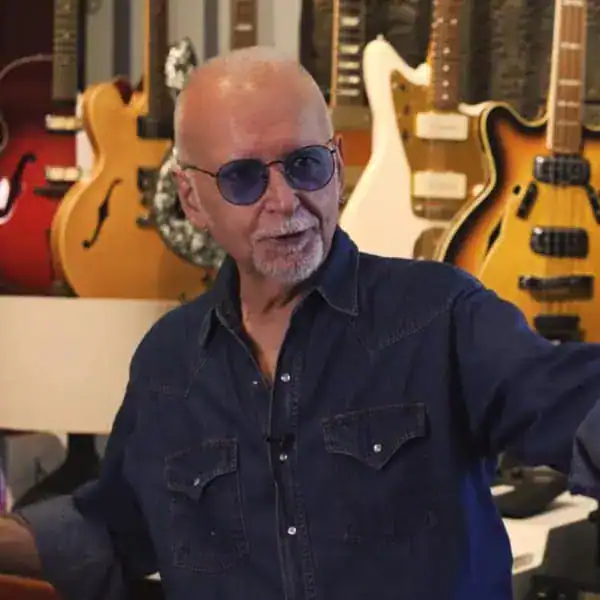
Reeves Gabrels helped shape a substantial chapter of David Bowie’s later career. Initially a founding member of Tin Machine, he became a recurring songwriting partner, an important contributor to Bowie’s live arrangements and, on Earthling and ‘hours…’, a coproducer. Their association developed from a friendship begun in 1987 into a musical partnership that continued through 1999.
Gabrels brought more than an unconventional lead-guitar sound. His work encompassed musical structures, acoustic accompaniment, electronic textures and the practical problem of translating new recordings into live performance. Across two Tin Machine studio albums and Bowie’s subsequent solo work, his contributions ranged from the exposed vulnerability of I Can’t Read to the abrasive, digitally manipulated surfaces of Earthling.
The partnership matters because it spans several changes of direction. Tin Machine placed Bowie inside a four-member rock group; 1. Outside explored a fictional world through improvisation and studio construction; Earthling combined a working band with electronic production; and ‘hours…’ returned attention to more reflective songs. Gabrels participated in these developments without becoming a single, unchanging stylistic signature.
His story also extends beyond Bowie. Earlier experience in New York and Boston, independent recordings, soundtrack work and a long association with Robert Smith and The Cure reveal a musician whose career cannot be understood solely through the famous singer beside him.
- Name: Reeves Gabrels
- Born: 4 June 1956, Staten Island, New York, United States
- Roles: Guitarist, songwriter, singer and record producer
- First met Bowie: During the Glass Spider Tour period in 1987
- First recording collaboration: The 1988 reworking of Look Back in Anger
- Tin Machine: Founding guitarist alongside David Bowie, Tony Sales and Hunt Sales
- Principal Bowie solo albums: Black Tie White Noise, 1. Outside, Earthling and ‘hours…’
- Bowie album production credits: Earthling and ‘hours…’
- Final live appearance with Bowie: VH1 Storytellers, New York, 23 August 1999
- Later Bowie project: Guitar on Never Let Me Down 2018
- The Cure: Joined in 2012, following earlier collaborations with Robert Smith
1956–1970s: New York beginnings and a wider musical education
Born on Staten Island on 4 June 1956, Reeves Gabrels grew up before the musical boundaries later associated with his name had become fixed. His eventual reputation for unusual guitar sounds can obscure how much of his vocabulary came from established rock, blues and other forms of American music. Experimentation developed alongside an understanding of familiar musical languages, rather than through a complete rejection of them.
Visual art was another significant interest. He studied at Parsons School of Design and the School of Visual Arts in New York before pursuing music more directly. This background would later give him and Bowie a shared field of conversation beyond records, instruments and the music business.
Lessons with guitarist John Scofield helped point him towards Berklee College of Music in Boston. Gabrels’ account of that education emphasises harmony and the value of listening beyond the guitar. Learning from the movement of a bass part, a keyboard voicing or a horn melody offered possibilities that could not be reduced to collecting faster or more elaborate guitar phrases.
Late 1970s–1980s: Developing a musical identity in Boston
Boston provided the setting in which Gabrels developed as a working musician. His pre-Bowie experience included local groups such as The Dark and Rubber Rodeo, with further connections extending across the city’s rock and experimental communities. This was a professional life already in progress, rather than an apprenticeship invented retrospectively by his later fame.
Moving between musical situations encouraged adaptability. A guitarist might need to support a song conventionally in one setting and create an unfamiliar sound in another. That combination became central to Gabrels’ later work: the capacity to understand an arrangement while also hearing where it could be interrupted, stretched or redirected.
His background helps explain why descriptions of him purely as a noise guitarist are incomplete. The startling sounds were real, but they existed within a larger interest in composition and ensemble playing. By the time Bowie heard his work, Gabrels had already spent years developing the relationship between those skills. International recognition changed the scale of his audience; it did not create his musical identity from nothing.
1987: Meeting David Bowie through a friendship about art
Gabrels met Bowie through his then-wife, Sara Terry, who worked on publicity during the Glass Spider Tour. He visited the tour to see her, rather than arriving as a guitarist hired for Bowie’s band. The distinction is important: Gabrels did not play in the touring group that audiences saw on the Glass Spider stage.
Their early connection centred on art, books and conversation. Gabrels has described spending time with Bowie before performances and bringing art books on his visits. The relationship therefore began without the immediate expectations attached to an audition, a session booking or a request for employment.
Reeves Gabrels on meeting David Bowie
“I knew David Bowie for over a year before he knew I played guitar.”
Terry eventually passed Bowie a recording of Gabrels’ band. Hearing it opened a musical dimension to a friendship that already existed. This sequence helps explain the unusual trust underlying their subsequent collaboration: Bowie first knew Gabrels as someone with whom he could exchange ideas, and only afterwards discovered the instrumental resources that accompanied those interests.
1988: Reconstructing Look Back in Anger
Their first recording collaboration involved a new treatment of Look Back in Anger, originally released on Lodger in 1979. The 1988 project was connected with Bowie’s dance performance with La La La Human Steps for an Institute of Contemporary Arts benefit. It required more than the straightforward reproduction of an existing record.
Gabrels helped expand the music around the original song, creating space for movement and a different performance structure. His recollections describe Bowie communicating through architectural imagery, particularly the idea of Gothic forms and spires. Their conversations about visual art had become a practical language for making music.
The assignment established a useful precedent. A familiar Bowie composition could be treated as material for reconstruction, its identity retained while its proportions and surroundings changed. Gabrels was contributing to the shape of the piece, rather than simply replacing an earlier guitarist’s solo.
That approach would become increasingly relevant when they later revisited Bowie’s catalogue. The question was how to make a song function in a new setting. Faithfulness could involve preserving its emotional or melodic centre while changing the means through which an audience encountered it.
1988–1989: The formation of Tin Machine
Tin Machine brought Bowie and Gabrels together with bassist Tony Sales and drummer Hunt Sales. Bowie already knew the Sales brothers from his work with Iggy Pop, including the Lust for Life period. Their forceful rhythm section gave the new group a foundation quite different from the presentation of Bowie’s recent large-scale tours.
The band developed during 1988 and emerged publicly with its first album in 1989. Its four-member identity was central to the project. Bowie remained the internationally famous participant, but the group was presented as a band in which the other musicians possessed their own musical personalities and writing contributions.
For Gabrels, this created room to work as a bandmate. His guitar could occupy an abrasive, unstable position against the Sales brothers’ playing, while Bowie sang and contributed guitar. The result depended on the interaction of those elements: reducing it to Bowie plus an unusually loud accompanist misses the rhythm section’s importance.
Tin Machine also changed the circumstances in which Bowie was making decisions. Songs could develop through collective playing and argument within a compact group. The project placed him in direct contact with the friction of a rock ensemble, with Gabrels becoming one of the principal sources of that friction.
1989: The first Tin Machine album
Released in May 1989, Tin Machine was produced by the band with Tim Palmer. Guitarist Kevin Armstrong also contributed to the recordings. The album’s sound foregrounded amplified instruments, abrupt changes of intensity and a sense of musicians pushing against one another.
Gabrels shared writing credits on material including Tin Machine, Prisoner of Love, I Can’t Read, Amazing and Bus Stop. These credits show that his contribution was embedded in the repertoire itself. He was helping create the music that the group would perform, not merely adding ornament after songs had been completed.
The record also contained contrasting kinds of performance. The sustained pressure of Heaven’s in Here and the political aggression of Under the God sat alongside more melodic or emotionally exposed material. Gabrels’ guitar helped connect these approaches without making them sound identical.
Reception was divided, and Tin Machine never escaped comparison with Bowie’s solo career. Nevertheless, the album established a working relationship that would outlast the group. Its significance includes both the music released under the band’s name and the collaborative methods that Bowie and Gabrels carried forward.
1989: I Can’t Read and a different kind of vulnerability
Written by Bowie and Gabrels, I Can’t Read became one of the most durable songs to emerge from Tin Machine. Its importance is not dependent on a chart position. Bowie returned to it after the group had ended, demonstrating that the composition retained possibilities beyond its original arrangement.
On the first album, the song’s exposed vocal and unsettled instrumental surroundings create a striking relationship. The guitar does not merely underline an emotion already expressed by the singer; its interruptions and changes of pressure become part of the musical drama. The listener encounters a performance that resists a comfortable, polished resolution.
Later versions would bring different aspects of the song forward. That adaptability is particularly revealing for a Gabrels co-composition. The piece could survive when the balance between amplification, acoustic texture and vocal delivery changed. Its identity was stronger than any single production treatment.
For anyone approaching Tin Machine through the band’s loudest reputation, I Can’t Read offers an essential point of entry. It demonstrates that Bowie and Gabrels were also developing a vocabulary for uncertainty and restraint, even when the surrounding sound remained rough-edged.
1989: Taking the band into smaller venues
Tin Machine’s first tour placed the group in substantially smaller spaces than those associated with Bowie’s Glass Spider production. The change affected the relationship between musicians and audience. Instead of a large theatrical framework, attention rested more directly on the band’s repertoire, volume and interaction.
Kevin Armstrong joined the touring musicians, expanding the guitar arrangements beyond the four principal members. His presence should not be confused with a change to Tin Machine’s core membership. The distinction between a band’s named members and the additional musicians supporting a tour matters when reconstructing its history.
Gabrels’ role was especially exposed in this setting. A small-venue performance leaves fewer distractions between an audience and an unfamiliar sound. The guitar’s harsh edges could be exciting or confrontational, depending on the listener. Tin Machine invited that response by concentrating on its own material rather than presenting a conventional survey of Bowie’s best-known songs. The concerts asked the audience to encounter the group in the present tense.
1991: A broader palette on Tin Machine II
Tin Machine II followed in September 1991. Its opening song, Baby Universal, immediately demonstrated the melodic force of the Bowie–Gabrels writing partnership. Other collaborations included You Belong in Rock n’ Roll, Amlapura, Betty Wrong and Shopping for Girls, each suggesting a different balance between song form and guitar texture.
The album is useful precisely because it complicates the image of Tin Machine as a single, continuous blast of noise. The music contains space, changing colours and passages in which the guitar helps define an atmosphere rather than simply increasing the volume. Gabrels could create tension through the placement and character of a sound as effectively as through its force.
The band also recorded Roxy Music’s If There Is Something, while Hunt Sales took lead vocals on Stateside and Sorry. Those performances reinforce the fact that Tin Machine contained musical identities beyond the Bowie–Gabrels partnership.
The second album was the group’s final studio release. It should therefore be heard both as a continuation of the first record’s working methods and as evidence of how much variety could exist within them. The material would subsequently disperse into live recordings, later reinterpretations and the individual careers of the musicians.
1991–1992: The final Tin Machine tour and Oy Vey, Baby
The It’s My Life Tour carried Tin Machine through 1991 and into 1992, with Eric Schermerhorn providing additional guitar. The repertoire now drew on two studio albums, giving the concerts a wider range of material and a different musical balance from the first tour.
The live album Tin Machine Live: Oy Vey, Baby, released in 1992, preserved part of that stage identity. As with any selected concert release, it represents a particular view of the performances rather than a complete account of every song or tour date. Its value includes hearing how the musicians reshaped the studio material through live interaction.
Tin Machine did not develop into a continuing recording unit after this period. Bowie resumed releasing solo albums, but Gabrels remained part of his musical world. Their continued association is a crucial distinction: the end of the band was not the end of their collaboration. What changed was the framework around it, with Gabrels moving from membership in a named group into a more variable role within Bowie’s projects.
1993: You’ve Been Around and Black Tie White Noise
On Black Tie White Noise, released in 1993 and produced by Bowie and Nile Rodgers, Gabrels’ presence was more limited than on the Tin Machine albums. His contribution centred on You’ve Been Around, a song he had written with Bowie and which had roots in their earlier work together.
The recording places the guitar within a different production environment. Rhythm, saxophone, voices and studio processing shape a dense arrangement in which a contribution need not dominate the foreground to matter. The move away from Tin Machine’s presentation did not require Bowie to abandon every composition or musical relationship associated with the band.
This is also a point at which credits require precision. Gabrels was not the coproducer of Black Tie White Noise, and his involvement should not be expanded into an unsupported album-wide role. The specific credit is sufficient to show continuity. A song developed with him could enter a Bowie solo album and acquire a new identity through a different set of collaborators.
1993–1995: Paul Rodgers, independent work and The Sacred Squall of Now
Gabrels’ career during these years also included work with Paul Rodgers. The connection is a useful reminder of his command of blues-based rock, a musical language sometimes overshadowed by discussion of his electronic and experimental playing. His interests encompassed both direct, familiar forms and more disruptive possibilities.
His first solo album, The Sacred Squall of Now, appeared in 1995. Bowie participated, as did guests including Frank Black and Gary Oldman. A new treatment of You’ve Been Around brought a shared composition into a record released under Gabrels’ own name.
That reversal of perspective matters. Bowie was now contributing to his collaborator’s project, rather than Gabrels appearing solely within Bowie’s catalogue. The album provides another setting in which to hear the guitarist’s preferences for song construction, unusual textures and contrasting voices.
Work with guitarist David Tronzo on Night in Amnesia offered a further route into improvisation and instrumental exchange. Together, these activities show that Gabrels’ creative life remained broader than the sequence of Bowie releases, even during their busiest period of collaboration.
1994–1995: Entering the world of 1. Outside
The sessions leading to 1. Outside brought Gabrels into a project shaped by Bowie’s renewed collaboration with Brian Eno. Musicians including Mike Garson, Erdal Kızılçay and Sterling Campbell helped generate material through ensemble playing and improvisation. The resulting album appeared in September 1995.
Its fictional setting involved art, crime, identity and the approach of the new millennium. Musical fragments and spoken character passages created an environment larger than a conventional collection of unrelated songs. Gabrels’ guitar operated within that environment, sometimes providing a clearly identifiable part and sometimes contributing to a more ambiguous field of sound.
The album’s official producers were David Bowie, Brian Eno and David Richards. Gabrels’ performance and songwriting contributions were substantial, but they should not be confused with a production credit he did not receive on this record.
A collective composition credit can document the importance of a group-generated foundation without identifying who supplied every individual element. The distinction is especially relevant to Outside, where the finished recording may contain layers of improvisation, selection and later development. Its collaborative character is best understood through those interacting processes.
1995: Guitar, composition and the architecture of Outside
Gabrels’ writing credits on Outside include The Hearts Filthy Lesson, credited to the principal improvising musicians, and The Voyeur of Utter Destruction (As Beauty), written with Bowie and Eno. Thru’ These Architects Eyes carries a Bowie–Gabrels credit, demonstrating another form of collaboration within the same album.
These tracks offer different ways of hearing his contribution. The Hearts Filthy Lesson integrates guitar into an insistent, layered arrangement; Voyeur builds tension through interlocking movement and accumulating force; Thru’ These Architects Eyes places the writing partnership inside one of the album’s more expansive song performances.
Reeves Gabrels on rearranging music
“I love taking a song and doing a complete rearrangement of it.”
The album rewards attention to the relationship between parts. Garson’s piano and the guitar can suggest contrasting forms of motion, while the rhythm section holds together music that appears ready to fragment. Gabrels belongs to that ensemble conversation. The record’s complexity cannot be assigned to one instrument, but removing the guitar’s instability would alter its character considerably.
1995: The Outside Tour and the encounter with Nine Inch Nails
The Outside Tour began in 1995, with Nine Inch Nails sharing the North American bill. Bowie’s group included Gabrels, Carlos Alomar, Mike Garson, Peter Schwartz, George Simms, Gail Ann Dorsey and Zachary Alford. It was a larger ensemble than the compact band that would emerge the following year.
The overlap between the Bowie and Nine Inch Nails performances became a distinctive feature of the American concerts. Musicians crossed into one another’s repertoire, including performances of Hurt and Reptile. The encounter placed Bowie’s current work alongside an artist whose industrial rock had reached a substantial younger audience.
Gabrels was well suited to this setting because his guitar could function both as a recognisable rock instrument and as a source of processed texture. He could contribute to the physical impact of a band while also working within arrangements shaped by electronics and pre-recorded elements.
The tour should not be described simply as a retrospective built around established hits. Its emphasis on recent material and selected older songs made it a further act of presentation and reinterpretation. Gabrels helped translate that decision into actual performances, dealing with the musical consequences of placing unfamiliar and familiar material beside one another.
1996: A smaller band and greater responsibility
By the 1996 summer performances, the touring ensemble had contracted to Bowie, Gabrels, Garson, Dorsey and Alford. With fewer musicians, individual parts assumed more responsibility. Guitar, piano, bass and drums had to carry a wider share of the arrangement, while technology could supply additional material where required.
For Gabrels, the challenge included reconsidering older guitar parts without treating every recording as a fixed template. Bowie’s catalogue contained the work of very different musicians, from Mick Ronson and Earl Slick to Robert Fripp and Adrian Belew. A live arrangement had to acknowledge the song while also belonging to the musicians performing it that evening.
Reeves Gabrels on his responsibility in Bowie’s music
“When I got in there, my responsibility was to move the music along, not to restate it.”
That balance between recognition and change became central to the next phase. The smaller ensemble was not merely an economical version of the previous band. It became the working group through which Bowie and Gabrels developed another studio direction.
1996–1997: Building Earthling with Mark Plati
Work at Looking Glass Studios in New York led to Earthling, released in February 1997. The official production credits name David Bowie, Mark Plati and Reeves Gabrels. Plati’s engineering and musical contributions were integral to a record in which performance, editing and electronic construction became closely connected.
The album drew on the working band while allowing recorded material to be cut, looped and transformed. Dorsey’s bass, Alford’s drums, Garson’s keyboards and Gabrels’ guitar did not have to remain in the forms in which they first entered the studio. A played gesture could become a repeating component or be placed against a contrasting rhythmic pattern.
This gives Earthling a different relationship to live music from a straightforward concert recording. The musicians’ identities remain audible, but the studio actively reorganises their performances. Gabrels’ role joined those processes: he supplied instrumental material and helped determine how it could function within the finished track.
His use of the Roland VG-8 and other processing also complicates the distinction between guitar and synthesizer. The instrument remained a source of touch, pitch and physical movement even when the resulting sound no longer resembled an ordinary amplified guitar. The technology expanded his vocabulary rather than removing the performer from it.
1997: Little Wonder, Looking for Satellites and Seven Years in Tibet
Little Wonder, written by Bowie, Gabrels and Plati, demonstrates the album’s combination of electronic assembly and instrumental identity. Gabrels contributed guitar sounds that could be treated as samples, becoming structural features within the track rather than remaining continuous performances. Short, sharply characterised fragments helped give the recording its restless surface.
Looking for Satellites offers a contrasting showcase. Its extended guitar passage develops a sense of release against the repeating environment around it. The solo’s movement has a dramatic function: the sound appears to struggle with the boundaries of the arrangement before pushing beyond them. It is a conspicuous performance, but its impact depends on the comparatively controlled setting.
On Seven Years in Tibet, a Bowie–Gabrels composition, changes of density become central. Quieter passages and heavily amplified sections place different emotional pressures on the vocal. The guitar can provide an apparently familiar colour and then transform the scale of the recording when the heavier material arrives.
Taken separately, these songs reveal three different functions: sound as a reusable fragment, soloing as an unfolding event and texture as a means of organising contrast. Grouping all of them under the description of an aggressive guitar style conceals how differently the instrument behaves in each arrangement.
January 1997: ChangesNowBowie and the fiftieth-birthday concert
The radio session later released as ChangesNowBowie was recorded in November 1996 and broadcast on Bowie’s fiftieth birthday, 8 January 1997. With Gabrels, Gail Ann Dorsey and Mark Plati participating, it presented selected material in a mostly acoustic setting. Bowie, Gabrels and Plati shared the production credits.
Its restrained scale offers a valuable counterpart to Earthling. The performance depends on space, articulation and the relationship between voices and instruments. Gabrels’ involvement in both projects makes it difficult to sustain the idea that his usefulness to Bowie depended only on distortion or volume.
On 9 January 1997, Bowie celebrated with a major concert at Madison Square Garden. Guests included Lou Reed, Robert Smith, Frank Black, Sonic Youth, Foo Fighters and Billy Corgan. Gabrels’ work within the house band connected the changing combinations on stage. The event placed him at a meeting point between Bowie’s musical history and contemporary alternative rock, while his encounter with Smith would lead to an important further collaboration.
1997: Dead Man Walking and the Earthling Tour
Dead Man Walking, another Bowie–Gabrels composition, demonstrates the distance a song can travel between arrangements. Its studio version belongs to Earthling’s electronic environment, but Bowie and Gabrels also performed it acoustically during promotional appearances. The change revealed melodic and harmonic possibilities that could be less obvious beneath the album’s busy surface.
The Earthling Tour developed the compact ensemble’s ability to move between those extremes. Gabrels, Garson, Dorsey and Alford worked with programmed material while retaining the interaction of a live group. The challenge was to make timing and technology support a performance that could still change in emphasis and energy.
Reeves Gabrels on his place in the band
“I thought the job description said ‘loose cannon.’”
— Reeves Gabrels, in Joe Gore’s interview with Bowie and Gabrels, Guitar Player, June 1997
Another expression of the band’s electronic interests was Tao Jones Index, the name used for an unannounced dance set at the Phoenix Festival on 19 July 1997. Gabrels participated alongside Bowie and the other members of the touring band. The performance brought their experiments into a dance-tent setting, outside the presentation of Bowie’s main-stage concert the following day.
1997–1998: Robert Smith, Wrong Number and soundtrack work
Gabrels’ connection with Robert Smith extended beyond the birthday concert. He played on The Cure’s Wrong Number, released in 1997, and subsequently collaborated with Smith and drummer Jason Cooper as COGASM. Their A Sign from God appeared on the soundtrack to Orgazmo.
These projects connected musicians who shared an interest in the relationship between song, atmosphere and processed sound. They also established that Gabrels’ future work with The Cure did not begin with an isolated invitation in 2012. A creative relationship had existed since the late 1990s, alongside his continuing work with Bowie.
His soundtrack activity offered another area of responsibility. Gabrels composed music for David Sutherland’s The Farmer’s Wife, the documentary presented by PBS’s Frontline. Writing for a film requires attention to duration, pace and the space occupied by speech and images. It provided a different setting for a musician already interested in using sound to construct an environment, with the drama taking place on screen rather than around a lead singer.
1999: Omikron: The Nomad Soul and ‘hours…’
Bowie and Gabrels’ work connected with the computer game Omikron: The Nomad Soul formed part of the setting from which ‘hours…’ emerged. Music associated with the project existed across different contexts and versions. Developed by Quantic Dream, the game included a virtual band featuring Bowie, Gabrels and Gail Ann Dorsey. Bowie also appeared as the character Boz. This brought their collaboration into an interactive fictional world, with songs encountered as part of the player’s journey.
Released in 1999, ‘hours…’ was produced by Bowie and Gabrels. The guitarist shared songwriting credits across the album’s ten tracks. Alex Grant, winner of the BowieNet lyric competition, additionally contributed lyrics to What’s Really Happening?. Gabrels’ participation extended through the record’s central creative processes, even though its sound moved away from the concentrated electronic attack associated with Earthling.
The change is particularly important when assessing his range. A musician remembered for disruptive guitar could also contribute to a record built around reflection, melody and an older narrator’s perspective. Acoustic instruments and more open arrangements allowed details of phrasing and harmony to assume a different weight.
The album does not erase the preceding decade. Its more direct songs were made by collaborators who had already passed through band improvisation, conceptual recording and digital construction together. Their experience provided a shared language even when they chose to reduce the density of the finished sound.
1999: Melodic guitar on Survive, Seven and The Dreamers
Survive provides a particularly clear example of Gabrels working through melody. His guitar can be heard as a response to the vocal, adding movement around a song concerned with regret and endurance. The part’s effectiveness depends on how it enters and leaves space, rather than on how many sounds it can accumulate.
Seven adopts another scale of intimacy, while The Dreamers gives the album a more expansive conclusion. Elsewhere, The Pretty Things Are Going to Hell retains a much more assertive rock profile. These differences prevent the album from being reduced to a single soft or retrospective mood.
The album’s lead single, Thursday’s Child, released on 20 September 1999, was another Bowie–Gabrels composition. Its restrained arrangement and reflective vocal introduced the album’s change of emphasis before its release. Alongside the more forceful The Pretty Things Are Going to Hell, it demonstrates the contrasting material that their final studio collaboration could accommodate.
August 1999: VH1 Storytellers and the end of the regular partnership
On 23 August 1999, Gabrels performed with Bowie for VH1’s Storytellers at the Manhattan Center in New York. The recording combined songs with Bowie’s spoken introductions and recollections. It became the guitarist’s final live appearance with him.
Gabrels then left the regular working relationship. His later accounts describe a mixture of artistic divergence and a desire to pursue his own work. These recollections deserve to be presented as his perspective, without turning a complex professional separation into a sensational account of a single quarrel.
It is equally misleading to describe him as Bowie’s guitarist on the later tours. He did not play on the Heathen or A Reality Tour campaigns, and his earlier prominence should not be extended into recordings on which he did not perform.
The ending nevertheless left a substantial body of shared work. Tin Machine’s repertoire and the solo albums of the 1990s document a partnership that changed repeatedly before it concluded. Its importance does not require an uninterrupted association for the remainder of Bowie’s life.
1999–2000s: Ulysses (Della Notte) and an independent path
Ulysses (Della Notte) emerged around the end of the Bowie partnership, first released online on 4 November 1999. Its collaborators included Bowie, Robert Smith, Frank Black and Dave Grohl. Smith sang Yesterday’s Gone, a composition that linked their late-1990s work with Gabrels’ own catalogue.
The record illustrates how relationships formed around Bowie could continue within another artist’s projects. Gabrels was now the organising presence, bringing guest musicians into music released under his own name. Its initial internet distribution also placed Gabrels within the period’s experiments in bringing recordings directly to listeners, bypassing the conventional sequence of record-company release and shop distribution.
Further independent work included Rockonica in 2005. During the following years, Gabrels developed connections in Nashville and continued exploring performance outside the infrastructure of a major international artist’s touring organisation. Smaller venues and changing ensembles supplied different kinds of musical contact. The scale of a room did not determine how much freedom or concentration the music could contain.
2012: Joining The Cure
In 2012, Gabrels joined The Cure for their European summer performances and became a member of the band. The invitation renewed his working relationship with Smith, but introduced the larger task of entering a group with decades of established repertoire and a strongly recognisable musical identity.
The role required a different balance of responsibilities. The Cure’s songs contain guitar figures that listeners recognise immediately, alongside long passages in which atmosphere and gradual development are essential. Gabrels had to contribute his own musical judgement while preserving the identity of those arrangements.
This later career offers a useful perspective on his Bowie years. His adaptability was not limited to one singer’s willingness to experiment. It could also function within another band’s history, where the relationship between guitars, bass, keyboards and voice had developed across numerous records. The continuity lies in listening and responding to an ensemble, even when the outward sound differs markedly from Tin Machine or Earthling.
2014–2017: Bill Nelson and His Imaginary Friends
Gabrels continued releasing work outside The Cure. Fantastic Guitars, made with Bill Nelson and released in 2014, placed two individual guitar vocabularies in direct conversation. The project provided another setting in which texture and melodic invention could develop without the familiar structure of a Bowie song.
Reeves Gabrels & His Imaginary Friends presented a different format: a power trio. The self-titled 2015 album featured Kevin Hornback on bass and Jeff Brown on drums. Marc Pisapia subsequently occupied the drum position and appears on Imaginary Friends Live, released in 2017.
The trio setting gives the guitar considerable space, but also exposes the importance of songs and rhythmic communication. A sound has fewer places to hide when only three players are responsible for the performance. These recordings therefore offer a valuable companion to his work with larger groups, bringing the interaction of instruments into particularly clear focus.
2018: Returning to Bowie’s music on Never Let Me Down 2018
Gabrels contributed guitar to Never Let Me Down 2018, a new production of Bowie’s 1987 album supervised by Mario McNulty. The project involved musicians including David Torn, Sterling Campbell and Tim Lefebvre, with string arrangements by Nico Muhly.
Its chronology must remain clear. These were new instrumental contributions made after Bowie’s death, working with existing recordings. Gabrels had not played on the original 1987 album, and his participation in the later version should never be presented as a previously overlooked original credit.
Reeves Gabrels on revisiting Bowie’s recordings
“We just wanted to serve the songs, really.”
The project carried a personal resonance because the original album belonged to the period in which he had first met Bowie. Their musical partnership had begun after that recording; decades later, his playing entered a reconsideration of its songs. The new production brought that history into contact with musicians from several other stages of Bowie’s career.
2020 onwards: Archival releases and Songs of a Lost World
Official archival releases have widened access to different aspects of the Bowie–Gabrels partnership. ChangesNowBowie, issued in 2020, made the mostly acoustic radio session available as an album. The Is It Any Wonder? project also brought renewed attention to recordings including I Can’t Read ’97 and Baby Universal ’97.
These releases distinguish the date of a performance from the date it reached a wider audience. They are later publications of earlier work, not evidence that Bowie and Gabrels resumed recording together in 2020. They also allow listeners to follow compositions across changing arrangements and hear aspects of the partnership that the original album sequence did not fully reveal.
Meanwhile, Gabrels’ career with The Cure continued. Songs of a Lost World, released on 1 November 2024, placed him within another major studio chapter. The album and its associated performances belong to The Cure’s own story, demonstrating that his working life continued to develop long after the end of his regular association with Bowie.
Legacy: Reeves Gabrels in David Bowie’s collaborative history
Gabrels’ place in Bowie’s history rests on several distinct contributions. As a member of Tin Machine, he helped establish the musical interaction of a four-person group. As a songwriter, he shared responsibility for compositions that Bowie carried into different settings. As a performer and arranger, he helped make a changing live repertoire function. As a coproducer, he participated in shaping Earthling and ‘hours…’ at the level of the finished recording.
Those roles should be considered together without being collapsed into an unrestricted claim that he created everything associated with Bowie’s 1990s work. Other musicians, engineers, producers and writers were indispensable. Gabrels’ importance becomes clearer when the credits are accurate, because the actual range of his contribution is substantial enough to need no enlargement.
His guitar also challenged expectations about what a prominent instrumental partner could supply. It might be the most disruptive sound in a track, but it could also provide a melodic answer, acoustic support or material that would be transformed electronically. Hearing only the most confrontational performances produces an incomplete portrait of the musician Bowie continued choosing across successive projects.
The partnership offers no simple account of one artist rescuing another. Bowie remained an active writer and decision-maker, while Gabrels supplied a particular combination of friendship, ideas, technique and resistance. Their strongest work emerged from interaction: musicians making choices together, sometimes following a shared impulse and sometimes finding something useful through disagreement or contrast.
The records remain the most concrete evidence. From Tin Machine’s first album to the reflective songs of ‘hours…’, they document a sustained exchange that altered both the sound and the working circumstances of Bowie’s music. Gabrels belongs among the collaborators whose importance is heard across an extended period, in compositions and arrangements as well as in the unmistakable character of the guitar itself.
Official Website & Further Information
Reeves Gabrels’ official online links provide routes into his own recordings and continuing musical activities. His artist-managed Bandcamp pages are particularly useful for exploring work that sits outside the Bowie and Cure catalogues, including the recordings of His Imaginary Friends. These projects allow listeners to encounter him as a singer, composer and bandleader as well as a guitarist.
Official links:
Reeves Gabrels – official links
Solo recordings:
Reeves Gabrels on Bandcamp
Reeves Gabrels & His Imaginary Friends:
His Imaginary Friends on Bandcamp
The Cure:
The Cure official website
These links are provided for further exploration. Their inclusion does not imply that Gabrels, his representatives or The Cure have commissioned, approved or contributed directly to this article.
Article Origin
This article has been researched and written exclusively for DavidBowieWorld.com as part of its David Bowie Collaborations & Creative Circle Archive. It traces Reeves Gabrels’ career in chronological order, with particular attention to his work with Tin Machine and his subsequent contributions to Bowie’s recordings and live performances.
The account draws on published interviews, documented recording credits, official release information and historical research. Quotations are attributed to their published sources. Recollections are treated as the testimony of the speaker, while performance, composition and production credits are distinguished wherever those roles differ.
This is an independently researched editorial article. It is not presented as an authorised biography or as a collaboration with Reeves Gabrels. Its purpose is to preserve a detailed account of his contribution while keeping the distinction between documented events, credited work and personal recollection clear. The article forms part of an ongoing archive examining the musicians and creative relationships through which Bowie’s recorded and live work developed.
© DavidBowieWorld.com — David Bowie Collaborations & Creative Circle Archive.

Leave a comment