
David Bowie – Rainbow Theatre (1972)
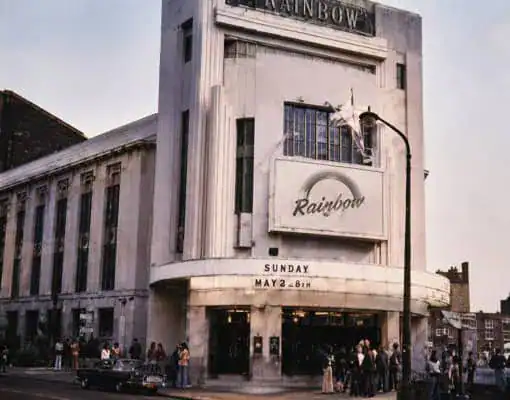
Image: David Bowie World collection / editorial use
The Rainbow Theatre in London became one of the most important stages in the rise of Ziggy Stardust. During 1972, David Bowie arrived as a rapidly emerging star and left having cemented his reputation as one of the most innovative live performers of his generation.
Audiences witnessed a show unlike anything typically seen in British rock venues. Combining music, theatre, mime, fashion and science fiction imagery, Bowie transformed the concert experience into a complete artistic performance.
- Location: Finsbury Park, London
- Venue: Rainbow Theatre
- Period: Ziggy Stardust era (1972–1973)
- Key performers: David Bowie & The Spiders from Mars
- Historical significance: Rise of Ziggy Stardust as a national phenomenon
Starman Over The Rainbow
David Bowie performing during the Ziggy Stardust era at London’s Rainbow Theatre.
In the summer of 1972, David Bowie arrived at London’s Rainbow Theatre as a rising star. The success of The Rise and Fall of Ziggy Stardust and the Spiders from Mars had transformed him from an ambitious singer-songwriter into one of the most talked-about performers in Britain. The Rainbow Theatre became one of the stages on which the Ziggy Stardust phenomenon truly came to life.
Audiences entering the venue encountered something unlike the traditional rock concerts of the era. Bowie appeared in colourful costumes, dramatic make-up and striking poses that blurred the boundaries between theatre, science fiction and popular music. Supported by Mick Ronson, Trevor Bolder and Mick Woodmansey, he presented a carefully constructed world in which Ziggy Stardust seemed less like a fictional character and more like a visitor from another planet.
The Ziggy Stardust experience
Contemporary reports often described the performances as intense, theatrical and unpredictable. Bowie moved across the stage with an energy that combined rock music, mime, cabaret and performance art. Songs such as Starman, Moonage Daydream, Rock ’n’ Roll Suicide and Ziggy Stardust were no longer simply concert numbers; they became scenes within a larger narrative about fame, identity and alienation.
The Rainbow Theatre performances demonstrated how quickly Bowie’s audience was expanding. What had begun as a devoted cult following was evolving into a national phenomenon. Fans copied his hairstyles, clothing and make-up, while newspapers and music magazines increasingly devoted space to analysing the Ziggy Stardust character and Bowie’s artistic ambitions.
The Spiders from Mars
A major part of the Rainbow Theatre experience was the chemistry between Bowie and the Spiders from Mars. Guitarist Mick Ronson provided the musical power and dramatic arrangements that complemented Bowie’s theatrical vision, while Trevor Bolder and Mick Woodmansey supplied a driving rhythm section.
Together they created one of the most distinctive live acts of the early 1970s, blending hard rock energy with a sense of spectacle rarely seen in popular music at the time.
Mick Rock’s iconic photographs
Photographer Mick Rock captured many of the images that would come to define this period. His photographs reveal a performer constantly shifting between reality and character, presenting himself simultaneously as a rock musician, actor and living work of art.
These images remain among the most iconic visual documents of Bowie’s early 1970s career and continue to shape public perceptions of the Ziggy Stardust era.
A venue linked to Bowie history
Looking back, the Rainbow Theatre stands as one of the venues most closely associated with the rise of Ziggy Stardust. Long before the famous farewell concert at Hammersmith Odeon in July 1973, the Rainbow provided a stage on which Bowie refined the theatrical style that would make him one of the most influential performers of the twentieth century.
For many fans, it remains one of the places where Ziggy truly came alive.
Video
David Bowie documentary clip for Rainbow theatre shows on the 19th & 20th August 1972.
Historical significance
The Rainbow Theatre occupies a special place within Bowie’s live history. It represents the period when his artistic ideas, visual identity and stagecraft merged into a fully realised concept that captivated audiences across Britain.
More than simply a concert venue, the Rainbow became a proving ground for the Ziggy Stardust character and helped establish Bowie as one of the defining performers of the 1970s.
Place within Bowie’s career
Within the broader timeline of David Bowie’s career, the Rainbow Theatre marks the moment when he evolved from a promising artist into a cultural phenomenon. The performances held there remain among the most celebrated of the Ziggy Stardust era and continue to inspire generations of musicians and fans.
