
The Making Of The Man Who Sold The World (1970)
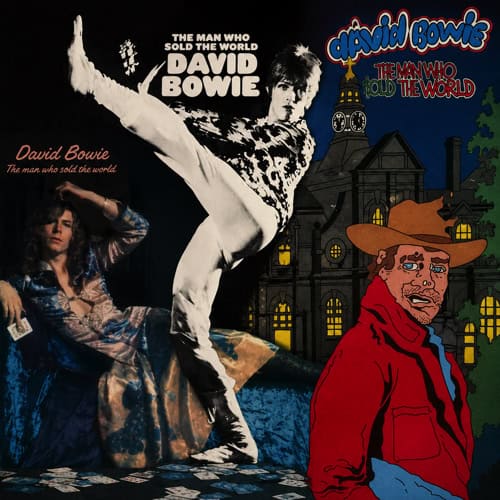
Image: David Bowie World collection / editorial use
Released in November 1970 in the United States and April 1971 in the United Kingdom, The Man Who Sold The World marked one of the most important turning points in David Bowie’s career. The album abandoned much of the folk and psychedelic atmosphere of his earlier work and replaced it with a darker, heavier and more ambitious sound.
It was also the album that introduced the creative partnership between Bowie, guitarist Mick Ronson, producer Tony Visconti and drummer Mick Woodmansey — a combination that would soon evolve into the foundation of the Spiders From Mars.
Although the album was not a major commercial success upon release, it would later become recognised as one of the most influential records in Bowie’s catalogue and the first true glimpse of the artist who would soon conquer the world with Hunky Dory, Ziggy Stardust and beyond.
- Album: The Man Who Sold The World
- Released (US): 4 November 1970
- Released (UK): 10 April 1971
- Producer: Tony Visconti
- Studios: Advision Studios & Trident Studios, London
- Main Musicians: David Bowie, Mick Ronson, Tony Visconti, Mick Woodmansey, Ralph Mace
- Original Working Title: Metrobolist
- Genre: Hard rock, heavy rock, art rock
- Notable Song: The Man Who Sold The World
A New Direction
Following the modest success of Space Oddity, Bowie found himself searching for a stronger musical identity. During 1969 and 1970 he became increasingly interested in heavier rock music, inspired by artists such as Cream, Led Zeppelin, Jimi Hendrix and the emerging hard-rock scene.
At the same time, he was becoming fascinated by themes of madness, alienation, identity, philosophy and personal transformation. These subjects would become central to The Man Who Sold The World.
The result was an album unlike anything Bowie had recorded before. Darker, louder and more psychologically complex, it stood in sharp contrast to the folk influences that had dominated much of his earlier work.
Building The Band
One of the most important developments during this period was the arrival of guitarist Mick Ronson.
Ronson possessed a powerful, aggressive playing style that immediately transformed Bowie’s music. His guitar work brought weight, drama and technical precision to the new material.
Alongside Ronson came drummer Mick Woodmansey, while producer Tony Visconti took on bass duties in addition to overseeing the recordings.
The final key figure was Ralph Mace, whose pioneering use of the Moog synthesiser added an unsettling and futuristic dimension to the album.
Together, these musicians created the sonic blueprint that would eventually evolve into the classic Bowie sound of the early 1970s.
Haddon Hall: Bowie’s Creative Headquarters
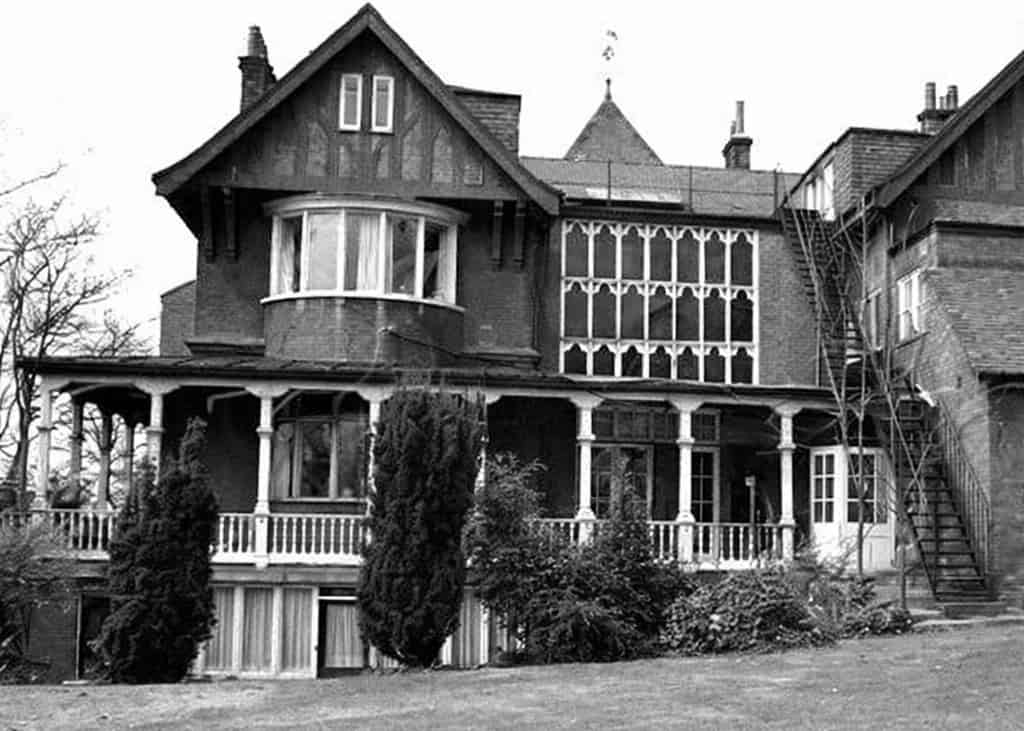
Many of the ideas that shaped The Man Who Sold The World emerged at Haddon Hall in Beckenham, where Bowie lived with Angie Bowie during this period.
The large Victorian house became much more than a residence. It functioned as a creative headquarters where songs were written, ideas were exchanged and future plans were developed.
Friends, musicians, artists and managers regularly passed through Haddon Hall, creating an atmosphere that encouraged experimentation and artistic ambition.
The house would continue to play an important role during the creation of Hunky Dory and the early Ziggy Stardust period.
Recording Begins
Recording sessions took place between April and May 1970 at Advision Studios and Trident Studios in London.
Unlike later Bowie albums, much of the material was developed directly in the studio. Producer Tony Visconti later recalled that Bowie often arrived with only partial ideas, leaving the musicians to build arrangements around simple chord sequences and musical concepts.
This collaborative approach gave the album an unusually organic quality. Rather than being fully composed before recording began, many songs evolved through experimentation between Bowie, Ronson, Visconti and Woodmansey.
The process could sometimes be frustrating, especially when Bowie delayed writing lyrics until the final stages of recording, but it also produced some of the most adventurous music of his career.
The Sound Gets Heavier
The most striking feature of The Man Who Sold The World is its dramatic shift toward heavy rock.
Ronson’s guitar dominates much of the album, delivering powerful riffs and explosive solos that pushed Bowie into territory far removed from the acoustic-based sound of his previous releases.
At the same time, Visconti’s bass playing became unusually prominent, while Woodmansey’s dynamic drumming provided the energy needed to support the album’s ambitious arrangements.
The result was one of the heaviest records Bowie would ever make and a crucial stepping stone toward the theatrical rock music that would soon define the Ziggy Stardust era.
Psychology, Madness And Identity
Lyrically, the album explored subjects that fascinated Bowie throughout his career.
Mental health, fractured identity, isolation, mythology and existential uncertainty appear repeatedly throughout the songs.
Several tracks were influenced by Bowie’s relationship with his half-brother Terry Burns, whose struggles with mental illness deeply affected him.
Songs such as All The Madmen transformed these personal experiences into powerful artistic statements, creating an emotional depth rarely found in contemporary hard rock.
The Width Of A Circle
The album opens with the epic The Width Of A Circle, one of the most ambitious recordings Bowie had attempted up to that point.
Originally conceived as a shorter composition, the song expanded into an eight-minute journey combining hard rock, philosophical imagery and surreal storytelling.
Driven by Mick Ronson’s powerful guitar work, the track established the album’s darker atmosphere immediately and demonstrated how far Bowie had moved from the folk influences of his earlier recordings.
Today it remains one of the most celebrated deep cuts in Bowie’s catalogue and an early example of his willingness to push beyond conventional song structures.
All The Madmen
One of the album’s most personal songs was All The Madmen.
The track was inspired in part by Bowie’s half-brother Terry Burns, whose struggles with mental illness profoundly influenced Bowie throughout his life.
Rather than portraying institutionalised patients as objects of fear, Bowie presented them with sympathy and humanity, challenging many of the stereotypes that surrounded mental health at the time.
The result is one of the most emotionally resonant songs on the album and an early indication of Bowie’s willingness to address difficult subjects in his work.
The Title Track
Although it was not initially considered the album’s most important song, The Man Who Sold The World would eventually become its most famous.
Built around one of Mick Ronson’s most memorable guitar riffs, the song explored themes of duality, identity and self-confrontation.
Its cryptic lyrics encouraged endless interpretation, helping transform it into one of Bowie’s most discussed compositions.
Over the following decades the song would gain an entirely new audience through cover versions and live performances, eventually becoming one of the defining works of Bowie’s career.
The Supermen
Closing the album was The Supermen, a dramatic and mythological composition inspired by Friedrich Nietzsche’s concept of the Übermensch.
The song reflected Bowie’s growing fascination with philosophy, mythology and larger-than-life characters — interests that would later influence the creation of Ziggy Stardust and many other personas.
Musically, it combined powerful guitar work, tribal rhythms and theatrical vocals, bringing the album to a suitably epic conclusion.
Track Listing
The original 1970 album contained nine tracks that introduced a darker and heavier Bowie while laying the foundations for many themes that would dominate his work throughout the 1970s.
- The Width Of A Circle
- All The Madmen
- Black Country Rock
- After All
- Running Gun Blues
- Saviour Machine
- She Shook Me Cold
- The Man Who Sold The World
- The Supermen
Although often overshadowed by Bowie’s later classics, the album’s track list reveals a remarkable leap in songwriting confidence and artistic ambition.
No Hit Singles, But Lasting Influence
Unlike many of David Bowie’s later albums, The Man Who Sold The World did not produce major hit singles at the time of its release.
The record was largely appreciated as a complete artistic statement rather than a collection of radio-friendly songs. While tracks such as All The Madmen, The Width Of A Circle and The Supermen became favourites among dedicated Bowie fans, none achieved significant commercial success as standalone releases.
The album’s reputation grew steadily throughout the 1970s as Bowie became an international star. Critics and musicians increasingly recognised it as a crucial turning point in his artistic development and one of the foundations of his later success.

Nirvana - The Man Who Sold The World

Lulu- The Man Who Sold The World
-
Nirvana - The Man Who Sold The World
Nirvana - The Man Who Sold The World - Taken from the 25th Anniversary Editions of Nirvana – MTV Unplugged in New York -
Lulu- The Man Who Sold The World
Lulu - The Man Who Sold The World ( Original Promo 1974 Rebroadcast HQ Audio )
The title track, The Man Who Sold The World, eventually became the album’s most famous song. Its profile was boosted by Lulu’s 1974 version, produced by Bowie and Mick Ronson, and later by Nirvana’s celebrated performance during their 1993 MTV Unplugged appearance.
As a result, an album that initially produced no major hit singles ultimately became one of the most respected and influential records in Bowie’s catalogue.
The Singles And Lasting Legacy Of The Songs
Unlike many later Bowie albums, The Man Who Sold The World did not generate a major hit single upon release.
Its influence grew gradually over time as listeners and critics began to recognise its importance within Bowie’s artistic development.
Several songs later achieved legendary status, particularly the title track, which became one of the most widely recognised compositions in Bowie’s catalogue.
The Man Who Sold The World
The title song enjoyed a remarkable second life long after the album’s original release.
In 1974, Lulu recorded a version produced by Bowie and Mick Ronson, helping introduce the song to a broader audience.
Its reputation grew even further in the 1990s when Nirvana performed an acclaimed acoustic version during their MTV Unplugged appearance.
As a result, a song that had originally been one of many strong album tracks became one of the most famous compositions Bowie ever wrote.
A Cult Album Becomes A Classic
Although commercial success initially proved limited, musicians and critics increasingly recognised the album’s significance.
Many later artists cited it as an important influence because of its combination of heavy rock, intellectual themes and emotional complexity.
The record also marked the beginning of Bowie’s partnership with Mick Ronson, one of the most important creative relationships of his career.
Without The Man Who Sold The World, the musical breakthroughs of Hunky Dory and The Rise And Fall Of Ziggy Stardust And The Spiders From Mars would have been impossible.
Three Covers, One Album
Few albums in David Bowie’s catalogue possess a visual history as unusual as The Man Who Sold The World.
Over a relatively short period, the album appeared with several completely different sleeve designs, each reflecting a different aspect of Bowie’s evolving artistic identity.
The story behind these covers became almost as fascinating as the music itself and would ultimately play an important role in the album’s enduring mythology.
1. The US “Cartoon Cover” And Metrobolist
The first version of The Man Who Sold The World, released in the United States in November 1970, looked completely different from the sleeve most Bowie fans know today.
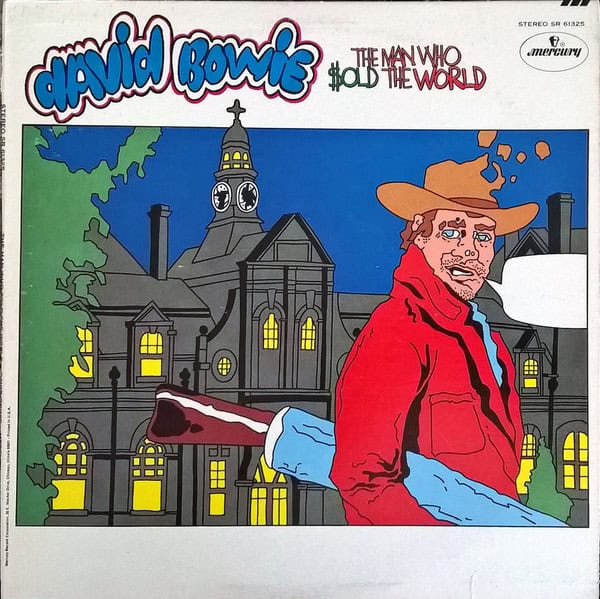
Image: David Bowie World collection / editorial use
The cover featured artwork by Mike Weller and was based on a painting titled Metrobolist, the album’s original working title.
The image depicted a strange urban landscape together with references to violence, authority and psychological instability, themes that appeared throughout the album.
One notable feature was the inclusion of Cane Hill Hospital, the institution associated with Bowie’s half-brother Terry Burns and the inspiration behind All The Madmen.
Although highly original, the cover failed to reflect Bowie’s own vision for the album and would later be replaced.
2. The UK “Dress Cover”
When the album finally appeared in Britain in April 1971, it featured a dramatically different design that Bowie had personally approved.
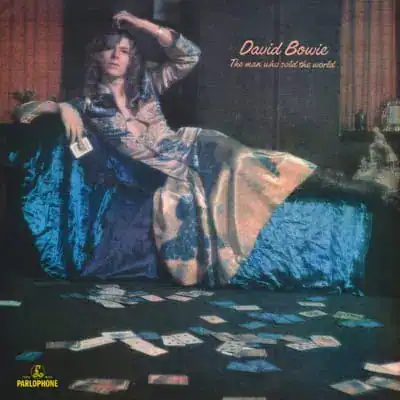
Image: David Bowie World collection / editorial use
Photographed by Keith “Keef” MacMillan at Haddon Hall, the image showed Bowie reclining on a chaise longue while wearing a flowing Mr Fish dress.
The photograph challenged traditional ideas about gender and masculinity at a time when very few male rock stars would have considered appearing in such a manner.
Inspired partly by Pre-Raphaelite art and the work of Dante Gabriel Rossetti, the image blended fashion, theatre and visual art into a single statement.
The famous cover was created at Haddon Hall, the large Victorian house where Bowie lived during this period. Far from being a conventional rock-star home, Haddon Hall became one of the most important creative locations in Bowie’s early career, serving as a place where songs were written, ideas were discussed and visual concepts were developed.
The house provided the setting for one of the most famous photographs of Bowie’s pre-Ziggy years and helped establish his growing reputation as an artist who viewed image and music as inseparable.
Today it is regarded as one of the most daring album covers of the early 1970s.
3. The RCA Reissue Cover
Following Bowie’s breakthrough success with Ziggy Stardust, RCA reissued The Man Who Sold The World in 1972 with an entirely new sleeve.
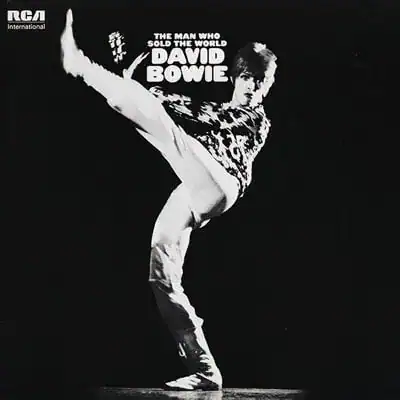
Image: David Bowie World collection / editorial use
The new cover replaced the controversial dress photograph with a striking black-and-white image of Bowie in his Ziggy Stardust period.
This became the version most record buyers encountered during the 1970s and helped introduce the album to a new audience.
Although less provocative than the UK dress cover, it linked the album directly to Bowie’s growing international fame.
For many years, this became the most familiar edition of the record.
The Making Of The Cover
The cover of The Man Who Sold The World represented a major step in Bowie’s artistic evolution.
Rather than presenting himself as a conventional rock musician, he used the artwork to challenge expectations and create discussion.
The Mr Fish dress, the theatrical pose, the Victorian setting and the art-historical references all pointed toward a future in which Bowie would continuously reinvent himself through visual identity as well as music.
Many of the ideas first explored on this cover would later reappear in more famous forms during the Ziggy Stardust, Aladdin Sane and Diamond Dogs eras.
Want to discover the full story behind the album cover? Explore the complete history of the original Mercury release, the famous dress cover, later RCA editions and their artwork.
Legacy
Although it initially sold modestly, The Man Who Sold The World has become recognised as one of the most important albums in David Bowie’s catalogue.
The record introduced many of the themes, sounds and creative partnerships that would define his greatest work of the 1970s.
It marked the emergence of Mick Ronson as Bowie’s most important musical collaborator, established the darker and more ambitious direction of his songwriting and demonstrated his growing confidence as both a musician and visual artist.
Today the album stands as the bridge between the talented but uncertain Bowie of the late 1960s and the revolutionary artist who would soon transform popular music with Hunky Dory and The Rise And Fall Of Ziggy Stardust And The Spiders From Mars.
Article Origin
This page was created using documented research into the making of The Man Who Sold The World, including historical interviews with David Bowie, Tony Visconti, Mick Woodmansey, Ralph Mace and other participants involved in the album’s creation.
Additional information was drawn from recording-session documentation, contemporary Mercury and RCA material, research into the album’s various cover designs and historical studies of Bowie’s early 1970s creative development.
