
David Bowie – Dominion Theatre / ICA Benefit 1988
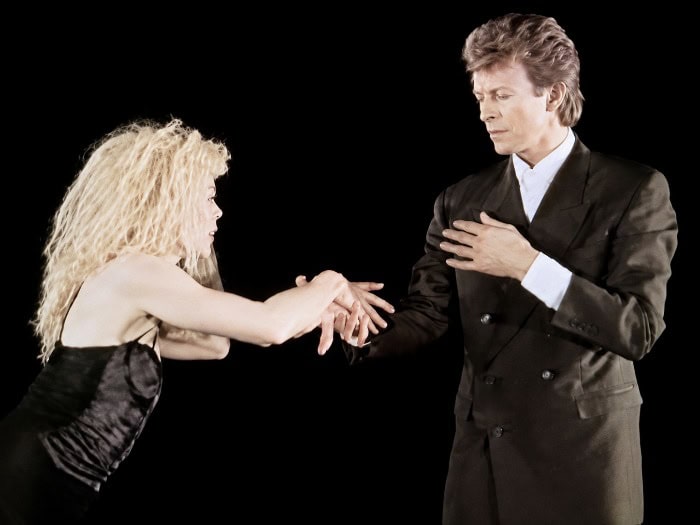
Louise Lecavalier of La La La Human Steps. Source: DavidBowieWorld archive.
On 1 July 1988, David Bowie appeared at London’s Dominion Theatre as part of Intruders at the Palace, a musical benefit for the Institute of Contemporary Arts (ICA).
Bowie did not present a conventional concert. His contribution was a specially conceived collaboration with the Montreal-based contemporary dance company La La La Human Steps, led by choreographer Édouard Lock.
Together they transformed Bowie and Brian Eno’s Look Back in Anger, originally released on Lodger in 1979, into an extended work combining live music, choreography and visual performance.
The appearance is also important because it was one of the earliest public results of Bowie’s developing musical partnership with guitarist Reeves Gabrels.
- Event: Intruders at the Palace
- Date: 1 July 1988
- Venue: Dominion Theatre, London
- Benefit: Institute of Contemporary Arts (ICA)
- Bowie performance: Look Back in Anger
- Dance company: La La La Human Steps
- Choreographer: Édouard Lock
- Featured dancer: Louise Lecavalier
- Musicians: David Bowie, Reeves Gabrels, Kevin Armstrong and Erdal Kızılçay
- Bowie connection: Early public Bowie–Gabrels collaboration
Intruders at the Palace
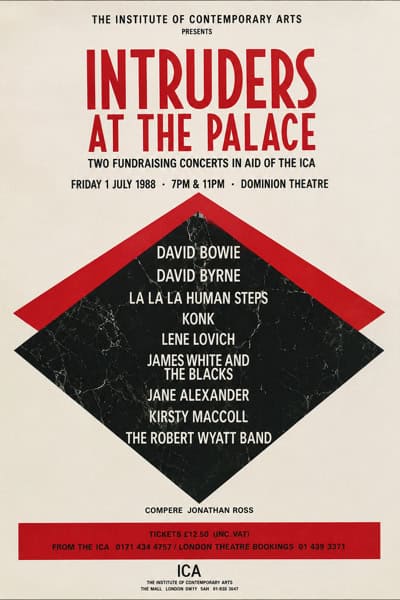
Intruders at the Palace – ICA benefit, Dominion Theatre, London, 1 July 1988.
Intruders at the Palace was an ICA off-site musical benefit held at the Dominion Theatre. The event belonged to the ICA’s long tradition of bringing experimental music, performance and contemporary art into settings beyond its own galleries.
The programme on 1 July 1988 also featured The Woodentops, Microdisney and the Kronos Quartet.
Bowie’s contribution was therefore one part of a wider programme rather than a normal David Bowie tour date. Contemporary venue documentation described his appearance with La La La Human Steps as a specially conceived live performance.
David Bowie in 1988
Bowie entered 1988 immediately after the enormous Glass Spider Tour, which had ended in November 1987. That production had combined stadium-scale staging, choreography, dancers, elaborate structures and an extensive international touring schedule.
The Dominion Theatre appearance presented a very different format. Rather than building an entire evening around Bowie as a solo star, it placed him inside a concentrated collaborative work in which music and contemporary dance were equally important.
It would be misleading to describe the performance as a Tin Machine concert or as a formal announcement that Bowie was abandoning his 1980s career. Tin Machine had not yet emerged publicly in its familiar form.
What the performance does document is Bowie once again testing a new collaborative environment at a moment when his musical direction was beginning to change.
La La La Human Steps and Édouard Lock
La La La Human Steps had developed an international reputation for an exceptionally fast and athletic form of contemporary dance.
Under choreographer Édouard Lock, the company used sudden changes of direction, demanding lifts, rapid turns and strongly physical movement that challenged conventional distinctions between ballet, contemporary dance and performance art.
That independent artistic identity was important to Bowie. This was not a dance company being brought in merely to decorate a rock performance. Lock’s choreography formed a central part of the work itself.
David Bowie on La La La Human Steps
“It’s where punk and ballet clash with each other.”
Louise Lecavalier
At the centre of La La La Human Steps during this period was Louise Lecavalier.
Lecavalier became closely associated with the company’s extraordinary physical vocabulary. Her performances combined strength, speed and precision in ways that challenged conventional expectations of gender and physical roles within dance.
The collaboration with Bowie gave her movement an unusually prominent place within a rock performance. Bowie and Lecavalier were not presented simply as singer and supporting dancer; their interaction formed part of Lock’s choreographic conception.
Their association would continue beyond the Dominion Theatre and later intersect again with Bowie’s visual presentation during the Sound+Vision Tour.
Look Back in Anger Reconstructed
David Bowie with La La La Human Steps – Look Back in Anger, Dominion Theatre, London, 1 July 1988.
The musical foundation of the Dominion Theatre collaboration was Look Back in Anger, written by Bowie and Brian Eno and originally released on Lodger in 1979.
For the 1988 performance, Bowie did not simply revive the original studio arrangement. The song was rebuilt into a substantially longer and harder-edged piece designed to work with the physical intensity of La La La Human Steps.
Guitar became particularly important to the new arrangement. The reconstruction provided one of the first occasions on which Bowie and Reeves Gabrels developed music together for public presentation.
David Bowie on the new arrangement
“I like the hard-edged wall of guitar sound that we put into it.”
— David Bowie, filmed interview, 1988
Reeves Gabrels
The Dominion Theatre performance occupies a particularly important place in the history of Bowie’s relationship with Reeves Gabrels.
Gabrels helped reshape Look Back in Anger and brought an abrasive, unconventional guitar vocabulary into Bowie’s music. The collaboration offered a striking contrast with the polished production associated with much of Bowie’s mid-1980s output.
The partnership did not end with this one performance. Bowie and Gabrels continued working together, and Gabrels soon became one of the founding members of Tin Machine.
He would remain an important Bowie collaborator through much of the 1990s, contributing to projects including 1. Outside, Earthling and ‘hours…’.
Kevin Armstrong and Erdal Kızılçay
The other principal musicians connected with the Dominion Theatre performance were guitarist Kevin Armstrong and multi-instrumentalist Erdal Kızılçay.
Armstrong was already part of Bowie’s wider musical circle and played alongside Bowie and Gabrels during the 1988 performance.
Kızılçay had worked with Bowie extensively during the 1980s and supplied bass within the new musical setting. Programmed percussion was also incorporated into the arrangement.
Their presence connected musicians from Bowie’s established circle with the new creative partnership developing around Gabrels.
A Multimedia Performance
The Dominion Theatre piece combined live rock music with choreography and visual presentation rather than treating those elements as separate layers.
This approach belonged naturally within Bowie’s much longer history of combining music with theatre and movement. His early mime work, the Ziggy Stardust performances, the Diamond Dogs production and later tours had all demonstrated his interest in the physical and visual possibilities of live music.
What distinguished the La La La Human Steps collaboration was its concentration. Rather than constructing an entire Bowie show, the participants built a single interdisciplinary performance around one radically altered composition.
Not a Conventional David Bowie Concert
The Dominion Theatre appearance should not be described as a full Bowie concert with a set spanning different periods of his career.
The documented Bowie repertoire for the performance consisted of Look Back in Anger.
That distinction is essential to understanding the event. Its historical importance comes from the collaboration itself rather than from the size of the setlist.
The 1988 Studio Version
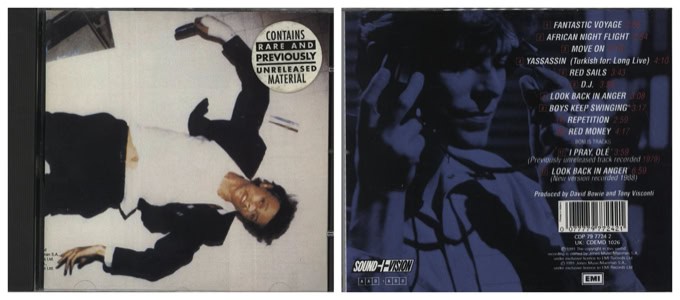
David Bowie – Lodger, 1991 Rykodisc/EMI CD reissue featuring Look Back in Anger (New Version Recorded 1988) as a bonus track.
The reconstruction of Look Back in Anger also produced a new studio recording in 1988.
The recording preserved the harder musical approach associated with the Bowie–Gabrels collaboration and extended the song well beyond the length of its original Lodger version.
It was eventually issued as a bonus track on the 1991 Rykodisc/EMI reissue of Lodger.
The recording therefore became more than documentation of a one-off performance. It also marked Reeves Gabrels’ first appearance on a commercially released Bowie recording.
Video – David Bowie with La La La Human Steps
David Bowie Wired Interview July 1988
David Bowie With La La La Human Steps London 01 July 1988
Wrap Around the World
The Bowie–La La La Human Steps collaboration did not end with the Dominion Theatre appearance.
Later in 1988, Bowie and the company also appeared in Nam June Paik’s Wrap Around the World, an ambitious international television project connected by satellite.
The programme linked broadcasts and performances from numerous countries and deliberately brought popular performers together with experimental and contemporary artists.
Bowie appeared with La La La Human Steps and also participated in a satellite exchange involving Japanese musician Ryuichi Sakamoto.
The project placed the collaboration inside an even broader multimedia context and connected Bowie’s interest in music and movement with the pioneering video-art practice of Nam June Paik.
The Connection Continues into Sound+Vision
Bowie’s relationship with Édouard Lock, Louise Lecavalier and La La La Human Steps continued beyond 1988.
Lock later became involved in the visual direction of Bowie’s Sound+Vision Tour in 1990, while filmed material featuring Lecavalier became part of the tour’s visual presentation.
Lecavalier also appeared with Bowie in the visual campaign surrounding Fame ’90.
The Dominion Theatre collaboration was therefore not an isolated experiment. It began an artistic relationship that continued into another important phase of Bowie’s live presentation.
From Glass Spider Toward Tin Machine
In Bowie’s chronology, the Dominion Theatre performance sits between the end of the Glass Spider Tour and the emergence of Tin Machine.
The event should not be treated as a disguised Tin Machine performance: Tony Sales and Hunt Sales were not part of the Dominion Theatre line-up, and the band had not yet emerged publicly in its familiar form.
Nevertheless, the developing partnership between Bowie and Gabrels documented here would become one of Tin Machine’s foundations.
The performance therefore offers a genuine transitional document without requiring the exaggerated claim that Bowie had already decided exactly what his next career phase would become.
Legacy
David Bowie’s appearance at Intruders at the Palace is a relatively compact event within the chronology of his career, but its importance is unusually concentrated.
It brought together contemporary dance, live music and multimedia performance; gave Bowie and Reeves Gabrels an early public platform together; connected Bowie with Édouard Lock and Louise Lecavalier; and produced a radical reconstruction of a song from his own catalogue.
The collaboration also continued beyond London through Wrap Around the World and later through Bowie’s Sound+Vision period.
Rather than representing a forgotten conventional concert, the Dominion Theatre performance is better understood as a focused piece of collaborative experimentation at a moment when Bowie was once again opening his work to new people and new methods.
Official Website & Further Information
Further historical information about the event and the artists involved can be found through the Institute of Contemporary Arts archive and David Bowie’s official archive.
Institute of Contemporary Arts – Official Website
David Bowie – Official Website
Article Origin
This DavidBowieWorld archive article was researched and rewritten as a historically focused account of David Bowie’s collaboration with La La La Human Steps at the Dominion Theatre during the ICA’s Intruders at the Palace benefit on 1 July 1988.
Particular attention has been given to distinguishing the appearance from a conventional Bowie concert, documenting the reconstructed performance of Look Back in Anger, identifying the musicians and dancers involved, and placing the event within Bowie’s developing relationships with Édouard Lock, Louise Lecavalier and Reeves Gabrels.
Contemporary and archival sources have been prioritised where available, including the Institute of Contemporary Arts archive, the official David Bowie archive and documentation relating to the Dominion Theatre and Wrap Around the World.
© DavidBowieWorld.com — David Bowie Collaborations & Creative Circle Archive.
