Feathers – David Bowie, Hermione Farthingale and John Hutchinson
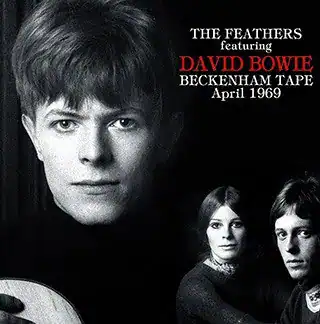
Image: David Bowie World collection / editorial use
Feathers was the short-lived acoustic and multimedia trio formed by David Bowie, Hermione Farthingale and John “Hutch” Hutchinson during Bowie’s transitional 1968–1969 period.
Before becoming Feathers, the project was briefly known as Turquoise. It began with Bowie, Farthingale and guitarist Tony Hill, before Hill was replaced by Hutchinson, Bowie’s former bandmate from The Buzz.
Feathers never became commercially successful and released no records during its lifetime, but the group is historically important because it connected Bowie’s folk, mime, poetry and performance-art interests directly to the emotional and musical world that would soon produce Space Oddity.
- Name: Feathers
- Earlier name: Turquoise
- Core members: David Bowie, Hermione Farthingale, John “Hutch” Hutchinson
- Earlier member: Tony Hill
- Active: Late 1968 – early 1969
- Style: Acoustic folk, vocal harmony, mime, poetry, multimedia performance
- Key associated recording: Ching-a-Ling
- Historical role: Bridge between Bowie’s Deram period and Space Oddity
From Turquoise to Feathers
The story of Feathers begins in 1968, after David Bowie’s early pop career had failed to produce a commercial breakthrough. His 1967 debut album had not been a success, and Bowie was searching for new artistic directions outside the standard pop-group format.
During this period he became increasingly involved with mime, theatre, poetry, folk music and London’s countercultural arts scene. He worked with Lindsay Kemp, explored performance as something more than singing songs, and began thinking about music as part of a wider visual and theatrical language.
The first version of the group was called Turquoise. It featured Bowie, Hermione Farthingale and guitarist Tony Hill. The act was not a conventional folk group. From the beginning, it was intended to combine songs with mime, poetry, movement and experimental presentation.
Tony Hill soon left and was replaced by John “Hutch” Hutchinson, who had previously played guitar with Bowie in The Buzz. Hutchinson had returned from Canada with a strong interest in contemporary folk music, including artists such as Leonard Cohen, Joni Mitchell and Gordon Lightfoot.
With Hutchinson in place, the trio became known as Feathers.
Hermione Farthingale’s importance
Hermione Farthingale was central to this period of Bowie’s life. She was Bowie’s partner, but she should not be reduced to that role. She was also a performer whose background in dance and theatre helped shape the atmosphere of the trio.
Through Farthingale, Bowie’s interest in movement, visual presentation and emotional performance deepened. Her presence encouraged him to explore a softer and more intimate musical language than the one he had used in his earlier beat and mod groups.
The emotional importance of their relationship became clearer after their separation. Songs such as Letter to Hermione and An Occasional Dream grew from the aftermath of that relationship and remain among Bowie’s most direct early love songs.
Feathers therefore stands not only as a musical project, but also as a personal turning point.
John “Hutch” Hutchinson returns
John Hutchinson’s return was important because he gave Bowie a strong acoustic partner at exactly the moment Bowie was moving away from electric band formats.
Hutchinson’s guitar work and lower vocal register helped create the close harmony sound that became central to Feathers and later to the Bowie-and-Hutch duo.
Unlike some of Bowie’s earlier collaborators, Hutchinson was able to adapt to Bowie’s changing interests. He could support folk songs, Jacques Brel material, demos, theatrical pieces and more intimate acoustic arrangements.
This made him one of Bowie’s most sympathetic early collaborators.
A multimedia folk act
Feathers was never simply a folk trio. The group combined acoustic music with poetry, mime, theatrical gesture and recorded sound.
Their performances could include Bowie originals, Jacques Brel songs, spoken passages and small performance-art elements. This reflected Bowie’s growing desire to create an act that was more than a sequence of songs.
The group’s approach was ambitious but fragile. It was intimate, experimental and not especially commercial. At the same time, it allowed Bowie to test ideas about character, staging and atmosphere that would become much more important later in his career.
Feathers belongs to the same creative world that produced Bowie’s involvement with arts labs, mime performance and the Love You Till Tuesday film project.
Ching-a-Ling
The recording most closely associated with Feathers is Ching-a-Ling.
The song was recorded during the autumn of 1968 with producer Tony Visconti. It was not released at the time, but later appeared on archival Bowie releases, becoming one of the few surviving studio documents of the Feathers period.
Ching-a-Ling captures the light, harmony-based side of Bowie’s brief folk experiment. It is not one of his major songs, but it is historically valuable because it shows how far Bowie had moved from the sound of his early R&B and mod groups.
The song also shows the unusual position Feathers occupied: not quite a conventional group, not quite theatre, not yet the Bowie who would record Space Oddity, but clearly part of the road toward that breakthrough.
Live performances
Feathers performed mainly at colleges, arts centres, folk clubs and small London venues. Their appearances were modest compared with Bowie’s later career, but they provided valuable experience in front of live audiences.
Unlike Bowie’s earlier groups, which had relied heavily on electric instruments and beat-group energy, Feathers focused on atmosphere, storytelling and performance.
Contemporary accounts suggest that audiences were sometimes fascinated and sometimes confused by what they saw. The mixture of folk songs, mime and poetry was unusual even by the standards of London’s late-1960s underground scene.
Bowie nevertheless persisted because the project allowed him to experiment freely without the expectations attached to a conventional pop group.
The repertoire


The group performed a mixture of Bowie originals and carefully selected cover versions.
Jacques Brel songs featured prominently, reflecting Bowie’s growing admiration for theatrical European songwriting. Brel’s influence would remain important throughout Bowie’s career and later surface in performances and recordings during the 1970s.
Other material associated with the Feathers and Bowie-and-Hutch period included songs by Leonard Cohen and contemporary folk writers.
Bowie originals performed during this era included songs such as When I’m Five, Sell Me A Coat, Ching-a-Ling and early versions of material that would eventually lead toward Space Oddity.
From Feathers to Bowie & Hutch
The end of Feathers was closely connected to the end of Bowie’s relationship with Hermione Farthingale.
Following their separation in early 1969, the trio effectively ceased to exist. Bowie and Hutchinson continued for a short period as an acoustic duo, often referred to by collectors and historians as Bowie & Hutch.
This partnership proved important because it enabled Bowie to continue developing new songs while searching for a recording contract.
Hutchinson’s harmony vocals became an important part of the duo’s sound, helping Bowie refine arrangements that were very different from his previous band work.
The Bowie & Hutch demos
In April 1969 Bowie and Hutchinson recorded a series of demo recordings that would become historically significant.
These demos included early versions of songs that soon formed the backbone of Bowie’s next phase. Among them were compositions that would appear on the Space Oddity album as well as carefully chosen cover versions.
The sessions also included recordings of Love Song by Lesley Duncan and Life Is A Circus by Roger Bunn.
Although these recordings were originally intended as demonstration material, they later became important historical documents because they captured Bowie at the exact moment his fortunes were beginning to change.
The road to Space Oddity
Feathers occupies a unique position in Bowie’s story because it sits directly between failure and breakthrough.
The commercial disappointment of the Deram years had left Bowie searching for a new identity. Through Feathers he discovered a more personal style of songwriting and a greater confidence in presenting himself as an individual artist rather than simply the singer in a group.
Many of the themes that would soon define Bowie’s work were already visible: isolation, imagination, performance, identity and emotional vulnerability.
By the time Space Oddity emerged in 1969, Bowie had already spent months exploring these ideas through Feathers, mime performances and acoustic songwriting.
For that reason, Feathers should not be viewed as an obscure side project. It was one of the final and most important stepping stones toward David Bowie’s first major breakthrough.
Legacy
Feathers lasted only a matter of months and never achieved commercial success, yet its importance within David Bowie’s story far outweighs its brief existence.
The trio allowed Bowie to combine music with mime, poetry, theatre and performance art in a way that no previous Bowie project had done.
Through Feathers, Bowie discovered new ways of presenting songs and new ways of thinking about performance. The project also strengthened his relationships with Hermione Farthingale, John Hutchinson and Tony Visconti, all of whom played important roles during this formative period.
Most importantly, Feathers formed a direct bridge between Bowie’s unsuccessful Deram years and the emergence of Space Oddity. The group occupies a small but essential chapter in the story of David Bowie’s artistic development.
Chronology
📅 1968-08
📍 London 🇬🇧, England
🎤 Formation of Turquoise
🗒️ David Bowie, Hermione Farthingale and Tony Hill form an acoustic multimedia trio combining folk music, mime and poetry.
📅 1968-09
📍 London 🇬🇧, England
🎸 John Hutchinson joins
🗒️ Tony Hill departs and is replaced by John “Hutch” Hutchinson. The group soon adopts the name Feathers.
📅 1968-09-16
📍 London 🇬🇧, England
🏛️ Advision Studios
🎧 Recording: Back To Where You’ve Never Been and Ching-a-Ling
🗒️ First professional studio session for the trio. Produced by Tony Visconti.
📅 1968
📍 London 🇬🇧, England
🎙️ Private BBC-related sessions (informal)
🗒️ Informal recordings and performance-related activity associated with BBC contacts during the Feathers period.
📅 1968-10-24
📍 London 🇬🇧, England
🏛️ Trident Studios
🎧 Recording: Ching-a-Ling
🗒️ Tony Visconti oversees a recording session that later becomes one of the key surviving documents of the Feathers era.
📅 Late 1968
📍 Various venues 🇬🇧, England
🎤 Live performances
🗒️ Feathers performs at folk clubs, colleges, arts venues and small London events, mixing songs with mime and poetry.
📅 Early 1969
📍 London 🇬🇧, England
💔 Hermione Farthingale leaves
🗒️ The end of Bowie’s relationship with Hermione effectively brings Feathers to a close.
📅 1969-04
📍 London 🇬🇧, England
🎧 Bowie & Hutch demo sessions
🗒️ David Bowie and John Hutchinson record acoustic demos including early versions of songs connected to the forthcoming Space Oddity era.
📅 1969-04
📍 London 🇬🇧, England
🎵 Recordings: Love Song and Life Is A Circus
🗒️ Bowie and Hutchinson record cover versions as part of their demonstration tapes for record companies.
📅 Mid 1969
📍 London 🇬🇧, England
🚀 Transition to the Space Oddity era
🗒️ The Feathers and Bowie & Hutch period ends as Bowie moves toward his Mercury contract and the recording of Space Oddity.
