
Glass Spider Tour – David Bowie’s Monumental 1987 Stadium Spectacle
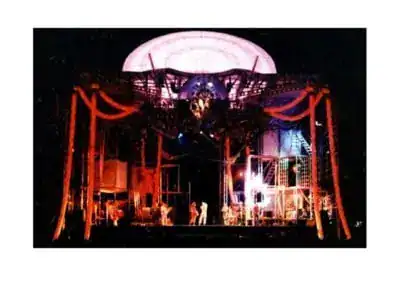
Photo: Unknown photographer – Glass Spider Tour stage.
The Glass Spider Tour was David Bowie’s most ambitious live production and one of the largest concert tours ever mounted by a solo artist during the 1980s. Staged between 30 May and 28 November 1987, the tour supported the Never Let Me Down album while simultaneously celebrating more than fifteen years of Bowie’s constantly evolving career.
Rather than presenting a conventional rock concert, Bowie envisioned the production as a form of theatrical performance art. Music, choreography, dramatic lighting, narrative scenes and one of the most spectacular stage sets ever constructed for a touring artist combined to create a unique multimedia experience that divided critics at the time but has since been widely reassessed as one of the boldest productions of its era.
- Tour: Glass Spider Tour
- Dates: 30 May – 28 November 1987
- Shows: 86 concerts
- Continents: Europe, North America and Oceania
- Supporting album: Never Let Me Down (1987)
- Stage designer: Mark Ravitz
- Choreography: Toni Basil
- Concept: A rock concert presented as theatrical performance art
The Road to Glass Spider
Following the enormous commercial success of the Serious Moonlight Tour in 1983–1984, David Bowie deliberately resisted repeating the same formula. Although that earlier tour had established him as one of the world’s biggest live performers, Bowie increasingly felt that traditional stadium concerts offered limited creative possibilities. He wanted his next production to be something audiences had never experienced before.
While recording Never Let Me Down, Bowie began developing ideas for an elaborate stage production inspired as much by theatre, modern dance and visual art as by rock music. He imagined a concert with recurring characters, symbolic imagery and dramatic transitions that would blur the boundaries between music, storytelling and performance art.
The result became the Glass Spider Tour, officially announced during a series of international promotional performances and press events in March 1987. Before the tour itself began, Bowie introduced the new material and concept through intimate showcase appearances in cities including Toronto, New York, London, Paris, Madrid, Rome, Munich, Stockholm and Amsterdam, giving journalists an early glimpse of what would become his most spectacular live production.
The Glass Spider Stage
The visual centrepiece of the tour was an enormous spider-shaped stage designed by production designer Mark Ravitz. Measuring approximately 60 feet (18 metres) high and 64 feet (19.5 metres) wide, the structure dominated every stadium in which it appeared. Constructed from steel and fibreglass, the giant spider became one of the most recognisable concert stages ever created and immediately established the Glass Spider Tour as one of the largest touring productions of the decade.
The stage was far more than an impressive backdrop. Bowie incorporated the entire structure into the performance, appearing beneath the spider, moving through different parts of the set and, when weather conditions allowed, descending dramatically from the spider’s head at the beginning of the show. Hydraulic lifts, moving platforms, trapdoors, extensive lighting rigs and giant video screens transformed the concert into a constantly changing theatrical environment.
Transporting the production across three continents required an enormous logistical operation involving dozens of trucks, hundreds of crew members and several days of construction before each performance. At the time, it ranked among the most ambitious touring productions ever undertaken by a solo performer and demonstrated Bowie’s willingness to push the technical limits of live entertainment.
Music, Theatre and Dance
Unlike most stadium concerts of the period, the Glass Spider Tour was conceived as a complete theatrical production rather than simply a sequence of songs. Bowie described the show as “rock theatre”, combining music with choreography, dramatic scenes and recurring visual motifs inspired by expressionist theatre, mime and contemporary dance.
American choreographer Toni Basil, herself a respected dancer, actress and choreographer, played a major role in shaping the production. Working closely with Bowie, she developed movement sequences that integrated dancers directly into the narrative instead of using them merely as visual accompaniment. Their performances became an essential part of the storytelling throughout the evening.
Professional dancers including Melissa Hurley, Constance Marie, Craig “Spazz” Rothwell, Viktor Manoel and Stephen Nichols portrayed a series of symbolic characters who interacted with Bowie during key moments of the performance. Their appearances helped transform the concert into an evolving visual drama rather than a traditional rock show.
The Glass Spider Band
To realise his ambitious vision, Bowie assembled one of the strongest touring bands of his career. Long-time musical director Carlos Alomar returned on guitar alongside childhood friend Peter Frampton, whose appearance reunited the two musicians on stage for the first time since their school days in Bromley.
The rhythm section featured bassist Carmine Rojas and drummer Alan Childs, while multi-instrumentalists Erdal Kızılçay and Richard Cottle expanded the sound with keyboards, saxophone, violin, trumpet, percussion and additional backing vocals. Together they recreated Bowie’s extensive catalogue while adapting many familiar songs to fit the theatrical concept of the production.
Although some critics later argued that the highly polished arrangements reflected the production style of the late 1980s, the musicianship throughout the tour was consistently praised. The combination of experienced Bowie collaborators with newer performers allowed the concerts to move comfortably between hard rock, electronic textures, soul influences and dramatic orchestral passages.
The Music and Setlist
Although the Glass Spider Tour was created to promote Never Let Me Down, David Bowie deliberately avoided building the entire show around his latest album. Instead, he constructed a career-spanning setlist that combined new material with songs from every major period of his career, allowing audiences to experience both the contemporary Bowie and the artist who had continually reinvented himself since the late 1960s.
Songs from Never Let Me Down, including Time Will Crawl, Day-In Day-Out, Beat of Your Drum, ’87 and Cry, Glass Spider, Bang Bang and the title track, were presented alongside classics such as Heroes, Young Americans, Fame, Fashion, China Girl, Modern Love and Let’s Dance. Bowie also revived less frequently performed songs including All the Madmen, Sons of the Silent Age, Big Brother and Time, giving long-time fans the opportunity to hear material that had rarely appeared in previous tours.
Many of the arrangements were completely reworked. Rather than simply reproducing the original studio recordings, Bowie adapted songs to fit the theatrical concept of the production, often extending introductions, adding instrumental passages or incorporating dramatic transitions between songs and stage scenes.
A Theatre Production on a Stadium Scale
Unlike the comparatively straightforward Serious Moonlight Tour, the Glass Spider production unfolded almost like a stage play. Spoken dialogue, choreographed movement, dramatic lighting and symbolic characters linked many of the songs, creating a continuous theatrical experience rather than a traditional sequence of individual performances.
Several songs formed part of short dramatic scenes in which Bowie interacted with the dancers and actors. These sequences explored recurring themes such as innocence, temptation, conflict, isolation and redemption. While some critics found the theatrical elements overly ambitious, others admired Bowie’s determination to challenge the conventions of the modern rock concert.
The title song, Glass Spider, became the centrepiece of the production. Introduced with pre-recorded narration and elaborate staging, the performance illustrated Bowie’s continuing fascination with storytelling and surreal imagery, ideas that had shaped much of his work since Diamond Dogs more than a decade earlier.
The Berlin Concert
One of the most historically significant performances of the Glass Spider Tour took place on 6 June 1987 at the Platz der Republik, directly beside the Berlin Wall. Thousands of fans gathered on both sides of the divided city to hear Bowie perform, with many East Berlin residents listening from behind the Wall despite heavy police presence.
When Bowie performed Heroes, the emotional significance of the song became impossible to ignore. Originally inspired by a couple embracing beside the Berlin Wall during the recording of the “Heroes“ album in 1977, the performance carried a profound symbolic meaning for audiences living in a still-divided Germany. Many historians and eyewitnesses have since remembered the concert as one of the cultural moments that reflected the growing desire for change in East Germany during the final years before the Wall fell in 1989.
Critical Reception
Critical reaction to the Glass Spider Tour was sharply divided. Many reviewers praised the extraordinary scale of the production, the ambitious staging and Bowie’s willingness to experiment with the stadium concert format. Others argued that the elaborate theatrical concept occasionally distracted attention from the music itself.
David Bowie himself later acknowledged that the production may have attempted to accomplish too many ideas simultaneously. Nevertheless, he never apologised for its ambition, instead viewing it as an important creative experiment that demonstrated his determination to continue taking artistic risks even at the height of his commercial success.
The End of the Tour
The final performance of the Glass Spider Tour took place on 28 November 1987 at Western Springs Stadium in Auckland, New Zealand, bringing to a close six months of almost continuous touring across Europe, North America and Oceania. By the end of the tour Bowie, his musicians and crew had performed 86 concerts, making it one of the largest and most demanding productions of his career.
The sheer scale of the production placed enormous physical and logistical demands on everyone involved. The giant spider stage required days to assemble, hundreds of crew members worked behind the scenes, and transporting the production around the world became one of the most complex touring operations ever attempted by a solo artist during the 1980s.
In later interviews Bowie admitted that, although he remained proud of the tour’s ambition, he felt he had perhaps tried to combine too many theatrical ideas into a single production. Rather than viewing the Glass Spider Tour as a failure, he regarded it as an important creative lesson that influenced the more stripped-back musical direction he would pursue with Tin Machine only a year later.
David Bowie on the Glass Spider Tour
“I probably tried to include too many new ideas in one show.”
Legacy
Although contemporary reviews were often divided, the Glass Spider Tour has undergone a significant critical reassessment. Modern writers increasingly recognise the production as one of the first large-scale stadium tours to integrate theatre, choreography, narrative storytelling and cinematic staging into a complete concert experience. Many productions that followed during the late 1980s and 1990s adopted similar ideas on an even larger commercial scale.
The tour also demonstrated Bowie’s remarkable willingness to take artistic risks. At a time when he could easily have repeated the commercially successful formula of the Serious Moonlight Tour, he instead invested enormous time, energy and resources into creating something completely different. Whether audiences loved or disliked the production, few questioned its originality or its extraordinary ambition.
Today the Glass Spider Tour is widely regarded as one of the most fascinating chapters in David Bowie’s live career. Rather than representing a creative misstep, it illustrates an artist who consistently preferred experimentation over repetition and innovation over safety. The production remains a remarkable example of Bowie’s determination to challenge both himself and his audience.
Official Tour Information
DavidBowieWorld.com maintains one of the most comprehensive online archives dedicated to the Glass Spider Tour, including a complete concert chronology, venue information, musicians, setlists, rare photographs and historical notes covering all 86 performances.
Tour Personnel
The David Bowie Glass Spider Tour began on 30 May 1987 and concluded on 28 November 1987.
It featured 86 shows across 3 legs, making it one of Bowie’s most ambitious tours of the 1980s.
Tour Band
- David Bowie – vocals, guitar
- Peter Frampton – guitar, vocals
- Carlos Alomar – guitar, backing vocals, music director
- Carmine Rojas – bass guitar
- Alan Childs – drums
- Erdal Kızılçay – keyboards, trumpet, congas, violin, backing vocals
- Richard Cottle – keyboards, saxophone, tambourine, backing vocals
Tour Dancers
- Melissa Hurley
- Constance Marie
- Spazz Attack (Craig Allen Rothwell)
- Viktor Manoel
- Stephen Nichols
- Toni Basil – choreography
Tour Design
- Allen Branton – lighting design
- Mark Ravitz – set design
- Christine Strand – video director
Complete Tour Itinerary
Below is the complete Glass Spider Tour concert chronology, featuring promotional press shows, all confirmed tour performances, venues, cities, countries and additional historical notes.
The Songs
🎵 From Aladdin Sane: The Jean Genie / Time
🎵 From Ziggy Stardust: The Motion Picture: White Light/White Heat
🎵 From Diamond Dogs: Big Brother / Chant of the Ever Circling Skeletal Family / Rebel Rebel
🎵 From Young Americans: Young Americans / Fame
🎵 From “Heroes”: Heroes / Sons of the Silent Age
🎵 From Scary Monsters: Fashion / Scary Monsters / Up the Hill Backwards
🎵 From Let’s Dance: China Girl / Let’s Dance / Modern Love
🎵 From Tonight: Blue Jean / Dancing With the Big Boys / Loving the Alien
🎵 From Never Let Me Down: ’87 and Cry / Bang Bang / Beat of Your Drum / Day-In Day-Out / Glass Spider / Never Let Me Down / New York’s in Love / Time Will Crawl / Zeroes
🎵 Other songs: Absolute Beginners / I Wanna Be Your Dog / Lavender’s Blue / London Bridge Is Falling Down / War / Who Will Buy?
🎵 Rehearsed but not performed: Because You’re Young / Scream Like a Baby / Shining Star (Makin’ My Love)
Promotional Press Shows
📍 Toronto, 🇨🇦 Canada
🏛️ Diamond Club
🎤 Artist: David Bowie
📍 New York City, 🇺🇸 USA
🏛️ Cat Club
🎤 Artist: David Bowie
📍 London, 🇬🇧 UK
🏛️ Player’s Theatre
🎤 Artist: David Bowie
📍 Paris, 🇫🇷 France
🏛️ La Locomotive
🎤 Artist: David Bowie
📍 Madrid, 🇪🇸 Spain
🏛️ Halquera Plateaux
🎤 Artist: David Bowie
📍 Rome, 🇮🇹 Italy
🏛️ Piper
🎤 Artist: David Bowie
📍 Munich, 🇩🇪 Germany
🏛️ Park Cafe Löwenbräu
🎤 Artist: David Bowie
📍 Stockholm, 🇸🇪 Sweden
🏛️ Ritz
🎤 Artist: David Bowie
📍 Amsterdam, 🇳🇱 Netherlands
🏛️ Paradiso
🎤 Artist: David Bowie
Europe
📍 Rotterdam, 🇳🇱 Netherlands
🏛️ Stadion Feijenoord
🎤 Artist: David Bowie
📍 Rotterdam, 🇳🇱 Netherlands
🏛️ Stadion Feijenoord
🎤 Artist: David Bowie
📍 Werchter, 🇧🇪 Belgium
🏛️ Rock Werchter
🎤 Artist: David Bowie
📍 Berlin, 🇩🇪 Germany
🏛️ Platz der Republik
🎤 Artist: David Bowie
📍 Nürburgring, 🇩🇪 Germany
🏛️ Rock am Ring
🎤 Artist: David Bowie
📍 Florence, 🇮🇹 Italy
🏛️ Stadio Comunale
🎤 Artist: David Bowie
📍 Milan, 🇮🇹 Italy
🏛️ Stadio San Siro
🎤 Artist: David Bowie
📍 Hamburg, 🇩🇪 Germany
🏛️ Festwiese Am Stadtpark
🎤 Artist: David Bowie
📍 Rome, 🇮🇹 Italy
🏛️ Stadio Flaminio
🎤 Artist: David Bowie
📍 Rome, 🇮🇹 Italy
🏛️ Stadio Flaminio
🎤 Artist: David Bowie
📍 London, 🇬🇧 UK
🏛️ Wembley Stadium
🎤 Artist: David Bowie
📍 London, 🇬🇧 UK
🏛️ Wembley Stadium
🎤 Artist: David Bowie
📍 Cardiff, 🇬🇧 UK
🏛️ Cardiff Arms Park
🎤 Artist: David Bowie
📍 Sunderland, 🇬🇧 UK
🏛️ Roker Park
🎤 Artist: David Bowie
📍 Gothenburg, 🇸🇪 Sweden
🏛️ Ullevi Stadium / Eriksbergsvarvet
🗒️ Notes: Cancelled / moved to Eriksberg Festival Site
📍 Lyon, 🇫🇷 France
🏛️ Stade de Gerland
🎤 Artist: David Bowie
📍 Vienna, 🇦🇹 Austria
🏛️ Praterstadion
🎤 Artist: David Bowie
📍 Paris, 🇫🇷 France
🏛️ Parc départemental de La Courneuve
🎤 Artist: David Bowie
📍 Toulouse, 🇫🇷 France
🏛️ Stadium Municipal
🎤 Artist: David Bowie
📍 Madrid, 🇪🇸 Spain
🏛️ Vicente Calderón Stadium
🎤 Artist: David Bowie
📍 Barcelona, 🇪🇸 Spain
🏛️ Ministadio C.F.
🎤 Artist: David Bowie
📍 Barcelona, 🇪🇸 Spain
🏛️ Ministadio C.F.
🎤 Artist: David Bowie
📍 County Meath, 🇮🇪 Ireland
🏛️ Slane Castle
🎤 Artist: David Bowie
📍 Manchester, 🇬🇧 UK
🏛️ Maine Road Football Ground
🎤 Artist: David Bowie
📍 Manchester, 🇬🇧 UK
🏛️ Maine Road Football Ground
🎤 Artist: David Bowie
📍 Nice, 🇫🇷 France
🏛️ Stade de l’Ouest (Nice)
🎤 Artist: David Bowie
📍 Turin, 🇮🇹 Italy
🏛️ Stadio Comunale di Torino
🎤 Artist: David Bowie
North America
📍 Philadelphia, 🇺🇸 USA
🏛️ Veterans Stadium
🎤 Artist: David Bowie
📍 Philadelphia, 🇺🇸 USA
🏛️ Veterans Stadium
🎤 Artist: David Bowie
📍 East Rutherford, 🇺🇸 USA
🏛️ Giants Stadium
🎤 Artist: David Bowie
📍 East Rutherford, 🇺🇸 USA
🏛️ Giants Stadium
🎤 Artist: David Bowie
📍 San Jose, 🇺🇸 USA
🏛️ Spartan Stadium
🎤 Artist: David Bowie
📍 Anaheim, 🇺🇸 USA
🏛️ Anaheim Stadium
🎤 Artist: David Bowie
📍 Anaheim, 🇺🇸 USA
🏛️ Anaheim Stadium
🎤 Artist: David Bowie
📍 Denver, 🇺🇸 USA
🏛️ Mile High Stadium
🎤 Artist: David Bowie
📍 Portland, 🇺🇸 USA
🏛️ Civic Stadium
🎤 Artist: David Bowie
📍 Vancouver, 🇨🇦 Canada
🏛️ BC Place Stadium
🎤 Artist: David Bowie
📍 Edmonton, 🇨🇦 Canada
🏛️ Commonwealth Stadium
🎤 Artist: David Bowie
📍 Winnipeg, 🇨🇦 Canada
🏛️ Winnipeg Stadium
🎤 Artist: David Bowie
📍 Rosemont, 🇺🇸 USA
🏛️ Rosemont Horizon
🎤 Artist: David Bowie
📍 Rosemont, 🇺🇸 USA
🏛️ Rosemont Horizon
🎤 Artist: David Bowie
📍 Toronto, 🇨🇦 Canada
🏛️ Canadian National Exhibition Stadium
🎤 Artist: David Bowie
📍 Toronto, 🇨🇦 Canada
🏛️ Canadian National Exhibition Stadium
🎤 Artist: David Bowie
📍 Ottawa, 🇨🇦 Canada
🏛️ Frank Clair Stadium
🎤 Artist: David Bowie
📍 Montreal, 🇨🇦 Canada
🏛️ Olympic Stadium
🎤 Artist: David Bowie
📍 New York City, 🇺🇸 USA
🏛️ Madison Square Garden
🎤 Artist: David Bowie
📍 New York City, 🇺🇸 USA
🏛️ Madison Square Garden
🎤 Artist: David Bowie
📍 Foxborough, 🇺🇸 USA
🏛️ Sullivan Stadium
🎤 Artist: David Bowie
📍 Chapel Hill, 🇺🇸 USA
🏛️ Dean Smith Center
🎤 Artist: David Bowie
📍 Chapel Hill, 🇺🇸 USA
🏛️ Dean Smith Center
🎤 Artist: David Bowie
📍 Milwaukee, 🇺🇸 USA
🏛️ Marcus Amphitheater
🎤 Artist: David Bowie
📍 Milwaukee, 🇺🇸 USA
🏛️ Marcus Amphitheater
🎤 Artist: David Bowie
📍 Pontiac, 🇺🇸 USA
🏛️ Pontiac Silverdome
🎤 Artist: David Bowie
📍 Lexington, 🇺🇸 USA
🏛️ Rupp Arena
🎤 Artist: David Bowie
📍 Miami, 🇺🇸 USA
🏛️ Miami Orange Bowl
🎤 Artist: David Bowie
📍 Tampa, 🇺🇸 USA
🏛️ Tampa Stadium
🎤 Artist: David Bowie
📍 Atlanta, 🇺🇸 USA
🏛️ Omni Coliseum
🎤 Artist: David Bowie
📍 Atlanta, 🇺🇸 USA
🏛️ Omni Coliseum
🎤 Artist: David Bowie
📍 Hartford, 🇺🇸 USA
🏛️ Hartford Civic Center
🎤 Artist: David Bowie
📍 Landover, 🇺🇸 USA
🏛️ Capital Centre
🎤 Artist: David Bowie
📍 Landover, 🇺🇸 USA
🏛️ Capital Centre
🎤 Artist: David Bowie
📍 St. Paul, 🇺🇸 USA
🏛️ St. Paul Civic Center
🎤 Artist: David Bowie
📍 St. Paul, 🇺🇸 USA
🏛️ St. Paul Civic Center
🎤 Artist: David Bowie
📍 Kansas City, 🇺🇸 USA
🏛️ Kemper Arena
🎤 Artist: David Bowie
📍 New Orleans, 🇺🇸 USA
🏛️ Louisiana Superdome
🎤 Artist: David Bowie
📍 Houston, 🇺🇸 USA
🏛️ The Summit
🎤 Artist: David Bowie
📍 Houston, 🇺🇸 USA
🏛️ The Summit
🎤 Artist: David Bowie
📍 Dallas, 🇺🇸 USA
🏛️ Reunion Arena
🎤 Artist: David Bowie
📍 Dallas, 🇺🇸 USA
🏛️ Reunion Arena
🎤 Artist: David Bowie
📍 Los Angeles, 🇺🇸 USA
🏛️ LA Memorial Sports Arena
🎤 Artist: David Bowie
📍 Los Angeles, 🇺🇸 USA
🏛️ LA Memorial Sports Arena
🎤 Artist: David Bowie
Oceania
📍 Sydney, 🇦🇺 Australia
🏛️ Tivoli Club
🎤 Artist: David Bowie
🗒️ Notes: Press conference
📍 Brisbane, 🇦🇺 Australia
🏛️ Boondall Entertainment Centre
🎤 Artist: David Bowie
📍 Brisbane, 🇦🇺 Australia
🏛️ Boondall Entertainment Centre
🎤 Artist: David Bowie
📍 Sydney, 🇦🇺 Australia
🏛️ Sydney Entertainment Centre
🎤 Artist: David Bowie
📍 Sydney, 🇦🇺 Australia
🏛️ Sydney Entertainment Centre
🎤 Artist: David Bowie
📍 Sydney, 🇦🇺 Australia
🏛️ Sydney Entertainment Centre
🎤 Artist: David Bowie
📍 Sydney, 🇦🇺 Australia
🏛️ Sydney Entertainment Centre
🎤 Artist: David Bowie
📍 Sydney, 🇦🇺 Australia
🏛️ Sydney Entertainment Centre
🎤 Artist: David Bowie
📍 Sydney, 🇦🇺 Australia
🏛️ Sydney Entertainment Centre
🎤 Artist: David Bowie
📍 Sydney, 🇦🇺 Australia
🏛️ Sydney Entertainment Centre
🎤 Artist: David Bowie
📍 Sydney, 🇦🇺 Australia
🏛️ Sydney Entertainment Centre
🎤 Artist: David Bowie
📍 Melbourne, 🇦🇺 Australia
🏛️ Kooyong Stadium
🎤 Artist: David Bowie
📍 Melbourne, 🇦🇺 Australia
🏛️ Kooyong Stadium
🎤 Artist: David Bowie
📍 Melbourne, 🇦🇺 Australia
🏛️ Kooyong Stadium
🎤 Artist: David Bowie
📍 Melbourne, 🇦🇺 Australia
🏛️ Kooyong Stadium
🎤 Artist: David Bowie
📍 Auckland, 🇳🇿 New Zealand
🏛️ Western Springs Stadium
🎤 Artist: David Bowie
Article Origin
This article has been researched and written for DavidBowieWorld.com as part of the site’s ongoing project documenting David Bowie’s major tours, performances and creative periods. It combines verified historical research, tour personnel information, concert chronology and setlist documentation to present an accurate overview of the Glass Spider Tour.
