
The Making Of Space Oddity (1969)
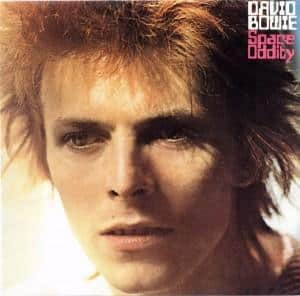
Image: David Bowie World collection / editorial use
Released in 1969, the album now widely known as Space Oddity marked a crucial turning point in David Bowie’s early career. It was originally issued in the United Kingdom simply as David Bowie, even though Bowie had already released a self-titled debut album in 1967.
The record captured Bowie at a moment of transition: moving away from the theatrical novelty style of his Deram years and toward folk rock, progressive songwriting, science-fiction imagery and the more ambitious artistic world that would later define him.
Its title song, Space Oddity, gave Bowie his first major hit and introduced Major Tom, one of the most famous characters in his entire catalogue.
- Album: David Bowie / Space Oddity
- Original UK release: 14 November 1969
- Original UK label: Philips
- US release title: Man of Words / Man of Music
- 1972 RCA reissue title: Space Oddity
- Official album sessions began: 16 July 1969
- Recording period: June – October 1969
- Main studio: Trident Studios, London
- Producers: Tony Visconti and Gus Dudgeon
- Engineers: Ken Scott, Malcolm Toft and Barry Sheffield
- 1969 front cover photography: Vernon Dewhurst
- 1969 back cover artwork: George Underwood
- 1972 RCA reissue photography: Mick Rock
The Album With Two Identities
The album’s history is unusually complicated because it has existed under more than one title.
In Britain, the original 1969 release was called David Bowie. In the United States, Mercury presented it as Man of Words / Man of Music. After Bowie became famous through Ziggy Stardust, RCA reissued the album in 1972 under the title Space Oddity.
That 1972 title eventually became the name by which most listeners know the album today.
Before Space Oddity
Before this album, Bowie had already spent several years trying to find a clear artistic direction.
His 1967 debut album had shown imagination, humour and theatrical ambition, but it did not establish him as a major recording artist. By 1968 and 1969, Bowie was searching for a more mature voice.
His work with mime, theatre, folk performance and the Beckenham Arts Lab all helped shape the material that would become his second album.
Hermione Farthingale And A Personal Turning Point
A major emotional influence on the album was Bowie’s relationship with Hermione Farthingale.
The end of their relationship in early 1969 deeply affected him and helped inspire several songs, including Letter To Hermione and An Occasional Dream.
These songs revealed a more vulnerable and personal Bowie than many listeners had heard before.
The Birth Of Major Tom
The most important song from the period was Space Oddity.
Bowie was inspired in part by Stanley Kubrick’s film 2001: A Space Odyssey, which had made a strong impression on him after its UK release in 1968.
Rather than writing a simple celebration of space exploration, Bowie created a strange and haunting story about Major Tom, an astronaut who becomes separated from Earth.
The song captured the public fascination with space travel during the Apollo era, but it also introduced themes that would remain central to Bowie’s work: isolation, alienation, distance and identity.
Released as a single on 11 July 1969, Space Oddity attracted considerable attention as the Apollo 11 mission dominated headlines around the world. Although the single did not become an immediate major hit, it established Bowie as a songwriter capable of combining contemporary events with deeply personal themes.
Just five days later, on 16 July 1969, Bowie entered Trident Studios with producer Tony Visconti to begin the first official recording sessions for the remainder of his second studio album. During these early sessions, work began on songs including Janine, An Occasional Dream and Letter To Hermione, marking the true beginning of the album that would later become known worldwide as Space Oddity.
Love You Till Tuesday

Space Oddity (1969)
-
Space Oddity (1969)
On 2 February 1969, David Bowie went in to Willesden’s Morgan Studios to cut a new song, ‘Space Oddity’, with colleague John ‘Hutch’ Hutchinson (who sings the ‘ground control’ sections) for ‘Love You Till Tuesday’, a film that was being made by Bowie’s then manager, Kenneth Pitt. Bowie subsequently demoed further versions of the song in an attempt to secure a record deal, which led ultimately to a contract with Mercury/Philips and the world-famous hit version recorded on 20 June 1969. The February recording finally became part of Decca when Pitt sold the rights to Love You Till Tuesday to PolyGram in 1984.
An early version of Space Oddity was recorded for the promotional film Love You Till Tuesday, which was filmed in February 1969 as part of an attempt to introduce David Bowie to a wider audience.
In this original version, Bowie performed the song as a duet with guitarist John “Hutch” Hutchinson, who sang the Ground Control dialogue. The arrangement differed noticeably from the later hit single and provides a fascinating glimpse into the song’s early development.
Although Love You Till Tuesday was never released commercially at the time, the surviving footage preserves the earliest filmed performance of Major Tom and demonstrates that Bowie was already exploring the powerful combination of music, theatre and visual storytelling that would become central to his career.
Today the film is regarded as an invaluable document of Bowie’s transition from promising songwriter to one of rock music’s most innovative visual artists.
Recording The Single
The famous single version of Space Oddity was recorded at Trident Studios on 20 June 1969.
Tony Visconti produced most of the album, but he declined to produce Space Oddity itself, believing at the time that the song was too novelty-like.
Instead, Gus Dudgeon produced the track. Rick Wakeman contributed Mellotron, Herbie Flowers played bass, and the recording captured the eerie atmosphere that made the song so distinctive.
The single was released on 11 July 1969, just days before the Apollo 11 Moon landing.
The Moon Landing Connection
Because of its timing, Space Oddity became permanently associated with the Moon landing.
The connection helped bring the song attention, although its lyrics were far more unsettling than a simple celebration of space travel.
Bowie later noted that broadcasters seemed to focus on the space theme rather than the darker fate of Major Tom.
That tension between public spectacle and private isolation is one of the reasons the song has remained so powerful.
Tony Visconti Takes Control
Although Gus Dudgeon produced the hit single Space Oddity, the remainder of the album was overseen by Tony Visconti.
Visconti had already worked with Bowie on earlier recordings and played a crucial role in shaping the sound of the album. He was responsible not only for production duties but also contributed as a musician and arranger.
At this stage Bowie was still developing his songwriting approach, and many arrangements evolved directly inside the studio through collaboration between Bowie, Visconti and the musicians involved.
Visconti later admitted that he viewed the album as a learning experience and felt that both he and Bowie were still discovering exactly what kind of artist Bowie would become.
The Recording Sessions At Trident Studios
Most of the album was recorded at Trident Studios in London between June and October 1969.
The sessions were spread across several months because Bowie was simultaneously involved in live performances, television appearances, promotional commitments and personal events.
Unlike many later Bowie albums that were completed quickly, the recording of Space Oddity developed gradually, with songs being added and refined over an extended period.
The atmosphere was highly creative, with musicians often helping shape arrangements as recording progressed.
Junior’s Eyes And The Backing Musicians
Several members of the group Junior’s Eyes played important roles during the sessions.
Guitarist Tim Renwick, bassist John “Honk” Lodge, guitarist Mick Wayne and drummer John Cambridge contributed significantly to the album’s sound.
Their combination of folk, rock and progressive influences helped Bowie move beyond the style of his earlier recordings.
The result was a richer and more ambitious musical landscape than anything he had attempted before.
Mick Ronson’s First Bowie Appearance
One of the most historically important moments connected with the album came during the recording of Wild Eyed Boy From Freecloud.
Drummer John Cambridge introduced Bowie and Visconti to a young guitarist from Hull named Mick Ronson.
Ronson added guitar and handclaps during the recording and mixing process, marking his first appearance on a David Bowie album.
Neither Bowie nor Ronson could have known at the time that they would soon form one of the most important creative partnerships in rock history.
David Bowie’s Personal Loss
The recording sessions were overshadowed by tragedy when Bowie’s father, John Jones, became seriously ill during the summer of 1969.
Bowie was informed of his father’s death while work on the album was still underway.
The loss deeply affected him and influenced several songs, particularly Unwashed And Somewhat Slightly Dazed, which contains some of the album’s most emotional and introspective writing.
The experience added a level of maturity and emotional depth to the material that distinguished it from much of Bowie’s earlier work.
Moving Into Haddon Hall
During the album’s creation Bowie moved into Haddon Hall in Beckenham with Angela Barnett, who would later become Angie Bowie.
The large Victorian house quickly became a centre of creative activity and would play an important role in Bowie’s development over the next several years.
Haddon Hall would later become closely associated with the creation of The Man Who Sold The World, Hunky Dory and the early Ziggy Stardust period.
Many of Bowie’s most important artistic ideas of the early 1970s emerged from this environment.
Beckenham Free Festival
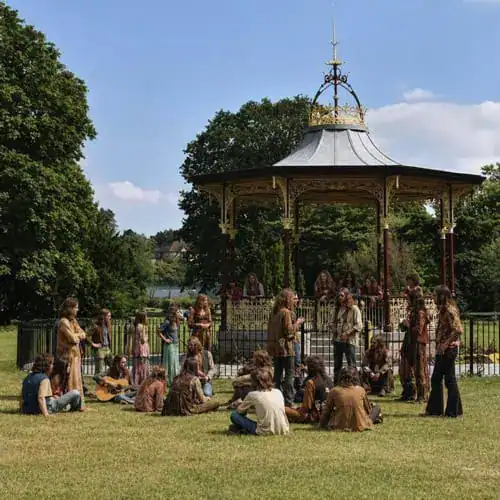
On 16 August 1969, shortly before the release of the album, David Bowie helped organise the first Beckenham Free Festival at Croydon Road Recreation Ground.
The event reflected Bowie’s growing belief in community, creativity and artistic freedom. Musicians, poets, performers and local residents gathered for a relaxed day of music, theatre and open-air entertainment.
Although only a modest event at the time, the festival became an important milestone in Bowie’s early career and demonstrated his desire to create opportunities outside the traditional music business.
Its atmosphere directly inspired Memory Of A Free Festival, the closing track on the album, preserving the optimism and communal spirit of that remarkable summer.
Track Listing
The original 1969 album contained nine songs that revealed a major leap forward in Bowie’s songwriting and musical ambition.

- Space Oddity
- Unwashed And Somewhat Slightly Dazed
- Letter To Hermione
- Cygnet Committee
- Janine
- An Occasional Dream
- Wild Eyed Boy From Freecloud
- God Knows I’m Good
- Memory Of A Free Festival
The album balanced personal reflection, folk influences, progressive arrangements, science-fiction imagery and philosophical themes in a way that pointed clearly toward Bowie’s future artistic direction.
The Making Of The Album Covers
The visual history of Space Oddity is almost as fascinating as the music itself. Unlike most David Bowie albums, this record appeared in several official sleeve designs during its early years, each reflecting a different stage in his rapidly evolving career.
The original British release presented Bowie as an emerging singer-songwriter surrounded by psychedelic artwork, while the American edition adopted a simpler design and the 1972 RCA reissue introduced an entirely new Ziggy Stardust-era image. Together these sleeves document Bowie’s remarkable transformation between 1969 and 1972.
Want to discover the full story behind the album cover? Explore the original 1969 UK artwork, the American Man of Words / Man of Music sleeve and the famous 1972 RCA reissue.
1. The Original 1969 UK Cover
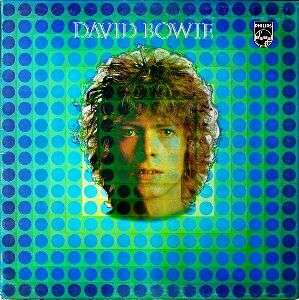
Image: David Bowie World collection / editorial use
The original British release featured a portrait photograph by Vernon Dewhurst placed over an optical-art design inspired by Hungarian artist Victor Vasarely.
The psychedelic artwork perfectly reflected the atmosphere of the late 1960s while presenting Bowie as an ambitious young songwriter exploring folk, theatre, science fiction and progressive ideas.
Unlike the glamorous image he would later become famous for, this sleeve captured Bowie during a period of artistic experimentation, before the creation of Ziggy Stardust.
2. The Original Back Cover
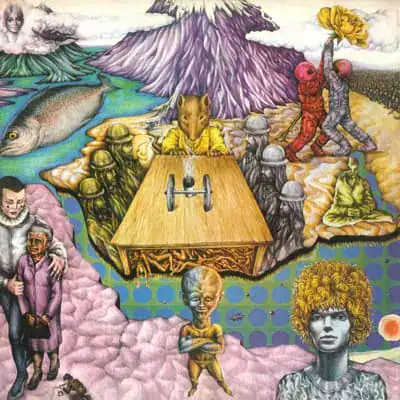
Image: David Bowie World collection / editorial use
The reverse of the sleeve featured an illustration by George Underwood, Bowie’s lifelong friend and one of the most important visual artists involved in his early career.
The surreal drawing complemented the mysterious atmosphere of the music and reinforced the album’s themes of imagination, fantasy and exploration.
Together, the front and back covers formed one of Bowie’s earliest attempts to present an album as a complete visual artwork rather than simply a record sleeve.
3. The US “Man Of Words / Man Of Music” Sleeve
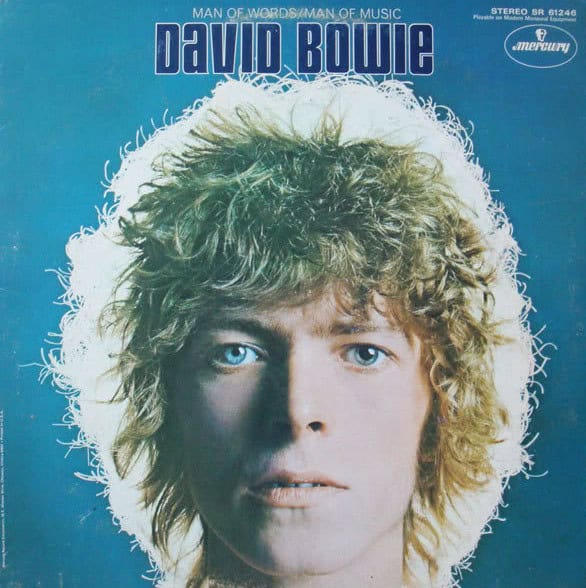
Image: David Bowie World collection / editorial use
The American release carried the phrase Man Of Words / Man Of Music prominently on the sleeve and replaced the British Op Art design with a much simpler blue background.
Although many collectors later assumed this was the album’s official title, it was simply a subtitle used for the American edition of the same 1969 album.
This version remains one of the most sought-after variations among Bowie collectors.
4. The 1972 RCA Space Oddity Reissue
Image: David Bowie World collection / editorial use
Following Bowie’s breakthrough with The Rise And Fall Of Ziggy Stardust And The Spiders From Mars, RCA reissued the album in 1972 under the title Space Oddity.
The new sleeve featured a Mick Rock photograph showing Bowie in his Ziggy Stardust appearance, visually connecting the earlier recordings with his newly established international image.
For many listeners throughout the 1970s, this became the definitive version of the album and introduced a new generation of fans to Bowie’s first major artistic breakthrough.
The Making Of The Cover
Taken together, the various editions of Space Oddity perfectly document David Bowie’s extraordinary artistic transformation between 1969 and 1972. In only three years he evolved from an ambitious young singer-songwriter into one of rock music’s most distinctive visual innovators.
Each sleeve tells part of that story: the psychedelic optimism of the original British release, the simplified American edition, George Underwood’s imaginative artwork and finally the iconic Ziggy-era reissue that introduced the album to millions of new listeners.
Today these different covers are valued not only by collectors but also as visual milestones in the early development of David Bowie’s remarkable career.
Singles From The Album
The album’s commercial story was dominated by Space Oddity, but Memory Of A Free Festival also became an important single release in Bowie’s early catalogue.
Space Oddity
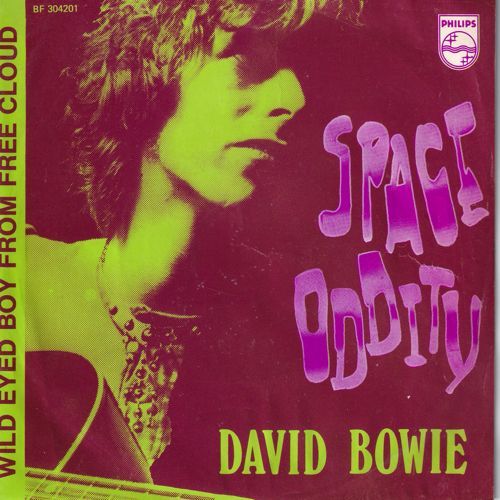
Released on 11 July 1969, Space Oddity became David Bowie’s first major hit single.
The song reached number five on the UK Singles Chart and introduced Major Tom, one of the defining characters in Bowie’s work.
Issued just days before the Apollo 11 Moon landing, the single became closely associated with the excitement of the Space Age. Although inspired primarily by Stanley Kubrick’s 2001: A Space Odyssey, its timely release helped establish Bowie’s lifelong connection with themes of space, isolation and exploration.
Memory Of A Free Festival
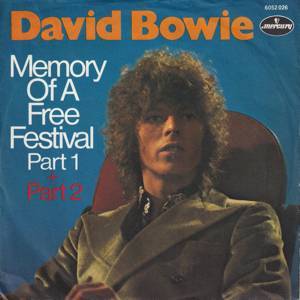
Inspired by the Beckenham Free Festival organised by David Bowie in August 1969, Memory Of A Free Festival captured the communal optimism and countercultural spirit of the late 1960s.
The song reflected Bowie’s belief in creativity, togetherness and artistic freedom, drawing directly on the atmosphere of the festival he helped organise in Beckenham shortly after moving to Haddon Hall.
A re-recorded two-part single version was released in June 1970, giving the song a separate life beyond the original album recording and marking one of Bowie’s final releases before the darker musical direction of The Man Who Sold The World.
Its closing refrain, “The Sun Machine Is Coming Down”, remains one of the most memorable and uplifting moments from Bowie’s early career.
Release & Reception
The Space Oddity single was released on 11 July 1969, just days before the launch of Apollo 11 and nine days before the first Moon landing. Although the BBC initially limited airplay because of the song’s narrative about a stranded astronaut, the single gradually gained momentum after the astronauts returned safely to Earth.
By early November 1969, Space Oddity had reached number 5 on the UK Singles Chart, giving David Bowie his first major commercial success.
The album itself, released in the UK on 14 November 1969 as David Bowie, did not enjoy the same immediate success and failed to chart in either the United Kingdom or the United States. Critics recognised Bowie’s growing ambition, but sales remained modest.
Everything changed after Bowie’s breakthrough with The Rise And Fall Of Ziggy Stardust And The Spiders From Mars. RCA reissued the album in 1972 under the title Space Oddity, introducing it to a much larger audience. The reissue reached number 17 on the UK Albums Chart and number 16 on the US Billboard 200, finally giving the album the commercial recognition it had missed in 1969.
Legacy
Today, Space Oddity is recognised as the first truly significant album of David Bowie’s career and the point at which his mature artistic identity began to emerge.
The record forms the essential bridge between the theatrical, often whimsical Deram recordings of 1967 and the darker, heavier and more ambitious direction Bowie would explore on The Man Who Sold The World in 1970.
It introduced Major Tom, established Bowie’s fascination with themes of alienation, identity and isolation, and demonstrated a dramatic leap forward in both songwriting and musical sophistication.
Although later albums such as Hunky Dory, The Rise And Fall Of Ziggy Stardust And The Spiders From Mars and Low would secure Bowie’s place among rock’s greatest innovators, the foundations of that remarkable creative journey were first laid on this album.
Article Origin
This page was created using historically checked information about the 1969 David Bowie album, the later Space Oddity title, the original Philips artwork, the US Man Of Words / Man Of Music sleeve, George Underwood’s back-cover illustration and the 1972 RCA reissue.
Additional context was drawn from documented recording history, contemporary release information, Bowie’s early collaborations with Tony Visconti and Gus Dudgeon, and research into the development of Space Oddity as both a song and an album.
