
The King Bees – David Bowie’s First Commercial Release
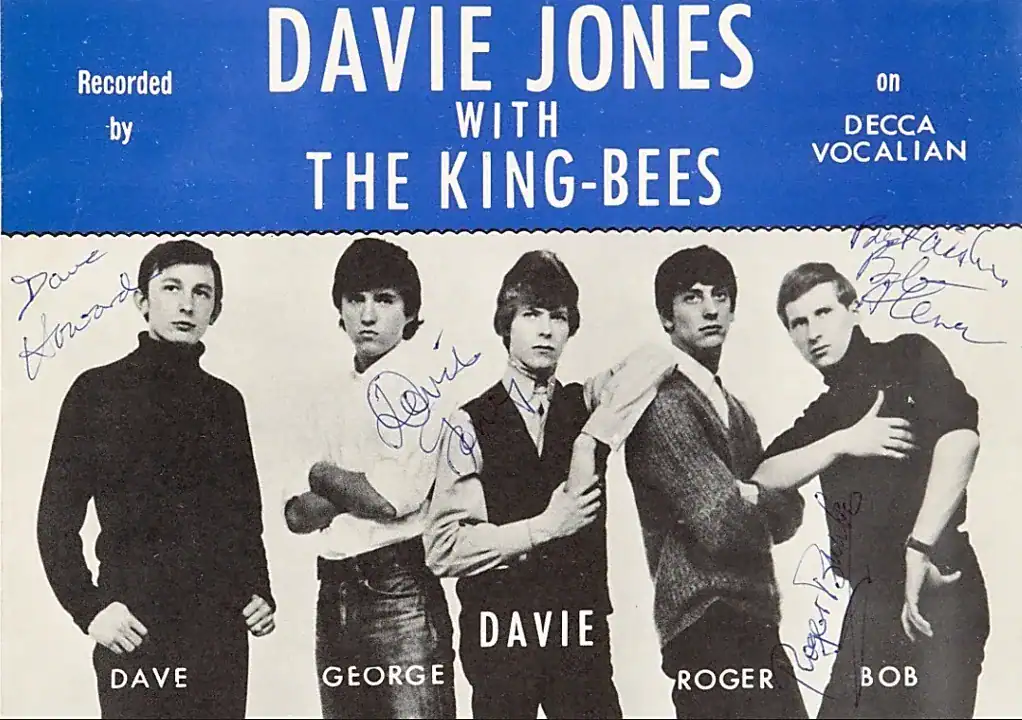
The King Bees occupy a small but crucial place in the history of David Bowie. In 1964, when he was still performing under the name Davie Jones, the group became the vehicle for his first commercially released record.
Their single Liza Jane, backed with Louie, Louie Go Home, did not become a hit and the band itself lasted only a short time. Yet the release marked an important dividing line between Bowie’s earlier group activity and his emergence as a professional recording artist.
The King Bees also brought Bowie into contact with manager and producer Leslie Conn, gave him valuable early publicity and placed him inside the professional record business at a moment when British rhythm and blues was becoming a major force in popular music.
- Band: The King Bees
- Active with Davie Jones: 1964
- Style: Rhythm & blues, beat
- Lead singer: Davie Jones, later David Bowie
- Single: Liza Jane / Louie, Louie Go Home
- Released: 5 June 1964
- Label: Vocalion Pop, catalogue number V.9221
- Producer/manager: Leslie Conn
- Historical significance: David Bowie’s first commercially released record
Before The King Bees
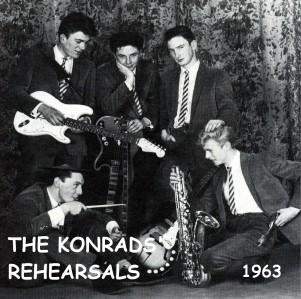
By the beginning of 1964, David Jones had already spent several years trying to find his place within London’s rapidly changing popular music scene.
His most substantial previous group had been The Konrads, a large local outfit that played youth clubs, dances and other engagements around south-east London and Kent. Jones sang, played saxophone and gradually became dissatisfied with the group’s musical direction.
The Konrads had already taken Jones into a recording studio. In August 1963 the group recorded a demo at Decca Studios in West Hampstead. Jones did not sing the lead vocal on the surviving song I Never Dreamed, but contributed backing vocals and saxophone. The recording was not commercially released.
The King Bees therefore represented something different: an opportunity for Jones to front a smaller group devoted more directly to the rhythm and blues music that increasingly fascinated him.
Formation of The King Bees
Davie Jones with The King Bees – Liza Jane (1964)
The King Bees emerged in early 1964 during the height of Britain’s rhythm-and-blues boom. Groups such as The Rolling Stones, The Yardbirds and The Animals were drawing heavily from American blues, R&B and early rock and roll, and the teenage Davie Jones was attracted to the same musical sources.
Rather than the broader repertoire he had encountered in The Konrads, The King Bees concentrated on harder rhythm-and-blues material. Their repertoire reportedly included songs such as Got My Mojo Working and Hoochie Coochie Man, both staples of the British R&B scene.
The band’s name itself reflected the same fascination with American blues and is generally associated with the blues standard I’m a King Bee, recorded by Slim Harpo and subsequently embraced by British R&B musicians.
The King Bees line-up
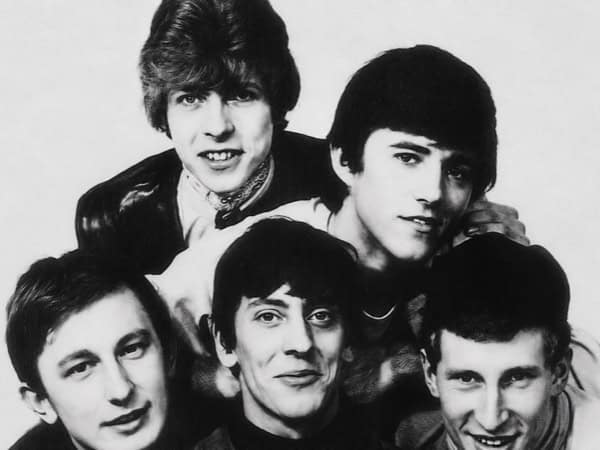
The best-documented 1964 line-up consisted of five musicians:
Davie Jones – lead vocals and tenor saxophone
George Underwood – rhythm guitar, harmonica and backing vocals
Roger Bluck – lead guitar
Dave Howard – bass guitar
Robert “Bobby” Allen – drums
George Underwood was already one of the most important figures in Jones’s early musical life. The two had known one another since their school years and had performed together before The King Bees.
Underwood would later pursue a successful career as an artist and designer and remained connected to Bowie’s history long after their early band days.
Ambition beyond the local circuit
Jones was already displaying a level of ambition that distinguished him from many other teenagers playing in local groups.
He was not content simply to wait for a record company or manager to discover The King Bees. Instead, he looked for ways to attract attention directly.
One of his boldest moves was a letter to entrepreneur John Bloom, whose business activities had made him a widely recognised public figure in Britain. Jones essentially invited Bloom to do for The King Bees what Brian Epstein had done for The Beatles.
Bloom did not personally take over the band, but Jones’s approach led to a referral to Leslie Conn, an important figure in the next stage of his career.
Leslie Conn
Leslie Conn became one of the first professional music-business figures to take Davie Jones seriously.
His relationship with The King Bees was brief, but historically important. Conn provided contacts, management and promotion and ultimately helped Jones secure his first commercial record contract.
The association also produced one of the more amusing episodes in Bowie’s earliest career. The King Bees were given a booking at a wedding anniversary celebration connected with John Bloom, but their uncompromising R&B approach proved badly suited to the occasion.
The unsuccessful engagement did not end Conn’s interest. He continued working with Jones and helped arrange the opportunity that mattered most: a recording contract.
The Decca opportunity
Through Conn, The King Bees reached the professional recording system that Jones had been trying to enter.
A one-single arrangement was secured through Vocalion Pop, part of the Decca organisation. For a seventeen-year-old singer who only months earlier had been playing local halls and clubs, this represented a significant step.
The group recorded at Decca Studios in Broadhurst Gardens, West Hampstead, the same studio complex Jones had previously encountered with The Konrads.
This time, however, the purpose was different. The recordings were not merely a demonstration intended to attract interest. They were being prepared for commercial release.
Creating Liza Jane
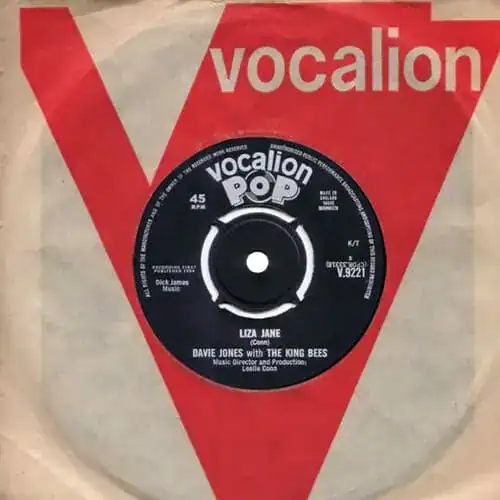
The origins of Liza Jane are not completely straightforward because the people involved later remembered the process differently.
The song drew on the long-established American traditional number commonly known as Li’l Liza Jane. The King Bees transformed that material into a compact British R&B performance suitable for a mid-1960s single.
George Underwood later recalled that he and Jones developed the song rapidly at the Underwood family home.
Underwood remembered that Huey “Piano” Smith’s recording of Little Liza Jane had influenced what they were doing.
Leslie Conn later remembered the creation differently. He maintained that the musicians had been working around a six-bar blues pattern and that he contributed to the song.
The accounts do not fit together perfectly, and decades later there is little value in forcing them into a single definitive version. What is certain is that Leslie Conn received the songwriting credit on the released record and produced the single.
Recording the first single
Liza Jane and its B-side were recorded at Decca Studios in West Hampstead.
Jones took the lead vocal and played saxophone, while The King Bees supplied the guitars, bass and drums that gave the record its rough British rhythm-and-blues character.
The recording bears little resemblance to the sophisticated music Bowie would make later in the decade, but it captures him at seventeen absorbing and reproducing the American R&B music that fascinated him.
His singing is forceful and deliberately blues-oriented, documenting a young performer still experimenting with vocal style and musical identity.
Louie, Louie Go Home
Davie Jones with The King Bees – Louie, Louie Go Home (1964)
The B-side, Louie, Louie Go Home, came from the repertoire of Paul Revere and the Raiders.
Its inclusion reinforced the band’s orientation towards American R&B and rock rather than original British pop songwriting.
Contemporary recollections indicate that Louie, Louie Go Home had at one stage been considered the stronger side, with Liza Jane originally intended as the B-side.
History ultimately reversed that emphasis. Liza Jane became the title by which Bowie’s debut record would forever be remembered.
5 June 1964 – Bowie’s first commercial release
On 5 June 1964, Vocalion Pop released Liza Jane backed with Louie, Louie Go Home, catalogue number V.9221.
The artist credit read Davie Jones with The King-Bees. Bowie was seventeen years old.
The release gave the young Jones something his earlier recording attempts had not achieved: an officially issued record available to the public.
Decades later Bowie’s official website would use the anniversary of Liza Jane to mark the beginning of his professional recording career.
Promotion and television
The release received a surprising amount of attention for an unknown seventeen-year-old singer and his new band.
Contemporary music papers reviewed the single, with several writers praising its forceful rhythm-and-blues sound even though the hoped-for sales never followed.
The King Bees also entered the rapidly expanding world of British television promotion. The group appeared in connection with programmes including Ready! Steady! Go! and the BBC’s The Beat Room, helping place Davie Jones before a national pop audience for the first time.
Jones also appeared on Juke Box Jury during this early period. These appearances formed part of his first experience of the close relationship between records, television, press coverage and visual presentation.
Live performances
The King Bees played a modest series of live engagements during their short existence in 1964.
Their appearances took place within the London and south-east England club circuit where young rhythm-and-blues groups could build experience and attract the attention of managers, journalists and other musicians.
These were small rooms and clubs, far removed from the arenas Bowie would eventually command, but they gave Jones opportunities to test material, develop his stage presence and observe other performers within the competitive British music scene.
Commercial failure and the end of The King Bees
Despite encouraging reviews and Conn’s promotional efforts, Liza Jane failed to sell in significant numbers.
The record did not become the breakthrough Jones hoped for, and the group’s connection with Vocalion did not develop into a sustained recording career.
Jones responded in a way that would become familiar during his early career: rather than remain attached to an unsuccessful configuration, he moved quickly towards another opportunity.
Within a couple of months he was fronting The Manish Boys, a more established R&B group from Maidstone. The King Bees were left behind after only a brief period, but they had already given Jones his first experience of the commercial record business.
The single becomes a collector’s item
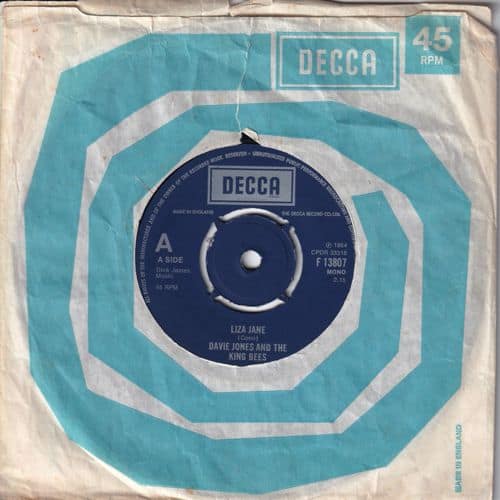
The commercial failure of the original release eventually contributed to its later desirability.
As David Bowie became internationally famous, original Vocalion copies of Liza Jane became highly sought-after collectibles. The obscure 1964 single was transformed into one of the key artefacts for collectors tracing Bowie’s career back to its earliest professional beginnings.
Decca reissued Liza Jane in 1978, by which time the unknown Davie Jones pictured in early publicity material had become one of the world’s most recognisable recording artists.
Revisiting Liza Jane for Toy
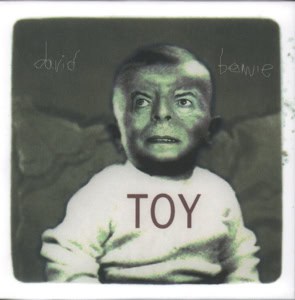
Bowie did not leave Liza Jane entirely in 1964.
In 2000, during the sessions for Toy, he returned to songs from his earliest career and recorded a new version of Liza Jane.
The project allowed Bowie to reconsider early material using the musicianship and perspective of his later career, creating a direct connection between the teenage Davie Jones and the artist he had become more than three decades later.
Although the original Toy project remained unreleased for many years, the re-recording of Liza Jane was eventually officially issued as part of the later presentation of the album.
A live return in 2004
David Bowie revisits Liza Jane during A Reality Tour, Holmdel, 5 June 2004
Bowie also briefly returned to Liza Jane on stage during A Reality Tour.
At the PNC Bank Arts Center in Holmdel, New Jersey, on 5 June 2004 — exactly forty years after the original single was released — Bowie performed part of the song during the concert.
It was not presented as a major revival. Bowie approached the early number with characteristic humour and performed only a portion of it before moving on.
Nevertheless, the moment created a remarkable bridge between the seventeen-year-old Davie Jones of 1964 and David Bowie four decades later.
Why The King Bees matter
The King Bees existed only briefly and left behind just one commercially released single, but their importance within Bowie’s story extends beyond the size of their recorded catalogue.
Through the group, Jones encountered management, a record contract, professional recording, press reviews, television promotion and commercial disappointment while still only seventeen.
Several characteristics associated with his later career were already visible: unusual ambition, a willingness to approach influential people directly, intense curiosity about contemporary music and an unwillingness to remain in a group once he believed another path offered greater possibilities.
Musically, he remained deeply indebted to the blues and R&B performers he admired. He was still years away from Space Oddity, Ziggy Stardust and international fame, and he had not yet adopted the surname Bowie.
The importance of The King Bees lies precisely in that distance. They capture David Jones before the reinventions, before the famous characters and before success, already pushing to turn musical ambition into a professional career.
Liza Jane is therefore more than a rare collector’s item. It is the first commercially released document in the recording career that eventually became the extraordinary story of David Bowie.
Article origin
This article was researched and compiled for the David Bowie Collaborations & Creative Circle Archive at DavidBowieWorld.com, documenting The King Bees and their place at the beginning of David Bowie’s professional recording history.
© DavidBowieWorld.com — David Bowie Collaborations & Creative Circle Archive.
The King Bees Chronology
🏛️ Jack Of Clubs
🎤 Artist: Davie Jones & The King Bees
🗒️ Notes: The band’s debut professional performance, playing at a private party to celebrate the 3rd wedding anniversary of washing machine tycoon John Bloom.
🏛️ Unknown Venue
🎤 Artist: Davie Jones & The King Bees
🗒️ Notes: Early audition for manager Leslie Conn.
🏛️ Riverside Tennis Club
🎤 Artist: Davie Jones and the King Bees
🗒️ Notes: This was a significant early professional booking for the band arranged by manager Leslie Conn.
🏛️ Jack Of Clubs
🎤 Artist: Davie Jones & The King Bees
🗒️ Notes: Live performance
🏛️ Café des Artistes
🎤 Artist: Davie Jones & The King Bees
🗒️ Notes: Live performance
🏛️ Hillsiders Youth Club
🎤 Artist: Davie Jones and the King Bees
🗒️ Notes: One of the earliest public performances.
🏛️ Ilford Palais
🎤 Artist: Davie Jones & The King Bees
🗒️ Notes: The band performs as part of an audition for a talent contest sponsored by the music newspaper Melody Maker.
🏛️ Justin Hall
🎤 Artist: Davie Jones & The King Bees
🗒️ Notes: A hometown performance for Bowie, who had previously appeared in the area with earlier groups. The show took place during the promotional push for the debut single ‘Liza Jane’.
🏛️ Astor Theatre
🎤 Artist: Davie Jones & The King Bees
🗒️ Notes: Live performance
🏛️ BBC Aeolian Hall, New Bond Street
🎤 Artist: Davie Jones and the King Bees
🗒️ Notes: Radio Session. The band records an audition/session for the BBC. This was part of the intensive promotion week leading up to the single release.
🏛️ Pembroke Club
🎤 Artist: Davie Jones & The King Bees
🗒️ Notes: Live performance
🏛️ Vocalion Pop Records
🚀 Single Release: ‘Liza Jane’ (Debut single)
🗒️ Note: Released under the name Davie Jones with the King Bees.
🏛️ Star Club (Kings)
🎤 Artist: Davie Jones & The King Bees
🗒️ Notes: Live performance
🏛️ Davy Jones‘ Locker (Royal Beach Hotel)
🎤 Artist: Davie Jones & The King Bees
🗒️ Notes: Two shows the same day.
🏛️ Star Club
🎤 Artist: Davie Jones & The King Bees
🗒️ Notes: Live performance / Second show same day / Afternoon show
🏛️ Marquee Club, Soho
🎤 Artist: Davie Jones and the King Bees
🗒️ Notes: Corrected venue. Supporting John Mayall’s Bluesbreakers. This was a significant booking at London’s premier R&B club immediately following their single release.
🏛️ BBC Television Centre, White City
📺 Event: TV Appearance ‘Juke Box Jury’
🗒️ Notes: Bowie appears in the audience. Although not performing, he is interviewed about the new single ‘Liza Jane’.
🏛️ High Wycombe Town Hall
🎤 Artist: Davie Jones & The King Bees
🗒️ Notes: Live performance , This was an important performance in the first week after the release of their single
🏛️ Star Club
🎤 Artist: Davie Jones & The King Bees
🗒️ Notes: Live performance , This was a performance by The King Bees. Although the Manish Boys (the band Bowie would later join) were from Maidstone and based there, Bowie played there on June 12th with his own band from London to promote their new single “Liza Jane.”
🏛️ Town Hall
🎤 Artist: Davie Jones and the King Bees
🗒️ Notes: One of several appearances in the High Wycombe area during the promotion of ‘Liza Jane’.
🏛️ Rediffusion TV Studios, Kingsway
📺 Event: TV Appearance ‘Ready Steady Go!’
🗒️ Notes: Davie Jones is interviewed; ‘Liza Jane’ is played on the programme.
🏛️ Studio 51 (Ken Colyer Club), Great Newport Street
🎤 Artist: Davie Jones & The King Bees
🗒️ Notes: A Saturday afternoon session at this renowned jazz and R&B venue.
🏛️ The Public Hall
🎤 Artist: Davie Jones and the King Bees
🗒️ Notes: A rare booking in the north of England, highlighting the management’s efforts to promote the debut single outside of London.
🏛️ Bricklayer’s Arms
🎤 Artist: Davie Jones & The King Bees
🗒️ Notes: Late-period performance as Bowie began seeking a new band.. Behind the scenes, Bowie was already dissatisfied with the single’s lack of success and began looking for another band.
🏛️ Record Retailer Charts
🎤 Event: Chart Update
🗒️ Notes: Despite heavy promotion and a ‘Ready Steady Go!’ appearance, ‘Liza Jane’ fails to enter the UK Top 50. This commercial disappointment leads to the first serious tensions within the band and David’s decision to look for a more established group.
🏛️ Star Club
🎤 Artist: Davie Jones and the King Bees
🗒️ Notes: One of the final live performances of the group. During these appearances in Maidstone, Bowie makes his first connections with members of his future band, The Manish Boys.
🏛️ BBC Television Centre, White City
📺 Event: TV Recording ‘The Beat Room’
🗒️ Notes: The band records a performance of ‘Liza Jane’ for the BBC show ‘The Beat Room’. This is the final major promotional activity for the single.
🏛️ Eel Pie Island Jazz Club
🎤 Artist: Davie Jones & The King Bees
🗒️ Note: Final performance with The King Bees.
🏛️ BBC Two Television
📺 Event: TV Broadcast ‘The Beat Room’
🗒️ Notes: The performance recorded on July 24 is broadcast nationwide. This marks one of the final public milestones for Davie Jones with The King Bees before Bowie moved on to other groups.

Leave a comment