
Cherry Vanilla & David Bowie | MainMan Publicist and Glam Rock Provocateur
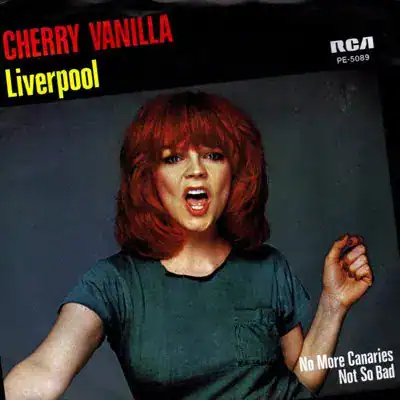
Image: Cherry Vanilla / editorial use
Cherry Vanilla, born Kathleen Anne Dorritie in Queens, New York, in 1943, is an American publicist, actress, singer, songwriter, writer and performer whose career has crossed advertising, underground theatre, glam rock, punk and popular culture.
Her place in David Bowie history belongs principally to the early 1970s. After appearing in the London production of Pork, the controversial theatrical work associated with Andy Warhol, she entered Bowie’s circle and later joined the New York operation of MainMan, the organisation headed by Bowie’s manager Tony Defries.
Vanilla was not a member of Bowie’s band and did not contribute to his studio recordings. Her documented contribution was in publicity and promotion. During Bowie’s emergence as Ziggy Stardust in the United States, she became part of the unconventional MainMan team charged with generating attention and introducing Bowie to American audiences.
- Stage name: Cherry Vanilla
- Birth name: Kathleen Anne Dorritie
- Born: 1943, Queens, New York City, United States
- Professions: Publicist, actress, singer, songwriter, writer and performer
- Bowie connection: MainMan publicity and promotion during the early 1970s
- First Bowie connection: London, 1971, through the cast of Pork
- MainMan base: New York City
- Own albums: Bad Girl (1978) and Venus d’Vinyl (1979)
- Memoir: Lick Me: How I Became Cherry Vanilla (2010)
Early Life and Background
Cherry Vanilla was born Kathleen Anne Dorritie in Queens, New York City, in 1943. Her later career would move through an unusually wide range of creative fields, but before she entered the worlds of David Bowie, Andy Warhol and rock music, she gained professional experience in advertising.
During the 1960s she worked as a producer of radio and television commercials. At the same time, she became involved in nightlife and worked as a DJ in clubs in Manhattan and on the French Riviera. Those apparently different occupations gave her experience in both the commercial presentation of ideas and the more spontaneous culture of clubs, music and entertainment.
New York also exposed her to the increasingly experimental theatrical and artistic culture developing downtown. Traditional distinctions between acting, music, performance art, sexuality and personal identity were being challenged by artists and performers associated with off-off-Broadway theatre and Andy Warhol’s Factory.
Vanilla became attracted to this world and eventually moved from advertising into performance. That transition would lead directly to the production that first brought her into David Bowie’s orbit.
Advertising, Nightlife and the New York Underground
Vanilla’s Madison Avenue background is significant because she did not arrive at MainMan entirely unfamiliar with publicity or commercial media. Producing commercials required an understanding of audiences, timing, presentation and how to communicate an idea quickly.
Outside office hours, however, she was increasingly part of a very different New York. She immersed herself in clubs and rock culture, becoming known as Cherry Vanilla rather than Kathleen Dorritie. The stage name gradually became the identity under which she would work as an actress, publicist, poet and recording artist.
Her interest in underground theatre brought her into contact with director Tony Ingrassia and performers including Tony Zanetta, Leee Black Childers and Wayne County, later known as Jayne County.
Several of those people would soon become important not only to Vanilla’s own story, but also to the expanding organisation around David Bowie.
Andy Warhol’s Pork
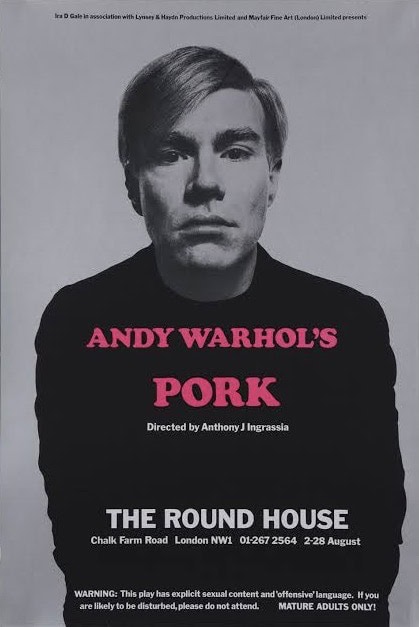
In 1971 Cherry Vanilla appeared in Pork, the provocative theatrical production directed by Tony Ingrassia and based on material from Andy Warhol’s world. Vanilla played Amanda Pork, a character based on Warhol associate Brigid Polk, also known as Brigid Berlin.
The production first appeared in New York before travelling to Britain. Its London run took place at the Roundhouse in Camden in August 1971 and attracted considerable attention because of its explicit dialogue, sexuality and unconventional cast.
The company included Tony Zanetta, Leee Black Childers, Wayne County and other performers connected with New York’s underground theatre scene. For British audiences, they represented a cultural world closely associated with Warhol, downtown Manhattan and the theatrical experimentation that had grown around the Factory.
Bowie had long been interested in Andy Warhol and the Velvet Underground. He had written the song Andy Warhol, recorded during the sessions for Hunky Dory, and was fascinated by the New York artistic world from which the Pork cast had emerged.
Meeting David Bowie
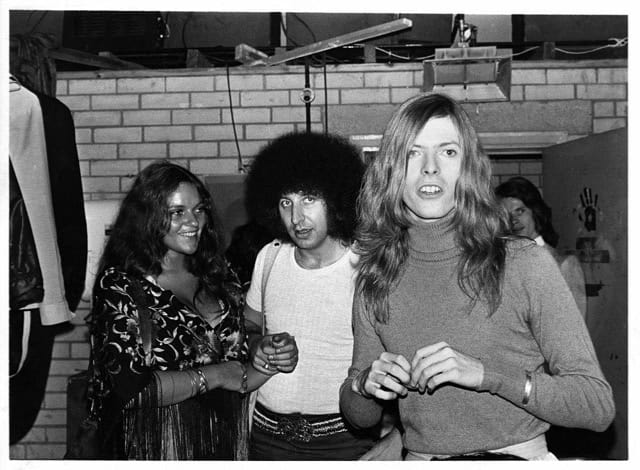
Cherry Vanilla’s first documented connection with David Bowie developed during the London run of Pork in August 1971.
Members of the cast, including Vanilla, Tony Zanetta and Leee Black Childers, went to see Bowie perform at the Country Club in Hampstead. Bowie and Mick Ronson were appearing there at a time when Bowie had not yet become the internationally recognised Ziggy Stardust figure.
Vanilla invited Bowie to see Pork. Bowie and his wife Angie Bowie attended the production and returned on further occasions. Tony Defries was also introduced to the circle surrounding the play.
Tony Zanetta later recalled that Bowie and Angie were fascinated by the visiting New Yorkers. To Bowie, they represented a direct connection with the Warhol and New York underground culture that had interested him for years.
The meeting proved important. What initially began as a social and artistic connection would soon develop into a professional one as Bowie’s management operation expanded into the United States.
From Pork to MainMan
During 1972 David Bowie’s career accelerated dramatically. The Rise and Fall of Ziggy Stardust and the Spiders from Mars was released in June, while Tony Defries developed MainMan into an ambitious management, production and promotional organisation.
Several people from the Pork circle entered this new organisation. Tony Zanetta became deeply involved with MainMan’s American operation, while Leee Black Childers worked in photography and promotion.
In the summer of 1972 Cherry Vanilla became part of MainMan’s promotions team. MainMan’s own historical archive identifies her as one of the key members employed by Defries to promote Bowie’s Ziggy Stardust tour in the United States.
The New York operation included Vanilla, Zanetta and Childers. Their task was to generate as much attention as possible for Bowie as the Ziggy Stardust phenomenon moved into America.
Cherry Vanilla on MainMan
“We were just wild and crazy – we went out and broke ALL the rules – we didn’t care.”
— Cherry Vanilla, 2022
Building MainMan’s New York Publicity Operation
Tony Zanetta’s later recollections provide valuable detail about how Vanilla’s role developed. According to Zanetta, she initially worked as a receptionist before proposing that she should handle public relations.
Vanilla began assembling an extensive publicity list. Zanetta recalled that the list eventually contained thousands of contacts covering not only the music business but other areas of media and culture.
The team also produced newsletters announcing MainMan’s activities and distributed photographs and information widely. Zanetta believed this helped spread awareness of Bowie very quickly.
The approach was unconventional, but it reflected the character of early MainMan. The organisation combined professional ambition with people who had emerged from theatre, nightlife, photography and the underground rather than from traditional record-company publicity departments.
Vanilla’s own advertising background, her familiarity with musicians and journalists, and her willingness to attract attention made her particularly suited to this environment.
Promoting David Bowie in America
Bowie’s first American Ziggy Stardust tour began in September 1972. Although interest in Bowie had already been growing, he was not yet an established mainstream star throughout the United States.
MainMan’s New York team therefore had an important promotional task. Vanilla, Zanetta and Childers used their contacts and knowledge of New York culture to generate press and public interest around Bowie and the American concerts.
Their promotional activity extended beyond conventional music-industry contacts. Zanetta later described using specialist guides to identify gay venues around the country and sending Bowie promotional material to them. This was particularly relevant at a moment when Bowie’s presentation of sexuality and gender had become a major part of the public discussion surrounding Ziggy Stardust.
Vanilla’s role was publicity, not artistic direction. There is no reason to credit her with creating Ziggy Stardust or Bowie’s visual concepts. Her documented contribution was helping communicate, promote and amplify Bowie’s work during a crucial period of his American breakthrough.
Publicity, Provocation and the Ziggy Stardust Era
Bowie’s Ziggy Stardust presentation worked across several forms at once. The songs, costumes, interviews, photography, stage performances and stories surrounding Bowie combined to create a powerful public identity.
MainMan understood that traditional publicity alone was not enough for an artist being presented as something radically new. The organisation encouraged attention and spectacle, while Bowie himself frequently gave interviews that challenged expectations about sexuality, identity and rock stardom.
Vanilla’s instinct for bold publicity fitted naturally within that environment. The same person who had moved through Madison Avenue advertising and provocative underground theatre was now helping promote one of the most theatrical developments in early-1970s rock.
At the same time, Vanilla’s later recollections make clear that the apparent chaos around MainMan should not be confused with an absence of work. Behind the parties, limousines and outrageous stories was a staff putting long hours into press contacts, organisation, promotion and touring.
Working with David Bowie
Cherry Vanilla later spoke warmly about Bowie as both an artist and a person with whom she worked. Her accounts are especially valuable because they come from someone who knew him before and during the international breakthrough of Ziggy Stardust.
In a 2023 interview with LA Weekly, Vanilla rejected the idea that MainMan’s enthusiastic promotion exaggerated Bowie beyond his actual abilities. In her view, Bowie repeatedly justified the claims being made for him through the scale of his talent and creativity.
Cherry Vanilla on David Bowie
“He was everything we were touting him to be and more.”
— Cherry Vanilla, LA Weekly, 2023
Vanilla remembered Bowie as continually observing, imagining and creating, while somehow making the process appear natural rather than forced. She also remembered the trust Bowie placed in people around him despite the fact that several members of the early MainMan team had entered their roles without conventional music-business careers behind them.
That trust is an important part of the MainMan story. The organisation’s early American team was unconventional, but Bowie and Defries gave its members considerable freedom to pursue publicity in ways they believed would work.
Bowie as an Employer and Colleague
In a later interview, Vanilla described Bowie as surprisingly easy to work with. She recalled that he generally trusted MainMan’s staff to exercise their own judgement and did not constantly reprimand them when something went wrong.
Her description provides a useful counterpoint to the mythology surrounding Bowie during the Ziggy years. Behind the dramatic stage identity, Vanilla remembered a working artist who knew what he wanted but did not always insist upon getting it through temperamental behaviour.
Cherry Vanilla on Working with Bowie
“He had a clear and specific idea of what he wanted, but he was never a diva about getting it.”
The New York MainMan World
Cherry Vanilla’s role also helps explain the unusual cultural network surrounding Bowie during this period. MainMan’s American operation was populated by people who had moved through theatre, Warhol’s world, photography, nightlife and queer culture as well as the music business.
Tony Zanetta, Leee Black Childers and Vanilla were not simply interchangeable office employees. Each brought personal contacts and knowledge of New York’s underground scene into Bowie’s professional organisation.
Bowie’s fascination with New York was already well established. He admired the Velvet Underground and Lou Reed and had sought out Warhol during his early visits to America. By working with people from the Pork circle, that fascination became connected to real friendships and professional relationships.
The link should not be exaggerated into a claim that these figures created Bowie’s artistic direction. What they did provide was access to a cultural environment that Bowie had long found fascinating and a group of people capable of helping him navigate and attract attention within the United States.
The American Ziggy Stardust Campaign
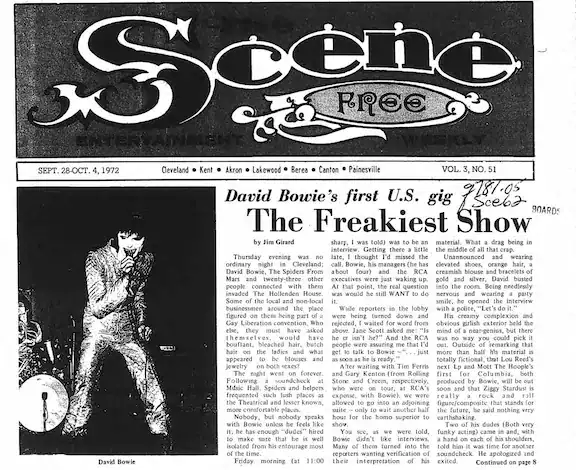
MainMan documentation identifies Vanilla as part of the promotional team working around Bowie’s first Ziggy Stardust tour of the United States in 1972.
The campaign required attention in individual cities as well as national press. Bowie was travelling through a country in which many potential concertgoers still had little direct experience of him. Local journalists, radio personnel, club audiences and cultural networks could therefore play an important role in building awareness.
Vanilla and the MainMan team promoted both the concerts and Bowie’s rapidly expanding catalogue. MainMan’s archive associates their work with the American promotion of the Ziggy period and subsequent Bowie releases during the years in which Vanilla remained part of the organisation.
Her own official biography describes her period as Bowie’s publicist as lasting approximately two years. This places her direct professional association firmly in the period when Bowie moved from Ziggy Stardust through the next stages of his early-1970s career.
Life Inside MainMan
The surviving memories and documents from MainMan reveal an organisation that could be both disciplined and chaotic. Staff communicated internationally, organised travel and media appearances, handled promotional material and managed countless practical details around artists whose careers were expanding rapidly.
A surviving MainMan telex from October 1973 demonstrates the range of Vanilla’s responsibilities. It shows her dealing with travel, hotels, cars, media arrangements, promotional materials, mailing lists and other organisational matters.
The document is useful because it moves the story beyond later mythology. Vanilla was not simply a colourful personality attached to Bowie’s entourage; surviving MainMan material shows her engaged in practical organisational and media work.
In later recollections, Vanilla and Zanetta also described comparatively modest salaries despite the outward appearance of glamour around MainMan. The staff often worked extraordinarily long hours while the company projected an image of luxury and unlimited resources.
Expanding into Film and Media
Vanilla’s responsibilities eventually extended beyond conventional public relations. In a 2026 oral-history discussion with Tony Zanetta, she recalled being given responsibility for a radio, television and film operation within MainMan Productions.
She became interested in documenting MainMan activities on film and later regretted that more footage had not been preserved. Among the projects she remembered was filming connected with Mick Ronson, including a multi-camera concert production.
This part of her MainMan career demonstrates how quickly roles within the organisation could expand. Someone who had entered through administration and publicity could find herself working on film production and other media projects as the company attempted to grow beyond conventional artist management.
Personal Connection with Bowie
Cherry Vanilla’s relationship with Bowie was not exclusively professional. In her memoir, interviews and published excerpts, she described a friendship and sexual relationship with him.
Those memories belong to her first-hand account and form part of the historical record, but they do not need to overshadow her documented professional work. Her importance to Bowie history does not depend on the private relationship between them.
More significant for this page is the fact that Vanilla remained close enough to Bowie during part of the MainMan period to observe his working habits, changing relationship with Tony Defries and the increasingly complicated environment surrounding his fame.
Her memoir therefore provides a participant’s perspective on a period normally reconstructed through record-company documents, interviews, concert histories and later biographies.
The End of the MainMan Period
Vanilla’s own official biography describes her work as David Bowie’s PR representative as a two-year period. By the middle of the 1970s, her professional direction was changing.
Bowie’s own relationship with Tony Defries and MainMan was also deteriorating. The organisation that had been central to the rapid international expansion of Bowie’s career was entering a period of conflict and eventual separation.
Vanilla did not remain simply a former publicist. She increasingly turned her attention toward writing, poetry, performance and eventually her own music career.
Pop Tart Compositions and Performance Poetry
In 1974 Vanilla self-published Pop Tart Compositions, a collection of her writing. The book marked an important stage in her development as an artist working under her own name.
She also launched a career as a performing poet. This was a natural progression from her earlier experience in theatre and publicity: spoken performance allowed her to combine writing with the direct relationship with an audience that had always attracted her.
Poetry became a bridge between her MainMan years and the rock career that followed. Rather than simply promoting another performer, Vanilla was increasingly creating and presenting her own material.
Becoming a Rock Performer
By the middle of the 1970s Cherry Vanilla had begun developing her own rock performances. She formed bands, wrote lyrics and played live in New York at a time when the city’s underground rock culture was moving toward what would soon be internationally identified as punk and new wave.
Vanilla’s background meant that she approached rock performance differently from a singer who had come exclusively through music. Theatre, spoken word, sexual provocation and audience interaction were already part of her artistic vocabulary.
She later recalled that band line-ups changed frequently, sometimes leading her jokingly to promote the act as “Cherry Vanilla and This Week’s Band.” What remained constant was Vanilla herself as writer, performer and focal point.
London, Punk and The Police
In February 1977 Vanilla relocated to London after an arrangement involving Miles Copeland. She arrived with guitarist Louie Lepore and keyboard player Zecca Esquibel and entered a British music scene in which punk was expanding rapidly.
Her early British performances included temporary backing from Sting and Stewart Copeland of the newly developing The Police. The Police also appeared as her opening act.
Cherry’s own official biography confirms that Sting and Copeland were among the musicians in her European touring band during this period. Her memoir preserves detailed memories of travelling and performing with the musicians before The Police became internationally successful.
The association was temporary. After Vanilla secured a record deal with RCA UK, she brought musicians from New York into the band that would record most of her RCA material.
Nevertheless, the episode places her at another significant point in rock history: a former Bowie publicist from the glam era was now performing in Britain alongside musicians who were themselves on the verge of becoming part of the next major wave of international rock.
The Punk
In 1977 RCA UK released Cherry Vanilla’s single The Punk. The title associated her directly with the movement then transforming British popular music, although her own musical identity drew upon a wider mixture of rock, theatre, glam and New York underground culture.
Vanilla later contrasted the New York and British approaches to punk. She remembered New York punk as comparatively playful and theatrical, while British punk often presented itself through a more overt language of class conflict and political anger.
Her own work belonged partly to both worlds. She was American and had developed within New York’s underground culture, but her first major record contract came while she was living and performing in Britain.
Bad Girl
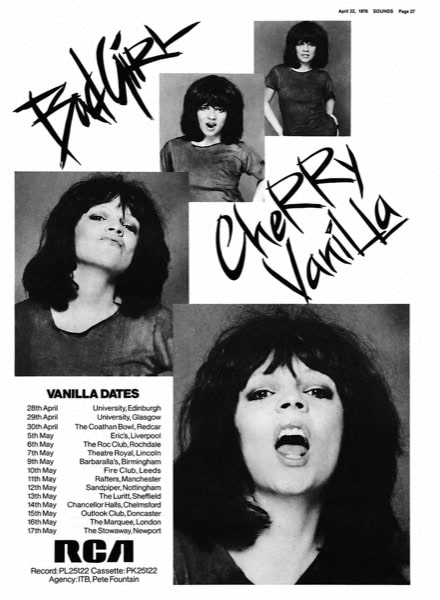
Cherry Vanilla’s first RCA UK album, Bad Girl, was released in 1978.
The album established her as a recording artist in her own right. According to her official discography, Vanilla wrote the lyrics, while musical collaborators included Louie Lepore, Michael Kamen, Thomas Morrongiello and Zecca Esquibel.
By this stage, the temporary involvement of Sting and Stewart Copeland had ended. Vanilla later explained that Manny Mancuso and Howie Finkel joined Lepore and Esquibel in the group she most strongly remembered as her regular band from the RCA period.
Bad Girl did not turn Vanilla into a mainstream commercial star, but it remains one of the principal documents of her own musical career.
Venus d’Vinyl
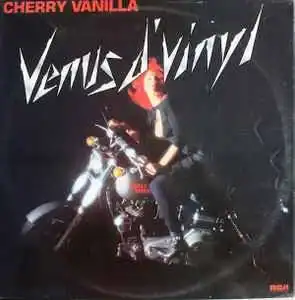
A second RCA UK album, Venus d’Vinyl, followed in 1979. Vanilla again supplied the lyrics, with Louie Lepore credited with the music.
By this point her relationship with RCA had become difficult. In later interviews she recalled frustration over the label’s promotion and distribution of her work.
The album completed the pair of RCA releases most closely associated with her late-1970s rock career. Together with singles including The Punk, Liverpool and Moonlight, they preserved her movement from underground performer and Bowie publicist to singer and songwriter.
Video – Cherry Vanilla Live
Cherry Vanilla live performance
This performance provides a direct view of Cherry Vanilla as an artist in her own right. By this stage of her career, the woman who had once worked behind the scenes promoting Bowie had moved firmly into the spotlight herself.
Her stage work combined rock music with the theatricality and direct audience communication that had been part of her career since her underground-theatre and performance-poetry years.
Collaborations in the 1980s
After her RCA period, Vanilla continued to contribute to recording projects by other artists.
Her official discography credits her with voice-over work on Vangelis’ 1980 album See You Later, specifically on Not a Bit – All of It. She also contributed voice work to the Vangelis single My Love.
In 1984 she appeared on Roger Waters’ album The Pros and Cons of Hitch Hiking, where her contribution is credited as spoken word and sound effects.
The same year she appeared on the Man Parrish album, providing vocals on Together Again. Her collaboration with Parrish continued into later releases.
These projects show that the end of her RCA recording career did not mark the end of her involvement with music. Her distinctive speaking voice and performance background remained useful in rock and electronic recording contexts.
Vangelis and Europa Entertainment
Vanilla’s connection with Vangelis eventually developed into a long-term professional relationship.
In 1995 she moved to Hollywood, California. She initially worked for director Tim Burton and subsequently established Europa Entertainment, Inc., which served as the United States office for Vangelis.
Vanilla’s official biography states that she continued this work until 2014. In later interviews she described her role with Vangelis as involving public-relations and management contact in America, including communication with his record-company interests.
The work returned her, in a different form, to skills she had first developed decades earlier in advertising and during the MainMan period: organisation, communication, publicity and the representation of an artist.
Lick Me: How I Became Cherry Vanilla
In 2010 Chicago Review Press published Cherry Vanilla’s memoir Lick Me: How I Became Cherry Vanilla.
The book documents the many stages of her life, including her Queens childhood, advertising career, nightlife, groupie experiences, underground theatre, Andy Warhol, David Bowie and MainMan, her own music career and later professional work.
For Bowie historians, the book is particularly useful because Vanilla writes as a participant in the MainMan story rather than as an outside biographer. Her account contains memories of Bowie, Angie Bowie, Tony Defries and others who formed part of the organisation during the early 1970s.
Vanilla later explained that she had retained diaries from parts of the 1960s and 1970s and also consulted Tony Zanetta while writing the memoir. She has openly acknowledged that Zanetta’s recollections sometimes helped her check her own memories.
As with any memoir, the book represents the author’s personal recollection and perspective. Used alongside contemporary documents and other first-hand accounts, however, it provides valuable evidence about the atmosphere and personal relationships inside the Bowie/MainMan world.
Remembering Bowie
Cherry Vanilla has continued to speak about Bowie decades after their period working together.
Her later accounts consistently emphasise his creativity and the trust he placed in the unconventional people working for MainMan. They also make clear that, despite the outrageous public face of the organisation, the people promoting Bowie believed deeply in the artist they represented.
Vanilla’s testimony is especially valuable because her relationship with Bowie began before the full emergence of Ziggy Stardust and continued through part of the period in which his international fame was expanding.
She therefore witnessed the difference between Bowie before the American breakthrough and the increasingly famous artist MainMan was promoting only a short time later.
Video – Cherry Vanilla and David Bowie
Cherry Vanilla and David Bowie connection
Cherry Vanilla’s Bowie connection belongs to a clearly identifiable historical period: the years in which Bowie moved from the world of Hunky Dory into Ziggy Stardust and established himself in the United States.
Her documented importance lies in MainMan’s publicity operation. Together with Tony Zanetta, Leee Black Childers and other members of the organisation, she helped create awareness around Bowie at a moment when his American reputation was still being built.
Legacy
Cherry Vanilla occupies a distinctive place in David Bowie’s history because her contribution was neither musical nor confined to a conventional management-office role.
She entered Bowie’s world through Pork, a production rooted in the New York underground culture that Bowie had admired from Britain. Within a year, she had become part of the American publicity operation responsible for promoting him as Ziggy Stardust.
Her presence illustrates the extraordinary range of people surrounding Bowie during this period. Musicians were only one part of the story. Managers, photographers, designers, publicists, actors, filmmakers and figures from underground theatre all contributed in different ways to the environment in which Bowie’s work was presented.
Vanilla’s contribution should not be inflated into authorship of Bowie’s artistic identity. Bowie created his music and developed Ziggy Stardust through his own creative process and collaboration with musicians, designers and other specialists. Vanilla’s documented role was to help ensure that people heard about him, talked about him and paid attention.
That work mattered particularly in America, where Bowie was still establishing an audience when the first Ziggy Stardust tour arrived in 1972.
Vanilla subsequently built an independent career that prevents her from being defined only by Bowie. She became a performing poet, songwriter, recording artist and author, worked with musicians ranging from Sting and Stewart Copeland to Vangelis and Roger Waters, and later returned professionally to publicity and artist representation.
Her memoir and later interviews have also preserved first-hand testimony about a period of Bowie history that might otherwise be remembered primarily through mythology.
Cherry Vanilla therefore belongs in the Bowie story not because she stood beside him on a record sleeve or played in his band, but because she was one of the people working inside the extraordinary MainMan operation during the transformation of David Bowie into an international star.
Official Website & Further Information
Cherry Vanilla’s official website contains her biography, discography, photographs, memoir extracts and other material documenting her career: Cherry Vanilla – Official Website .
First-hand information about her MainMan years can also be found in the MainMan archive and podcast series, including Cherry Vanilla’s own recollections of joining the organisation and promoting Bowie’s American Ziggy Stardust tour: MainMan – Cherry Vanilla, Episode 54 .
A detailed oral-history discussion with Cherry Vanilla and Tony Zanetta preserves additional memories of Pork, Bowie and MainMan: LGBTQ History Project – Cherry Vanilla and Tony Zanetta Oral History .
Vanilla’s memoir Lick Me: How I Became Cherry Vanilla, published by Chicago Review Press in 2010, provides her own extended account of her life and her years around David Bowie and MainMan.
Article Origin
This article was researched and developed for DavidBowieWorld.com as part of the site’s continuing project documenting the musicians, producers, photographers, managers, publicists, performers and other creative figures connected with David Bowie’s life and work.
The article draws on Cherry Vanilla’s official biographical and discographical information, her published memoir and memoir extracts, her own later interviews, MainMan archival material, and first-hand recollections from Cherry Vanilla and Tony Zanetta.
Particular care has been taken to distinguish Cherry Vanilla’s documented work in Bowie’s publicity and MainMan organisation from claims about musical or live-performance involvement for which reliable evidence has not been established.
© DavidBowieWorld.com — David Bowie Collaborations & Creative Circle Archive.
