
Dana Gillespie – Singer, MainMan Artist and Long-Time David Bowie Collaborator
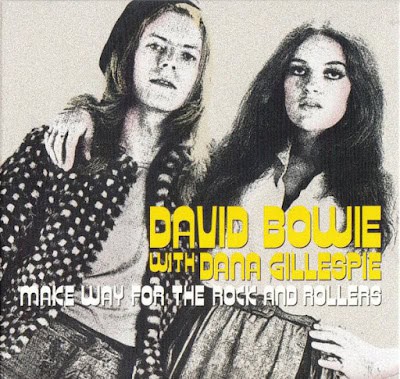
Image: David Bowie World collection / editorial use
Dana Gillespie is one of the most important figures in David Bowie’s early story. A singer, songwriter, actress and MainMan artist, she knew Bowie long before Ziggy Stardust, witnessed his transformation from struggling young musician David Jones into an international star, and participated directly in several key moments of his career.
Unlike many people who later entered Bowie’s orbit, Gillespie was present before the fame, before the breakthrough records and before the mythology. Their friendship began in the mid-1960s and continued throughout some of the most significant years of Bowie’s artistic development.
She recorded songs written by Bowie, sang on the Ziggy Stardust album, appeared alongside him in radio performances, became a MainMan artist and remained part of the wider Bowie circle during the years when Ziggy Stardust conquered Britain and America.
- Full name: Richenda Antoinette de Winterstein Gillespie
- Born: 30 March 1949, London, England
- Profession: Singer-songwriter, actress and performer
- Met Bowie: Marquee Club, London, 1964
- Bowie connection: Friend, performer, MainMan artist and recording collaborator
- Notable Bowie links: Andy Warhol, BowPromo, It Ain’t Easy, Haddon Hall and MainMan
Meeting David Jones at the Marquee Club
Dana Gillespie first met David Bowie in 1964, when both were still teenagers. The encounter took place at London’s famous Marquee Club after a performance by David Jones and the Manish Boys. Gillespie later recalled standing at the back of the room brushing her long hair when David approached, took the brush from her hand and began brushing her hair himself.
The story has become one of the most charming and frequently repeated memories from Bowie’s earliest years. At the time neither teenager had any reason to believe that David Jones would one day become one of the most influential artists in popular music.
Dana Gillespie on meeting David Bowie
“He took my hairbrush out of my hand and started brushing my hair.”
— Dana Gillespie, recalling their first meeting at the Marquee Club
Their relationship quickly developed into a close friendship that included romance, music, shared ambitions and endless conversations about songs, performance and creativity. Although they spent time together as a couple, both later suggested that music ultimately formed the strongest bond between them.
London in the 1960s
Dana Gillespie – London in the 1960s
During the mid-1960s, Gillespie and Bowie moved through many of the same musical circles. Both were searching for artistic direction while London transformed into one of the world’s most exciting cultural capitals.
Gillespie established herself as a young folk singer and performer, while Bowie experimented with rhythm and blues, mod pop, theatrical performance and songwriting. They encountered many of the same musicians, producers and venues, including the Marquee Club and other centres of London’s thriving underground music scene.
Unlike many later commentators, Gillespie never claimed that Bowie’s future superstardom was obvious. In her own recollections, he was simply an ambitious and talented young musician trying to find his place in an increasingly competitive world.
A friendship built on music
Throughout the second half of the 1960s, Bowie and Gillespie remained close. They played songs to one another, discussed ideas and supported each other’s ambitions. Their connection was rooted in mutual respect rather than celebrity.
Gillespie has often described Bowie as someone constantly searching, always writing and continually refining his craft. Long before Ziggy Stardust, she witnessed the determination that would eventually make him famous.
“David was always writing. He never stopped creating.”
Their friendship also survived the many stylistic changes Bowie underwent during this period. Whether experimenting with Anthony Newley-inspired songwriting, theatrical pop, folk music or more ambitious conceptual material, Bowie remained someone Gillespie could exchange ideas with honestly.
Andy Warhol: a song written for Dana
Dana Gillespie performing Andy Warhol on TopPop (Dutch TV), 1974.
One of the most important intersections between Bowie and Gillespie came through the song Andy Warhol. Bowie originally wrote the song with Dana in mind and helped her record an early version before recording his own interpretation for the album Hunky Dory.
Gillespie’s recording is historically fascinating because it captures Bowie participating directly in her session. He sang backing vocals and played twelve-string guitar, effectively creating an alternate version of a song that would later become associated with his own catalogue.
The episode illustrates the creative exchange between the two artists. Rather than Bowie simply writing material for another performer, both were actively involved in shaping how the song would sound.
Today, Dana’s version of Andy Warhol remains one of the most valuable documents of Bowie’s pre-superstar years and demonstrates how closely their musical lives overlapped.
The Hunky Dory period
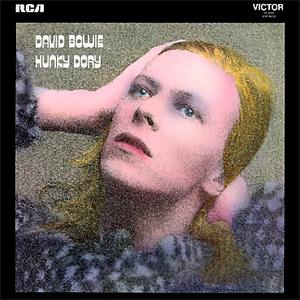
By 1971 Bowie was entering one of the most creative phases of his career. The sessions that produced Hunky Dory introduced many of the themes that would define his work for years to come: artistic reinvention, outsider culture, celebrity, performance and identity.
Gillespie observed this evolution from unusually close range. Unlike journalists or later biographers, she experienced it as a friend who had already known Bowie for years. She witnessed the confidence growing around him as his songwriting reached a new level of sophistication.
The emergence of songs such as Life on Mars?, Changes and Andy Warhol marked a turning point not only in Bowie’s career but also in the artistic world shared by many of the people around him, including Gillespie.
Haddon Hall and the Bowie inner circle
As Bowie’s career accelerated in the early 1970s, Haddon Hall in Beckenham became one of the most important locations in his personal and creative life. The large Victorian house served as a gathering place for musicians, friends, artists and future collaborators during the period leading to Ziggy Stardust.
Dana Gillespie was a frequent visitor. She later recalled spending time there with David and Angela Bowie, often arriving with manager Tony Defries. Haddon Hall provided an environment where music, ideas and friendships mixed freely, and it became one of the key centres of Bowie’s emerging creative universe.
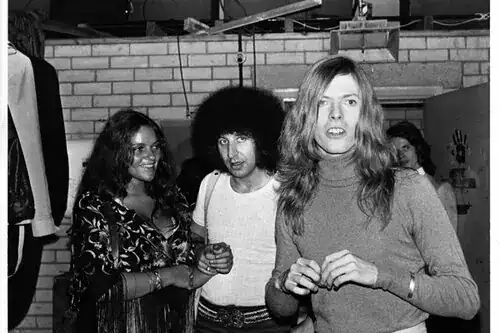
The friendships formed during this period extended far beyond Haddon Hall itself. This 1971 photograph, taken during the London production of Andy Warhol‘s Pork at the Roundhouse, captures Dana Gillespie alongside David Bowie and manager Tony Defries at a pivotal moment. It reflects the close personal and professional relationships that shaped Bowie’s creative circle as he stood on the threshold of international success.
Angela Bowie and the wider circle
Dana maintained a friendly relationship with Angela Bowie and became familiar with the wider group of people surrounding David during the period. This included musicians, artists, managers, photographers and friends who would collectively contribute to the Ziggy Stardust phenomenon.
Unlike many later observers, Gillespie knew these people before they became part of rock history. Her memories therefore provide a valuable perspective on Bowie’s world before it was transformed into mythology.
She was present during a period when careers, friendships and ambitions were still developing, and long before books and documentaries would turn many of those figures into legendary names.
Tony Defries and MainMan
One of the most significant developments in Bowie’s career was the arrival of manager Tony Defries. Gillespie knew Defries well and later became one of the artists represented by MainMan, the ambitious management company Defries created around Bowie.
Gillespie has consistently credited Defries as a major force behind Bowie’s rise. In her view, Bowie possessed the talent and vision, but Defries provided the business strategy, financing and international planning necessary to transform that talent into worldwide success.
Dana Gillespie on Tony Defries
“Without Tony Defries there would never have been the David Bowie the world came to know.”
Through MainMan, Gillespie found herself even more closely connected to Bowie’s professional world. The company attempted to build a roster of artists around Bowie’s growing success, and Dana became one of its most prominent female performers.
MainMan artist
During the early 1970s, Gillespie was not merely a friend of Bowie; she was also a MainMan artist. This distinction is important because it placed her inside the same management structure that was guiding Bowie’s career through the Ziggy Stardust years.
MainMan promoted her recordings aggressively and positioned her as a distinctive performer within its expanding roster. While Bowie was becoming one of the most talked-about artists in Britain, Gillespie was simultaneously developing her own career under the same organisational umbrella.
The arrangement further strengthened the personal and professional ties between the two artists.
BowPromo
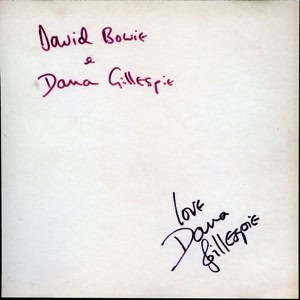
One of the most fascinating artefacts connected to Bowie, Gillespie and MainMan is the legendary BowPromo album. Produced as a promotional record for the American market, it combined material by Bowie and Gillespie and was intended to help secure wider interest in MainMan artists.
Only a small number of copies were produced, making it one of the most sought-after items in Bowie collecting history. Gillespie herself later recalled carrying copies to Los Angeles in the hope of attracting label interest.
Although the project did not immediately achieve its commercial objectives, it has since become an important historical document that captures Bowie and Gillespie at a pivotal moment in their careers.
David Bowie and Friends
Another significant collaboration came through the BBC and John Peel sessions often referred to by fans as David Bowie and Friends. These recordings brought together Bowie, Gillespie and members of what would soon become the Spiders from Mars.
The sessions are particularly important because they preserve a transitional Bowie: no longer the struggling performer of the late 1960s but not yet the fully realised global icon of the Ziggy era.
Gillespie’s performances during these recordings demonstrate how closely connected she remained to Bowie’s musical activities during this period.
Andy Warhol on the radio
One of the highlights of the BBC sessions was the performance of Andy Warhol. Hearing Gillespie perform a song written specifically for her, accompanied by Bowie and musicians from his circle, provides a rare glimpse into the collaborative atmosphere that existed before commercial success changed everything.
For Bowie historians, these recordings are invaluable because they document an artistic partnership in real time rather than through later recollections.
The performances also reveal how naturally Bowie and Gillespie worked together, sharing a musical understanding developed over many years of friendship.
Mick Ronson and the Spiders from Mars
Dana Gillespie became friendly with Mick Ronson and later spoke warmly of him. She described Ronson as both talented and generous, recognising the enormous contribution he made to Bowie’s music.
According to Gillespie, Ronson helped elevate many of Bowie’s songs beyond their original folk-oriented framework, bringing a powerful new sound through his arrangements and guitar work. His influence became central to the success of the Ziggy Stardust era.
Gillespie’s friendship with Ronson provides another example of how deeply connected she was to the people who helped create Bowie’s most celebrated work.
It Ain’t Easy and Ziggy Stardust
Dana Gillespie’s most direct contribution to Bowie’s recorded catalogue came through It Ain’t Easy, the Ron Davies composition included on The Rise and Fall of Ziggy Stardust and the Spiders from Mars.
Gillespie performed backing vocals on the recording, making her one of the relatively small number of artists whose voices appear on one of Bowie’s most important albums.
While her contribution is brief, its significance should not be underestimated. The Ziggy Stardust album remains one of the defining works of twentieth-century popular music, and Gillespie forms a small but genuine part of that history.
Witnessing the rise of Ziggy Stardust
Few people experienced Bowie’s transformation into Ziggy Stardust from as close a position as Dana Gillespie. She had known him before the fame, before the hit records and before the media attention.
As Ziggy Stardust exploded into public consciousness during 1972 and 1973, Gillespie observed not only the excitement surrounding Bowie but also the enormous pressure that accompanied success. The intimate friend she had met in the mid-1960s was becoming a global phenomenon.
Her memories therefore offer something unique: the perspective of someone who witnessed the creation of Bowie mythology while still remembering the young David Jones behind it.
Dana Gillespie on David Bowie
“He was extraordinary because he was never afraid to change.”
The final Ziggy performance
Gillespie later recalled being present with Bowie and Tony Defries when discussions took place about ending Ziggy Stardust. According to her recollections, she knew in advance that Bowie intended to retire the character.
This places her remarkably close to one of the most famous moments in rock history: Bowie’s announcement at the Hammersmith Odeon on 3 July 1973 that Ziggy Stardust was being retired.
The decision shocked audiences and many people within Bowie’s own circle, but it demonstrated the same willingness to abandon success and embrace reinvention that would define his entire career.
Weren’t Born A Man
One of the most important outcomes of Dana Gillespie’s association with MainMan was the album Weren’t Born A Man, released in 1973. The record represented the most ambitious stage of her career to that point and benefited directly from the creative environment surrounding Bowie and his circle.
David Bowie and Mick Ronson both contributed to the project, helping shape a record that remains one of the most significant releases in Gillespie’s catalogue. The album demonstrated that she was far more than simply “a friend of Bowie”; she was an accomplished performer capable of carrying major projects in her own right.
Today, Weren’t Born A Man is regarded as one of the strongest examples of the MainMan era beyond Bowie himself and serves as an important document of the wider creative community that developed around him.
Life after MainMan
The eventual legal disputes and business complications that surrounded MainMan affected many of the artists associated with the organisation, including Gillespie. Recording opportunities became restricted for a period, forcing her to focus more heavily on theatre, film and other performance work.
Rather than allowing these setbacks to define her career, Gillespie adapted and continued working across multiple disciplines. This resilience became one of the defining characteristics of her professional life.
While many performers of her generation became tied to a single era, Gillespie continually reinvented herself, moving between music, acting and live performance according to circumstance and opportunity.
Acting and stage work
Although music remained her primary passion, Gillespie developed a substantial parallel career as an actress. She appeared in theatre productions, films and television projects, often bringing the same commitment and energy that characterised her musical performances.
During periods when recording opportunities were limited, acting provided an important creative outlet. Her stage experience also strengthened her understanding of performance, something she had shared with Bowie since their earliest years together.
Both artists understood that music was only one aspect of a larger performance identity, and their careers frequently crossed into theatre, visual presentation and dramatic storytelling.
The blues years
In later decades, Gillespie increasingly focused on blues music, a genre she had loved since her youth. While Bowie continued moving through radically different musical styles, Gillespie developed a reputation as one of Britain’s most dedicated and respected blues performers.
Her commitment to the genre resulted in an extensive catalogue of recordings and live performances. Unlike many artists associated with a particular historical moment, Gillespie continued creating new work year after year.
This longevity is remarkable. Decades after her first meeting with Bowie, she remained an active recording artist with an international audience and an ever-expanding discography.
A witness to Bowie’s entire transformation
What makes Dana Gillespie especially valuable to Bowie historians is the extraordinary length of her perspective. Few people knew Bowie before fame, remained close during his breakthrough years and retained such clear memories of the journey.
She witnessed David Jones performing in small London clubs, saw the emergence of Bowie the songwriter, experienced the Haddon Hall years, worked with MainMan, participated in Ziggy Stardust-related recordings and watched Bowie become one of the biggest stars in the world.
Her story therefore overlaps with nearly every major stage of Bowie’s rise from ambitious young musician to international icon.
The last years of contact
After Bowie settled permanently in the United States, Gillespie saw him less frequently. Their lives followed different paths and geographical distance made regular contact difficult.
Nevertheless, the significance of their shared history remained. Gillespie consistently spoke about Bowie with warmth, humour and respect, recalling not only the superstar but also the young man she had first encountered at the Marquee Club.
Her recollections are notable for their balance. Rather than presenting Bowie as a mythological figure, she often described him as a talented, driven and endlessly curious human being.
Reaction to Bowie’s death
When Bowie died in January 2016, Gillespie expressed admiration for the way he had managed his final chapter. She was struck by the extraordinary public reaction and the profound sense of loss felt around the world.
At the same time, she emphasised that Bowie had achieved so much of what he had set out to do artistically. In her view, even his departure reflected the theatrical intelligence and careful planning that had characterised his entire career.
Her reflections carried particular weight because they came from someone who had known him long before the world did.
Why Dana Gillespie matters in Bowie history
Many people connected to David Bowie can be linked to a specific album, tour or recording session. Dana Gillespie’s significance is broader than that. She represents continuity across a crucial decade of Bowie’s life.
She was present before the breakthrough, during the breakthrough and throughout the years when Bowie’s artistic identity became fully formed. She contributed directly to recordings, worked alongside members of his inner circle and maintained a friendship that stretched across some of the most important years in his development.
Few individuals outside Bowie’s immediate family can claim such a long and well-documented connection.
Legacy within Bowie’s universe
Within David Bowie’s universe, Dana Gillespie occupies a unique position. She was simultaneously friend, performer, collaborator, MainMan artist and eyewitness to history. Her relationship with Bowie was never defined by a single song, album or event; instead, it evolved alongside his own remarkable journey.
The songs Bowie wrote for her, the recordings they shared, the performances they gave together and the memories she preserved all contribute to a richer understanding of his early years. Through Gillespie, we gain access to a version of Bowie before the masks, before the mythology and before global fame transformed him into a cultural icon.
More than sixty years after they first met at the Marquee Club, Dana Gillespie remains one of the most important living links to David Bowie’s formative years. Her memories, recordings and collaborations continue to illuminate a crucial chapter in the story of one of modern music’s most influential artists.
Media
Dana Gillespie performing Andy Warhol, a song originally written for her by David Bowie.
BowPromo (1971) – one of the rarest and most historically important recordings associated with David Bowie, Dana Gillespie and MainMan.
The media presented here illustrates two of the most important aspects of Dana Gillespie’s Bowie connection. The first is Andy Warhol, one of the clearest examples of Bowie writing specifically for her and participating directly in her recordings.
The second is BowPromo, a legendary MainMan promotional release that linked Bowie and Gillespie during a pivotal stage of their careers. Today it remains one of the most sought-after artefacts from the early 1970s Bowie universe.
Together, these recordings demonstrate that Gillespie’s place in Bowie history extends far beyond friendship. She was an active participant in the creative world that helped shape Bowie’s rise to international fame.
