
Carmine Rojas & David Bowie | Bassist During Bowie’s Global 1980s Peak
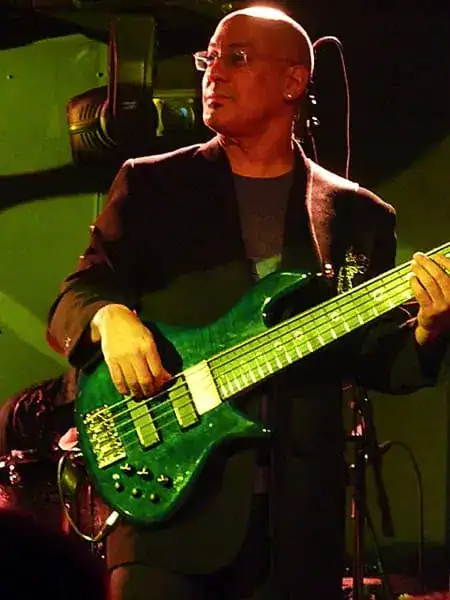
Photo: Stefan Brending (2eight) / Wikimedia Commons / CC BY-SA 3.0 (editorial use)
Carmine Rojas was the bass guitarist who anchored David Bowie’s biggest commercial live period: the Serious Moonlight Tour in 1983 and the Glass Spider Tour in 1987. His playing gave Bowie’s 1980s sound its physical drive, combining rock power with funk, R&B and pop precision.
Rojas was closely connected with the Let’s Dance era, playing bass on major Bowie recordings including Let’s Dance, China Girl and Modern Love. He later remained part of Bowie’s touring band for the ambitious Glass Spider production.
- Name: Carmine Rojas
- Born: 14 February 1953, Brooklyn, New York City, United States
- Role: Bass guitarist, musical director, composer and producer
- Bowie connection: Bass guitarist during the Let’s Dance period, Serious Moonlight Tour and Glass Spider Tour
- Known for: Bass work on Bowie’s 1980s recordings and world tours
Early background
Carmine Rojas was born in Brooklyn, New York City, and came from a musical environment shaped by rock, R&B, funk, Latin music and jazz. That wide musical background became central to his bass style. He was not only a rock player, but a groove-based musician able to support a song with feel, movement and discipline.
Before and after his work with David Bowie, Rojas built a long career as a bassist, musical director, composer and producer. His later credits include major work with artists such as Julian Lennon, Rod Stewart and Joe Bonamassa, but his Bowie period remains one of the most important and visible chapters of his career.
Joining Bowie’s 1980s band
Rojas entered Bowie’s world during the Let’s Dance period, when Bowie was working with producer Nile Rodgers and a new group of musicians in New York. This was a deliberate shift away from the sound and personnel of Bowie’s late-1970s work. Bowie wanted a fresh, direct and danceable sound, and Rojas became part of that new rhythmic identity.
His bass playing fitted the moment perfectly. It was clean, strong and highly controlled, supporting the glossy production of the album while still giving the songs a human pulse. The result helped Bowie reach a huge mainstream audience without completely abandoning rhythmic sophistication.
The Let’s Dance recordings
On Let’s Dance, Rojas contributed to some of Bowie’s most commercially successful music. His bass lines helped power songs such as Let’s Dance, China Girl and Modern Love. These tracks required a precise balance: they had to work as pop singles, but they also needed enough groove and depth to carry Bowie’s voice and Nile Rodgers’ production.
Rojas’s bass work was important because it did not overcrowd the songs. His parts were direct, memorable and rhythmically solid. In the title track, the bass supports the song’s dramatic build and dance-floor weight; in China Girl, the line gives the arrangement its rolling movement; and in Modern Love, the bass helps push the song’s bright, urgent energy.
The Serious Moonlight Tour
The Serious Moonlight Tour began in 1983 in support of Let’s Dance and became one of Bowie’s largest and most successful tours up to that point. Carmine Rojas was the bassist in the touring band, performing alongside musicians including Carlos Alomar, Earl Slick, Tony Thompson, Dave Lebolt, Steve Elson, Stan Harrison, Lenny Pickett, George Simms and Frank Simms.
Rojas’s role on the tour was essential. The setlist moved across many Bowie eras, from earlier material to the new 1983 hits, and the bass had to connect those different styles into one powerful live show. His playing gave the band both precision and drive, especially on the dance-oriented material from Let’s Dance.
Working with Carlos Alomar and Tony Thompson
On the Serious Moonlight Tour, Rojas worked within a rhythmically strong band. Carlos Alomar brought Bowie’s long-term guitar and musical-director experience, while Tony Thompson brought the force and authority of a major funk and rock drummer. Rojas’s bass connected those elements, locking the arrangements together and giving Bowie a reliable foundation on stage.
This rhythm section was very different from the experimental Berlin-era Bowie bands, but it was exactly right for 1983. The music had to be large, clear and immediate enough for arenas and stadiums, while still retaining enough musicality to serve Bowie’s catalogue.
Blue Jean and the mid-1980s sound
Rojas also remained associated with Bowie’s mid-1980s studio work, including the period around Tonight and the hit single Blue Jean. The song continued the polished, radio-ready direction of Bowie’s 1980s sound and again depended on a tight, disciplined rhythm section.
Although Bowie’s 1980s albums have often received mixed critical discussion, the musicianship on these recordings was strong. Rojas’s work was part of the professional foundation that made the songs effective as records and as live material.
The Glass Spider Tour
In 1987, Rojas returned as part of Bowie’s band for the Glass Spider Tour, a much more theatrical and elaborate production than Serious Moonlight. The tour was connected with the Never Let Me Down era and featured a large stage design, dancers, spoken sections and a more dramatic visual concept.
In that context, the band had to support not only the songs but also the movement and timing of the entire show. Rojas’s bass playing helped hold the music together inside a production that was much more complex than a standard rock concert.
Live recordings and visual legacy
Rojas can be seen and heard in official live documents from Bowie’s 1980s period, including Serious Moonlight and Glass Spider. These releases preserve his role in the band and show how important his bass playing was to Bowie’s live sound during those years.
The contrast between the two tours also shows his adaptability. Serious Moonlight was sleek, confident and built around Bowie’s renewed commercial power. Glass Spider was more theatrical, ambitious and heavily staged. Rojas provided the same core strength in both settings.
Musical style
Carmine Rojas’s bass style is rooted in groove. His playing is direct, but not simplistic. He often uses movement, space and carefully placed notes rather than excessive decoration. That made him ideal for Bowie’s 1980s material, where the songs needed to sound modern, accessible and rhythmically alive.
His approach also reflects his wider background in rock, R&B, funk, Latin and jazz. Instead of treating Bowie’s music as straight rock, Rojas brought a broader rhythmic vocabulary. That helped give the Let’s Dance era its particular feel: polished, muscular and danceable.
Video
Carmine Rojas discusses Bowie’s basslines and the Let’s Dance period
This interview is especially useful because Rojas explains his Bowie bass work from the perspective of the musician who actually played it. His comments help show how the bass lines were built around groove, feel and the needs of the song.
For a page about Bowie’s live collaborations, Rojas is important because his work connects the studio success of Let’s Dance with the massive live presentation of Serious Moonlight and the theatrical scale of Glass Spider.
After Bowie
After his Bowie years, Carmine Rojas continued to work at a high level. He recorded and toured with Julian Lennon as musical director and bassist, and later became strongly associated with Rod Stewart for many years. He also worked with a wide range of major artists across rock, blues, pop and soul.
In later years, Rojas also became known to blues-rock audiences through his work with Joe Bonamassa. This long career confirms that his Bowie role was part of a much wider musical life, but Bowie gave him one of his most internationally visible platforms.
Place within Bowie’s universe
Within David Bowie’s universe, Carmine Rojas represents the sound of Bowie’s global 1980s breakthrough. He was not part of the glam years or the Berlin experimentation, but he was central to the era when Bowie reached one of the largest audiences of his career.
His bass lines gave the Let’s Dance material its strength, and his live work helped carry Bowie through two major world tours. For that reason, Rojas deserves a clear place among Bowie’s important collaborators: not as a background figure, but as one of the musicians who helped define the physical sound of Bowie’s 1980s stage and studio work.
