
Mick Jagger & David Bowie – Friendship, Live Aid and “Dancing in the Street”

Mick Jagger occupies a distinctive place in David Bowie’s collaborative history. He was already an internationally established singer and songwriter when their friendship developed, and their best-known recording together brought two recognisable musical personalities into a single performance. Their version of “Dancing in the Street”, made for the Live Aid fundraising initiative in 1985, emerged from that relationship rather than from a permanent band or a continuing recording partnership.
The project combined a studio session, an overnight video shoot, an international television premiere and a commercially released charity single. Its familiar images can sometimes obscure the actual sequence of events. Bowie and Jagger recorded together in London before Live Aid; their duet was presented as a film during the concert. The video represented their joint contribution, while each artist also performed separately during the event.
Their association extended beyond those few hours in front of microphones and cameras. Bowie’s recordings had already acknowledged Jagger and the Rolling Stones, and Jagger later described a friendship involving conversations about musicians, songwriting, photography and stage presentation. The charity single therefore belongs within a wider history of musical interest and personal exchange, even though it remained their principal joint recording.
This page follows that history through the documented sessions, the people who helped create the record, its reception and the later appearances of the song. It also places Jagger’s work outside Bowie in context, recognising that he arrived at the collaboration with an established career of his own.
- Full name: Michael Philip Jagger
- Born: 26 July 1943, Dartford, Kent, England
- Principal roles: Singer, songwriter, performer, musician and film producer
- Best-known band: The Rolling Stones
- Principal Bowie collaboration: “Dancing in the Street” (1985)
- Original songwriters: William “Mickey” Stevenson, Marvin Gaye and Ivy Jo Hunter
- Original recording: Martha and the Vandellas, 1964
- Bowie–Jagger recording session: 29 June 1985, Westside Studios, London
- Session producers: Clive Langer and Alan Winstanley
- Video director: David Mallet
- Video location: Spillers Millennium Mills, London’s Docklands
- Live Aid premiere: 13 July 1985
- UK chart result: Number one for four weeks
- US chart result: Number seven on the Billboard Hot 100
- Later joint live appearance: The Prince’s Trust concert at Wembley Arena, June 1986
Early life in Dartford
Michael Philip Jagger was born in Dartford, Kent, on 26 July 1943. His connection with Keith Richards began in childhood, before either became a professional musician. Their later partnership developed through a shared interest in American music, particularly blues and rhythm and blues. Those interests supplied an important foundation for the singing, songwriting and repertoire with which Jagger would become associated.
Jagger attended the London School of Economics before committing himself to music. The contrast between an academic route and a developing performing career is part of his early biography, but his subsequent work is best understood through what he actually did: singing with other musicians, learning repertoire and helping build a group capable of reaching audiences beyond London’s small clubs.
That background also gives the Bowie collaboration a useful starting point. Jagger’s interest in a Motown song was consistent with a musical education shaped by American records. “Dancing in the Street” did not require him to adopt an entirely unfamiliar tradition. He approached it as a singer whose established work had long involved interpreting music from outside his own immediate surroundings, before developing a substantial catalogue of original songs.
The Rolling Stones and the development of a frontman
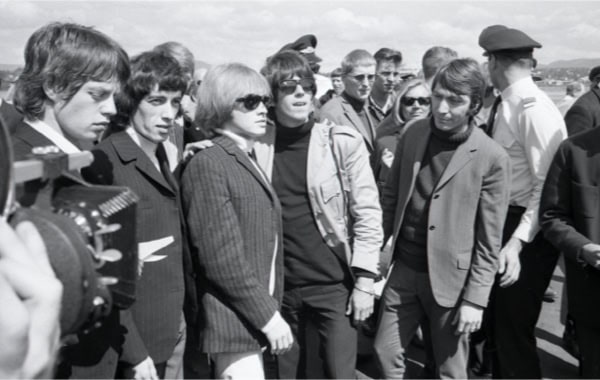
The Rolling Stones emerged in London in 1962, with Jagger and Richards at the centre of relationships that also involved Brian Jones and pianist Ian Stewart. Their first performances belonged to a club environment in which familiarity with blues and rhythm and blues was essential. The group’s early records drew heavily on existing songs before original Jagger–Richards material became increasingly important.
Jagger’s function involved more than delivering a melody. In performance, his voice, gestures and movement gave the band a visible focal point. A singer working in front of amplified instruments has to maintain contact with both musicians and audience; Jagger developed a presentation in which the body was an active part of that communication. The microphone became one element within a larger physical performance.
This history helps explain why his appearance in the Bowie video was immediately recognisable. He did not arrive as an anonymous guest vocalist. Viewers already associated him with a particular way of moving and addressing a camera or crowd. The collaboration could draw on that recognition without explaining it, allowing a few minutes of film to carry associations built through years of concerts, recordings and television appearances.
Songwriting with Keith Richards
Jagger’s songwriting partnership with Keith Richards helped establish the Rolling Stones as creators of their own repertoire. “(I Can’t Get No) Satisfaction”, “Paint It, Black”, “Jumpin’ Jack Flash” and other songs placed the partnership within the international development of rock music. Albums including Beggars Banquet, Let It Bleed, Sticky Fingers and Exile on Main St. broadened the settings in which their writing could appear.
The distinction between songwriter and interpreter matters when discussing “Dancing in the Street”. Bowie and Jagger supplied a new performance of a composition written by other musicians. Their celebrity, arrangement and vocal delivery shaped the 1985 record, but they did not acquire authorship of the underlying song. Its Motown writers remain central to the history, alongside Martha and the Vandellas.
For Jagger, performing a cover did not suspend his identity as a songwriter. It drew on another part of his work: finding an approach to existing material that could suit a particular occasion. In this case the occasion was a benefit broadcast, and the song had to serve two prominent singers within a short, self-contained presentation rather than become part of a new Rolling Stones album.
Let’s Spend the Night Together and Bowie’s connection to the Stones
David Bowie – “Let’s Spend the Night Together”
Bowie’s recorded connection with Jagger’s songwriting predates their charity duet. His 1973 album Aladdin Sane included a version of the Rolling Stones’ “Let’s Spend the Night Together”, written by Jagger and Richards. The recording placed an established Stones song within an album whose musicians and presentation belonged to Bowie’s own developing musical world.
Listening to that version reveals a different kind of relationship from the later duet. Jagger was present through the composition, rather than through a newly recorded vocal alongside Bowie. Bowie and his musicians could reshape the material without having to accommodate its original singer in the studio. The song became an interpretation within an album, with its character affected by the tracks surrounding it.
The cover is therefore a concrete example of Bowie engaging with the Stones’ repertoire. It provides firmer evidence than broad claims that one artist entirely created the other’s stage identity or musical direction. Influence is often distributed across records, performances and conversations. Here, the released recording offers a specific point at which the relationship can be heard, while preserving the difference between inspiration, songwriting credit and direct collaboration.
Jagger’s name in “Drive-In Saturday”
Aladdin Sane also included “Drive-In Saturday”, in which Bowie referred to Jagger by name. The reference placed him within a song concerned with images, remembered behaviour and the ways people might learn from the popular culture around them. Jagger appears as a recognisable figure whose public identity could be understood without a separate explanation.
This is another form of association rather than a joint recording credit. A person mentioned in a lyric has not necessarily participated in writing or performing the song. Keeping that distinction clear allows the reference to retain its significance without turning it into an undocumented session appearance. It shows that Jagger’s image had entered Bowie’s songwriting imagination by the early 1970s.
The cover and the name-check also operate differently. “Let’s Spend the Night Together” brings a Jagger–Richards composition into Bowie’s repertoire; “Drive-In Saturday” incorporates Jagger as a cultural reference within Bowie’s own composition. Together they demonstrate two documented connections before 1985, while leaving room for the personal exchanges that Jagger would later describe. Neither needs an invented account of a conversation to make its place in the history meaningful.
A friendship involving ideas and competition
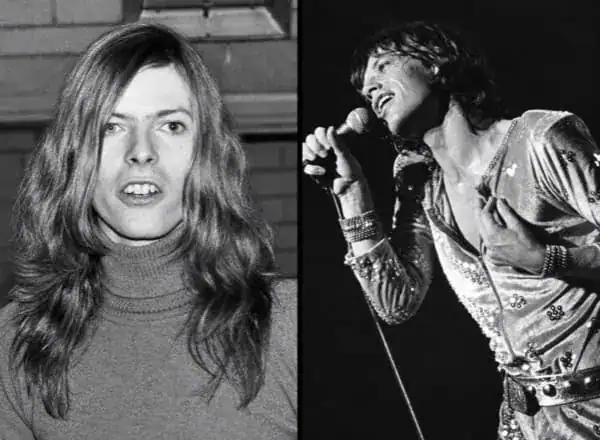
In his remembrance of Bowie published after Bowie’s death in 2016, Jagger described a friendship involving exchanges about their work. Their conversations included guitarists, ways of writing, visual style and photographers. He also acknowledged an element of competition, presenting it as one part of the relationship rather than as a defining feud.
His account provides a more human picture than the idea of two fixed, opposing archetypes. They were musicians interested in how other musicians worked. A new player, a different stage design or an effective visual idea could become a subject of discussion. Their professional lives supplied material for a friendship, while their friendship offered opportunities to observe another artist at close range.
The recollection also cautions against treating influence as a one-way transaction. Jagger described giving and receiving ideas. That does not mean their careers followed the same path, or that every similar gesture came from a private exchange. It establishes that sharing was part of their own understanding of the relationship, making the later duet easier to place within an existing acquaintance rather than an isolated meeting arranged purely for publicity.
Mick Jagger on exchanging ideas with Bowie
“I didn’t mind sharing things with him, because he would share so much with me — it was a two-way street.”
Mick Jagger, Rolling Stone remembrance, as reproduced by the Evening Standard, 27 January 2016.
Bowie’s position in the mid-1980s
By the time of the duet, Bowie had experienced the international success of Let’s Dance and the Serious Moonlight Tour. His audience extended well beyond the listeners who had followed his early albums. The single with Jagger appeared during a period in which major concerts, television and music videos were already important parts of how his work reached the public.
His activities in 1985 also included film-related music. The Absolute Beginners sessions are particularly relevant because they provided the immediate studio setting for “Dancing in the Street”. The duet was not created within an otherwise empty schedule. It was fitted into ongoing work, with a production team and musicians already available for another assignment.
That context explains part of the project’s speed without requiring a claim that Bowie had abandoned musical care. An existing professional environment could be redirected towards a new song. The session’s compressed timetable was real, but so were the accumulated skills of its participants. A short recording period should not be confused with the absence of preparation, experience or subsequent work on the released master.
She’s the Boss and Jagger’s solo identity
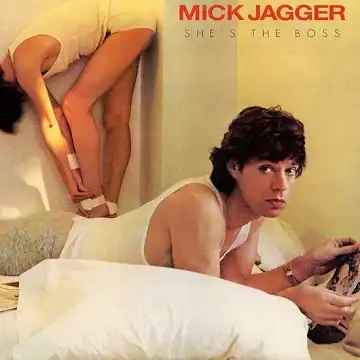
Jagger released his first solo album, She’s the Boss, in 1985. Its collaborators included Jeff Beck, Pete Townshend, Herbie Hancock, Carlos Alomar and Sly and Robbie. Jagger worked with producers Bill Laswell and Nile Rodgers, placing his singing within a different group of musical relationships from the regular Rolling Stones recording partnership.
The album included “Just Another Night”, “Lucky in Love” and “Hard Woman”. It established a practical setting in which Jagger could present material under his own name, with musicians selected for that project. His participation in the Bowie duet belongs to the same year, but the charity record was a separate release with a different purpose and a different production history.
Musicians connecting their wider careers
The two singers worked within overlapping professional circles. Nile Rodgers produced Bowie’s Let’s Dance and participated in Jagger’s She’s the Boss. Carlos Alomar, closely associated with Bowie’s recordings and tours, also contributed to Jagger’s solo debut. Such connections show how musicians could move between projects led by different prominent artists.
“Dancing in the Street” itself brought another combination into focus. Its initial London session involved players associated with the Absolute Beginners work, rather than simply importing the Rolling Stones or reproducing Bowie’s previous touring line-up. The song therefore belongs within both singers’ histories of collaboration with supporting musicians. Their names supplied the headline, but a band, engineers and producers made the recording possible.
Band Aid, Live Aid and the benefit setting
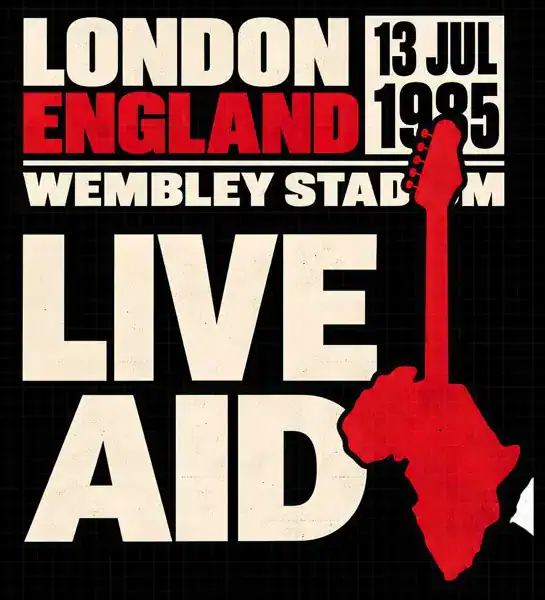
Live Aid took place on 13 July 1985, with its principal concerts at Wembley Stadium in London and John F. Kennedy Stadium in Philadelphia. Organised through the efforts of Bob Geldof, Midge Ure and a substantial production network, the event followed the Band Aid fundraising initiative and sought further support for famine relief in Ethiopia.
The scale of the undertaking depended on more than an impressive list of performers. Venues, broadcasters, technical crews, scheduling and donation arrangements had to be coordinated. The National Library of Ireland’s Band Aid archive includes correspondence, documents, recordings and personal accounts that reflect this work. The concerts were the public expression of a much larger organisational effort.
Bowie and Jagger’s duet fitted that setting as a contribution that could move between a broadcast and a record. Its immediate purpose was to attract attention within the benefit programme, while the later single provided another means of fundraising. The connection between music and charitable giving was central to its release, but the recording itself cannot establish what happened to every donation or measure the wider effects of the relief programme.
The proposed satellite duet
The original proposal was for Bowie and Jagger to perform together across the Atlantic, with Bowie at Wembley and Jagger in Philadelphia. The official anniversary history explains that the satellite link introduced a delay that made a synchronised musical performance impractical. They replaced that plan with a recording and video made before the concert.
The distinction is important because a shared broadcast does not automatically provide a shared musical clock. Two locations can appear within the same television programme while the performers experience a delay between sending and receiving sound. For singers responding to a band and to each other, even a relatively short delay affects the timing required for a convincing duet.
Their solution retained the visual partnership while changing the means of delivery. Instead of presenting two separate stages as one live performance, they could appear together in a film that both audiences saw. The resulting video was not a failed live duet disguised as something else. It was a prepared contribution in its own right, built to work within the broadcast after the original technical proposal had been abandoned.
The Motown song behind the collaboration
Martha and the Vandellas — “Dancing in the Street”
“Dancing in the Street” was written by William “Mickey” Stevenson, Marvin Gaye and Ivy Jo Hunter and recorded by Martha and the Vandellas in 1964. Their recording reached number two on the American pop chart and became a defining part of the group’s repertoire. Its later inclusion in the National Recording Registry recognised the historical importance of that original performance.
The song’s reception has included both celebration and political interpretation. Martha Reeves described it as a party song, while listeners also connected its invitation to public movement with the social tensions of the 1960s. Those interpretations belong to the history of the recording, but they should not be collapsed into a single, universally agreed intention shared by everyone involved.
The Bowie–Jagger version entered that existing history rather than replacing it. Two British singers brought the composition into a different media setting and a specific charitable initiative. Their performance can be discussed on its own terms while recognising the writers and the original singers. The Motown record remains the starting point for understanding why the song was already familiar, adaptable and capable of reaching listeners before the duet added another chapter.
Choosing and preparing the song
Bowie’s recollection of the project described a discussion of familiar older songs before the Saturday recording session. “Dancing in the Street” offered material both singers knew. Familiarity mattered because the timetable required them to move quickly from choosing a song to performing it, and then to making a video that could be ready for Live Aid.
Guitarist Kevin Armstrong supplied further detail in his own published account. He recalled meeting Bowie and Jagger in Soho with a guitar and working through the song before the studio session. His testimony establishes a stage of preparation that is easily lost when the entire project is described as an unplanned burst of inspiration.
The arrangement could therefore develop at more than one point. The singers and Armstrong could establish an approach together, while the later band rehearsal translated it into a full instrumental performance. This is a practical difference between knowing a song and having a recording ready to make. The musicians still needed to agree on structure, entrances and their relationship to the two lead voices, even when the underlying composition was familiar.
Westside Studios and Absolute Beginners
The recording took place at Westside Studios in London on 29 June 1985. Bowie was working with Clive Langer and Alan Winstanley on music for Absolute Beginners. The producers’ recollections describe the charity song being added to that working day, turning an existing film-music session into the setting for the duet.
Langer later explained that the immediate expectation centred on a video contribution. That recollection helps account for the speed and relatively contained ambition of the original assignment. The participants were making something for a forthcoming event; they were not beginning a full collaborative album or constructing a long-term performance schedule for Bowie and Jagger.
Clive Langer on the two recordings
“So we ended up recording Absolute Beginners and Dancing in the Street the same day, in the same studio.”
Clive Langer, interview with Laurent Rieppi, conducted in 2020; English version published in English in September 2025.
The musicians in the London session
Engineer Mark Saunders identified the initial band as Kevin Armstrong on guitar, Matthew Seligman on bass, Neil Conti on drums and Steve Nieve on piano. Tessa Niles and Helena Springs supplied backing vocals. These names establish the people involved in creating the London performance, alongside its two headline singers.
The division of roles gave the record a foundation that the vocals could work against. Guitar and keyboards supplied harmonic and rhythmic material, bass and drums established the groove, and the backing singers helped frame the leads. The song’s compact running time did not make these contributions incidental. A short recording still depends on the relationships between its instrumental and vocal parts.
Jagger’s arrival and the producers’ perspective
Alan Winstanley’s recollection emphasised the change when Jagger arrived. He remembered a tired band rehearsing the material, followed by a noticeable increase in energy once the singer began moving and engaging with the music. The account presents Jagger’s physical performance as part of the session itself, rather than something invented later for the camera.
That testimony is useful because a recording studio can encourage behaviour very different from a concert. Performers may concentrate on microphones, headphones and repeated passages rather than on a visible audience. Jagger brought a form of stage activity into that environment. The producers remembered it as affecting the room, giving the musicians a stronger sense of the performance they were making.
Alan Winstanley on the change in the studio
“But when Mick arrived, he immediately started doing the Jagger strut”
Alan Winstanley, excerpt from Classic Pop’s interview with Clive Langer and Alan Winstanley, September 2022.
Recording the voices
Saunders remembered the band and singers initially performing together. The lead and backing vocals were subsequently recorded again because the shared vocal space had allowed voices to reach one another’s microphones. His explanation identifies a technical reason for replacing vocal parts, rather than suggesting that the original performances had failed artistically.
A duet creates several possible relationships between voices. The singers can alternate lines, overlap, reinforce each other or respond to a phrase that has just been delivered. In this recording, much of the character comes from the sense of exchange. The listener hears recognisable individuals participating in the same song, with their differences remaining audible rather than disappearing into an indistinguishable combined voice.
Saunders also contrasted Jagger’s energetic delivery with Bowie’s more segmented approach to recording lead lines. Their methods could differ while serving the same finished track. That is an important distinction between performance character and recording procedure: what sounds continuous on a record may have been assembled through several passes, and a singer’s preferred studio method does not need to resemble the other singer’s for their contributions to work together.
Mark Saunders remembers the ensemble performance
“It was great to hear the whole band and singers all performing at the same time.”
Mark Saunders, The Making of “Dancing in the Street” – Bowie/Jagger, April 2021.
From session performance to released recording
The work completed before the video shoot should be distinguished from the final commercial master. A playback mix was needed so that Bowie and Jagger could perform to the recording while being filmed. Saunders’ account also describes later additions and identifies Bob Clearmountain as the mixer of the finished record.
This sequence explains why the story cannot be reduced to two singers entering a room and immediately producing every version subsequently released. The basic session, vocal work, video playback and final mixing had different functions. A usable track for filming can exist before the full process of preparing a single has ended. The speed of one stage does not eliminate the others.
Clive Langer and Alan Winstanley’s contribution
Langer and Winstanley brought an established production partnership to the session. Their work had included artists such as Madness, Dexys Midnight Runners and Elvis Costello. The Bowie assignments placed them within a different combination of performers, but they were already accustomed to translating musicians’ ideas into recordings intended for a public audience.
Their contribution involved the practical relationship between creative decisions and technical execution. Choosing a performance, organising recording time and making a track usable for the next stage are part of production. A project led by famous singers does not remove those responsibilities; it can make the circumstances more demanding because available time and public expectations are both substantial.
The producers’ later interviews are particularly valuable because they describe work rather than only the finished video. Their accounts include fatigue, excitement and changing expectations about the record’s future. That perspective complicates the simple claim that every visible gesture was part of a fully planned publicity strategy. Some decisions were made within a limited assignment, while the eventual chart success gave the session a larger place in both producers’ careers.
David Mallet and the overnight video shoot
After the London recording, Bowie and Jagger went to Spillers Millennium Mills in the Docklands to film with director David Mallet. Mallet had already worked with Bowie, including on “Ashes to Ashes”. The duet therefore involved an established visual collaborator who could work with Bowie’s performance style while accommodating Jagger’s presence beside him.
The industrial location supplied a setting very different from the two stadiums associated with Live Aid. The singers could move through a comparatively contained environment, with the camera deciding what the audience would see. Their performance did not depend on a concert crowd or the changing conditions of an outdoor broadcast. It could be shaped through filmed takes and editing.
Descriptions of the project’s total duration vary between recollections. Bowie gave a compressed account of an evening session followed by the rest of the night filming, while the anniversary history uses a longer total. The essential chronology is consistent: recording was followed directly by a late-night shoot. It is more responsible to preserve that sequence than to insist that every account supplies exactly the same number of hours.
Movement, humour and the two performers
David Bowie and Mick Jagger — “Dancing in the Street” (1985)
The finished video concentrates on Bowie and Jagger as visible personalities. Their movements, changes of position and responses to each other become much of its subject. The industrial surroundings do not develop into an elaborate fictional story. Instead, the film invites the viewer to watch two familiar performers working through a song together.
As a viewing interpretation, its humour comes partly from that familiarity. An audience can recognise a Jagger gesture, a Bowie expression or a moment in which one appears to answer the other. The performance allows exaggeration rather than concealing it. Their bodies supply a visual counterpart to the vocal exchange, making the duet legible even to someone who pays little attention to the individual instrumental parts.
Jagger’s later description supports the impression of play. He spoke of enjoying the shoot and trying out each other’s moves. This does not establish that every frame was improvised or that the director made no decisions. It does show that the participants remembered pleasure and imitation as part of the experience. The video can therefore be taken seriously as a professional production without denying the lightness that is visible within it.
Mick Jagger looks back at the video
“We enjoyed camping it up and trying to impersonate each other’s moves”
Mick Jagger, excerpt from his June 2025 statement, published on David Bowie’s official website.
The video within the Live Aid broadcast
The video premiered during Live Aid on 13 July 1985, before Bowie’s Wembley performance. Its function differed from that of the acts appearing directly on the stage. It was a prepared film inserted into a programme otherwise strongly associated with live music, bringing the two singers together without the technical difficulties of the proposed satellite duet.
For viewers, the film could still belong to the same event. A broadcast is capable of combining live performances, interviews, appeals and recorded material within one continuous presentation. The duet benefited from that structure: the event supplied an immediate audience, while the film supplied an image that could be reused after the concert had ended.
The difference between premiere and commercial release should also remain visible. Many people encountered the song through television before they could buy the later single. Its first public role was therefore tied to the concert programme rather than to a conventional record-company release campaign. The subsequent record extended the life of a contribution that had already been seen within the benefit, allowing it to reach listeners through radio, record shops and later collections.
Bowie’s separate Wembley performance
Bowie’s own Wembley set comprised “TVC 15”, “Rebel Rebel”, “Modern Love” and “Heroes”. These were live performances by Bowie and his band, separate from the previously recorded duet. Their presence within the same broadcast can explain why memories sometimes merge the video and the concert, but the distinction is clear in the surviving programme.
His contribution also included support for showing footage of the Ethiopian famine. Promoter Harvey Goldsmith recalled Bowie responding strongly to the news film set to the Cars’ “Drive” and urging its inclusion. The official Bowie account states that a song was dropped from his set to make room for the film, which followed his performance.
This gives his participation a broader context than the playful Jagger video alone. Live Aid combined entertainment with material intended to confront viewers with the reason for fundraising. Bowie could participate in both forms: a duet whose humour attracted attention and a stage appearance followed by distressing images. Those functions were different, but they belonged to the same event and should both be recognised when discussing his involvement.

Video: TVC 15

Video: Rebel Rebel

Video: Modern Love

Video: Heroes
-
Video: TVC 15
-
Video: Rebel Rebel
-
Video: Modern Love
-
Video: Heroes
Jagger’s separate Philadelphia performance
Mick Jagger and Tina Turner — Live Aid, Philadelphia, 13 July 1985
Jagger performed at the Philadelphia concert, where his appearance included work with Tina Turner. Their performances of “State of Shock” and “It’s Only Rock ‘n’ Roll” survive in the event’s filmed record. This was another visible partnership within Live Aid, distinct from Jagger’s prepared collaboration with Bowie.
The comparison illustrates how a singer could contribute to the programme in more than one way. With Turner, Jagger shared a physical stage and responded to the conditions of a concert performance. With Bowie, he appeared in a film completed before the event. Both involved interaction with another major performer, but their recording circumstances and their relationship to the audience were different.
The charity single and its chart history
The recording was released commercially after Live Aid, with its proceeds directed towards famine relief. The official anniversary history gives 27 August 1985 as the release date of the single version. Because release schedules can differ between territories and formats, that date should not be used to erase every other date appearing in discographical accounts.
The Official Charts Company records the duet at number one in Britain for four weeks. Its chart run began at the top on the chart dated 7 September 1985. In the United States it reached number seven on the Billboard Hot 100. These documented results establish a substantial commercial audience without requiring an unsupported claim that it topped every national chart.
Different mixes and different listening experiences
“Dancing in the Street” circulated in several versions, including the Clearmountain Mix, an instrumental, the Steve Thompson Mix, an edit and a dub. The later anniversary release gathered these together, making the differences part of the official presentation of the song’s history rather than leaving them solely to collectors’ accounts.
A mix can change how a listener encounters a recording without changing the underlying composition. The balance of voices and instruments, the length of passages and the emphasis placed on rhythm all affect the experience. An instrumental redirects attention towards the band; an extended treatment can allow material more space than a compact single designed for radio.
The Prince’s Trust reunion in 1986
David Bowie and Mick Jagger — “Dancing in the Street”, Prince’s Trust concert, Wembley Arena, June 1986
Bowie and Jagger did subsequently perform “Dancing in the Street” together on a concert stage. Their appearance at the Prince’s Trust birthday concert at Wembley Arena in June 1986 is documented by filmed performance, contemporary reporting and photography. The venue was Wembley Arena, rather than the stadium used for the London Live Aid concert.
The reunion placed the song within another benefit setting, but this time the partnership was physically present before an audience. The live performance could draw on a recording already known from the previous year. The singers no longer had to introduce the combination from nothing: their duet and its video had supplied a public reference point.
This appearance is important when assessing Jagger’s later description of the song as their only real collaboration. His remark concerns the scarcity of joint projects, not the claim that they never returned to the material. The 1986 performance extended the history of the same song. It did not establish a new studio partnership, but it prevents the story from ending with the 1985 video and acknowledges the live reunion that actually occurred.
Kevin Armstrong‘s assessment of the record
Not every participant later described the result without reservation. In a 2010 interview with The Rebel Magazine, Kevin Armstrong expressed doubts about the musical result while recognising the record’s charitable purpose. He also remembered attending the Docklands shoot after the session and watching the two singers perform for the cameras.
His assessment provides a useful alternative to an account made entirely from promotional statements. A musician can value an experience, recognise the purpose of a project and still have reservations about the finished recording. Those positions are compatible. Participation does not require permanent approval of every musical or visual decision, and a successful single does not remove the possibility of criticism from someone who helped make it.
The record’s reception can therefore be discussed without inventing a uniform response. Some listeners enjoy the voices, familiarity and humour; others find the presentation excessive or prefer the Motown original. Armstrong’s published view gives a documented example of that ambivalence. It belongs alongside the performers’ positive recollections, helping preserve a history in which the same brief project could have different meanings for the people involved.
Kevin Armstrong on the charitable purpose
“It was, let’s remember, a charity record and in that regard it may have been a very worthwhile thing.”
Kevin Armstrong, The Rebel Magazine interview, 20 November 2010.
Watching the video after its original moment
A later audience encounters the video under different conditions from the Live Aid viewer. It may appear as a standalone clip, a familiar piece of 1980s pop history or a source of humour. The original fundraising setting is no longer necessarily visible around it. What once occupied a place in a long benefit broadcast can now be watched independently in a few minutes.
That change affects interpretation. Exaggerated movement may become the main subject, while the song’s charitable purpose recedes. A viewer can laugh at the performance without knowing the session history, just as another can appreciate the historical setting without finding the record musically persuasive. Neither response automatically describes what Bowie and Jagger intended at every moment of filming.
The most useful reassessment holds several things together. The video is playful, its performers were working towards a practical deadline, and its first audience encountered it within Live Aid. Its subsequent visibility is also a genuine part of its history. Remembering the original context should enrich a present-day viewing rather than demand that everyone react exactly as an audience was presumed to react in 1985.
Jagger’s later solo recordings
Jagger continued recording outside the Stones after the Bowie single. Primitive Cool followed in 1987, and Wandering Spirit appeared in 1993. The latter was co-produced with Rick Rubin and included songs such as “Don’t Tear Me Up”, “Wired All Night” and “Sweet Thing”. These albums belong to Jagger’s own developing solo catalogue.
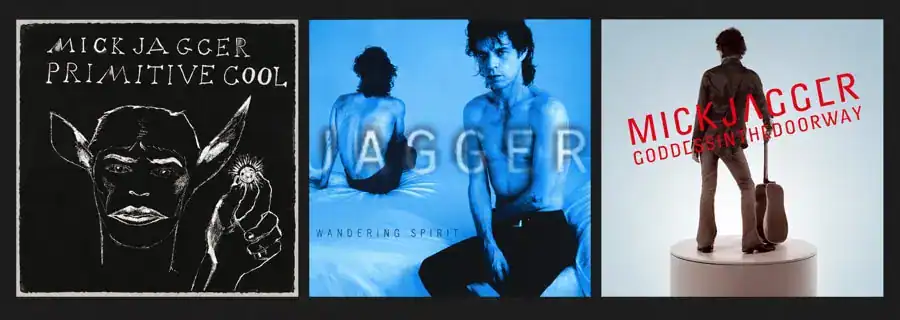
His 2001 album Goddess in the Doorway added another group of collaborations and songs, including “God Gave Me Everything” and “Visions of Paradise”. The sequence demonstrates that the duet with Bowie was one occasion within a continuing interest in working beyond his principal band, rather than the only time he entered a different musical environment.
Film music, film production and other partnerships
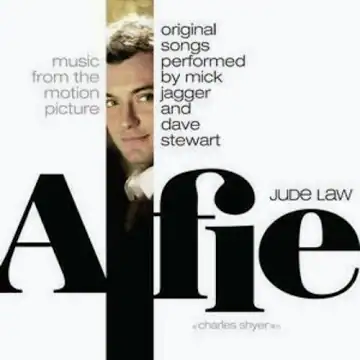
Jagger’s work also extended into film-related projects. For the 2004 Alfie soundtrack, he collaborated with Dave Stewart. The record included “Old Habits Die Hard” and contributions from other singers, placing his work within a film’s musical presentation. The song won the Golden Globe for Best Original Song in 2005.
His Jagged Films activities included Enigma, released in 2001. The documentary Being Mick, also associated with that year, followed him during the period of Goddess in the Doorway. These projects reveal different relationships with the camera: producing a dramatic film, participating in a soundtrack and becoming the subject of a documentary.
Jagger remembers Bowie in 2016
Following Bowie’s death on 10 January 2016, Jagger contributed to the remembrances gathered for Rolling Stone’s Bowie tribute issue. His account returned to their friendship and its exchange of ideas. It also acknowledged that they had lost regular contact later in Bowie’s life, rather than presenting an uninterrupted closeness extending through every decade.
That acknowledgement matters because retrospective tributes can encourage an overly smooth account of a relationship. Friendship may include periods of activity, distance and renewed interest. Jagger’s memory allows those changes to remain visible. The importance of their earlier exchanges does not depend on a claim that they spoke constantly or collaborated privately throughout the years after the single.
His remembrance also gives the duet a personal place beyond its chart position. It was an occasion when the friendship became a shared piece of work that other people could see and hear. Their wider exchanges were largely private; this project left a public record. The contrast helps explain why a short recording could remain significant to Jagger even though it occupied only a small part of a much longer career.
The fortieth-anniversary release
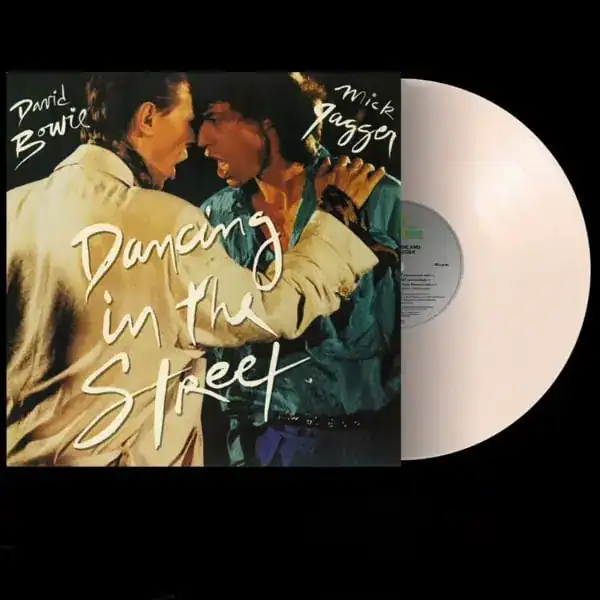
In 2025, “Dancing in the Street” received a fortieth-anniversary white-vinyl twelve-inch release on Parlophone. Its programme gathered the principal mixes, including the Clearmountain and Steve Thompson versions, an instrumental, an edit and a dub. The release treated the single’s different recorded forms as part of its continuing history.
The announcement specified that 30 per cent of the retail price would be donated to the Band Aid Charitable Trust. That stated arrangement should be distinguished from the wording used about proceeds from the original single. A later edition has its own terms; describing both as charity releases does not mean that their financial structures are identical.
The anniversary also brought a new statement from Jagger. His recollection emphasised the enjoyment of recording and filming with Bowie, while expressing regret that they had not undertaken more projects together. The release therefore combined an archival presentation of existing music with a participant’s later perspective. It was a return to a specific collaboration, rather than evidence of previously unknown joint studio work.
Restoring the film and revisiting the shoot
David Bowie & Mick Jagger — Dancing in the Street (Steve Thompson Extended Mix), featuring behind-the-scenes footage in the 2025 anniversary video.
The anniversary programme included an upgraded 4K version of the video, prepared from the original film negative. A further presentation accompanying the Steve Thompson Mix used behind-the-scenes footage from the Docklands shoot. That material offered viewers additional evidence of the production surrounding the familiar finished performance.
Behind-the-scenes material can also change the emphasis of a viewing. The finished clip places the performers before us; production footage makes the process more visible. It can show that the performance belonged to an organised shoot, with a setting and work taking place beyond the frame. This adds context without cancelling the humour of the original, allowing the video to be encountered as both entertainment and a surviving record of professional activity.
Jagger within Bowie’s collaborative history
Jagger’s role differs from that of a long-serving Bowie band member. He did not become part of Bowie’s regular touring ensemble, and the duet did not develop into an album-length partnership. Their contribution was concentrated in one principal recording, its video and a later live return to the same material.
Its significance comes from the particular relationship it made public. Two artists with established voices and stage identities agreed to share a performance for a benefit initiative. The result depended on their interaction, but also on the musicians and production workers who turned that agreement into a recording and film. Recognising those contributions makes the history more substantial than a description based only on celebrity.
“Dancing in the Street” can be enjoyed, criticised or reconsidered without losing its documented place. It connects Bowie’s earlier interest in Jagger and the Stones with a direct session, a major broadcast and a successful single. Jagger’s subsequent memories give that public history a personal dimension, while the later editions show how one brief collaboration continued to reach audiences through changing forms of distribution and presentation.
Official Website & Further Information
Mick Jagger‘s official website provides information about his solo catalogue, selected film projects and official releases. Its discography distinguishes his solo albums and soundtrack work from the Rolling Stones’ catalogue, making it a useful starting point for exploring the broader career outlined here.
Mick Jagger‘s official website:
www.mickjagger.com
The Rolling Stones’ official website:
rollingstones.com
For the Bowie collaboration, David Bowie’s official website contains the anniversary announcements, statements from the performers and information about the restored video. The Official Charts Company provides the British chart record. These resources serve different purposes: artist announcements document releases and statements, while chart records establish positions and dated chart runs.
Further reference points:
Official fortieth-anniversary announcement
Official UK chart history
Official Aladdin Sane album history
Official Drive-In Saturday history
National Library of Ireland: the Live Aid archive
First-Hand Accounts & Historical Sources
This page draws on published first-hand accounts from people involved in the collaboration. These include Mick Jagger‘s remembrances, statements by Bowie reproduced in official anniversary material, Kevin Armstrong‘s interviews, Mark Saunders’ account of the studio session and interviews with Clive Langer and Alan Winstanley.
Their testimony has been used with attention to its limits. A participant may remember a performance clearly while being less certain about a precise time, a later overdub or a decision made elsewhere. Where accounts differ, this article preserves the established sequence rather than inventing a single exact chronology. Recording in London, the Docklands shoot, the Live Aid premiere and the later commercial release are distinct stages.
Selected session and production sources:
Mark Saunders: The Making of “Dancing in the Street”
Kevin Armstrong interview, David Bowie News, 2021
Kevin Armstrong interview, The Rebel Magazine, 2010
Clive Langer and Alan Winstanley interview, Classic Pop
Clive Langer interview, Laurent Rieppi
The original Motown recording has also been considered separately from its later cover versions. The Library of Congress essay provides historical background for Martha and the Vandellas, while the chronology of the 1985 project has been checked against sources specific to Bowie, Jagger and Live Aid. No direct personal contribution from Mick Jagger to DavidBowieWorld.com is claimed.
Article Origin
This article has been researched and written for DavidBowieWorld.com as part of its David Bowie Collaborations & Creative Circle Archive. Its purpose is to document Mick Jagger‘s place in Bowie’s history through identifiable recordings, performances and published testimony, while giving appropriate credit to the songwriters, musicians and production team.
The page is an independently researched account. It does not imply endorsement by Mick Jagger, the Rolling Stones, the David Bowie estate or the organisations responsible for Live Aid. Quotations are attributed to their published sources, and interpretation of the music and video is presented separately from claims about what participants remembered or intended.
Future additions should strengthen the documentary record: a confirmed session credit, a properly identified photograph, a contemporary programme or a further first-hand account. Such material can refine the history without changing the central distinction between the 1985 recording, its filmed presentation at Live Aid and the subsequent joint live performance.
© DavidBowieWorld.com — David Bowie Collaborations & Creative Circle Archive.
