
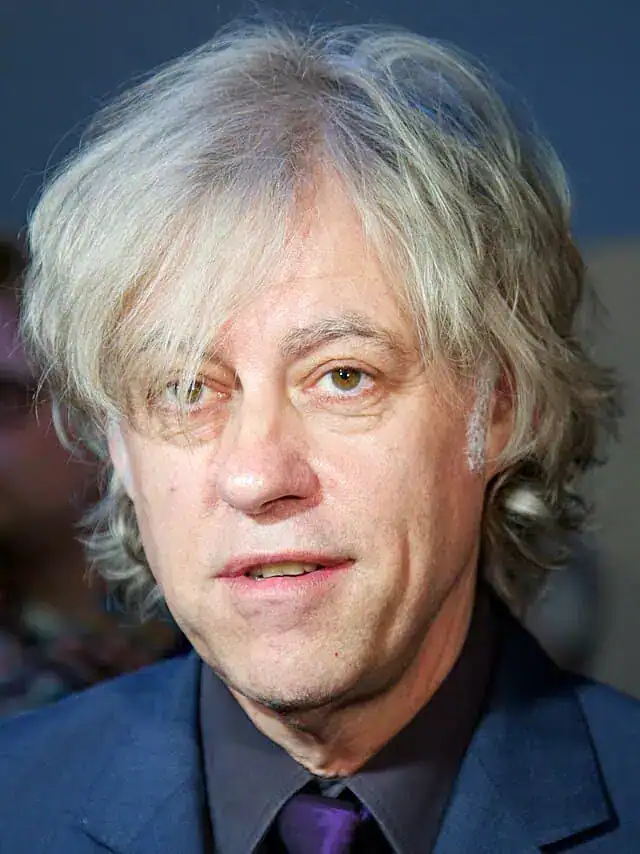
Photo: Barbara Mürdter / Wikimedia Commons / CC BY-SA 3.0 (editorial use)
Bob Geldof is an Irish musician, songwriter, political activist and organiser whose career uniquely bridges popular music and global humanitarian action. While best known as the driving force behind Live Aid, his cultural trajectory intersects with David Bowie during a moment when music became a vehicle for worldwide social change.
Geldof and Bowie represented very different artistic temperaments, yet shared a belief that artists could — and should — engage with the world beyond entertainment.
Early career and The Boomtown Rats
Bob Geldof rose to prominence in the late 1970s as the frontman of The Boomtown Rats, a band that combined punk urgency with sharp social commentary. Songs such as “I Don’t Like Mondays” attracted attention for their unsettling subject matter and confrontational tone.
Geldof positioned himself less as a traditional rock star and more as a cultural commentator, using music as a platform for social observation and critique.
From musician to activist
In 1984, after seeing BBC television reports on famine in Ethiopia, Geldof initiated the Band Aid project. The resulting single, “Do They Know It’s Christmas?”, became an international success and raised significant funds for famine relief.
This led directly to the organisation of Live Aid in 1985, one of the most ambitious global music events ever staged.
Live Aid and David Bowie
On 13 July 1985, Live Aid took place simultaneously in London and Philadelphia, broadcast to a global audience of hundreds of millions. David Bowie performed at Wembley Stadium as part of the London concert.
Bowie’s appearance was part of a carefully structured broadcast that combined live performance with direct appeals for humanitarian support.
Bowie’s broadcast moment
One of Bowie’s most significant contributions to Live Aid came not through music, but through television. During the broadcast, he introduced a short film about the famine in Ethiopia, featuring footage that had been widely circulated by news organisations.
The emotional impact of this footage was immediate and profound. It is widely recognised as one of the moments that triggered a major surge in donations during the event, reinforcing the power of television as a humanitarian tool.
This segment demonstrated how Bowie understood the importance of context and presentation, using his platform to amplify the urgency of the crisis rather than simply perform within it.
Contrasting personalities
While Geldof operated with urgency, confrontation, and direct activism, Bowie maintained a more measured and reflective stance, often wary of moral absolutism or simplified narratives.
Despite these differences, both artists recognised the scale of the crisis and the responsibility of global cultural figures to respond.
After Live Aid
Following Live Aid, Geldof continued his humanitarian work through initiatives such as Live 8 and ongoing advocacy for debt relief and African development. His career shifted permanently toward activism on a global scale.
Bowie, meanwhile, returned to his own artistic trajectory, maintaining a more indirect relationship with political engagement.
Legacy
Bob Geldof’s legacy lies not only in his music but in redefining the role of the musician as a global advocate. His work demonstrated that popular culture could mobilise international awareness and action.
The intersection between Geldof and Bowie at Live Aid represents a unique historical moment in which art, media, and humanitarian urgency converged on a global stage.
Although their collaboration was indirect, their combined presence contributed to one of the most significant cultural events of the twentieth century.
