
David Bowie & Marc Bolan – Friendship, Rivalry and Glam Rock

The relationship between David Bowie and Marc Bolan is one of the most fascinating connections in British popular music. They were never regular bandmates and never made an album together, yet their lives and careers repeatedly intersected from their uncertain beginnings in 1960s London until Bolan’s death in September 1977.
They were friends, contemporaries and, at times, competitors. Both repeatedly reinvented themselves and both eventually became central figures in the emergence of glam rock. Bolan achieved mass success first; Bowie followed with a different and increasingly international form of theatrical rock stardom.
Their shared history reaches from early manager Leslie Conn through joint concert bills and Bowie’s appearances as a mime artist with Tyrannosaurus Rex, Bolan’s guitar work on Bowie recordings, the rise of T. Rex and Ziggy Stardust, their much-discussed rivalry and finally their reunion on Bolan’s television series Marc in September 1977.
Marc Bolan was born Mark Feld in London on 30 September 1947. David Bowie, born David Jones on 8 January 1947, was less than nine months older. Their careers developed differently, but their paths crossed with remarkable frequency.
Marc Bolan: Born Mark Feld
Born: 30 September 1947, London, England
Died: 16 September 1977, London, England
Best known for: Tyrannosaurus Rex / T. Rex
Early Bowie connection: Leslie Conn and the London music scene of the 1960s
1968: Bowie and Tyrannosaurus Rex appeared on the same concert bills
1969: Bowie appeared as a mime artist on a Tyrannosaurus Rex concert tour
1970: Bolan played guitar on Bowie’s original recording of The Prettiest Star
1971: Bowie recorded the original demo of Lady Stardust, later officially described as an ode to Bolan
1976: Bolan and Gloria Jones attended Bowie’s Wembley concert
1977: Bowie appeared on Bolan’s Granada Television series Marc
Final joint performance: Standing Next To You, recorded 7 September 1977
Two Young London Dreamers
Long before either became internationally famous, Bowie and Bolan were young Londoners attempting to find a place in the rapidly changing British music business. Both were intensely interested in records, clothes, image and the possibility of transforming themselves into something more distinctive than the conventional pop singer.
Bolan had been involved in modelling and London’s mod culture and recorded early material before establishing the name Marc Bolan. Bowie passed through a succession of groups and identities, including The Konrads, The King Bees, The Manish Boys and Davy Jones and the Lower Third, before adopting the name David Bowie.
Neither man’s early career followed a straightforward path. Commercial disappointments were common, and both continued searching for a combination of music, appearance and personality capable of distinguishing them from the many other ambitious performers in mid-1960s London.
Leslie Conn – An Early Connection
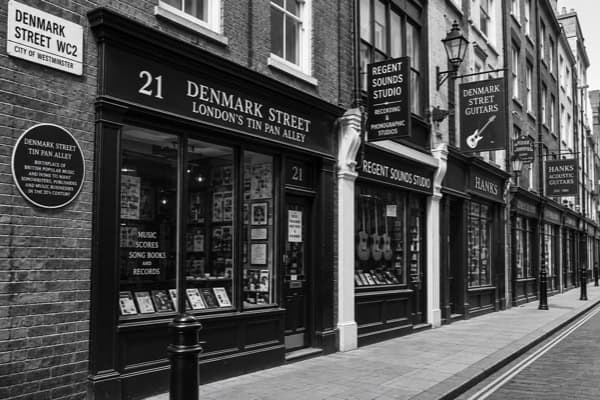
One of the earliest documented connections between Bowie and Bolan came through businessman and manager Leslie Conn. Both young performers were associated with Conn while attempting to establish themselves in London’s music industry.
Bowie later remembered that he and Bolan were both temporarily out of work when Conn put them to work painting his office. What became a famous story was therefore not merely a later piece of glam-rock mythology: Bowie himself recalled the episode.
The two young musicians reportedly talked about clothes, music and their ambitions while they worked. Seen from decades later, the scene seems almost improbable: Bowie and Bolan painting a manager’s office before either had achieved the fame they were pursuing.
Their relationship therefore did not begin with Ziggy Stardust, T. Rex or glam rock. They knew one another while both were still searching for an artistic identity and an audience.
Marc Bolan before T. Rex
Bolan’s route towards success involved several transformations. In 1967 he joined John’s Children and wrote Desdemona, a single whose suggestive lyric contributed to it being banned by the BBC.
His stay with John’s Children was brief. Bolan subsequently formed Tyrannosaurus Rex, initially working with percussionist Steve Peregrin Took. Their music was very different from the electric T. Rex sound that would later dominate the British charts.
Bolan played acoustic guitar while Took supplied percussion and backing vocals. Their recordings mixed folk, psychedelia, mythology and Bolan’s increasingly distinctive lyrical vocabulary.
Dragons, wizards, strange creatures and imaginary landscapes filled his songs. Although this was not yet the electric glam rock of the early 1970s, several characteristics of Bolan’s later persona were already present: fantasy, self-invention, a highly individual vocal identity and an instinctive understanding that a performer could construct an entire world around himself.
1968 – Bowie and Bolan on the Same Bill
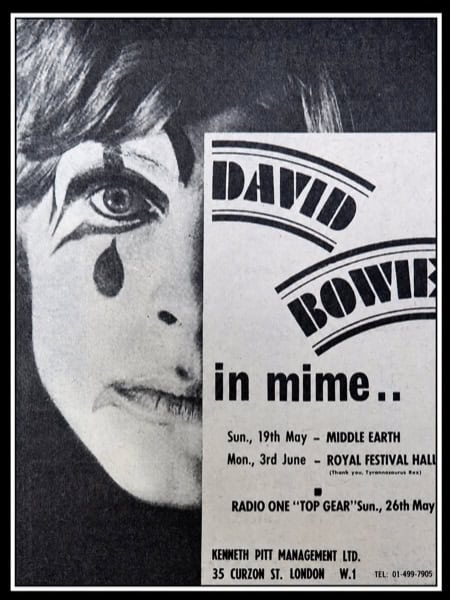
The live connection between Bowie and Bolan predates the better-known Tyrannosaurus Rex tour of 1969.
On 19 May 1968, Bowie appeared at the Middle Earth club in London’s Covent Garden on a bill headed by Tyrannosaurus Rex. Bowie was advertised not primarily as a singer but for his increasingly important theatrical work, including mime.
The connection continued only weeks later. On 3 June 1968, Bowie and Tyrannosaurus Rex were among the performers appearing in The Babylonian Mouthpiece Show at London’s Royal Festival Hall. The programme also included John Peel, whose association with both artists forms another link between their early careers.
These appearances are historically important because they demonstrate that Bowie and Bolan were already occupying the same performance world before either had become a mainstream star.
1969 – Bowie on Tour with Tyrannosaurus Rex
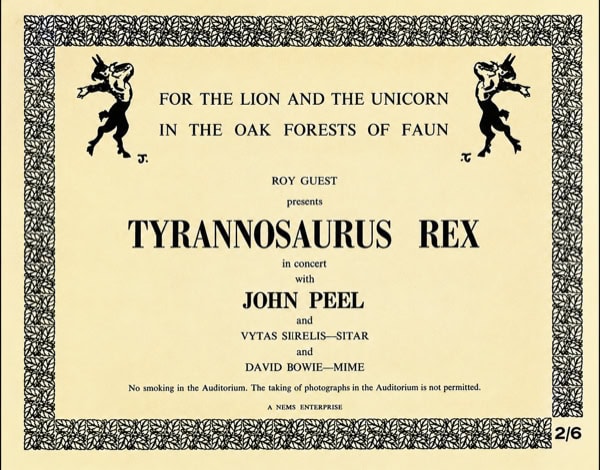
The connection became more substantial in February and March 1969, when Bowie appeared as a mime artist during a Tyrannosaurus Rex concert tour.
Surviving tour material lists a programme featuring Tyrannosaurus Rex, John Peel, Vytas Serelis and David Bowie – Mime. Bowie was therefore an advertised part of the show rather than an undocumented backstage visitor or occasional guest.
The tour visited British venues during February and March 1969, including performances in Birmingham, Croydon, Manchester, Bristol, Liverpool and Brighton.
Bowie had studied mime with Lindsay Kemp and regarded theatrical movement as an important part of his artistic development. His contribution to the Tyrannosaurus Rex shows was consequently a theatrical performance rather than a conventional musical support set.
One of the pieces Bowie performed during this period dealt with the Chinese occupation of Tibet. It was an unusual presentation for a rock audience, but it demonstrated an interest in theatrical performance that would remain important throughout his career.
Decades later, Bowie could look back on his attempt to bring mime to rock audiences with considerable humour.
David Bowie on mime
“Nobody in the world likes mime.”
— David Bowie, recalling his early mime years
At the time, however, mime was a serious part of Bowie’s developing artistic vocabulary. He was still months away from the success of Space Oddity, while Bolan was building a devoted following with Tyrannosaurus Rex.
The 1969 tour therefore represents one of the earliest sustained professional connections between Bowie and Bolan.
Tony Visconti – A Crucial Link
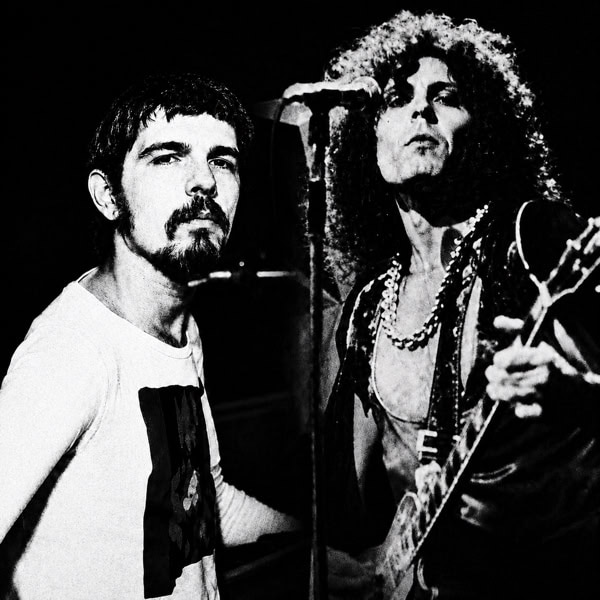
Another major connection between the two artists was producer, arranger and musician Tony Visconti.
Visconti became deeply involved in the work of both men. He produced important recordings for Tyrannosaurus Rex and T. Rex while also developing the creative relationship with Bowie that would eventually span decades.
His position gave him a rare view of both artists before and during their rise to fame. Visconti later recalled that Bolan possessed a strongly competitive personality and that Bowie became one of the people against whom he measured himself.
Competition did not mean that Bowie and Bolan were simply enemies. Visconti also remembered them meeting socially, listening to records and sharing musical interests. At Visconti’s home they could listen together to American soul records, an important reminder that their relationship existed away from the rivalry promoted by the music press.
The Prettiest Star
David Bowie – The Prettiest Star
The clearest surviving studio collaboration between David Bowie and Marc Bolan came in January 1970, when Bolan played guitar on the original single recording of Bowie’s The Prettiest Star.
The sessions began at Trident Studios in London on 8 January 1970, Bowie’s twenty-third birthday, with further work during January. Tony Visconti produced the recording.
Bowie wrote the song for Angela Barnett, whom he would marry in March. Bolan’s distinctive electric guitar contribution gives the original recording an important place in the Bowie–Bolan story.
The Prettiest Star was released as a single on 6 March 1970. Commercially, it failed to repeat the impact Bowie had achieved with Space Oddity, but its historical importance has increased considerably.
Bolan himself remembered the recording positively.
Marc Bolan on The Prettiest Star
“I played on ‘Prettiest Star’ … which I thought was a great song.”
Bowie later remembered Bolan’s guitar playing with affection, noting that Bolan was still developing as a lead guitarist. Rather than demanding technical perfection, Bowie valued the individual character of what Bolan played.
Bowie returned to The Prettiest Star for Aladdin Sane in 1973. That album version was a new recording, with Mick Ronson taking the prominent guitar role. Bolan’s contribution belongs specifically to the original 1970 single.
The Rise of T. Rex
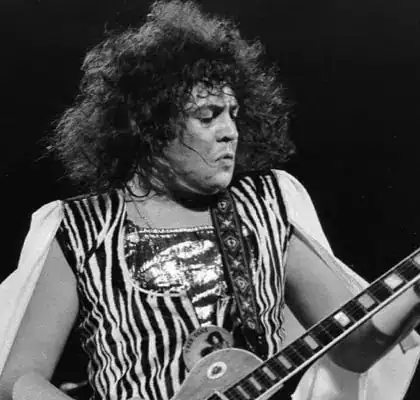
Bolan achieved his major commercial breakthrough before Bowie. As Tyrannosaurus Rex evolved and the name was shortened to T. Rex, the music became increasingly electric, direct and accessible.
Ride A White Swan became a major British hit in 1970. It was followed by an extraordinary sequence of singles including Hot Love, Get It On, Jeepster, Telegram Sam and Metal Guru.
By 1971 Bolan was one of Britain’s biggest pop stars. The intense audience reaction surrounding T. Rex became known as T. Rextasy.
Bolan’s curls, glitter, colourful clothes, electric guitar and playful sensuality helped establish a new visual vocabulary for British rock.
Bolan before Ziggy
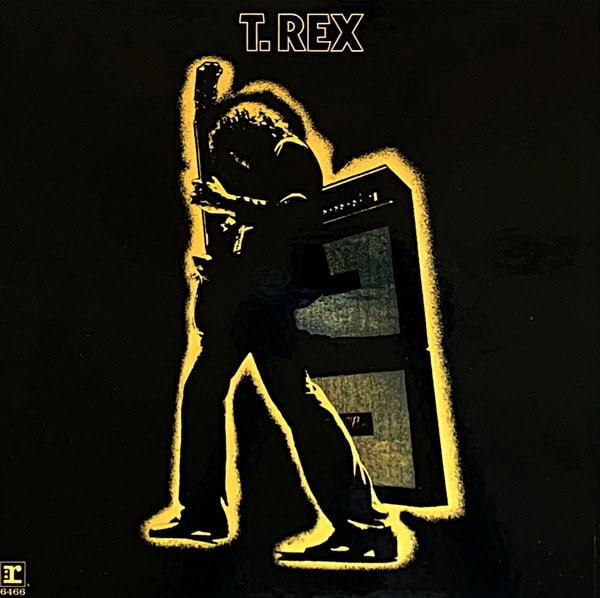
The chronology matters. When T. Rex became a national phenomenon, Bowie had still not achieved sustained commercial success.
Hot Love reached number one in Britain in 1971, followed by Get It On. The album Electric Warrior confirmed that Bolan was no temporary pop sensation.
Bowie was therefore witnessing a contemporary he had known during the uncertain years of the 1960s become one of Britain’s biggest stars.
It would be misleading to reduce Bowie’s subsequent development to imitation. Their music, ambitions and artistic methods were substantially different. Bolan’s success nevertheless demonstrated that fantasy, flamboyance, ambiguity and rock and roll could reach a mass British audience.
Lady Stardust – Bowie Writes about Bolan
David Bowie – Lady Stardust
One of the most important artistic links between Bowie and Bolan emerged in 1971.
On 9 March 1971, Bowie recorded an early piano-and-vocal demo of Lady Stardust at Radio Luxembourg Studios in London. The song would eventually appear on The Rise and Fall of Ziggy Stardust and the Spiders from Mars.
The connection with Bolan is stronger than later fan speculation. David Bowie’s official website has described Lady Stardust as “David’s ode to Marc Bolan.”
The song presents a charismatic and glamorous performer whose appearance fascinates an audience while challenging conventional expectations surrounding gender and presentation.
That does not mean that every lyric should be interpreted as literal Bolan biography. The song belongs to the developing theatrical world that eventually surrounded Ziggy Stardust. Nevertheless, Bolan is an acknowledged and important part of its inspiration.
1971 – Marc Bolan‘s Shoes and Andy Warhol
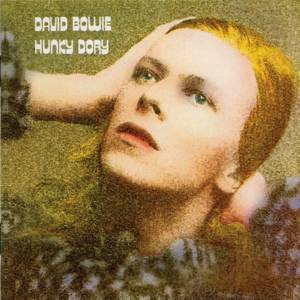
A small but revealing episode from 14 September 1971 demonstrates that the Bowie–Bolan connection extended beyond music.
During Bowie’s first visit to Andy Warhol‘s Factory in New York, Bowie wore a pair of shoes that had been given to him by Marc Bolan.
The meeting with Warhol was famously awkward, but the shoes attracted Warhol’s attention and briefly provided a subject around which the conversation could develop.
It is a minor detail compared with their recordings and performances, yet historically it is valuable. Bolan was literally present in an object Bowie carried into one of the most famous encounters of his early career, at a time when Bowie himself had not yet achieved the level of stardom Bolan was already experiencing.
Glam Rock as a Shared Revolution
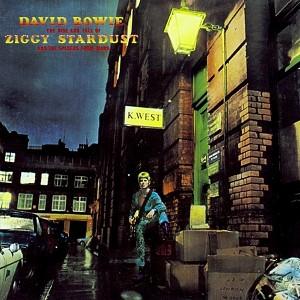
Bowie and Bolan are routinely grouped together under the term glam rock, but they approached performance from different directions.
Bolan’s music relied heavily on groove, concise songwriting, electric guitar and his distinctive vocal personality. His lyrics mixed sexuality, mythology, automobiles, cosmic imagery, humour and rock-and-roll fantasy.
Bowie increasingly approached performance through characters, theatre, narrative and deliberate transformation. Ziggy Stardust was not simply a costume but part of a larger constructed identity involving music, performance and storytelling.
Both nevertheless challenged conventional expectations surrounding the appearance and behaviour of male rock stars. Make-up, glitter, colour, sexuality and ambiguity became increasingly visible within mainstream British popular culture.
Neither man alone invented glam rock. The movement developed through numerous artists, musicians, producers, designers and wider cultural influences. Bolan and Bowie nevertheless became two of its most recognisable and influential figures.
Competition and Rivalry
Competition was an undeniable part of the Bowie–Bolan relationship.
In 1971 and early 1972, Bolan possessed far greater mass popularity in Britain. T. Rex dominated the charts while Bowie was still attempting to turn critical interest into sustained commercial success.
The situation changed rapidly after The Rise and Fall of Ziggy Stardust and the Spiders from Mars in 1972. Bowie’s profile expanded dramatically in Britain and then internationally.
The British music press repeatedly encouraged comparisons between the two performers, and Bolan could respond with characteristic bravado.
Marc Bolan on competition with Bowie
“I don’t consider David to be even remotely near big enough to give me any competition.”
The remark illustrates Bolan’s public confidence during a period when T. Rex were commercially dominant. It should not be treated as proof of permanent hostility. Their later contact demonstrates a considerably more complicated relationship.
Ziggy Stardust and the Changing Balance
During 1972 and 1973, Bowie’s career accelerated at extraordinary speed.
The Ziggy Stardust concerts transformed him into a theatrical rock star whose influence extended beyond the records themselves. The red hair, costumes, make-up and carefully controlled stage presentation created a visual identity immediately recognisable to audiences and photographers.
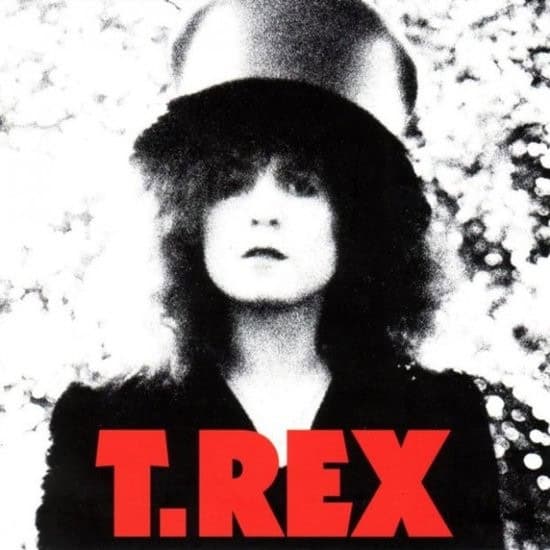
Bolan remained one of Britain’s most famous musicians during much of this period. T. Rex continued producing major hits, while The Slider reinforced the band’s position at the centre of the glam era.
Bowie and Bolan were increasingly presented as competing figureheads, but their shared history was older and more complicated than the public rivalry suggested.
Different Paths through the Mid-1970s
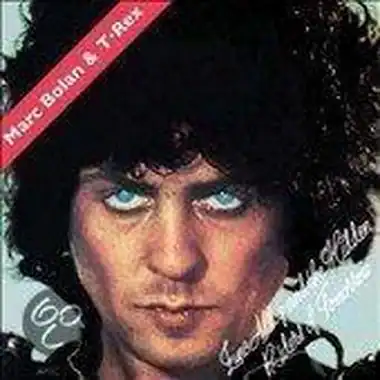
After glam rock’s initial commercial explosion, Bowie and Bolan followed increasingly different paths.
Bowie dismantled Ziggy Stardust and continued changing direction through Diamond Dogs, Young Americans and Station to Station. His music moved through dystopian rock, soul and funk before turning towards the experimental work associated with his late-1970s European period.
T. Rex continued recording and touring, but Bolan no longer enjoyed the almost uninterrupted run of enormous British hits that had defined the band’s commercial peak.
This period is sometimes reduced to a simple narrative of decline. Bolan nevertheless continued writing, recording and performing while attempting to move beyond the expectations created by his earlier success.
1975 – Bolan Reflects on Bowie
By the middle of the decade, Bolan could speak about Bowie very differently from the competitive comments associated with the height of T. Rextasy.
In a 1975 interview, Bolan openly acknowledged parallels between their careers and artistic interests.
The comment is important because it came after the period in which the press had most aggressively promoted the two men as rivals. Their careers had diverged, but Bolan continued to recognise a connection between their artistic outlooks.
1976 – The Friendship Continues
Their connection remained alive during Bowie’s Station to Station period.
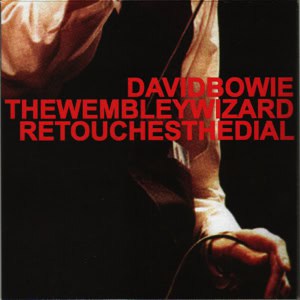
On 3 May 1976, Marc Bolan and his partner Gloria Jones attended Bowie’s concert at Wembley Empire Pool in London.
By then Bowie had moved far beyond the Ziggy Stardust image, while Bolan was rebuilding his own career. Their continued personal contact provides useful evidence against the idea that their early-1970s rivalry had permanently separated them.
Jones later described the relationship as one in which competition never completely destroyed the underlying friendship.
Gloria Jones on Bowie and Bolan
“Then came the rivalry, but their camaraderie never really diminished.”
— Gloria Jones
Marc Bolan‘s 1977 Revival
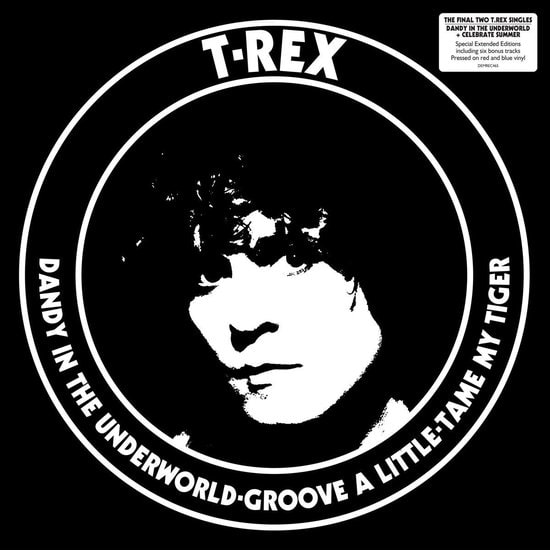
By 1977 Bolan was experiencing a significant creative and public revival.
Punk had transformed the British musical landscape, but Bolan showed considerable enthusiasm for many younger performers. In return, musicians associated with punk and new wave frequently recognised the directness and energy of early T. Rex as an influence.
Bolan released Dandy in the Underworld in March 1977 and toured Britain with The Damned as support.
The pairing made cultural sense. Bolan’s concise rock songs and outsider glamour had influenced musicians who were now challenging the elaborate conventions of mid-1970s rock.
The Marc Television Show
Marc Bolan – Marc, Granada Television, 1977
Bolan’s renewed visibility led to Marc, a Granada Television music series made for ITV in 1977.
The programme gave Bolan a platform for his own performances while also presenting contemporary artists. Guests across the series included musicians associated with Britain’s rapidly changing punk and new-wave scene.
Rather than presenting himself simply as a survivor of an earlier era, Bolan demonstrated an active interest in younger performers and contemporary music.
For the sixth and final programme, Bolan invited a guest whose history with him stretched back more than a decade: David Bowie.
7 September 1977 – Bowie and Bolan Together Again

Bowie’s appearance on Marc was recorded at Granada Television in Manchester on 7 September 1977.
The recording date is sometimes confused with the programme’s later transmission. The episode containing Bowie was broadcast on 28 September 1977.
By the time British viewers saw it, Marc Bolan had died.
Bowie arrived during another major creative period in his own career. Low had appeared earlier in 1977, while “Heroes” was about to become the centrepiece of his next album.
The television appearance therefore reunited two men who had known one another before fame, survived the glam-rock explosion and followed dramatically different routes through the decade.
“Heroes” on Marc
David Bowie – “Heroes”, Marc, Granada Television, 1977
Bowie performed “Heroes” during the programme.
The appearance occupies an important place in Bowie history because his official archive identifies it as the first television performance of “Heroes”.
Bolan’s final television series therefore became part of the early public history of one of Bowie’s most celebrated songs.
Standing Next To You
David Bowie and Marc Bolan – Standing Next To You, Marc, Granada Television, 1977
Bowie and Bolan then appeared together for an informal closing number titled Standing Next To You.
Bowie’s official archive describes the song as having been written by the two men together. The performance was loose and informal rather than a polished studio production.
Its historical appeal lies partly in that informality. After years of public comparisons, two musicians who had known one another since their uncertain early careers were once again standing together with guitars on a television stage.
Near the end of the performance, Bolan unexpectedly stepped backwards and fell from the low stage. Bowie laughed as the recording broke down, and the performance ended prematurely.
At the time it was simply an amusing accident. Subsequent events transformed the footage into something far more poignant. It became the final public performance shared by Bowie and Bolan.
The Death of Marc Bolan
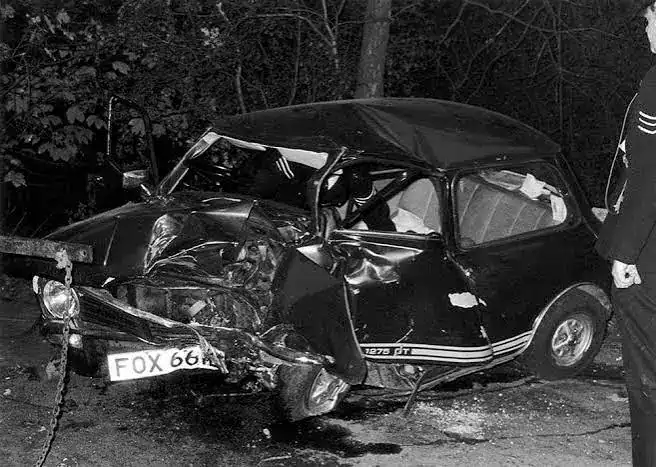
Only nine days after the Granada recording, Marc Bolan was killed in a road accident.
During the early hours of 16 September 1977, Bolan was travelling through southwest London in a Mini driven by his partner Gloria Jones.
The car left the road near Barnes Common and struck a tree.
Bolan died at the scene. He was 29 years old, only two weeks away from his thirtieth birthday.
Gloria Jones survived the crash but suffered serious injuries.
Bolan’s death ended a career that had recently shown renewed creative and public momentum.
20 September 1977 – Marc Bolan‘s Funeral
Marc Bolan‘s funeral took place at Golders Green Crematorium in London on 20 September 1977.
David Bowie attended the funeral. Among the other figures from the music world present were friends and colleagues who had known Bolan during different periods of his career.
A large floral white swan provided a poignant reference to T. Rex’s breakthrough hit Ride A White Swan.
Only thirteen days had passed since Bowie and Bolan had stood together at Granada Television recording Marc.
The Final Marc Programme
The episode containing Bowie’s appearance was transmitted on 28 September 1977, twelve days after Bolan’s death.
The circumstances inevitably changed the meaning of the programme. What had been recorded as a lively reunion between two figures who had survived the London music scene of the 1960s and the glam era became a final television document.
The surviving images of Bowie and Bolan smiling, playing and laughing together remain among the most memorable visual records of their relationship.
Marc Bolan‘s Legacy
Marc Bolan remains one of the defining figures in British popular music.
Through T. Rex he helped transform both the sound and appearance of early-1970s rock. His combination of electric boogie, concise pop songwriting, fantasy, sexuality, glitter and charismatic performance created a style that was immediately recognisable.
Electric Warrior and The Slider remain central albums of the glam era, while singles including Ride A White Swan, Hot Love, Get It On, Jeepster, Telegram Sam, Metal Guru and Children of the Revolution established a catalogue whose influence continued long after his death.
Bolan’s influence extended into punk, post-punk, new wave, alternative rock and later generations of British guitar music. His combination of simplicity, glamour and self-invention remained a model for performers who emerged long after T. Rextasy had ended.
Marc Bolan in Bowie’s Creative Universe
Marc Bolan was not a Bowie collaborator in the conventional sense of a long-term band member, producer or touring musician. His place in Bowie’s history is more unusual.
Bolan knew Bowie before fame. Their paths crossed through Leslie Conn, shared concert bills in 1968, the Tyrannosaurus Rex tour of 1969, Tony Visconti and the 1970 recordings of The Prettiest Star.
Bolan’s transformation into a major star preceded Bowie’s breakthrough as Ziggy Stardust, while Lady Stardust provides a direct artistic acknowledgement of Bolan within Bowie’s own songwriting.
Their differences were as important as their similarities. Bolan’s music was instinctive, concise and rooted in rock-and-roll fantasy. Bowie increasingly became conceptual and theatrical, repeatedly abandoning successful identities in favour of new artistic directions.
Yet both demonstrated that image, imagination and performance could be central components of rock music rather than decorative additions to it.
Friendship, Rivalry and Respect
Marc Bolan‘s place in David Bowie’s history cannot be reduced to either influence or rivalry.
They knew one another before fame, shared the same uncertain London music world, appeared on the same bills, worked together in the studio, became competing stars during glam rock’s commercial peak and remained personally connected after that era had passed.
Rivalry was real. Contemporary interviews and Tony Visconti‘s recollections demonstrate that competition existed. But Bolan’s later comments, Gloria Jones’s recollections and the continued personal contact between the two men show that competition did not erase friendship.
Bolan knew Bowie before Space Oddity, before Ziggy Stardust and before international fame. Bowie knew Bolan before T. Rex, before Electric Warrior and before T. Rextasy.
That shared history gives their final television appearance its lasting resonance. The men laughing together on Marc were not simply two glam-rock celebrities brought together for television. They were survivors of the same London music scene in which both had once struggled to be noticed.
Nine days after that final performance was recorded, Marc Bolan was dead.
Article Origin & Editorial Note
This DavidBowieWorld.com archive page documents the relationship between David Bowie and Marc Bolan from their early London connections through their final joint television appearance in September 1977.
Particular attention has been given to separating documented events from stories that have accumulated around the two artists. Dates, direct collaborations and first-hand statements are presented as precisely as surviving documentation allows, while insufficiently documented claims have not been treated as established fact.
The Bowie–Bolan story is best understood not simply as a rivalry but as a long relationship shaped by shared beginnings, musical exchange, competition, artistic development and continued personal contact.
Further Information
Further research into Marc Bolan and T. Rex can be found through contemporary interviews, surviving Tyrannosaurus Rex concert material, the T. Rex catalogue and the Granada Television recordings of Marc.
David Bowie’s official archive has also documented Marc Bolan‘s place in Bowie’s personal and musical history, including Lady Stardust and their final television appearance together in September 1977.
© DavidBowieWorld.com — David Bowie Collaborations & Creative Circle Archive.
