
Leslie Conn – David Bowie’s First Manager
Leslie Conn played an important role at the very beginning of David Bowie’s professional career. In 1964, when Bowie was still the 17-year-old David “Davie” Jones, Conn became his first personal manager and helped turn the ambitious young singer and saxophonist into a recording artist.
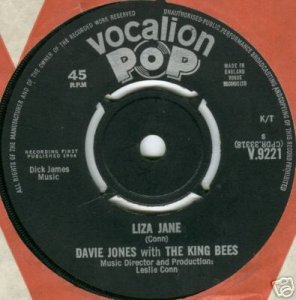
Conn managed and promoted Davie Jones with the King Bees, produced Bowie’s first commercially released single, “Liza Jane”, and helped secure the record deal that brought it to the Vocalion Pop label. He subsequently remained involved as Jones moved on to The Manish Boys.
Their formal working relationship was relatively brief, but Conn’s connection with Bowie did not disappear immediately. In 1965 he contributed backing vocals to recordings made by Jones with The Lower Third, giving him a small but remarkable additional place in Bowie’s earliest recorded history.
- Name: Leslie Conn
- Born: 14 December 1929, Stamford Hill, London
- Died: 13 December 2008, aged 78
- Roles: Manager, promoter, talent scout, producer
- Worked with David Jones: 1964–1965
- Key recording: “Liza Jane” (1964)
- Associated Bowie groups: The King Bees, The Manish Boys
- Later studio contribution: Backing vocals on 1965 Lower Third recordings
David Jones writes to John Bloom
The connection between David Jones and Leslie Conn began with an unusually ambitious move by the teenage musician.
In early 1964, Jones was fronting The King Bees and looking for financial and professional support. He wrote to entrepreneur John Bloom, whose success in the washing-machine business had made him a well-known public figure, asking him to support the group.
Jones suggested that Bloom could do for The King Bees what Brian Epstein had done for The Beatles.
Bloom did not become their manager or financial backer. Instead, Jones received a telegram giving him the telephone number of Leslie Conn, who was working within the London music business and was associated with the Dick James Organisation.
That referral gave Jones his first significant connection with professional management.
Leslie Conn meets The King Bees
Conn’s introduction to The King Bees was not immediately promising.
He arranged for the group to perform at a private celebration connected with John Bloom. Their loud rhythm-and-blues repertoire proved badly suited to the occasion, and the performance was stopped after only a short time.
Despite the unsuccessful appearance, Conn saw enough potential to continue working with Jones and the group.
He became manager and promoter for Davie Jones with the King Bees and began trying to create professional opportunities for them.
For Jones, who had already spent several years moving through teenage groups and local performances, the relationship represented an important change. He now had someone within the music business actively trying to secure recordings, bookings and publicity.
Liza Jane – Bowie’s first released single
Conn’s most important achievement with the young Jones was helping secure his first commercial record release.
In May 1964, Davie Jones with the King Bees entered Decca Studios in Broadhurst Gardens, West Hampstead. During the session they recorded “Liza Jane” and “Louie, Louie Go Home”.
Davie Jones with the King Bees – “Liza Jane”, David Bowie’s first commercially released single, 1964.
Conn produced the recordings.
The single was released on 5 June 1964 by Vocalion Pop, a Decca label, under the credit Davie Jones with the King Bees.
It was the first commercially released record of David Bowie’s career.
Jones sang lead vocals and played alto saxophone. The King Bees line-up on the recording also included George Underwood, Roger Bluck, Francis Howard and Bob Allen.
Who wrote Liza Jane?
The songwriting credit attached to “Liza Jane” has caused some confusion in accounts of Bowie’s early career.
The song drew upon the long-established American standard “Li’l Liza Jane”, yet the 1964 release credited Leslie Conn as its writer.
Conn later described the song as having developed from a blues framework and maintained that he contributed lyrics and ideas to the version recorded by The King Bees. Other participants subsequently remembered its development differently.
It is therefore safer to distinguish between the traditional origins of the song and the specific version developed for the King Bees recording rather than assume a single explanation for Conn’s songwriting credit.
Leslie Conn on Liza Jane
“It was based on a six-bar blues. I was very good at lyrics as well.”
— Leslie Conn, recalling the song’s development
Promoting Davie Jones
Conn did more than arrange the recording session.
He actively promoted “Liza Jane”, and the single received radio exposure and attention in the British music press.
The King Bees appeared on television programmes including Ready Steady Go! and The Beat Room, while Jones himself also appeared on Juke Box Jury.
For the 17-year-old Jones, this represented his first substantial experience of the machinery surrounding a professional record release: studio recording, record-company promotion, television appearances and national press coverage.
Commercial success, however, did not follow. “Liza Jane” failed to chart, and Jones soon left The King Bees.
From The King Bees to The Manish Boys
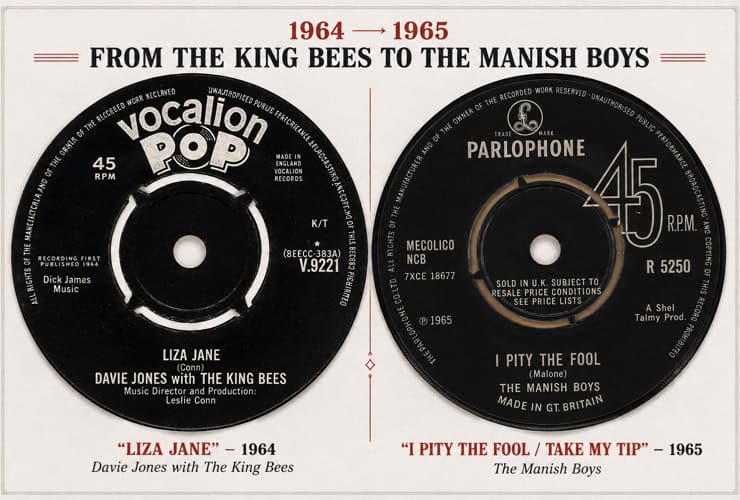
Conn remained involved with Jones after the end of The King Bees.
He was also handling The Manish Boys, an established rhythm-and-blues group from Kent, and helped bring Jones into contact with them during the summer of 1964.
Jones joined the group as singer and saxophonist, becoming the conspicuous frontman of a band whose musical roots lay firmly in American rhythm and blues.
Conn continued acting as an agent and promoter around the group while attempting to generate opportunities for both the band and Jones.
The long-haired men
17-year-old Davie Jones discussing the Society for the Prevention of Cruelty to Long-Haired Men on BBC television’s Tonight, 1964.
One of the most memorable publicity episodes from Jones’s Manish Boys period had nothing directly to do with a record.
In November 1964, Jones appeared on the BBC television programme Tonight discussing the treatment of young men with long hair.
He was presented as the spokesman – often subsequently described as the president – of the Society for the Prevention of Cruelty to Long-Haired Men.
The supposed organisation became one of the earliest examples of Jones attracting national attention through image and personality rather than through a hit record.
Conn was managing and promoting Jones during this period and encouraged the search for publicity opportunities, although the surviving evidence does not justify attributing every detail of the Society episode solely to him.
A national package tour
In December 1964, The Manish Boys received an important professional opportunity when they joined the final six dates of a major British package tour.
The tour featured Gerry and the Pacemakers, Gene Pitney, The Kinks and Marianne Faithfull, alongside other acts. Davie Jones and The Manish Boys appeared as an unbilled opening act on the six dates from 1 to 6 December 1964.
For Jones, still years away from fame, the tour provided valuable experience of a large-scale professional touring production and took him beyond his usual performances in London and southern England.
The Manish Boys themselves, however, remained commercially unsuccessful.
I Pity the Fool
The Manish Boys – “I Pity the Fool”, 1965, featuring Davie Jones.
In January 1965, The Manish Boys entered IBC Studios in London to record “I Pity the Fool” and Jones’s composition “Take My Tip”.
The session was produced by Shel Talmy, already associated with The Kinks and soon to become closely connected with The Who. Session guitarist Jimmy Page also contributed to the recording.
The single was released by Parlophone in March 1965 as The Manish Boys, with Jones prominently featured in its promotion.
Despite the stronger professional team surrounding the record, it also failed to provide the breakthrough Jones was seeking.
The end of Conn’s management role
By 1965, Jones was continuing to move rapidly between groups and professional relationships.
The King Bees had gone, The Manish Boys had failed to achieve commercial success, and Jones subsequently moved on to The Lower Third.
By the summer of 1965, as Jones entered his period with The Lower Third, Conn’s formal role as his manager was coming to an end.
The relationship had nevertheless already produced an important result: Conn had helped Jones make the transition from an ambitious teenage performer to a commercially released recording artist.
A surprising return to the studio
Davie Jones and The Lower Third – “You’ve Got a Habit of Leaving”, 1965. Leslie Conn contributed backing vocals to the recording.
Conn’s connection with Jones did not end completely when the management relationship finished.
During the July 1965 sessions at IBC Studios for “You’ve Got a Habit of Leaving” and “Baby Loves That Way”, Conn was among those contributing backing vocals.
The recordings were produced by Shel Talmy and featured Jones with The Lower Third, alongside pianist Nicky Hopkins. Engineer Glyn Johns and Talmy also contributed backing vocals.
It was a small contribution, but historically an interesting one: Bowie’s first manager became an audible participant in recordings made after his formal management role was ending.
Later life and death
Conn’s later life remained largely outside the public spotlight associated with Bowie.
Leslie Conn died on 13 December 2008, one day before what would have been his 79th birthday.
The official David Bowie website reported that Conn suffered a heart attack at his home. Its remembrance also emphasised his wider work as a talent scout and his willingness to help young performers begin their careers before allowing them to move on when greater opportunities became available elsewhere.
Remembering Leslie Conn
“He never once doubted that David would find major and lasting success.”
— DavidBowie.com, December 2008
Legacy
Leslie Conn’s importance in David Bowie’s story belongs specifically to the beginning. He was not responsible for the artistic transformations or international success that came later, but he was the first professional manager to help the teenage David Jones enter the record business.
By producing “Liza Jane”, helping secure Bowie’s first record deal and creating early professional opportunities, Conn played a clearly defined role at the starting point of Bowie’s recorded career. His later appearance as a backing vocalist on the Lower Third sessions provides an unusual final connection between the two men.
Official Website & Further Information
No verified official website dedicated to Leslie Conn has been identified.
The official David Bowie website published a remembrance of Conn following his death in December 2008:
Les Conn R.I.P. – DavidBowie.com
Further information about the musicians and groups connected with this period can be found on David Bowie World:
David Bowie and The Manish Boys
Article Origin
This article was researched and written exclusively for DavidBowieWorld.com as part of the David Bowie Collaborations & Creative Circle Archive.
The account distinguishes between documented events in Leslie Conn’s relationship with David Jones and later interpretations of his role. Particular care has been taken with the disputed authorship history of “Liza Jane”, the publicity surrounding the Society for the Prevention of Cruelty to Long-Haired Men, and Conn’s later backing-vocal contributions.
The article draws upon contemporary recording information, documented recollections and the official remembrance of Leslie Conn published by DavidBowie.com following his death in 2008.
© DavidBowieWorld.com – David Bowie Collaborations & Creative Circle Archive.
