
Richard Cottle – Keyboards and Saxophone on David Bowie’s Glass Spider Tour
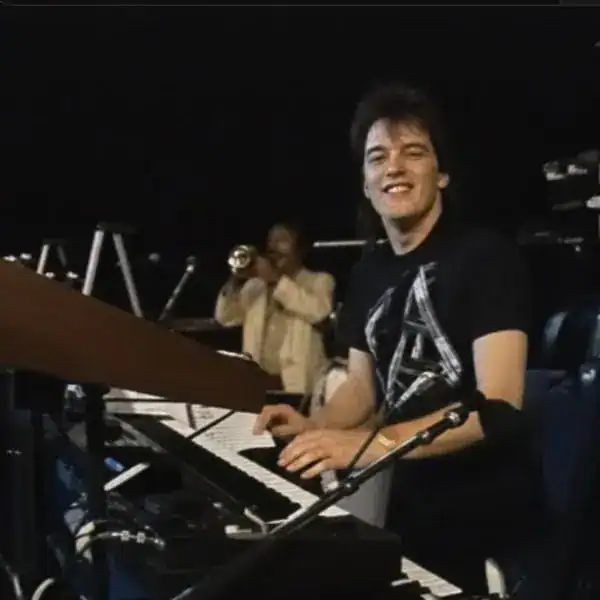
Richard Cottle helped supply the musical detail behind one of David Bowie’s most elaborate stage productions. On the Glass Spider Tour of 1987, his responsibilities encompassed keyboards, saxophone, tambourine and backing vocals. The spectacular scenery and choreography attracted much of the attention, but beneath that visual activity stood a working band responsible for carrying Bowie’s songs through a demanding international schedule.
Cottle arrived with experience that suited the assignment. His background combined wind instruments, rock performance and increasingly sophisticated electronic keyboards. Recording work with The Alan Parsons Project, together with sessions for other major artists, had already established his ability to move between a musical part and the sound required to deliver it. His earlier work with Peter Frampton also connected him with another musician who would become central to Bowie’s 1987 touring group.
His Bowie association belongs within a much broader career. Alongside the stadium performances were studio recordings, soundtrack work, production, library music and continuing connections with jazz. Following those activities reveals a musician whose contribution often lay in making several different musical worlds function together. The Glass Spider assignment was a particularly visible expression of that versatility.
- Name: Richard Cottle.
- Born: 26 June 1960, Swansea, Wales.
- Principal instruments: Keyboards, synthesizers, saxophone and clarinet.
- David Bowie connection: Member of the 1987 Glass Spider touring band.
- Tour responsibilities: Keyboards, saxophone, tambourine and backing vocals.
- Other important associations: The Alan Parsons Project, Alan Parsons, Peter Frampton and Mike Oldfield.
- Additional work: Session recording, production, music for libraries and soundtrack-related assignments.
- Later Bowie-related appearance: The Glass Spider Band, featuring Cottle and Erdal Kızılçay, in London in December 2013.
1960 onwards: A musical family in Swansea
Richard Cottle was born in Swansea, South Wales, on 26 June 1960. Music was a shared family activity rather than an interest pursued in isolation. His brothers Dave and Laurence also developed professional musical careers, creating a family connection that would continue through recordings and occasional performances.
Dave Cottle’s account of the brothers’ early music-making describes them playing traditional jazz with their father, Peter, at the piano. That repertoire brought together collective playing, melody and rhythmic conversation. In such music, a player must understand how a line fits around the other instruments, leaving room for another voice while retaining a recognisable contribution of his own.
The family’s later Dixieland projects preserve that connection. Their advertised repertoire reaches into early New Orleans music and the British traditional-jazz revival, with Richard appearing on piano, clarinet and saxophone. These activities provide an important background to the synthesizer specialist familiar from his rock credits. Wind instruments and ensemble music were already part of his musical identity before electronic keyboards became a major professional responsibility.
The 1970s: From clarinet and saxophone to Hammond organ
Cottle’s own recollection places the clarinet first, followed by the saxophone. During his teenage years, he began playing with local rock groups. This introduced a different setting from traditional jazz: amplified instruments, contemporary repertoire and the practical demands of small-band performances.
Richard Cottle on his first instrument
“The clarinet was my first instrument”
— Richard Cottle, quoted in The Avenue’s Richard Cottle biography.
A particular opportunity arose while he was playing in Wales with Alkatraz. When the keyboard player could not attend the final performance of a short run of dates, Cottle volunteered to cover the position. He learned the necessary chords and performed on Hammond organ. His account presents this as the practical beginning of a much deeper involvement with keyboards.
The episode concerns a musical need rather than a planned change of identity. He took on another instrument to keep a performance working. That willingness to extend his responsibilities would later become professionally valuable, particularly in touring groups where one musician might be required to supply several contrasting sounds within a single concert.
The late 1970s and early 1980s: Moving into London’s working music scene
By the time Sound On Sound interviewed him in 1986, Cottle had been based in London for several years. The magazine described his move from Swansea with a band and a subsequent job at Rod Argent’s Keyboards. Employment in that environment placed him close to the instruments becoming central to contemporary recording.
This was a period in which the keyboard player’s available vocabulary was expanding rapidly. Analogue synthesizers, digital instruments, sequencers and sampling systems offered different ways of building an arrangement. A working musician needed to understand how an instrument responded, how to prepare useful sounds and how to make those sounds fit alongside drums, bass, guitars and voices.
Cottle’s developing session career brought those practical and musical skills together. The work required adaptability: an effective contribution to a singer’s record could be very different from the part needed by an established rock band. His subsequent credits show him moving between both settings, with keyboards becoming a principal point of entry while saxophone remained part of his professional range.
1983–1984: Early recording credits and contrasting musical settings
Cottle’s early recording history includes work with Charlie and the John Verity Band, followed by credits involving Public Image Ltd. and John Parr. These associations placed him within markedly different approaches to rock and pop. They also establish that his professional recording life was underway well before the invitation to tour with Bowie.
His contribution to Public Image Ltd.’s This Is What You Want… This Is What You Get, released in 1984, belongs to the session work surrounding that album. It connects Cottle with a recording environment far removed from the polished melodic rock with which some of his later credits would associate him.
The same year brought keyboard work on John Parr’s self-titled debut album. Taken together, these credits demonstrate the breadth of the assignments available to a versatile session player. They do not suggest that each artist wanted the same keyboard language. The useful skill was the ability to enter an existing musical direction and contribute something appropriate to that particular record.
1984: Keats and the musicians around Alan Parsons
The 1984 album Keats placed Cottle within a circle of musicians closely connected with Alan Parsons. The group included Colin Blunstone, Ian Bairnson, David Paton, Stuart Elliott and Pete Bardens, with Parsons producing. Cottle contributed additional keyboards and saxophone.
This was a setting built around experienced players and carefully developed songs. Blunstone’s distinctive singing, Bairnson’s guitar and the rhythm section supplied established musical personalities. Additional keyboards had to find their place within that framework, supporting the material without obscuring the instruments already carrying its main movement.
The album also provides a bridge into Cottle’s longer association with Parsons. The connection extended beyond one band name or a single release. Musicians from the same professional circle appeared in different combinations across albums and other projects, allowing working relationships to continue as the surrounding repertoire changed. For Cottle, this network became an important part of his recording career during the middle of the decade.
1985: Joining the recorded world of Vulture Culture
Cottle contributed to The Alan Parsons Project’s Vulture Culture, released in 1985. The album combined concise songs with instrumental material, including Let’s Talk About Me, Days Are Numbers (The Traveller), Sooner or Later and Hawkeye. His synthesizer and saxophone work became part of that varied musical setting.
The Project’s identity depended on the partnership between Alan Parsons and Eric Woolfson, supported by invited musicians and singers. Woolfson’s songwriting and keyboard contributions existed alongside Parsons’ production and engineering. Cottle entered this established division of creative responsibilities as an instrumental contributor.
That organisation allowed specialist abilities to become important without every participant occupying the same role. A keyboard player could help determine a recording’s colour and movement while the central songwriting partnership remained intact. Cottle’s participation therefore belongs both to the album’s personnel history and to the development of its electronic sound.
1985: Ladyhawke and music written for the screen
The film Ladyhawke, released in 1985, supplied another connection with the Parsons circle. Its score was composed by Andrew Powell, with Alan Parsons handling production and engineering. Cottle is credited on keyboards, alongside musicians including Ian Bairnson and Stuart Elliott.
The soundtrack combined orchestral writing with the sounds of contemporary recording. This brought different demands from those of a conventional vocal album. Music for a dramatic scene must respond to pacing, atmosphere and changes of action, while instrumental themes can carry emotional information without a lyric explaining their purpose.
Cottle’s contribution forms part of that larger construction. His presence on the soundtrack demonstrates how the same professional relationships could extend from records into film. It also adds an early example of work in which keyboards served a visual narrative. The credit is for instrumental performance within Powell’s score; the composition and production responsibilities remain attached to the people named for those roles.
1985–1986: Stereotomy and the craft of electronic keyboards
On Stereotomy, Cottle continued working with The Alan Parsons Project as digital recording became increasingly important to its studio process. The album included the forceful title track, the ballad Limelight and instrumental pieces such as Urbania and Where’s the Walrus?.
A contemporary Sound On Sound interview gives a direct view of his methods. His equipment combined analogue and digital instruments, including Sequential Prophet-5 synthesizers, a PPG Wave, an Emulator II and Yamaha equipment. The selection offered several different kinds of tone and response rather than a single universal keyboard sound.
Richard Cottle on a favourite synthesizer
“I’m a great lover of Prophet 5s”
— Richard Cottle, interviewed by Richard Elen, Sound On Sound, May 1986.
Parsons also described Cottle supplying an already balanced keyboard mix during recording. That detail shows how instrumental performance could overlap with sound preparation. The player was making decisions about the relationship between electronic parts before they reached the main recording console. Such responsibility required an understanding of the whole arrangement as well as the individual notes.
1986: Peter Frampton and a connection that preceded Bowie
Cottle played keyboards on Peter Frampton’s Premonition, released in 1986. Produced by Frampton and Pete Solley, the album involved an experienced cast that included musicians such as Tony Levin, Steve Ferrone and Omar Hakim. Cottle also toured with Frampton during this period.
This earlier association matters when considering the Glass Spider band. Frampton and Cottle were already professional colleagues before appearing together behind Bowie. The 1987 group therefore brought together both new combinations and existing working relationships. Its members did not all arrive as strangers to one another’s playing.
Frampton’s guitar occupied a prominent position in the sound of the forthcoming Bowie tour. Cottle’s earlier work with him provides relevant background to their subsequent appearance in the same ensemble. It establishes a professional connection without requiring an undocumented story about who recommended him or how Bowie’s final personnel decisions were made.
1986: Eric Clapton and the sessions surrounding August
Another significant credit from 1986 connects Cottle with Eric Clapton’s August. He contributed synthesizer to It’s in the Way That You Use It, a song written by Clapton and Robbie Robertson. His brother Laurence played bass on the recording.
The track places the Cottle brothers within a prominent commercial rock setting. Richard’s electronic contribution sits within an arrangement also involving guitar, rhythm instruments and keyboards from other players. This is a session credit whose significance lies in a particular recording rather than an assumption that one musician performed every keyboard part across an entire album.
The brothers’ careers developed independently, but their recording histories occasionally intersected. By the time Bowie’s tour assembled, Richard’s experience already included major studio productions, guitar-led touring and the practical discipline of contributing to music released under another artist’s name.
1987: Gaudi and the continuation of the Parsons partnership
Gaudi, released in 1987, continued Cottle’s association with The Alan Parsons Project. Inspired by the life and work of the Catalan architect Antoni Gaudí, the album moved between extended dramatic writing and more compact songs. Its repertoire included La Sagrada Familia, Standing on Higher Ground and Closer to Heaven.
Richard contributed synthesizer and saxophone, while Laurence also participated in the album. Their involvement placed the brothers within a recording concerned with contrasts of scale: an expansive opening piece could sit alongside a direct, rhythmically focused song, with the instrumental Paseo de Gracia providing another kind of conclusion.
For Richard, this work sustained a studio relationship established before the Bowie tour. Parsons and Woolfson developed conceptually linked recordings, while Bowie was preparing a theatrical concert production. Cottle’s experience in the former helps explain the range of musical and technical abilities he could bring to the latter.
1987: Itchy Fingers and the production of Quark
Cottle’s work during this busy period also included Quark by Itchy Fingers. The 1987 album was co-produced by Cottle and saxophonist and composer Mike Mower. Its expanded arrangements placed the saxophone group alongside electronic keyboards and a rhythm section.
Laurence Cottle played bass, with Jeremy Stacey on drums among the additional contributors. The project connected jazz instrumentation with a more heavily produced recording environment. Richard’s responsibilities extended into the way the music was presented, giving him a role beyond that of an invited keyboard player.
Quark brings several strands of his career together: wind instruments, synthesizers, family collaboration and production. It also shows that the year of the Glass Spider Tour contained work outside Bowie’s organisation. His professional identity continued to develop through other recordings even while the tour would provide his most widely circulated stage appearance.
1987: Bowie prepares the Glass Spider production
Bowie’s Never Let Me Down appeared in April 1987, preceding the international tour that took its name from Glass Spider, one of the album’s songs. The concert production combined music with choreography, character, lighting and a giant spider-shaped stage structure.
This setting asked the musicians to function within a show whose action extended beyond the usual positions of singer and accompanying band. Bowie’s movements, the dancers’ entrances and the changing visual scenes formed part of the audience’s experience. The musical performance had to remain coherent while attention moved between those elements.
Cottle’s documented Bowie role belongs to the touring band. The original studio album and the subsequent concert arrangements have their own personnel histories. On stage, his task was to help realise a programme that combined recent recordings with songs from several earlier periods.
March 1987: The promotional performances before the stadium tour
Before the main tour opened, Bowie undertook a series of promotional press performances in March 1987. These appearances brought the music into smaller venues in cities including Toronto, New York, London, Paris, Rome and Amsterdam. Cottle was among the musicians accompanying him.
The press-show personnel listed in the tour chronology included Bowie, Carlos Alomar, Peter Frampton, Carmine Rojas, Alan Childs and Cottle. These performances belong to the preparation and promotion surrounding the tour, preceding the complete stadium production that opened in Rotterdam.
His association with the project was therefore already public before the first large-scale concert. The smaller appearances also provide a different context for the band: the musicians could present the material without every element of the enormous touring set. They form part of the transition from a new album’s launch to the much larger spectacle that followed.
1987: The musicians beneath the spider
Bowie’s principal touring band comprised Carlos Alomar and Peter Frampton on guitars, Carmine Rojas on bass and Alan Childs on drums. Erdal Kızılçay contributed keyboards, trumpet, congas and violin, while Richard Cottle supplied keyboards, saxophone, tambourine and backing vocals.
Cottle shared the keyboard responsibilities with Kızılçay. Contemporary technical coverage describes a division that included conventional keyboard parts and more elaborate electronic sounds. Their additional instruments also allowed the group to change its musical combination during the concert.
The tour chronology records preparations in New York and Rotterdam before the opening stadium performances. These rehearsals brought the band together with Bowie, the dancers and the production’s theatrical framework.
1987: Cottle’s keyboards and saxophone
Contemporary equipment reporting lists Sequential Prophet-5 synthesizers, Yamaha DX instruments and a PPG Wave 2.3 among Cottle’s touring equipment. His setup combined different electronic sound sources rather than relying on a single keyboard.
He also used a Selmer alto saxophone. Together with his tambourine and backing-vocal credits, this establishes the range of his assignment. The available personnel information does not, however, provide a complete song-by-song allocation of every instrumental part.
1987: Bringing the new album onto the stage
Material from Never Let Me Down formed a substantial part of the tour’s musical identity. Songs represented in the official concert releases include Day-In, Day-Out, Bang Bang, Never Let Me Down and Glass Spider. Other selections, preserved in the Montreal recording, include Time Will Crawl and Beat of Your Drum.
Performing these songs required the touring musicians to establish live versions of recently issued recordings. The arrangements existed within a larger programme, so their impact also depended on what came before and after them. A new song could introduce the current album’s sound, support a theatrical episode or change the pace of the evening.
For Cottle, this work involved contributing to the album’s concert life. The keyboard position helped place recent material alongside songs whose studio origins reached much further back. The changing programme consequently asked the band to create continuity between different recording eras while retaining the musical identity of the individual selections.
1987: Revisiting Bowie’s earlier catalogue
The Glass Spider repertoire extended beyond recent hits. Official releases preserve performances of songs such as Time, Sons of the Silent Age, All the Madmen and Big Brother. These choices brought theatrical and less routinely performed material into the same programme as Bowie’s better-known commercial successes.
Such selections gave the touring musicians a broad historical task. The songs had originated with different players, recording methods and musical priorities. A 1987 arrangement had to translate that material into the instruments and personnel available on the road.
The repertoire also created room for different voices within the group. Frampton’s vocal participation in Sons of the Silent Age, for example, contributed to that song’s live presentation. Cottle worked within this wider distribution of responsibilities, helping a contemporary touring band carry material drawn from several distinct chapters of Bowie’s recorded career.
30 May 1987: Opening night in Rotterdam
The main Glass Spider Tour opened at Stadion Feyenoord in Rotterdam on 30 May 1987. The date was also the sixteenth birthday of Bowie’s son, Duncan. For the musicians, it marked the point at which preparations became a public stadium performance.
A surviving handwritten note from Bowie gives a direct connection with the band. Preserved in photographer Denis O’Regan’s collection and subsequently catalogued by Propstore, it addresses the musicians by their first names: Alan, Carmine, Peter, Erdal, Carlos and Richard. The message thanks them collectively for their work before the opening show.
David Bowie to the Glass Spider band
“I thank you all for your tremendous work.”
— David Bowie, handwritten note to his band, 1987; reproduced in Propstore’s catalogue of the Denis O’Regan collection.
Richard’s inclusion places him explicitly within that working group. The note records Bowie acknowledging the musicians who had prepared the performance with him. It offers contemporary evidence of the collective effort behind a production more often remembered through photographs of its enormous stage.
Summer 1987: Taking the production through Europe
Following the opening Rotterdam concerts, the European itinerary included Berlin’s Platz der Republik on 6 June, Italian stadium performances and dates at Wembley Stadium. Cottle remained part of the touring ensemble as the production travelled between festivals and major concert venues.
These performances preceded the North American and Australasian legs. The itinerary documents the geographical extent of his Bowie assignment, from the earlier promotional appearances to the final concerts later in the year.
30 August 1987: The Montreal concert preserved on record
The performance at Montreal’s Olympic Stadium on 30 August 1987 became an important audio document of the tour. Later released as Glass Spider (Live Montreal ’87), it preserves the musicians’ work in a form that can be heard independently of the stage film.
Audio encourages a different kind of attention. The listener can follow the relationships between guitars, rhythm instruments, keyboards and voices without the scenery and choreography determining where to look. The concert remains a complete ensemble performance, but its instrumental organisation becomes easier to consider on its own terms.
For Cottle’s Bowie history, the release supplies a substantial official record of the touring assignment. His keyboard and saxophone credits are carried into the published recording, connecting the name in the personnel list with a performance available to later listeners. The Montreal concert also preserves material absent from the familiar Sydney film, widening the surviving picture of the band’s repertoire.
November 1987: Sydney and the Glass Spider concert film
The tour’s Australian performances supplied the footage for the Glass Spider concert film. Directed by David Mallet, the production was filmed in Sydney in November 1987 and released the following year. It became the most familiar moving-image document of Cottle’s work with Bowie.
The film preserves the relationship between musical performance and visual spectacle. Wide shots reveal the scale of the spider-shaped set, while closer views bring individual musicians and dancers into focus. Cottle appears within that changing visual account of the concert, alongside the other members of the touring band.
A concert film is also an interpretation shaped by camera positions and editing. Its sequence of images directs attention in ways that differ from being present in the venue. Nevertheless, it provides evidence of the production’s working form: the costumes, instrumental positions, choreography and repertoire become visible together. For a musician whose studio contributions often remained out of sight, this was an unusually extensive public record.
Late 1987: The end of the tour and its divided reputation
The Glass Spider itinerary concluded in Auckland on 28 November 1987. By then, the production had travelled through several continents and become one of the most conspicuous undertakings of Bowie’s career. Its combination of rock concert and theatre continued to divide opinion long after the final performance.
Bowie’s later reflections acknowledged the difficulty of translating simultaneous stage activity to very large venues. The distance between performer and spectator could turn several carefully devised events into a confusing overall image. That observation helps explain why the production can appear different in recollection, concert footage and an account from a particular seat.
Assessing Cottle’s contribution requires attention to the musical work within that larger reception. The touring band had a concrete task: to perform an extensive programme inside a complex show. Its arrangements and ensemble playing remain audible in the surviving recordings, allowing listeners to consider those achievements alongside the production’s more contested visual ambitions.
1989–1992: Returning to a wide range of recording work
After the Bowie tour, Cottle’s recording credits continued across mainstream pop and rock. Work from the following years included projects associated with Paul Young, Foreigner, Rod Stewart and Bad Company. These records placed him in different musical settings rather than extending one fixed touring identity.
His keyboard credit on Manic Street Preachers’ Generation Terrorists, released in 1992, adds another connection to this period. The album belonged to a different generation of British rock musicians, demonstrating how a session career could connect artists with very different public images.
Such work is often dispersed across album credits rather than gathered into a single visible narrative. Cottle’s post-tour activity broadens the perspective on his Bowie appearance: the stadium assignment was followed by further participation in the recording industry, with keyboards providing a recurring contribution across changing artists and production teams.
1990: Freudiana and a continuing connection with Eric Woolfson
Freudiana, released in 1990, continued Cottle’s involvement with music made around Eric Woolfson and Alan Parsons. He contributed synthesizer and saxophone to a project whose subject matter drew on the world of Sigmund Freud and psychoanalysis.
The recording connected concept-album practice with Woolfson’s growing interest in musical theatre. Its range of singers and dramatic situations created a framework in which instrumental parts supported a larger sequence of ideas. Cottle’s contribution belongs within that recorded ensemble and its carefully constructed production.
The project also marks the continuation of professional relationships beyond the original run of Alan Parsons Project albums. His participation followed the work into another setting, maintaining a connection with the people developing the music.
1992: Performing Tubular Bells II with Mike Oldfield
On 4 September 1992, Cottle played keyboards in the Edinburgh Castle performance of Mike Oldfield’s Tubular Bells II. Laurence Cottle was also involved, playing bass. The concert brought the brothers into another major filmed musical event.
Oldfield’s extended instrumental work required a different kind of concentration from a programme of separate rock songs. Themes, recurring figures and transitions contribute to a continuous musical structure. Individual players must understand how their entrances relate to that larger progression, particularly when the arrangement distributes material across several instrumentalists.
Richard’s appearance supplies a significant live credit after the Glass Spider period. It places him within an ensemble assembled to present a large-scale studio conception on stage, while the Edinburgh setting gave the performance its own visual identity. The surviving film offers another opportunity to see his work within a coordinated group, this time serving Oldfield’s instrumental writing rather than Bowie’s theatrical song programme.
1993–1996: Alan Parsons’ solo recordings and live performances
Cottle continued working with Alan Parsons during the 1990s. He contributed synthesizer and saxophone to Try Anything Once, released in 1993, and keyboards and saxophone to On Air, released in 1996.
His playing also appears on recordings from Parsons’ European tour of 1994. A live album was released in Europe that year; the American 1995 edition, The Very Best Live, added three studio recordings.
These performances gave material from The Alan Parsons Project a touring life under Parsons’ own name. The original Project had been a studio partnership between Parsons and Eric Woolfson; the later concert band was a separate performing organisation.
The later 1990s: Pop sessions and changing keyboard responsibilities
Cottle’s later-1990s credits continued to combine conventional playing with electronic preparation. His work included Tina Turner’s Wildest Dreams, Vanessa-Mae’s Storm and Céline Dion’s Let’s Talk About Love. The listed responsibilities across these projects encompassed keyboards, programming and Fender Rhodes.
These distinctions describe different kinds of contribution. Playing an electric-piano part involves touch, timing and harmonic placement. Programming can involve preparing material or sounds that become part of the arrangement through another process. Both require musical judgement, although their working methods and their relationship to the final performance can differ.
The later credits show that Cottle’s abilities remained relevant as production styles changed, extending his working life beyond the particular instruments and equipment associated with 1987.
1996–1999: Writing for production-music libraries
Music-library releases form another strand of Cottle’s career. Titles associated with his writing include Dance Power, Creative Image and Euro Graffiti. These recordings belong to the world of production music, prepared for possible use in television, film, advertising and other media.
Creative Image brought his name together with Simon Chamberlain and Dave Arch, while Euro Graffiti, issued in 1999, paired him with John Gallen. Such releases make the writing role more explicit than a conventional session credit on another artist’s album.
Library music also changes the relationship between composition and audience. A piece may be encountered within a programme or sequence rather than as a named performer’s commercial single. Its usefulness can depend on a clearly established mood, a particular rhythmic character or a shape that accommodates visual editing. Cottle’s involvement extended his musical activity into this less publicly visible but professionally important field.
Around 2000: Family priorities and soundtrack-related work
A biography published by The Avenue describes Cottle reducing touring during the later 1990s in order to spend more time near his family. This was a change in the balance of his work. Studio assignments and writing offered different working patterns from an extended international itinerary.
His credits for the 2000 television production Arabian Nights include synthesizer arrangements and sound design. The assignment brought his experience with electronic instruments into a dramatic screen production, continuing a strand already visible in the earlier Ladyhawke work.
These responsibilities show the breadth of a musician’s possible involvement in a soundtrack. Preparing and shaping electronic material can be an important part of the finished musical environment while remaining distinct from composing the complete score. Cottle’s career at this point encompassed performance, writing and the construction of recorded sound.
2006: Producing Ian Shaw’s Drawn to All Things
Ian Shaw’s Drawn to All Things, released in 2006, provides a clear example of Cottle working as a producer. The album explored the songs of Joni Mitchell, bringing Shaw’s voice into arrangements performed by an extensive group of jazz musicians. Cottle also contributed additional keyboards.
Shaw’s accompanying notes acknowledge Cottle’s role in shaping the project. The recording involved musicians including pianists Janette Mason and Tim Lapthorn, bassist Simon Little and drummer Mark Fletcher, with further instrumental and vocal guests.
Ian Shaw on working with Richard Cottle
“the extraordinary ears of the producer richard cottle”
— Ian Shaw, album notes for Drawn to All Things, reproduced by the Linn distributor.
The project brought Cottle back into close contact with jazz performance and interpretation. He helped organise the recorded presentation of another singer’s encounter with an established songwriter’s catalogue. That is a different creative position from his touring work with Bowie, yet it draws on the same attention to instrumental relationships and the requirements of a song.
2007: A new release brings Glass Spider back into view
The 2007 DVD release of Glass Spider renewed access to the Sydney concert film. Bowie’s official announcement described a standard edition and a version accompanied by a double live CD. The package placed the visual production and an additional concert recording alongside one another.
The audio and film programmes were not identical. The CD included songs absent from the DVD, while the film preserved encore performances involving guest guitarist Charlie Sexton. These differences make the releases complementary documents of the tour rather than interchangeable presentations of one concert.
For Cottle’s place in Bowie’s history, the reissue returned the band’s performance to circulation for another generation of listeners. A musician associated with a single major Bowie tour could now be encountered through an official digital presentation of the film, accompanied in the expanded edition by a fuller audio programme.
December 2013: Returning to the repertoire with The Glass Spider Band
In December 2013, Cottle revisited the Bowie connection with Erdal Kızılçay. Their participation in The Glass Spider Band brought two original tour musicians together for a performance at Under the Bridge in London on 17 December. Bowie’s official website announced the event.
Kızılçay also discussed Cottle’s involvement in an interview with Paul Sinclair for SuperDeluxeEdition. His statement provides a direct acknowledgement from a fellow member of the original touring group.
Erdal Kızılçay on the returning keyboard player
“We also have Richard Cottle the keyboard player who participated in the original Glass Spider tour with me.”
— Erdal Kızılçay, interviewed by Paul Sinclair, SuperDeluxeEdition, 11 December 2013.
This was a later celebration of the repertoire, with a different performing group and no appearance by Bowie. Its significance lies in the continuity supplied by the two original musicians. They brought their own connection with the 1987 production into a new setting, allowing that period to be revisited through live performance as well as archival recordings.
2018: The Montreal recording enters Loving the Alien
The box set Loving the Alien (1983–1988), released in 2018, gave the Glass Spider period a substantial place within Bowie’s official archival programme. Its contents included the Montreal concert recording, presented alongside studio albums and other material from the surrounding years.
This setting encouraged a broader view of the period. The tour could be heard as part of Bowie’s continuing recorded history, with its own arrangements and personnel, rather than encountered solely through a retrospective judgement about the stage spectacle. Cottle’s contribution remained part of the musical evidence available for that reassessment.
The musicians heard on the live album were playing in 1987; the later box set brought that work into another archival context. Cottle’s appearance on the 2018 release therefore extends the availability of his historical Bowie performance rather than marking a new recording collaboration.
Family jazz and later reflections on a working musical life
The Cottle brothers’ later family performances retain a connection with the music of their early years. Dave Cottle’s presentation of their traditional-jazz group lists Richard on piano, clarinet and saxophone. It offers a companion to the elaborate synthesizer setups associated with his 1980s recording and touring work.
In March 2025, Music Production Lounge published an interview with Cottle conducted by Derik Timms, presenting his career through its connections with Bowie, Clapton and other artists. The interview’s publication supplies a later opportunity to hear from the musician himself about a professional life spanning different settings.
The family performances keep conventional instruments and ensemble music in view, while the retrospective interview recognises the wider career behind the familiar credits. Both help restore the individual musician to a history that can otherwise appear as a succession of famous names on record sleeves.
Legacy: Richard Cottle’s place in Bowie’s live history
Richard Cottle’s documented contribution to David Bowie’s career centres on the 1987 Glass Spider Tour. His keyboards, saxophone, tambourine and backing vocals formed part of the ensemble heard during the promotional appearances and the international concert itinerary.
The Sydney film and Montreal live recording preserve complementary accounts of that work. The film shows the musicians within the theatrical production; the audio recording allows closer attention to the concert arrangements and includes repertoire absent from the film.
His significance lies in helping perform that demanding programme. His earlier studio and touring experience supplied the background for an assignment involving several instruments and contrasting periods of Bowie’s catalogue. The 2013 performance with Erdal Kızılçay later renewed his public connection with the repertoire.
Official Websites & Further Information
David Bowie’s official website provides release announcements and archival news connected with the Glass Spider period. Its material includes information about the concert-film reissue and the later London performance featuring Cottle and Erdal Kızılçay.
The Alan Parsons Project’s official website supplies album information and background on the musicians involved in the recordings. It is particularly useful for placing Cottle’s work on Vulture Culture, Stereotomy and Gaudi within the Project’s history.
Dave Cottle Music documents the family’s traditional-jazz connection. For a later spoken retrospective, the Music Production Lounge interview with Richard Cottle offers a further point of reference.
Article Origin
This article was researched and written for DavidBowieWorld.com as part of its archive of David Bowie’s collaborators and creative circle. It brings together Cottle’s documented touring role, selected recording credits, published interviews and official release information to place his Bowie association within his broader professional career.
Quotations are attributed to their published sources. The original studio recordings, the 1987 concert performances and their later archival releases are treated according to their separate dates and personnel. Musical commentary concerns the function of the instruments and arrangements; it does not imply access to private conversations or unpublished testimony.
This is an independent editorial account. It does not claim personal participation, review or endorsement by Richard Cottle, his collaborators or David Bowie’s representatives.
© DavidBowieWorld.com — David Bowie Collaborations & Creative Circle Archive.

Leave a comment