Brian Duffy – Photographer of David Bowie’s Five Iconic Sessions
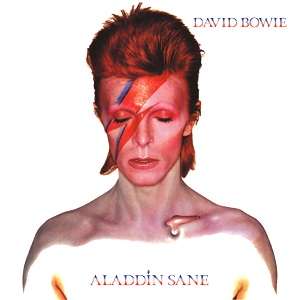
David Bowie photographed by Brian Duffy for the cover of Aladdin Sane, 1973.
Image credit: The Duffy Archive.
© The Duffy Archive & The David Bowie Archive™.
Brian Duffy was a British photographer whose five photographic sessions with David Bowie between 1972 and 1980 produced some of the most recognisable images of Bowie’s career.
Duffy first photographed Bowie as Ziggy Stardust in 1972. Their subsequent collaborations included the celebrated cover of Aladdin Sane in 1973, photographs made during the production of The Man Who Fell to Earth in 1975, and album imagery created for Lodger in 1979 and Scary Monsters (and Super Creeps) in 1980.
Three of these sessions provided the photographic foundations for official David Bowie album covers. Together, the five collaborations document Bowie’s changing visual presentation from Ziggy Stardust and Aladdin Sane through the mid-1970s film period, Lodger and the Pierrot imagery of Scary Monsters.
- Name: Brian Duffy
- Born: 15 June 1933, London, England
- Died: 31 May 2010
- Profession: Photographer, film producer and director
- Bowie connection: Five photographic sessions with David Bowie between 1972 and 1980
- Bowie album covers: Aladdin Sane, Lodger and Scary Monsters (and Super Creeps)
- Other Bowie sessions: Ziggy Stardust in 1972 and The Man Who Fell to Earth / White Sands in 1975
- Known for: Fashion, portrait, advertising and music photography
Early Life

Brian Duffy was born in London on 15 June 1933 to Irish parents. One of five children, he initially grew up in north London before his family moved to East Ham when he was five years old.
Duffy spent much of his childhood in wartime London. After two attempts to evacuate him and several of his siblings, his mother decided that the family would remain together. Duffy subsequently remembered running freely through the city and exploring bomb-damaged sites.
His formal education was unsettled. At one of the schools he attended, a programme intended to introduce difficult pupils to culture took him to art galleries and other cultural institutions. These experiences encouraged an interest in art and helped lead him towards formal creative training.
In 1950, Duffy enrolled at Saint Martin’s School of Art in London with the intention of studying painting. He was impressed by the ability of the painting students and soon transferred to dress design, a course he also recalled as being particularly attractive because of the number of young women studying it.
The change of direction began Duffy’s professional involvement with fashion. His understanding of clothing, fabric and construction would later become an important practical advantage when he moved from fashion design into photography.
From Fashion Design to Photography
After completing his dress-design course at Saint Martin’s in 1953, Brian Duffy worked as an assistant designer for Susan Small Dresses and later for Victor Stiebel, whose clients included Princess Margaret.
This early professional experience gave Duffy a practical understanding of clothing, fabric and construction. When he later became a fashion photographer, he already understood how garments were designed and how they were intended to hang on the body.
During the mid-1950s, Duffy was offered an opportunity to work for the Paris fashion house Balenciaga. He declined the position because June, his future wife, was expecting their first child, Chris, and he remained in Britain.
Duffy subsequently worked as a freelance fashion illustrator, including assignments for Harper’s Bazaar. While working in an art department, he became fascinated by photographic contact sheets passing across the art director’s desk and began considering photography as a new professional direction.
His application for a position with studio photographer John French was unsuccessful. Duffy then gained experience at Carlton Studios and Cosmopolitan Artists before becoming an assistant to photographer Adrian Flowers.
While working in Flowers’ studio, Duffy received his first independent photographic commission from The Sunday Times fashion editor Ernestine Carter. In 1957, he was hired by British Vogue, beginning the period in which he established himself as a professional fashion photographer.
British Vogue and the Swinging Sixties
In 1957, Brian Duffy joined British Vogue, working under editor Audrey Withers and art director John Parsons. The appointment gave him regular access to the leading models, designers and fashion editors of the period.
During his years with the magazine, Duffy photographed models including Jean Shrimpton, Paulene Stone, Joy Weston, Jennifer Hocking and Judy Dent. He remained part of the magazine’s core photographic team until 1962 and continued to contribute fashion photography after leaving his staff position.
Duffy belonged to a new generation that moved fashion photography away from the controlled formality associated with much of the previous decade. He frequently photographed models in streets, parks and other recognisable locations, allowing movement, personality and contemporary urban life to become part of the image.
In 1961, Duffy began working in New York for the American magazine Glamour. The following year, Swiss art director Peter Knapp commissioned him to photograph fashion in Paris for the French edition of Elle, beginning the first of two extended periods of work for the magazine.
Duffy’s work was not confined to fashion. He also contributed to the newly established colour supplement of The Sunday Times, where his assignments included portraits of writers and cultural figures such as William S. Burroughs and Gregory Corso.
By the beginning of the 1960s, Duffy had established himself across fashion, portraiture and editorial photography. His work became closely associated with the changing visual culture of London at a time when fashion, music, film, advertising and youth culture were becoming increasingly interconnected.
The Black Trinity
Brian Duffy’s rise coincided with that of fellow photographers David Bailey and Terence Donovan. The three men came from backgrounds outside the traditional British social establishment and became prominent representatives of a new generation within fashion photography.
In 1962, The Sunday Times referred to Duffy, Bailey and Donovan as the “Terrible Trio”. Photographer Norman Parkinson called them the “Black Trinity”, another name that became closely associated with their collective influence on British photography.
Unlike many photographers who remained largely unknown outside their profession, Duffy, Bailey and Donovan developed recognisable public identities. They mixed with models, actors, musicians, writers and other cultural figures, and their own personalities became part of the changing relationship between photography, fashion and celebrity.
The three photographers were friends as well as professional competitors. Their rivalry encouraged experimentation, while their refusal to accept established social and professional conventions helped alter the position of the fashion photographer within the publishing industry.
Duffy nevertheless maintained an identity distinct from Bailey and Donovan. Colleagues particularly respected his technical knowledge, visual intelligence and ability to solve complicated photographic problems before digital manipulation existed.
These qualities later became especially important during his collaborations with David Bowie, where photography, make-up, costume, set construction, printing and graphic design frequently had to be combined within a single image.
Portraits, Fashion and Film
In 1963, Brian Duffy established his own photographic studio in Swiss Cottage, north London. He was joined by Norman Brand, an experienced printer from Vogue who became Duffy’s personal photographic printer.
Alongside his fashion assignments, Duffy photographed prominent figures from music, film, literature and politics. His subjects included John Lennon, Nina Simone, Michael Caine, Brigitte Bardot, Sidney Poitier, William S. Burroughs, Reggie Kray and British prime minister Harold Wilson.
Duffy worked across editorial portraiture, fashion and social reportage for magazines and newspapers in Britain, France and the United States. His technical knowledge allowed him to construct complicated images and solve visual problems at a time when photographic effects had to be achieved in the camera, darkroom or printing process.
In 1965, Duffy photographed his first Pirelli Calendar on location in the south of France. The international commission demonstrated his ability to manage large-scale fashion productions outside the conventional studio environment.
Duffy also developed an interest in moving images. In 1967, he formed the production company Deighton Duffy with writer Len Deighton. They produced Only When I Larf, released in 1968, followed by Richard Attenborough’s directorial debut Oh! What a Lovely War in 1969.
After several years concentrating largely on film production, Duffy returned his attention to still photography in 1972. That year, he was commissioned to create a second Pirelli Calendar for publication in 1973, working with British pop artist Allen Jones and airbrush specialist Philip Castle.
The combination of photography, illustration and airbrush techniques developed for the Pirelli project became particularly relevant to Duffy’s next major collaboration. In August 1972, he photographed David Bowie as Ziggy Stardust, beginning their sequence of five photographic sessions.
The First Bowie Session: Ziggy Stardust – 1972
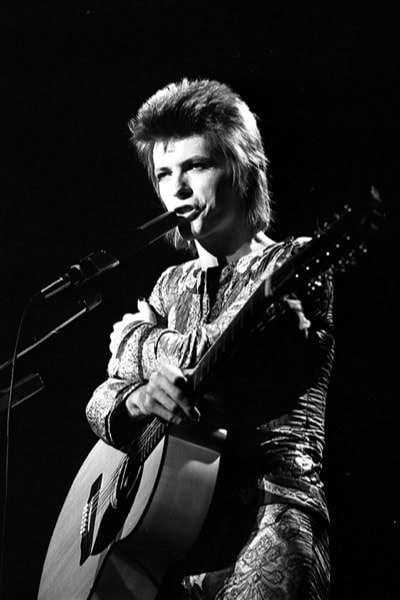
Brian Duffy first photographed David Bowie in August 1972, while Bowie was performing as Ziggy Stardust. It was the first of five photographic sessions that Duffy and Bowie would undertake between 1972 and 1980.
Bowie wore a two-piece quilted outfit that he had created with fashion designer Freddie Burretti. For Duffy’s photographs, he posed with a borrowed red teardrop-shaped twelve-string guitar.
The same costume had been worn several weeks earlier when Bowie and the Spiders from Mars performed Starman for Top of the Pops. Broadcast on 6 July 1972, the performance became one of the defining public appearances of the Ziggy Stardust period.
At the time of Duffy’s session, Bowie was approaching the end of the British dates of the Ziggy Stardust Tour before travelling to North America in September. His manager, Tony Defries, closely controlled photographic access to Bowie, and Duffy was among the selected photographers permitted to work with him during this rapidly developing stage of his career.
The photographs were not created for the original cover of The Rise and Fall of Ziggy Stardust and the Spiders from Mars. The album had already been released on 16 June 1972 with front and back cover photographs by Brian Ward.
Duffy’s photographs instead formed an independent Ziggy Stardust portrait session. Although they were not used for the original album cover, the images began an eight-year visual collaboration that would eventually produce three Bowie album sleeves.
The First Bowie Album Cover: Aladdin Sane – 1973
Aladdin Sane: David Bowie, Brian Duffy and that iconic photograph, presented by the Southbank Centre.
Five months after their first session, Brian Duffy and David Bowie worked together again on the visual presentation of Bowie’s sixth studio album, Aladdin Sane. The photographic session took place in London in January 1973.
The album followed the commercial breakthrough of Ziggy Stardust but required a distinct new visual identity. Rather than repeating Bowie’s earlier appearance, the cover presented him against a stark white background with red hair, pale skin and a red-and-blue lightning flash crossing his face.
Duffy was responsible for the photography and played a central role in developing the cover concept. The project was produced through Duffy Design Concepts, the company he operated with designer Celia Philo.
The wider creative team included make-up artist Pierre La Roche and illustrator and airbrush specialist Philip Castle. Duffy had recently worked with Castle on the 1973 Pirelli Calendar, where photography, illustration and airbrush techniques had also been combined.
The selected close-up portrait appeared on the front cover, while a full-length photograph from the same session was used inside the original gatefold sleeve. Both images presented Bowie against the same white background and formed part of a single carefully controlled visual design.
Released in April 1973, Aladdin Sane became David Bowie’s first number-one album in the United Kingdom. It was also the first of three Bowie albums whose cover imagery was photographed by Brian Duffy.
Creating the Aladdin Sane Image
Tony Defries wanted the Aladdin Sane artwork to present Bowie as a major international star. According to Brian Duffy, the brief was deliberately ambitious: the cover had to look exceptionally striking and expensive.
Brian Duffy on the Aladdin Sane brief
“Tony DeFries, his manager, wanted to make the most expensive cover you could possibly get a record company to pay for.”
Several accounts exist of how the lightning-flash design originated. Bowie was interested in the lightning bolt on Elvis Presley’s TCB jewellery, while the flash motif had already appeared in Bowie’s visual presentation. Duffy later also referred to the red-and-blue logo used by National Panasonic as a source of inspiration.
Celia Philo remembered the idea emerging through discussion during the session, with make-up artist Pierre La Roche suggesting that the flash should cross Bowie’s face. Although the precise origin cannot be attributed with certainty to one person, the surviving accounts agree that La Roche initially began a smaller flash and Duffy drew a much larger outline across Bowie’s face. La Roche then completed the design, using red lipstick as part of the make-up.
Duffy photographed Bowie at his studio at 151a King Henry’s Road in London in January 1973. He used a Hasselblad camera, Ektachrome 120 transparency film and a specially constructed ring flash, producing the bright, shadowless appearance that helped give the portrait its polished and almost unreal quality.
The photographic session itself was remarkably brief. Studio manager Francis Newman later recalled that the principal shoot lasted approximately twenty to thirty minutes and produced only two rolls of film.
After the shoot, illustrator Philip Castle refined the selected image under Duffy’s direction. He enhanced details around Bowie’s eyes and added the liquid-like symbol resting in the hollow of Bowie’s clavicle. This airbrushed element contributed to the cover’s strange mixture of glamour, vulnerability and theatrical artificiality.
Celia Philo coordinated the design and layout through Duffy Design Concepts. The final artwork was reproduced using the costly dye-transfer process, with specialist separation work carried out in Switzerland. Typography and production details were handled with Conways, helping create a sleeve reportedly regarded at the time as one of the most expensive album-cover productions yet undertaken.
According to Duffy’s later account, he also helped transform the phrase A Lad Insane into the written name Aladdin Sane. The completed cover was therefore not the work of a single individual, but the result of a closely coordinated collaboration between Bowie, Duffy, La Roche, Castle, Philo and the wider production team.
The Aladdin Sane Contact Sheets and “Eyes Open”
During the January 1973 session, Brian Duffy photographed several variations of the Aladdin Sane portrait. The surviving contact sheets preserve changes in Bowie’s expression, pose and position as Duffy worked towards the photograph selected for the album cover.
On the familiar cover, Bowie appears with his eyes closed. Duffy also photographed him in almost the same position with his eyes open, revealing the permanently dilated pupil of Bowie’s left eye. The condition resulted from an eye injury sustained during a fight with his friend George Underwood in 1962.
This alternative portrait was not used for the original album packaging and remained unpublished for more than three decades. After it was recovered and researched by the Duffy Archive, it was publicly released in 2010 under the title “Aladdin Sane – Eyes Open”.
Because the pose, make-up and composition closely resemble the photograph selected for the album, the alternative image has sometimes been mistaken for the original 1973 cover. The difference is immediately visible in Bowie’s open eyes and direct gaze towards the camera.
In 2013, the Victoria and Albert Museum worked with the Duffy Archive to select “Eyes Open” as the principal campaign image for the exhibition David Bowie is. The exhibition opened at the V&A in London on 23 March 2013 and subsequently travelled to venues around the world.
By the time the international tour ended at the Brooklyn Museum in New York on 15 July 2018, David Bowie is had been presented at twelve venues and welcomed more than two million visitors. To mark that achievement, the Duffy Archive donated a colour print of “Eyes Open” to the V&A’s permanent collection.
The later history of “Eyes Open” demonstrates the importance of the material preserved by the Duffy Archive. A photograph that had not appeared on the original album acquired a separate public identity four decades after the session and became one of the most widely recognised alternative portraits from Duffy and Bowie’s collaboration.
White Sands and The Man Who Fell to Earth – 1975
Brian Duffy’s third photographic session with David Bowie took place in New Mexico in 1975, during the production of Nicolas Roeg’s film The Man Who Fell to Earth. Duffy travelled to the location on an assignment commissioned by The Sunday Times.
Bowie played Thomas Jerome Newton, an extraterrestrial who comes to Earth in search of water for his drought-stricken planet. The role was Bowie’s first starring performance in a feature film. Filming began in July 1975 at several locations in New Mexico, and the completed film was released in 1976.
During the assignment, Duffy took Bowie to the White Sands desert. Away from the controlled environment of a studio, the open landscape and fading daylight provided a stark setting for a short series of experimental portraits.
According to accounts preserved by the Duffy Archive, Duffy exposed only two rolls of film at White Sands. He worked with a modified triple-flash unit and a long exposure. Bowie kept his head and body still while moving his hands during parts of the exposure, creating repeated and partially blurred hand movements around an otherwise sharply defined figure.
The resulting photographs show Bowie dressed in a dark suit and white shirt against the pale desert landscape. Their restrained clothing, angular poses and ghostlike movement differ sharply from the vivid make-up and saturated colour of the Aladdin Sane session two years earlier.
The Duffy Archive now identifies photographs from this series with the title “Thin White Duke”. However, the session took place before Bowie publicly established the Thin White Duke as the stage persona associated with Station to Station and the 1976 Isolar tour. The title is therefore best understood as a later description of Bowie’s emerging visual appearance rather than the original purpose of the assignment.
These photographs were not created for an album cover. They documented Bowie during a transitional period between the soul-influenced presentation of Young Americans, his performance as Thomas Jerome Newton and the austere visual identity that would accompany Station to Station.
Although separate from Duffy’s three Bowie album-cover projects, the White Sands photographs form the third of their five documented sessions and remain among the most distinctive portraits from Bowie’s mid-1970s career.
The Second Bowie Album Cover: Lodger – 1979

Brian Duffy and David Bowie worked together for a fourth time in February 1979, when Bowie returned to Duffy’s north London studio to create the cover artwork for Lodger. It was their first photographic collaboration since the White Sands session in 1975.
Lodger was Bowie’s thirteenth studio album and is generally regarded as the third and final part of the so-called Berlin Trilogy, following Low and “Heroes”, both released in 1977. Its lyrics and presentation repeatedly explored themes of travel, displacement, instability and cultural dislocation.
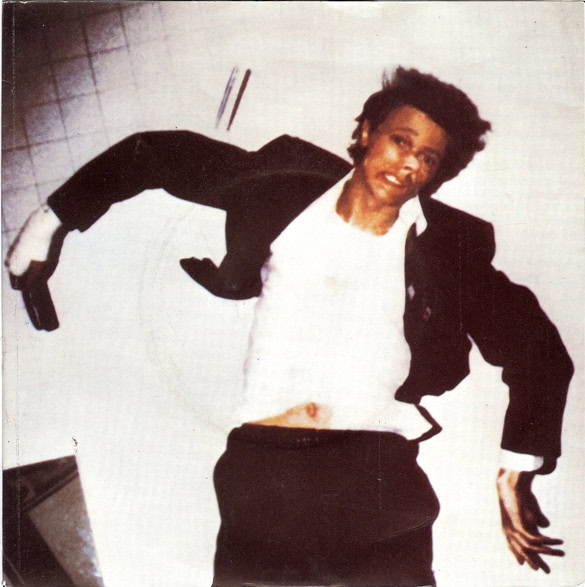
For the cover, Bowie wanted to appear as a man falling from a great height. Instead of producing a conventional portrait, Duffy constructed a staged photographic scene in which Bowie’s body and face appeared physically distorted by the imagined fall.
The album sleeve was created through a collaboration between Bowie, Duffy and British artist Derek Boshier. Duffy devised and photographed the central falling figure, while Boshier developed the wider graphic presentation and helped connect the photographs with the album’s themes of travel and displacement.
Duffy made carefully composed photographs of the completed scene using Kodachrome film. However, Bowie ultimately preferred the rougher and less detailed appearance of an earlier test Polaroid. A cropped version of that Polaroid became the principal image on the original gatefold cover.
Its deliberately imperfect appearance differed sharply from the highly polished dye-transfer portrait produced for Aladdin Sane six years earlier. Whereas that cover presented Bowie as a precisely constructed glamorous figure, Lodger showed him as a battered and disorientated accident victim.
Released by RCA Records on 25 May 1979, Lodger became the second of the three David Bowie albums whose cover photography was created by Brian Duffy.
Creating the Lodger Cover
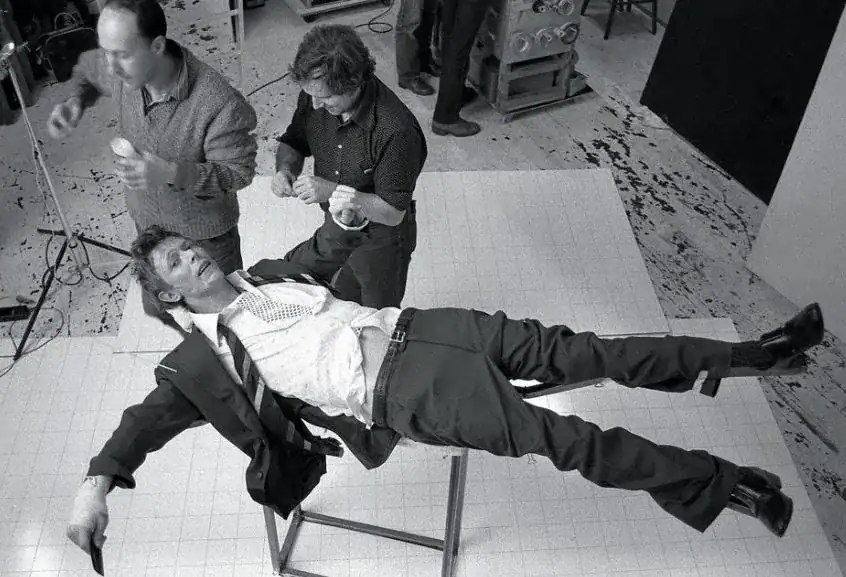
To create the illusion of a man falling from a great height, the photographic set was constructed horizontally on the floor of Duffy’s studio. Bowie rested on a specially made metal support shaped to follow the position of his body. The structure was designed to remain hidden beneath him when photographed from directly above.
A washbasin was placed on the floor beneath the support, transforming the studio set into a disorientating tiled interior. When viewed in the finished photograph, the horizontal construction appears to be a vertical room through which Bowie is falling.
Duffy positioned himself safely in the studio’s roof space and photographed the scene from above. This unusual viewpoint allowed the set, Bowie’s body and the washbasin to be combined without requiring Bowie to be suspended in the air.
Make-up artist Anthony Clavet and his assistant applied prosthetic effects to give Bowie the appearance of an injured accident victim. Fine nylon fishing line was attached to areas of Bowie’s face and gently pulled in different directions to distort his features. Bowie’s long-time assistant Coco Schwab helped with this process.
Bowie arrived at the studio with one hand already bandaged after burning it when he spilled hot coffee earlier that morning. Instead of concealing the genuine injury, Bowie and Duffy retained the bandage because it added another convincing detail to the battered figure being created for the cover.
Duffy used Polaroids to test the composition before producing carefully detailed Kodachrome photographs of the completed scene. Bowie’s eventual preference for the rougher test Polaroid gave the finished cover its grainy, immediate and deliberately imperfect appearance.
The original gatefold sleeve also included a behind-the-scenes photograph showing Bowie being prepared on the support structure. One of Duffy’s experimental images of the washbasin was incorporated into the wider artwork, allowing elements of the physical set to remain visible within the completed design.
Derek Boshier combined Duffy’s photographs with postcard-style graphics and multilingual versions of Bowie’s name and the album title. The completed sleeve turned a carefully engineered studio construction into an unsettling image of physical collapse, travel and displacement.
Leaving Photography and Burning the Archive
Shortly after completing the Lodger project in 1979, Brian Duffy abruptly withdrew from commercial still photography. After more than two decades working in fashion, portraiture, editorial photography and advertising, he had become deeply dissatisfied with the profession and with the demands of running a large studio.
Duffy later recalled that the immediate trigger was a minor conversation about the studio having run out of toilet paper. The mundane problem made him realise how much of his time was being consumed by managing staff and making administrative decisions rather than pursuing creative work.
In a deliberately destructive act, Duffy carried boxes of negatives and colour transparencies into the yard of his London studio and set fire to them. The material did not burn easily, but it produced thick, acrid black smoke.
The fire was interrupted when an official from the local council ordered Duffy to extinguish it. By that time, part of his photographic archive had already been destroyed. The surviving negatives and transparencies were packed away, some of them remaining for decades in boxes at Duffy’s home.
The precise extent of the loss cannot be calculated. Much of Duffy’s surviving work was later recovered not only from his personal collection but also from contact sheets, negatives and prints retained by magazines, newspapers and other independent archives.
Duffy’s departure in 1979 marked the end of his regular career as a still photographer, but it was not quite his final photographic assignment. In 1980, David Bowie persuaded him to return for one last major session connected with Scary Monsters (and Super Creeps).
After that final Bowie collaboration, Duffy concentrated increasingly on moving-image work, including television commercials and music videos, before later devoting much of his time to antique furniture restoration.
The Third Bowie Album Cover: Scary Monsters (and Super Creeps) – 1980
In 1980, David Bowie persuaded Brian Duffy to return temporarily to still photography for their fifth and final session. The photographs were commissioned for Scary Monsters (and Super Creeps), making it the third Bowie album whose cover was based on imagery created by Duffy.
Because Duffy had retired from commercial photography and closed his own photographic operation, the session took place at the London studio of his son, photographer Chris Duffy.
Bowie was photographed as Pierrot in an elaborate costume designed by Natasha Korniloff. Bowie had asked Korniloff to create “the most beautiful clown in the circus,” reconnecting him with the theatrical and mime traditions he had explored while working with Lindsay Kemp during the late 1960s.
Make-up artist Richard Sharah created the accompanying Pierrot make-up. The same costume and make-up were also used for the promotional film for Ashes to Ashes, making the character central to both the album’s visual presentation and one of Bowie’s most celebrated music videos.
Brian Duffy conducted the principal album-cover photography. After the main session, Bowie’s make-up was smeared and he requested additional press photographs, which Chris Duffy took in his studio. The resulting body of work therefore includes photographs by both father and son, although Brian Duffy’s selected portrait provided the photographic foundation for the album cover.
Artist Edward Bell transformed Duffy’s selected image into the large-scale painted and photographic composition used for the finished sleeve. Official credits consequently identify Bell for the illustration and artwork and Brian Duffy for the photography.
Released by RCA Records on 12 September 1980, Scary Monsters (and Super Creeps) was Bowie’s fourteenth studio album and his first following the so-called Berlin Trilogy. It reached number one on the UK Albums Chart.
The project concluded the five documented photographic sessions undertaken by Brian Duffy and David Bowie between 1972 and 1980. It was also the final Bowie album cover connected with Duffy’s photography.
Creating the Scary Monsters Imagery
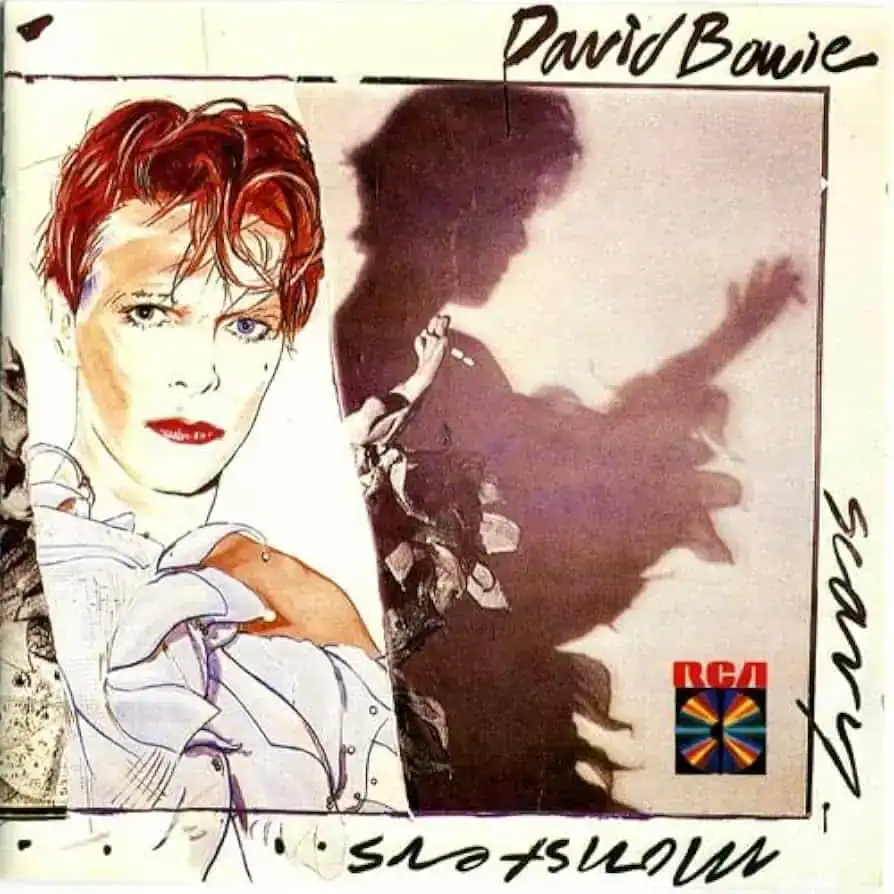
Bowie asked costume designer Natasha Korniloff to create what he described as “the most beautiful clown in the circus.” Korniloff designed an elaborate Pierrot costume that recalled Bowie’s earlier theatrical work with Lindsay Kemp, including Pierrot in Turquoise.
Make-up artist Richard Sharah created the white-faced Pierrot appearance. The preparation and principal album-cover photography took place at Chris Duffy’s London studio, which Brian Duffy used after retiring from regular commercial photography.
Brian Duffy photographed Bowie in a number of poses and variations of the character. The surviving images include the immaculate Pierrot as well as more dishevelled versions in which the costume and make-up appear disturbed and Bowie is shown smoking.
After Brian Duffy’s principal work was completed, the make-up was further smeared and Bowie requested additional press photographs. These later studio portraits were taken by Chris Duffy. The surviving material from the day therefore includes separate photographs by Brian and Chris Duffy.
Brian Duffy had previously introduced Bowie to British artist Edward Bell. For Scary Monsters, Bell was commissioned to transform the photographic material into the finished album artwork and was given considerable freedom in developing the design.
Duffy selected a photograph of Bowie and supplied it to Bell, expecting the artist to work onto the print while leaving much of the original portrait visible. Bell instead used the photograph as the foundation for a much more extensive painted and graphic interpretation of Bowie as Pierrot.
The completed front cover combined Bell’s painted portrait with photographic elements from Duffy’s session, including the darker, smoking Pierrot figure and its elongated shadow. The result was neither a conventional photograph nor a simple illustration, but a layered combination of photography, painting and graphic design.
Bowie immediately approved Bell’s completed artwork. According to accounts preserved by the Duffy Archive, Brian Duffy was disappointed that so much of his selected photograph had been obscured by the painted interpretation. Despite that disagreement, the official sleeve continued to credit Duffy for photography and Bell for illustration and artwork.
The rear of the original LP extended the retrospective character of the design by including partly obscured references to Low, “Heroes”, Lodger and Aladdin Sane. Two of those earlier visual projects, Lodger and Aladdin Sane, had also involved Duffy’s photography.
Images from the 1980 session were additionally used on the different UK picture sleeves issued for the Ashes to Ashes single. Together with the Pierrot costume’s appearance in the accompanying promotional film, this connected the album cover to one of Bowie’s most recognisable visual presentations of the period.
The Five Bowie Sessions: A Chronological Overview
Brian Duffy photographed David Bowie during five distinct projects between 1972 and 1980. They were not conceived as a single continuing series: each session had its own commission, collaborators and visual purpose.
- 1972 – Ziggy Stardust: Duffy photographed Bowie wearing the quilted stage costume created with Freddie Burretti and holding a borrowed twelve-string guitar. This was an independent portrait session, not the shoot for the original Ziggy Stardust album cover.
- 1973 – Aladdin Sane: Their second session produced Duffy’s first Bowie album cover and the celebrated red-and-blue lightning-flash portrait.
- 1975 – The Man Who Fell to Earth and White Sands: Working on assignment for The Sunday Times, Duffy photographed Bowie during the production of Nicolas Roeg’s film and created the experimental long-exposure portraits at White Sands in New Mexico.
- 1979 – Lodger: Their fourth session produced Duffy’s second Bowie album cover, presenting Bowie as a battered figure falling through a distorted interior.
- 1980 – Scary Monsters (and Super Creeps): Bowie persuaded Duffy to return temporarily to still photography for their final session. Duffy’s Pierrot portrait provided the photographic foundation for the album artwork created by Edward Bell.
Chris Duffy on Brian Duffy and David Bowie
“My father greatly enjoyed his unique creative partnership with David.”
— Chris Duffy
Together, the five sessions follow Bowie from Ziggy Stardust through Aladdin Sane, his mid-1970s film period and the damaged Pierrot of Scary Monsters. Three of the five projects resulted in photography used for official David Bowie album covers.
Three David Bowie Album Covers
Three of Brian Duffy’s five photographic sessions with David Bowie produced imagery for official album covers: Aladdin Sane in 1973, Lodger in 1979 and Scary Monsters (and Super Creeps) in 1980.
Together, the three sleeves demonstrate three very different uses of photography. For Aladdin Sane, Duffy’s polished colour portrait dominated the cover. For Lodger, a deliberately imperfect test Polaroid became part of Derek Boshier’s wider graphic design. For Scary Monsters, Duffy’s photograph provided the foundation for Edward Bell’s painted and photographic composition.
The sequence shows that Duffy and Bowie never repeated a fixed visual formula. Photography functioned successively as a finished portrait, raw source material within a graphic design and the basis of a mixed-media artwork.
Duffy’s Photography on Bowie Single Sleeves
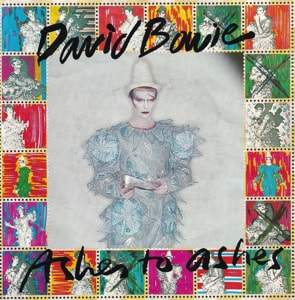

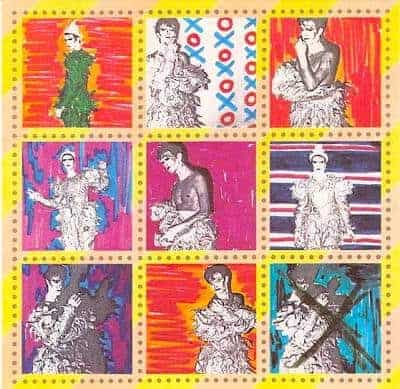
Brian Duffy’s Bowie photography was not confined to album packaging. Images connected with his Lodger and Scary Monsters (and Super Creeps) sessions were also used or adapted for selected contemporary single sleeves.
An early British picture sleeve for Boys Keep Swinging reproduced Bowie’s injured, falling appearance from the Lodger session. During the following year, imagery associated with Duffy’s 1980 Pierrot photographs appeared in the visual presentation of the singles Ashes to Ashes and Fashion.
This does not mean that Duffy designed every element of these single sleeves. His contribution was the original photography, while the typography, illustration, layout and final packaging could involve other artists, designers and RCA. Sleeve designs also varied between countries and formats, so only editions that clearly use Duffy’s photographic work are included here.
More in the Album Cover Stories
More detailed information about the creation, photography, design and historical background of Brian Duffy’s three David Bowie album covers can be found in the dedicated Album Cover Stories on DavidBowieWorld.com.
- Aladdin Sane – Album Cover Story
- Lodger – Album Cover Story
- Scary Monsters (and Super Creeps) – Album Cover Story
Each article provides an extended account of the individual sleeve and the photographers, artists, designers, make-up specialists and other collaborators involved in its production.
Life After Still Photography
After withdrawing from regular still photography, Brian Duffy continued working professionally with moving images. In 1981, he joined the film production company Lewin Matthews and concentrated increasingly on television commercials and music videos.
In 1982, Duffy directed the promotional video for ABC’s All of My Heart. He also directed two videos for the Human League, including Mirror Man. The following year, he directed the video for Spandau Ballet’s Gold.
From 1984 until 1986, Duffy worked with Paul Kramer Productions in New York. During this period, he also returned to a subject that had interested him throughout his life: the First World War.
In 1985, Duffy directed Lions Led by Donkeys for Channel 4. The television production examined the experience and military leadership of the First World War and continued themes he had previously explored through his involvement with Oh! What a Lovely War.
After returning to Britain, Duffy established his own production company, 3DZ. In 1988, the company pioneered the use of the Super 16 film format in television commercials and promotional films, including work connected with the flotation of British Steel.
By the beginning of the 1990s, Duffy had retired almost completely from professional image-making. He devoted increasing attention to antique furniture restoration, a long-standing personal interest, and became an accredited restorer with the British Antique Furniture Restorers’ Association.
Furniture restoration occupied much of Duffy’s later life and reflected the same interest in materials, construction and skilled craftsmanship that had characterised his earlier work in design, photography and film.
The Creation of the Duffy Archive
Chris Duffy discussing Brian Duffy’s photographs of David Bowie for the Bowie by Duffy exhibition.
Chris Duffy had become concerned that his father’s contribution to British photography was gradually slipping into obscurity. He repeatedly encouraged Brian Duffy to reconsider the negatives, contact sheets and prints that had survived the destruction of part of his archive in 1979.
Brian initially showed little interest in returning to his earlier work. In 2006, after being diagnosed with the degenerative lung disease pulmonary fibrosis, he finally gave Chris permission to begin assembling and organising the surviving photographic material.
The project required thousands of negatives, transparencies, contact sheets and prints to be identified, scanned, catalogued and entered into a searchable database. Chris undertook much of this work while continuing to run his own professional photographic studio.
Because part of Duffy’s personal collection had been destroyed or dispersed, rebuilding the archive also required material to be traced through publications and external collections. Negatives, contact sheets and prints were recovered from sources including Vogue, French Elle, Glamour, The Sunday Times, The Telegraph and independent archives.
Chris Duffy formally established The Duffy Archive Limited in 2008. Its purpose was to preserve, research and catalogue Brian Duffy’s surviving work and to manage its publication, exhibition and licensing.
In 2009, the Chris Beetles Gallery in Mayfair, London, presented Brian Duffy’s first-ever exhibition. The exhibition brought widespread public and critical attention to work that had remained largely unseen for approximately three decades.
The reconstruction of the archive also preserved the surviving material from Duffy’s five sessions with David Bowie. Contact sheets, alternative frames and behind-the-scenes photographs made it possible to examine those collaborations in far greater detail and later supported exhibitions, publications and newly released images.
The Man Who Shot the 60s
The Man Who Shot the 60s, the BBC Four documentary about Brian Duffy’s life and work.
While Brian Duffy’s first exhibition was being prepared in 2009, the BBC commissioned a documentary about his life and work. Directed by Linda Brusasco, the one-hour film was broadcast on BBC Four on 13 January 2010 under the title The Man Who Shot the 60s.
The documentary followed the rediscovery of Duffy’s surviving photographs as Chris Duffy worked to organise the archive and return his father’s work to public view. It examined Duffy’s childhood, fashion career, portraiture, advertising campaigns, film production and his decision in 1979 to burn part of his photographic collection.
Duffy participated extensively in the film and discussed his career in his own characteristically direct manner. Contributions from family members, colleagues and contemporaries placed his work within the transformation of British photography during the 1960s and examined his relationship with photographers David Bailey and Terence Donovan.
The programme also explored Duffy’s portraits of major cultural figures and his collaborations with David Bowie. The creation and later cultural importance of the Aladdin Sane cover formed a significant part of its account of Duffy’s photographic legacy.
The film was completed during the final period of Duffy’s life, before his death on 31 May 2010. It therefore preserves an important filmed record of the photographer discussing his own work as his surviving archive was beginning to receive renewed public recognition.
The Duffy Archive now presents the documentary under the written-out title The Man Who Shot the Sixties, but it is the same BBC film originally broadcast as The Man Who Shot the 60s.
Museum Recognition at the V&A
Reporting on the presentation of a Brian Duffy Aladdin Sane photograph to the V&A in 2018.
The reconstruction of The Duffy Archive led to growing recognition of Brian Duffy’s work by major museums. In 2011, the Victoria and Albert Museum requested Duffy photographs for its permanent collection.
In 2012, the V&A displayed an original dye-transfer print of Duffy’s classic Aladdin Sane portrait in its exhibition British Design 1948–2012: Innovation in the Modern Age. This placed the album cover within a wider history of influential British art, design and visual culture.
The museum’s relationship with The Duffy Archive continued in 2013 when the previously unpublished “Eyes Open” portrait was selected as the principal campaign image for David Bowie is. As described earlier, the image subsequently travelled with the exhibition and helped introduce Duffy’s photography to a new international audience.
In June 2018, as David Bowie is welcomed its two-millionth visitor during the final stage of its international tour, The Duffy Archive presented the V&A with a print made from a rarely seen original colour transparency from the 1973 Aladdin Sane session. The photograph entered the museum’s Theatre and Performance collection.
These exhibitions and acquisitions established Duffy’s Bowie photography not only as record-cover imagery but also as an important part of British photographic and design history.
Duffy/Bowie: Five Sessions
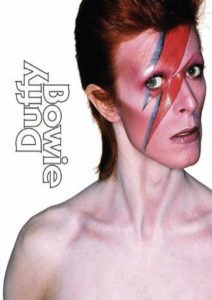
In 2014, Bowie historian Kevin Cann and photographer Chris Duffy published Duffy Bowie: Five Sessions through ACC Editions. The title is also commonly styled Duffy/Bowie – Five Sessions.
The book was the first publication devoted specifically to reconstructing all five photographic projects undertaken by Brian Duffy and David Bowie between 1972 and 1980. It placed the famous Aladdin Sane portrait within the wider history of their collaboration rather than treating it as an isolated image.
Its research drew upon surviving photographs, previously unseen outtakes, contact sheets, behind-the-scenes material and documents preserved by The Duffy Archive. These sources revealed how the concepts, costumes, make-up, physical sets and graphic designs developed during the different projects.
The book also incorporated recollections and historical contributions from people connected with the sessions and their wider creative context. These included Tony Defries, Celia Philo, Philip Castle, Francis Newman, May Routh, Geoff MacCormack, Derek Boshier, Natasha Korniloff, Edward Bell, Steve Strange and Chris Duffy.
Their accounts documented the different artistic and technical roles involved in producing the photographs and album artwork. They also helped distinguish Brian Duffy’s contribution from the work of the designers, illustrators, make-up artists, costume designers and studio personnel with whom he collaborated.
By bringing the surviving visual material and first-hand recollections together, Duffy/Bowie: Five Sessions became an important published record of one of the most sustained photographer–artist relationships in David Bowie’s career.
Aladdin Sane 50 Years – Two Exclusive Editions
In 2023, fifty years after the release of Aladdin Sane, The Duffy Archive celebrated Brian Duffy’s historic 1973 photographic session with the publication of Aladdin Sane 50 Years. The 258-page hardback book is devoted to the album, the creation of its famous cover and the continuing cultural importance of Duffy’s portrait of David Bowie.
The book contains previously unseen photographs from the original Aladdin Sane cover session. A QR code provides access to a developing online resource containing additional images, video interviews, news and information connected with the project.
Edited by Chris Duffy, the book combines Brian Duffy’s photography with essays by Paul Morley, Charles Shaar Murray, Nicholas Pegg, Kevin Cann, Jérôme Soligny and Geoffrey Marsh, curator of the V&A’s David Bowie is exhibition. The publication was designed by Barnbrook, the creative studio responsible for several later David Bowie projects.
Limited Postcard Edition

The Limited Postcard Edition was produced in an edition of 1,000 hardback copies. Each book contains two bound-in 5-by-7-inch postcards featuring previously unreleased images from the Aladdin Sane session.
Every copy is signed by Chris Duffy and embossed with both The Duffy Archive stamp and the AS50 stamp. The book measures 11 by 9 inches and may be personalised with a message when ordered through the official Bowie Web Store.
Special Limited Edition Anniversary Box Set
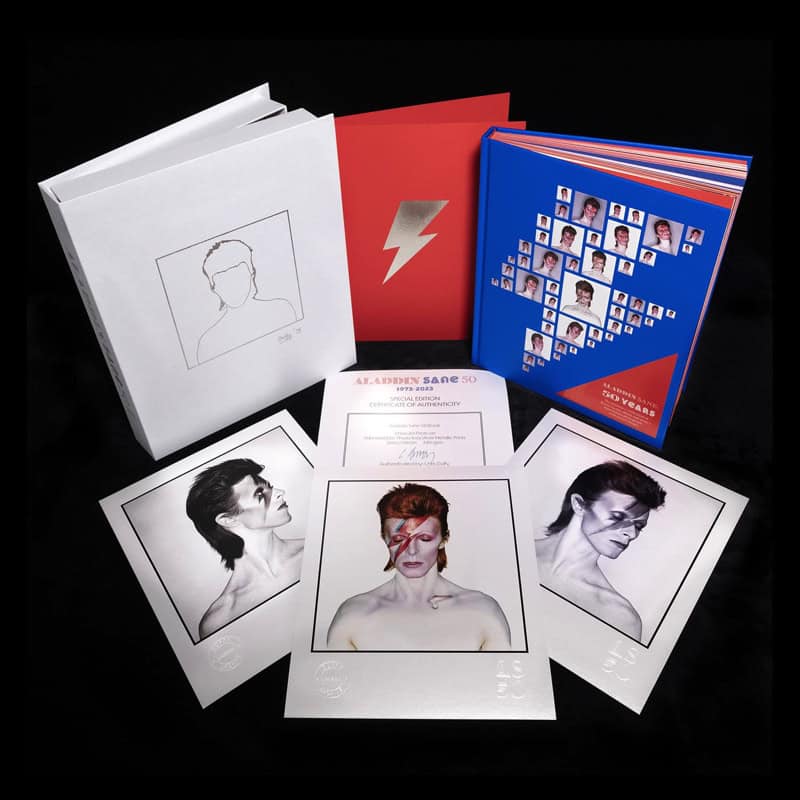
The Special Limited Edition was produced in an edition of 500 copies. It presents the Aladdin Sane 50 Years hardback book in a white linen clamshell box finished with silver-foil lettering. The box measures 12.5 by 10 inches.
The set also contains three exclusive 10-by-8-inch fine-art prints produced on Hahnemühle 340 gsm silver metallic paper. Each print is embossed with The Duffy Archive and AS50 stamps. A signed and numbered certificate of authenticity is also included.
Together, the two editions preserve previously unseen material from the 1973 session and document the collaborative process behind one of the most recognisable photographs in popular music. Both editions were produced exclusively for The Duffy Archive.
Death and Legacy
Brian Duffy died from pulmonary fibrosis on 31 May 2010, fifteen days before his seventy-seventh birthday. The preservation and reassessment of his photographic career had begun during his lifetime, but much of the international recognition of his work followed his death.
In 2011, ACC Editions published Duffy: Photographer, the first major monograph devoted to his career. Compiled by Chris Duffy, the book presented more than 160 photographs from the 1950s, 1960s and 1970s.
Subsequent publications and exhibitions introduced Duffy’s fashion, portrait, reportage, advertising and music photography to new international audiences. His surviving work provides an extensive visual record of British cultural life during a period of profound social and artistic change.
Duffy’s importance lies not only in the famous people he photographed but also in the way he helped transform the role of the photographer. His work combined technical precision with experimentation, strong visual concepts and an often confrontational interest in the character of his subjects.
His collaboration with David Bowie remains one of the most visible parts of that legacy. Its continuing cultural and financial significance was demonstrated on 5 November 2025, when the original dye-transfer artwork print created for the Aladdin Sane cover was sold by Bonhams in London for £381,400.
The sale established a new world record for the most expensive album artwork sold at auction. It confirmed the enduring status of Duffy’s Aladdin Sane portrait as both a photographic work and a major artefact of popular culture.
Through the continuing work of The Duffy Archive, Duffy’s surviving negatives, contact sheets, prints and historical records remain available for exhibitions, publications and research.
Brian Duffy in Bowie’s Collaborative Universe
David Bowie worked with numerous photographers, designers, illustrators, make-up artists and costume designers throughout his career. Brian Duffy’s position within that creative network was unusual because their working relationship extended across five separate projects and several sharply contrasting Bowie identities.
Duffy’s contribution went beyond documenting finished appearances. During the three album-cover projects, he participated in the development of the visual concepts, devised photographic solutions and worked with specialists who transformed those ideas into finished artwork.
The relationship also demonstrates the collaborative nature of Bowie’s visual presentation. Images now closely identified with Bowie were created through exchanges between the artist, photographer and wider creative team rather than by one person working in isolation.
Duffy’s five sessions chart Bowie’s movement from the theatrical colour of the early 1970s to the fractured and self-reflective imagery that opened the following decade. At the same time, they reveal Duffy’s ability to adapt his photography to each new artistic context instead of imposing a single recognisable formula.
Brian Duffy therefore belongs not only among the photographers who documented David Bowie but also among the creative collaborators who helped shape how Bowie’s music and changing identities were presented to the public.
Official Website & Further Information
The Duffy Archive preserves, researches and manages Brian Duffy’s surviving photographic work. Founded by his son Chris Duffy, the archive maintains collections of negatives, transparencies, contact sheets, vintage prints and authorised modern editions.
Its official website provides biographical information, exhibition history, publications and dedicated collections covering Duffy’s work in fashion, portraiture, advertising, reportage and music photography.
Official website:
The Duffy Archive
The archive also maintains a dedicated David Bowie portfolio containing surviving photographs and contact sheets from the five projects undertaken between 1972 and 1980.
David Bowie portfolio:
Brian Duffy – David Bowie Photography
Brian Duffy’s photographs remain protected by copyright. Anyone wishing to reproduce, publish or otherwise use an image should obtain the appropriate permission directly from The Duffy Archive.
Image licensing:
The Duffy Archive – Image Licensing
Article Origin
This article was researched and written exclusively for DavidBowieWorld.com. It is based on documented biographical information, contemporary publications, museum records, published interviews and historical material preserved by The Duffy Archive.
Particular attention has been given to distinguishing Brian Duffy’s five documented photographic projects with David Bowie from the three sessions that produced imagery for official Bowie album covers.
The research also identifies the designers, illustrators, make-up artists, costume designers, studio personnel and other creative contributors involved in transforming Duffy’s photographs into finished album artwork.
Principal sources consulted include documentation published by The Duffy Archive, the Victoria and Albert Museum, Bonhams, official David Bowie sources and published recollections from people directly connected with the photographic sessions.
Where surviving accounts differ — including explanations of how the Aladdin Sane lightning flash originated — the article acknowledges those differences rather than presenting one disputed recollection as established fact. The quotations included on this page have been traced to identifiable published sources.
© DavidBowieWorld.com
