
George Underwood – Artist, Illustrator & Lifelong David Bowie Collaborator

George Underwood (born Richard Michael Underwood) is a British artist, illustrator, painter and former musician whose remarkable connection with David Bowie spanned more than sixty years. A childhood friend, early bandmate and lifelong confidant, Underwood witnessed Bowie’s development from an ambitious South London teenager into one of the most influential artists of the twentieth century.
Unlike many of Bowie’s collaborators, Underwood was part of the story long before international fame arrived. Together they played in several early groups, shared a passion for music and art, attended school together and encouraged one another’s creative ambitions. Even after Underwood left the music business, their friendship remained strong, eventually leading to some of the most recognisable artwork associated with Bowie’s early career.
Today George Underwood is widely respected as one of Britain’s leading figurative painters and illustrators. His artwork for David Bowie, T. Rex, Mott the Hoople, Procol Harum and many other artists helped define the visual identity of British rock during the 1970s, while his imaginative paintings have earned admiration from collectors around the world—including David Bowie himself.
Following publication, George Underwood kindly reviewed this article and provided factual corrections to help ensure its historical accuracy. He has also generously offered to share images from his personal collection, making this one of the few Bowie biographies developed with direct input from its subject.
- Full name: Richard Michael Underwood
- Born: 5 February 1947, Bromley, Kent, England
- Profession: Artist, illustrator, painter and former musician
- Early Bowie connection: Childhood friend, schoolmate and bandmate
- Major Bowie collaborations: The King Bees, album illustrations, lifelong artistic friendship
- Also worked with: T. Rex, Mott the Hoople, Procol Harum, The Fixx and many other artists
Growing Up Together
George Underwood and David Jones first met during childhood after joining the 18th Bromley Cub Scouts, long before either imagined a career in the arts. Born only twenty days apart in January 1947, the two boys quickly discovered a shared fascination with drawing, popular music and American rhythm and blues. Their friendship would become one of the longest-lasting relationships of Bowie’s life.
As they grew older they attended Bromley Technical High School together, where creativity increasingly became the centre of their lives. Both enjoyed drawing and painting, listened obsessively to Radio Luxembourg and collected records by artists such as Little Richard, Chuck Berry, Elvis Presley and John Lee Hooker. Their conversations constantly revolved around music, design and the possibility of one day making careers in the arts.
Bowie later reflected that Underwood’s remarkable talent as a young artist had a profound influence on him. Watching George draw with such confidence convinced Bowie that he was unlikely ever to become an illustrator of the same calibre. Instead, he began to concentrate more seriously on music, eventually persuading his father to help him buy his first saxophone.
David Bowie on George Underwood
“I think he may well have unconsciously tipped me toward music.”
The First Bands
Music soon became as important as art. During the early 1960s Underwood and Bowie played together in several local groups, beginning with The Konrads, where George sang while David initially played saxophone before gradually becoming the band’s vocalist. After leaving The Konrads, Underwood formed George and the Dragons, while Bowie continued developing his own musical career with other groups.
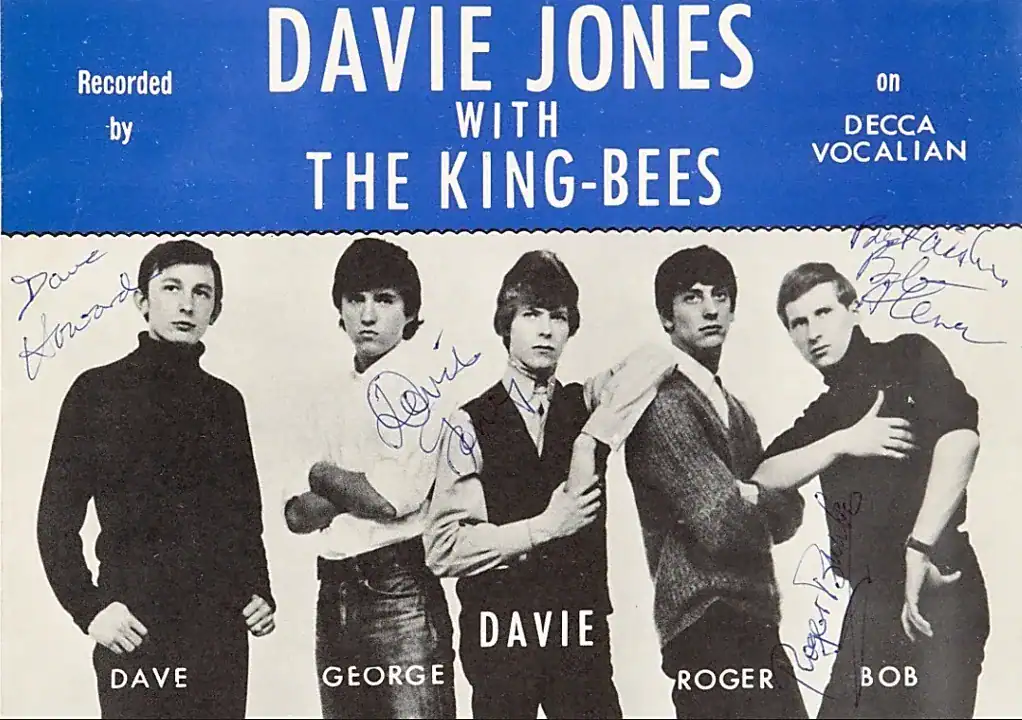
The two friends later reunited in Davie Jones and the King Bees, recording one of Bowie’s earliest commercial singles together before their careers gradually took different directions. Their time together in these early bands provided valuable experience and helped lay the foundations for Bowie’s future career.
Although the groups enjoyed only modest local success, they proved invaluable in developing Bowie’s confidence as both a songwriter and performer. Underwood later recalled the friendly rivalry between them, each encouraging the other to improve while quietly hoping to be the first to achieve success.
The Eye Injury That Became Part of Rock History
One of the most frequently retold stories in David Bowie’s early life concerns an incident involving George Underwood. During their teenage years, the two friends became involved in an argument over a girl named Carol Goldsmith. After a misunderstanding, Underwood believed Bowie had interfered with his planned date and, in a moment of anger, struck him in the left eye.
The punch itself was not unusually severe, but Underwood was wearing a ring and one of its sharp edges scratched Bowie’s left eye. The injury damaged the muscles controlling the pupil and required hospital treatment and two operations. Although Bowie’s eyesight was preserved, the pupil remained permanently dilated, a condition known as anisocoria.
Contrary to popular belief, Bowie did not have different coloured eyes. Both eyes remained blue, but the permanently enlarged pupil in his left eye absorbed much more light, creating the striking illusion of one dark eye and one light eye. This distinctive appearance would later become one of the most recognisable features of his public image.
Underwood has often expressed regret about the accident, but Bowie never blamed his lifelong friend. Instead, the two quickly reconciled and remained exceptionally close throughout Bowie’s life. Far from ending their friendship, the incident became one of the many stories they would later laugh about together.
George Underwood on David Bowie
“People say, ‘You were lucky to know David Bowie.’ I say, he was lucky to know me.”
From Musician to Artist
Although music occupied much of George Underwood‘s teenage years, he increasingly realised that his greatest talent lay in visual art. While David Bowie continued pursuing a professional music career, Underwood chose a different path.
Before establishing himself as a freelance illustrator, Underwood briefly pursued a solo recording career under the name Calvin James. His single attracted industry attention and earned him a recording contract with producer Mickie Most. Although the opportunity appeared promising, Underwood eventually concluded that music was not his true calling.
He subsequently returned to his art studies before working in commercial design studios as an illustrator. His earliest commissions focused on fantasy, horror and science-fiction book covers, allowing him to develop the distinctive visual style that would later become one of his trademarks.
As his reputation grew, many of his former colleagues from the music business began asking him to create album artwork. What started as occasional commissions soon developed into a successful freelance career that established George Underwood as one of Britain’s leading album illustrators during the 1970s.
David Bowie Opens Another Door
David Bowie remained one of George Underwood‘s greatest supporters. As Bowie’s own career gathered momentum, he frequently recommended Underwood to fellow musicians, recognising both his artistic talent and his remarkable ability to translate musical ideas into powerful visual imagery.
One of the earliest and most significant opportunities came when Bowie introduced Underwood to his friend Marc Bolan. The resulting commission to create artwork for Tyrannosaurus Rex proved to be a turning point, establishing Underwood as a sought-after illustrator within the British music industry.
From that point onwards, commissions arrived steadily. Underwood would go on to produce memorable artwork for numerous artists, but his collaborations with David Bowie remained among the most celebrated of his career.
Creating the Visual World of David Bowie
By the early 1970s George Underwood had established himself as one of Britain’s most imaginative commercial illustrators. Combining technical precision with a vivid imagination, he developed a distinctive style that blended realism, fantasy and symbolism. His growing reputation soon led to commissions from many of the leading names in British rock, but some of his most enduring work was created for his lifelong friend David Bowie.
Unlike many commercial artists, Underwood rarely treated an album cover as simple packaging. He believed every illustration should extend the atmosphere of the music itself, creating an image that invited listeners into the artist’s world before the record had even begun to play.
The Hunky Dory Artwork

One of George Underwood‘s best-known Bowie commissions was his contribution to the artwork surrounding Hunky Dory (1971). While the famous front-cover photograph was taken by Brian Ward, Underwood was responsible for the distinctive illustrations used on the album packaging, helping to create the elegant visual identity that perfectly complemented Bowie’s increasingly sophisticated songwriting.
The artwork reflected the album’s dreamlike atmosphere and growing sense of artistic confidence. Underwood understood that Bowie was moving beyond straightforward rock music into something far more theatrical and visually ambitious. His illustrations became an important part of that transformation.
The collaboration demonstrated the ease with which Bowie and Underwood communicated. Having known each other since childhood, Underwood instinctively understood the imagery Bowie was seeking, often requiring remarkably little explanation before translating ideas into finished artwork.
The Rise and Fall of Ziggy Stardust and the Spiders from Mars

George Underwood also contributed artwork associated with The Rise and Fall of Ziggy Stardust and the Spiders from Mars (1972), one of the most influential albums in rock history. As with Hunky Dory, photographer Brian Ward created the celebrated cover photograph, while Underwood’s illustrations formed part of the album’s wider visual presentation.
By this point Bowie had become one of Britain’s most original performers, and every aspect of his presentation—from costumes and stage design to album artwork—was carefully considered. Underwood’s ability to combine fantasy with subtle emotional depth made him an ideal collaborator during this period.
Although the Ziggy Stardust image itself became iconic, Underwood’s contribution formed part of the broader visual language surrounding Bowie’s early 1970s work. His illustrations helped reinforce the sense that Bowie was creating not simply records but complete artistic worlds.
The Space Oddity Album Artwork
Among George Underwood‘s most imaginative Bowie commissions was the surreal illustration created for the back cover of David Bowie’s 1969 album David Bowie, later reissued under the title Space Oddity. Working from ideas discussed with Bowie himself, Underwood produced a richly detailed fantasy landscape populated by symbolic figures, oversized creatures and dreamlike imagery.
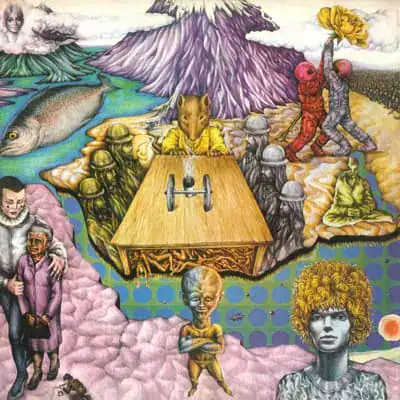
Underwood later explained that Bowie often arrived with rough sketches and visual concepts rather than finished designs. Bowie knew exactly what atmosphere he wanted to create but trusted his lifelong friend to transform those ideas into polished illustrations. Their shared artistic background allowed them to communicate almost instinctively.
The resulting artwork reflected many of the themes that would become central to Bowie’s career: imagination, mythology, isolation and journeys into unknown worlds. Today it remains one of the most distinctive pieces of artwork associated with Bowie’s early recordings.
George Underwood on working with David Bowie
“David knew exactly what he wanted, but he thought I was the best person to interpret it.”
Beyond David Bowie
George Underwood‘s reputation soon extended far beyond his work with David Bowie. Throughout the 1970s and beyond he produced memorable album artwork for artists including T. Rex, Mott the Hoople, Procol Harum, The Fixx and many others, while simultaneously creating hundreds of book covers, magazine illustrations, advertising commissions and portrait studies.
His ability to create dramatic, imaginative imagery established him as one of Britain’s leading illustrators during the golden age of vinyl album design. At a time when a twelve-inch LP sleeve served as an important artistic statement, Underwood’s work became instantly recognisable for its rich symbolism, meticulous detail and powerful storytelling.
From Illustrator to Fine Artist
Although George Underwood achieved considerable success as an illustrator during the 1970s, his ambitions gradually moved beyond commercial artwork. Increasingly drawn to painting, he developed a highly personal style inspired by mythology, symbolism and the Viennese School of Fantastic Realism. Artists such as Ernst Fuchs, Rudolf Hausner and Ernst Brauer influenced his approach, while the imaginative worlds of Pieter Bruegel and Hieronymus Bosch also left a lasting impression on his work.
Unlike his commercial illustrations, Underwood’s paintings were rarely based on live models. Instead, he created entirely imagined figures who inhabited mysterious, timeless landscapes filled with symbolism and emotional ambiguity. His work combined technical precision with an unmistakable sense of fantasy, inviting viewers to discover new details every time they returned to a painting.
As his reputation grew, Underwood’s paintings entered private collections throughout Britain and beyond. Exhibitions at leading galleries and regular appearances at the Royal Academy Summer Exhibition confirmed his standing as one of Britain’s most respected figurative painters.
For Underwood, imagination has always remained at the heart of his work. Rather than documenting reality, he seeks to create worlds that exist only within the viewer’s imagination, encouraging each person to discover their own interpretation of the scene before them.
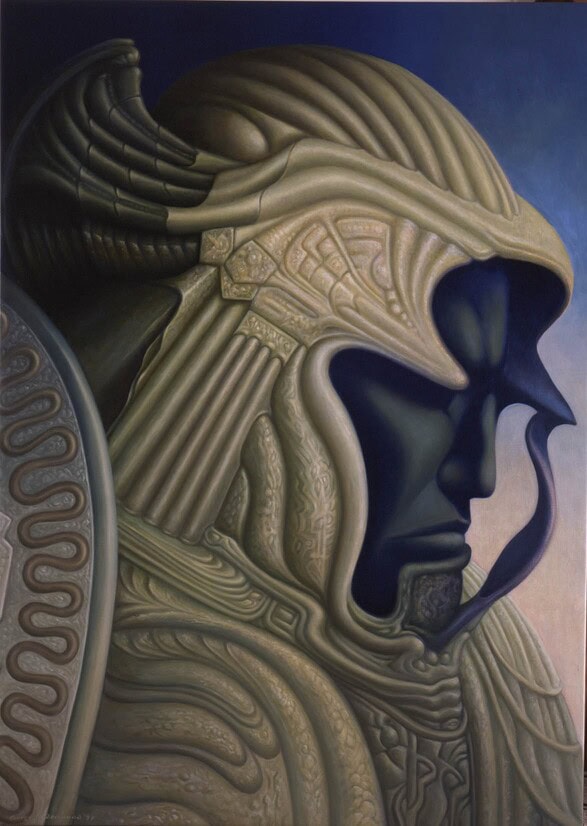
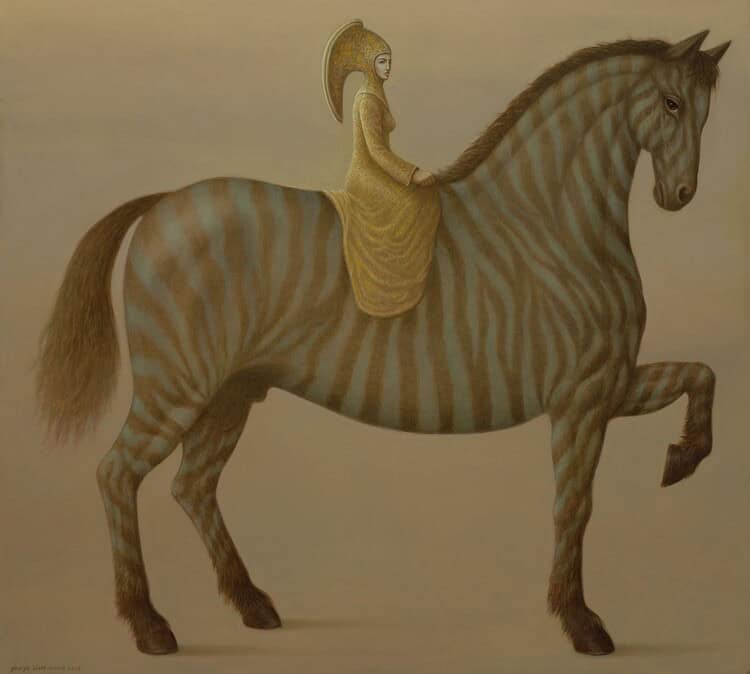
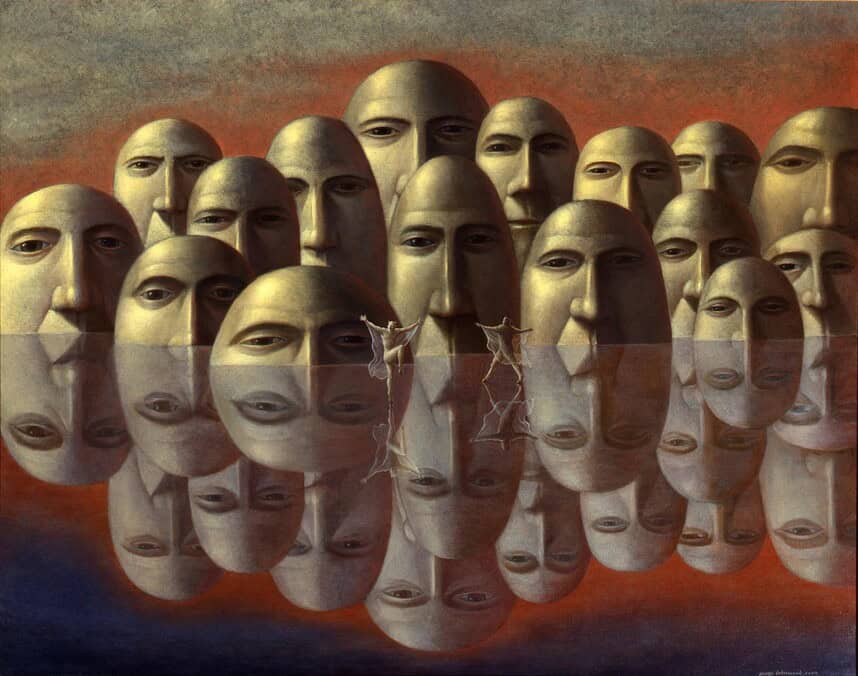
During correspondence with DavidBowieWorld.com, George Underwood kindly shared a selection of his paintings for inclusion on this page. We are sincerely grateful for his generosity, his historical corrections and his continued support in helping document both his remarkable artistic career and his lifelong association with David Bowie.
David Bowie on George Underwood
“George has, over the years, refined his work to the point where I would put him among the top figurative painters coming out of the UK right now.”
— David Bowie
A Lifelong Friendship
George Underwood and David Bowie remained close friends throughout their lives. What had begun as a shared love of music and drawing during childhood developed into a lifelong friendship built on mutual admiration, humour and creative respect. Despite their very different careers, they never lost touch.
Bowie regularly collected Underwood’s paintings and proudly displayed them in his own homes, while Underwood continued to admire Bowie’s relentless artistic curiosity. They exchanged birthday presents, stayed in contact over the decades and often met privately away from the public eye. Underwood also visited Bowie in Switzerland, where the two friends could spend time together away from the pressures of fame.
Their friendship was never based solely on professional collaboration. Instead, it represented one of the longest and most enduring relationships of Bowie’s life, stretching from childhood in Bromley to Bowie’s final years.
George Underwood on David Bowie
“He used to invite us to Switzerland just to get away from the spotlight. That was David.”
After David Bowie’s Death
David Bowie’s death in January 2016 deeply affected George Underwood. Having known Bowie since childhood, he found it difficult to return to painting in the months that followed. Eventually, however, he began creating a new series of angel paintings, reflecting both loss and remembrance.
Underwood later recalled sending photographs of earlier angel sculptures to Bowie following the death of Mick Ronson. Bowie telephoned him afterwards to say that the images had moved him to tears. Remembering that conversation inspired Underwood to return to the theme after Bowie’s own passing, creating works that quietly reflected friendship, memory and hope.
Legacy
George Underwood occupies a unique place in David Bowie’s history. He was not simply an illustrator, musician or childhood friend, but someone who accompanied Bowie through many of the defining stages of his artistic development. From the first school bands and the King Bees to the artwork surrounding some of Bowie’s most celebrated albums, Underwood’s influence can be found throughout Bowie’s early creative journey.
At the same time, Underwood established an outstanding career entirely in his own right. His paintings, illustrations and album artwork have earned international recognition, while his distinctive artistic vision continues to inspire collectors and admirers around the world.
George Underwood within Bowie’s Collaborative Universe
Few people knew David Bowie as long—or as well—as George Underwood. Their friendship survived youthful rivalry, changing careers, worldwide fame and more than six decades of shared history. Underwood’s contributions extended far beyond a single famous incident or a handful of album illustrations; he helped shape both the visual and personal world surrounding one of popular music’s greatest artists.
Within David Bowie’s collaborative universe, George Underwood stands as a childhood friend, musician, illustrator, painter and trusted creative companion whose influence can still be seen in the music, artwork and memories that continue to define Bowie’s remarkable legacy.
Article Origin
This article has been researched and written for DavidBowieWorld.com as part of the site’s ongoing project documenting the musicians, artists, designers and creative collaborators who helped shape David Bowie’s extraordinary career. It is based on documented historical research, published interviews and verified recollections from both George Underwood and David Bowie.
Following publication, George Underwood personally reviewed this article and kindly provided factual corrections to help ensure its historical accuracy. As additional first-hand information and images become available, this page will continue to be updated in collaboration with George Underwood.
Official Website & Further Information
George Underwood continues to work as one of Britain’s leading figurative painters, producing exhibitions, private commissions and original artwork that reflects his lifelong fascination with mythology, imagination and the human condition.
For more information about George’s paintings, exhibitions and current work, please visit his official website: www.georgeunderwood.com
Following the publication of this page, George Underwood kindly contacted DavidBowieWorld.com to review the article and provide factual corrections to help ensure its historical accuracy. He has also generously offered to share images from his personal collection for inclusion on this page. As new material becomes available, this biography will continue to be expanded with first-hand information shared directly by George Underwood.
