

Angie Bowie – Creative Catalyst in David Bowie’s Early Glam Years

Photo: Phil King / Wikimedia Commons / CC BY-SA 2.0 (editorial use)
Angie Bowie, born Mary Angela Barnett, is an American writer, journalist, performer and former model whose place in David Bowie’s history extends beyond their marriage. Between their meeting in 1969 and the collapse of their relationship during the second half of the 1970s, she was closely involved with the social, domestic and visual environment surrounding Bowie’s transformation from a commercially uncertain singer-songwriter into an international star.
Angie did not write Bowie’s songs, perform on his albums or create Ziggy Stardust by herself. Bowie remained the principal artist and driving creative intelligence, supported musically by collaborators including Mick Ronson, Tony Visconti, Trevor Bolder and Woody Woodmansey. Angie’s contribution belonged to a different but still significant area: fashion, presentation, social confidence, publicity and the unconventional atmosphere that developed around their home at Haddon Hall.
Her openness towards sexual freedom, theatrical clothing and gender nonconformity complemented ideas Bowie was already exploring through mime, music, film and performance. She encouraged experimentation and helped connect people who became part of his creative circle.
Because Angie later published candid and sometimes disputed accounts of their marriage, her story requires careful treatment. Her memories provide essential first-hand testimony, but claims about individual events must be distinguished from independently documented recording credits and chronology.
- Full birth name: Mary Angela Barnett
- Known as: Angie Bowie and Angela Bowie
- Born: 25 September 1949, Ayios Dhometios, Nicosia, British Cyprus
- Nationality: American
- Occupations: Writer, journalist, performer and former model
- Met David Bowie: London, 1969
- Married David Bowie: 19 March 1970, Bromley Register Office
- Marriage: 1970–1980
- Son: Duncan Zowie Haywood Jones, born 30 May 1971
- Associated home: Haddon Hall, Beckenham
- Associated Bowie period: The Man Who Sold the World, Hunky Dory, Ziggy Stardust and Aladdin Sane
- Important books: Free Spirit and Backstage Passes: Life on the Wild Side with David Bowie
- Historical importance: An influential presence within the social and visual environment surrounding Bowie’s early glam breakthrough
Early life in Cyprus
Mary Angela Barnett was born on 25 September 1949 in Ayios Dhometios, near Nicosia, at a time when Cyprus was still under British administration. Her father, George Milton Barnett, was American and worked as a mining engineer, while her mother, Helena Maria Galas Barnett, had Canadian citizenship.
Growing up in an internationally connected family gave Angie a background different from the suburban English environment in which David Jones had been raised. She encountered different nationalities, attitudes and social conventions from an early age and later studied in both Europe and the United States.
Her independent temperament repeatedly brought her into conflict with institutions and expectations. Rather than following a conventional professional route, she gravitated towards fashion, performance, literature and the expanding counterculture of the late 1960s.
By the time she arrived in London, the city’s earlier Swinging Sixties optimism was changing. Fashion, underground theatre, experimental music, sexual politics and new forms of personal identity were beginning to overlap. Angie was strongly attracted to that environment and possessed the confidence to participate in it rather than merely observe it.
Meeting David Bowie
Angie met David Bowie in London in 1969 through connections within the music business. Record executive Calvin Mark Lee is commonly identified as the person who brought them into the same social circle.
At the time, Bowie had achieved recognition through Space Oddity, but his long-term commercial future remained uncertain. He had already explored mod music, theatrical songs, mime, Buddhism and acoustic folk, yet had not established a stable public identity.
Angie recognised both his ambition and his ability to transform himself. Bowie, in turn, encountered somebody who was direct, socially fearless and enthusiastic about overturning conventional expectations. Their relationship developed rapidly.
They were not a simple combination of passive muse and creative artist. Both possessed strong personalities, and their partnership included affection, ambition, performance, practicality and conflict. Later recollections by both participants and members of their circle demonstrate that the relationship cannot be reduced to a single romantic explanation.
Marriage in 1970
David Bowie and Angie Barnett married at Bromley Register Office on 19 March 1970. Their marriage began before Bowie achieved the sustained success that followed Hunky Dory and Ziggy Stardust.
Angie later stated that practical considerations, including her ability to remain and work in Britain, formed part of the decision to marry. Her recollection challenges attempts to present the wedding as a conventional romantic event.
Angie Bowie on their decision to marry
“We got married so that I could work. I didn’t think it would last.”
— Angie Bowie, interviewed by the Evening Standard
That statement should not be interpreted as proof that their entire relationship was emotionally empty. Their marriage lasted ten years, included the birth of their son and passed through periods of intense shared activity. It does, however, reveal Angie’s characteristically unsentimental way of describing the choices she made.
The wedding also took place at a decisive moment in Bowie’s musical development. Mick Ronson, Tony Visconti and Woody Woodmansey were helping him establish the heavier sound heard on The Man Who Sold the World. Angie entered the Bowie story before Ziggy Stardust existed and before international fame made every private decision a matter of public interest.
The Prettiest Star
David Bowie – “The Prettiest Star”
Bowie’s 1970 single The Prettiest Star was written for Angie Barnett during the period surrounding their engagement and marriage. The original recording featured Marc Bolan on lead guitar and was released on 6 March 1970.
According to Angie’s later recollection, Bowie played the song to her over the telephone while she was away from London. The personal association gives Angie a direct place within Bowie’s songwriting history, although she did not participate in the recording itself.
The original single was not a major commercial success. Bowie nevertheless retained his affection for the composition and returned to it during the recording of Aladdin Sane.
The 1973 version was performed with the Spiders from Mars, with Mick Ronson recreating the essential shape of Bolan’s original guitar contribution. Its inclusion on one of Bowie’s most successful glam-era albums gave the song a much larger audience.
Haddon Hall
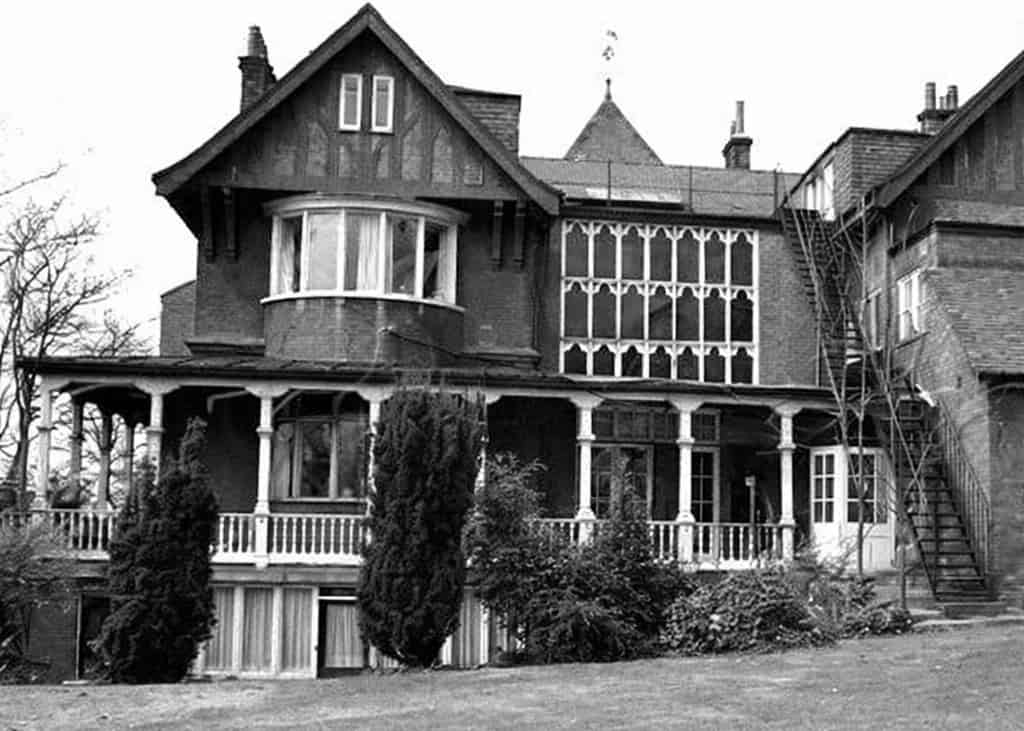
David and Angie lived at Haddon Hall, a large Victorian house in Beckenham. Despite its grand name and appearance, the building was not the luxurious mansion of an established rock star. Bowie’s finances remained uncertain, and parts of the house had a faded, improvised quality.
Haddon Hall nevertheless became one of the important creative environments of Bowie’s early career. Musicians rehearsed there, songs were written and discussed, clothes were tried, photographs were planned and visitors moved through a household in which domestic life and professional ambition constantly overlapped.
Mick Ronson and Woody Woodmansey spent time there, while Trevor Bolder later joined the musical unit that became the Spiders from Mars. Other musicians, designers, friends and members of London’s alternative culture also entered the household.
Angie was central to the atmosphere of Haddon Hall. She welcomed people, encouraged unconventional presentation and helped make the house feel removed from ordinary suburban life. For younger visitors, entering the Bowie household could feel like encountering a different social world only a short distance from conventional London.
The Ziggy Stardust environment

During the early 1970s, Angie became an important presence within the social and visual environment surrounding Bowie. Her fashion awareness, international outlook and comfort with unconventional identities complemented the direction in which Bowie was moving.
She encouraged experimentation and helped create a setting in which musicians, designers, hairdressers and performers could exchange ideas. Her influence was therefore often indirect: she brought people together, promoted confidence and treated visual presentation as an essential part of rock performance.
The creation of Ziggy Stardust involved many sources. Bowie drew upon science fiction, Japanese design, mime, theatre, Hollywood imagery, Vince Taylor, Iggy Pop, the Legendary Stardust Cowboy and his own ideas about fame. The character cannot accurately be credited to Angie alone.
Her importance lies instead in the encouragement and practical energy she supplied while those influences were being combined. She understood that music, clothing, hair, sexuality, photography and publicity could function as parts of one complete presentation.
That understanding helped distinguish the Bowie organisation from rock acts that treated clothing as decoration added after the music had been completed. During the Ziggy period, image and sound were developed as connected elements.
Fashion and visual presentation
Angie’s interest in clothing preceded Bowie’s commercial breakthrough. Both explored boutiques and designers whose work challenged the rigid division between menswear and womenswear. Bowie wore dresses and garments by designers including Michael Fish, while Freddie Burretti became an important member of the creative circle.
Burretti designed clothing for Bowie, including costumes associated with the Ziggy era. His contribution should not be absorbed into a simplified story in which Angie personally designed every outfit. Her role was more accurately one of encouragement, participation, networking and visual judgement.
Hairdresser Suzi Fussey, later Suzi Ronson, also became important. Angie first encountered her through the salon used by Bowie’s mother and invited her into the Haddon Hall circle. Bowie subsequently showed Fussey a magazine photograph featuring a model connected with Japanese designer Kansai Yamamoto and asked for a related short, vividly coloured hairstyle.
Suzi Ronson remembering Angie Bowie
“Angie was American, she was tall, cool and as bold as brass.”
— Suzi Ronson, interviewed by The Guardian, 2024
Fussey created the cut and colour that became inseparable from Ziggy Stardust’s public image. Angie did not perform that work herself, but she helped bring Fussey into the household and supported the willingness to attempt something extreme.
This distinction is important. Angie’s historical contribution becomes more credible when it is described precisely. She was not the sole designer of Bowie’s image, but she helped establish conditions in which specialist collaborators could make decisive contributions.
Gender, sexuality and performance
Angie’s rejection of conventional sexual and gender expectations matched the broader atmosphere surrounding Bowie’s early 1970s presentation. Their marriage was openly unconventional, and both later discussed relationships outside it.
Bowie’s public declarations about sexuality became part of his challenge to British rock culture. His androgynous appearance, theatrical movement and physical closeness to Mick Ronson onstage unsettled conventional ideas of masculinity.
Angie’s confidence helped normalise that experimentation within their immediate environment. She did not need Bowie to appear as a traditionally masculine husband, nor did she treat feminine clothing or make-up as incompatible with artistic authority.
Bowie’s exploration of identity had begun before he met Angie. His work with mime artist Lindsay Kemp, his theatrical interests and his earlier image changes already demonstrated a desire to escape fixed categories. Angie amplified that impulse rather than creating it from nothing.
Publicity and social confidence
Angie understood that provocation could attract attention. At a time when Bowie’s record sales remained uncertain, visibility mattered. Clothes, interviews, parties and striking personal appearances helped keep him in the attention of journalists and influential figures.
She possessed a directness that contrasted with Bowie’s more controlled and sometimes elusive personality. While he could observe a room and absorb its possibilities, Angie could dominate it, initiate conversations and insist that people take notice.
This did not make her Bowie’s official manager. Tony Defries and MainMan later controlled the commercial organisation surrounding his career, while record companies, publicists, photographers and journalists each had distinct responsibilities.
Angie’s contribution was less formal but still valuable. She could create momentum around Bowie and communicate certainty before the commercial evidence fully justified it. That confidence supported the transition from cult figure to star.
Angie and the musicians
Angie’s relationship with the musicians around Bowie varied. She recognised the importance of Mick Ronson’s musical ability and visual presence and understood that the backing group needed to appear connected to Bowie’s theatrical world.
Ronson, Trevor Bolder and Woody Woodmansey brought musical discipline and a direct Yorkshire rock sensibility to the project. Angie represented a more socially theatrical energy. The contrast became part of the unusual chemistry surrounding the Spiders from Mars.
She also encouraged members of the circle to accept forms of presentation that could initially seem unfamiliar. This did not mean that every musician shared the same opinions or felt equally comfortable with every aspect of Bowie’s evolving image.
Accounts from the period reveal both enthusiasm and tension. Haddon Hall could be exciting and liberating, but the rapid transformation of Bowie’s career also created uncertainty about money, status, loyalty and who controlled the story.
Family life and Duncan Jones
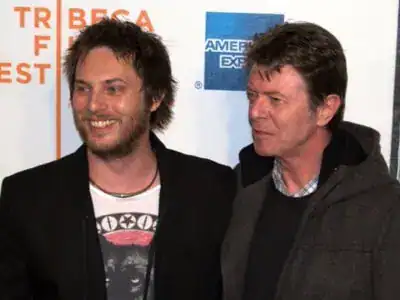
Photo: David Shankbone / Wikimedia Commons / CC BY 3.0 — Wikimedia file page
On 30 May 1971, Angie and David Bowie welcomed their son, Duncan Zowie Haywood Jones. Bowie responded to the birth by writing Kooks, which appeared on Hunky Dory.
The child was widely known as Zowie Bowie during his early years, although he later used Joe before returning to his birth name, Duncan. He eventually established an independent career as the director of films including Moon, Source Code and Warcraft.
His birth occurred while Bowie’s professional life was accelerating. The family therefore experienced domestic life alongside rehearsals, recording sessions, visitors, financial uncertainty and the increasingly demanding organisation surrounding Bowie’s career.
Photographs of David, Angie and their young son became part of the visual record of the period. They showed a family unit that existed behind the alien imagery of Ziggy Stardust, although the realities of the marriage were more complicated than those images suggested.
Following the divorce, Duncan lived primarily with his father. His later estrangement from Angie has been discussed publicly by both mother and son. Because this is a painful family matter involving conflicting perspectives, it should not be reduced to gossip or used to make simple judgements about either participant.
Fame and changing relationships
Bowie’s breakthrough dramatically changed the balance of the marriage. The household that had once operated under financial uncertainty became connected to international tours, press campaigns, recording schedules and a growing management organisation.
The greater Bowie’s fame became, the more control moved towards Tony Defries and MainMan. The informal creative atmosphere of Haddon Hall could not easily survive the machinery required to manage an international star.
Angie remained visible during the Ziggy period and appeared backstage in D. A. Pennebaker’s film of the final Ziggy concert at the Hammersmith Odeon on 3 July 1973. Her presence in the film preserves a glimpse of her place inside the theatrical world surrounding Bowie.
At the same time, the couple’s relationship was becoming increasingly difficult. Touring, separate relationships, management pressure, drugs and conflicting ambitions all contributed to greater distance between them.
David Bowie on Angie during the Ziggy period
“She’s so outrageous and brave. Not a jealous bone in her body.”
— David Bowie, as recalled by Suzi Ronson in Me and Mr Jones
The recollection captures the admiration that could exist within their unconventional relationship. It does not erase the later conflict, but it demonstrates why the marriage should not be presented only through its unhappy ending.
Separation and divorce
By the middle of the 1970s, Angie was becoming increasingly separated from Bowie’s professional world. His career had moved through Diamond Dogs, American soul, severe drug problems, the Thin White Duke period and eventual relocation to Europe.
The couple separated before their divorce was completed in 1980. The legal and financial arrangements have generated many repeated stories, not all of which agree in their details. The essential fact is that the marriage ended after a decade in which both their private lives and Bowie’s public career had changed beyond recognition.
The divorce also affected Angie’s ability to control her own public identity. Bowie’s fame was so extensive that almost everything she subsequently did was interpreted through her former marriage.
She remained willing to discuss the relationship, often in language that was funny, provocative or angry. This ensured continued public attention but also contributed to a cycle in which her independent work was overshadowed by headlines about David Bowie.
Life after Bowie
Angie Bowie – life after David Bowie
Following the divorce, Angie pursued work as a writer, performer, journalist and media personality. Establishing an independent identity was difficult because public interest remained concentrated on her former husband.
Her first memoir, Free Spirit, appeared in 1981. She later returned to the story of her marriage and the glam period in Backstage Passes: Life on the Wild Side with David Bowie, written with Patrick Carr and published in 1993.
These books offered details about Haddon Hall, Bowie’s career, their relationships and the personalities surrounding them. They also reinforced Angie’s reputation as an outspoken and controversial witness to the period.
Her other published work includes Bisexuality: A Pocket Guide, Cat’Astrophe, Lipstick Legends, the poetry collection Fancy Footwork and POP.SEX. Together, these publications demonstrate that her writing extended beyond recollections of David Bowie.
Angie continued contributing to media projects and writing about sexuality, popular culture and personal experience. She also made television appearances and participated in projects that drew upon her association with glam rock.
Her 2016 appearance on Celebrity Big Brother introduced her to another large television audience. News of David Bowie’s death reached her while she was participating in the programme, creating a difficult collision between private history and reality television.
Memoirs, memory and disputed stories
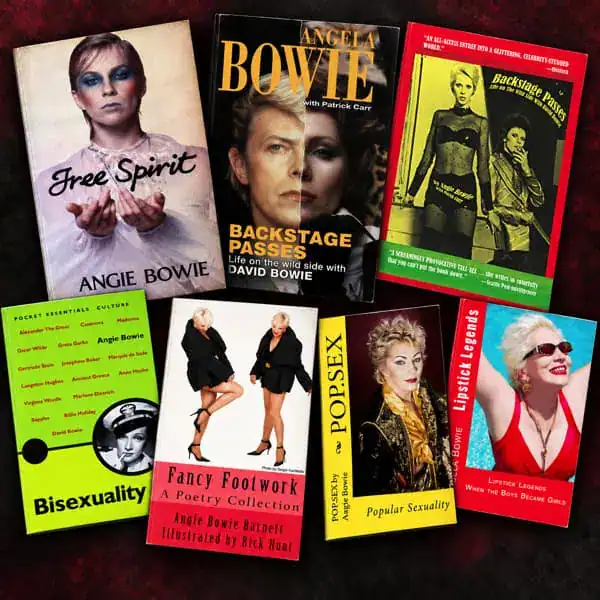
Angie’s memoirs are important first-hand sources, but memoir is not the same as a complete documentary record. Personal memories are shaped by emotion, later knowledge and the circumstances in which a story is retold.
Some of her most sensational claims have received far more attention than her descriptions of daily life, clothing, ambition and the practical creation of Bowie’s early environment. Stories involving famous musicians are easily repeated even when independent confirmation is limited.
A responsible history must therefore separate several different kinds of evidence. Recording credits can establish who performed on an album. Contracts and dated documents can establish professional arrangements. Contemporary photographs can confirm who was present at particular events. Personal testimony can describe atmosphere and conversation but may remain impossible to verify completely.
This does not make Angie an unreliable witness to everything she experienced. It means her recollections should be read critically, just as the memories of Bowie, his musicians, managers and other participants should be examined critically.
Was Angie Bowie responsible for Ziggy Stardust?
The simple answer is no. Ziggy Stardust was David Bowie’s creation, assembled from numerous musical, theatrical, literary and visual influences. Bowie wrote the songs, developed the character and made the decisive artistic choices.
Mick Ronson, Trevor Bolder and Woody Woodmansey gave the project its essential band sound. Ken Scott helped capture it in the studio. Freddie Burretti, Suzi Fussey, Kansai Yamamoto, Pierre La Roche, Mick Rock and other collaborators made important contributions to clothing, hair, make-up and photography.
The opposite claim—that Angie had no meaningful role—is also too simple. She was present during the formative period, encouraged experimentation, helped people enter Bowie’s circle and strengthened the belief that image, sexuality and presentation could be used without apology.
Her influence was environmental and catalytic rather than authorial. She did not invent every element, but she helped create the conditions in which different elements could meet.
Historical importance
Angie Bowie witnessed and participated in one of the most dramatic transformations in popular music. When she met Bowie, his future remained uncertain. Within a few years, Ziggy Stardust had made him one of Britain’s most recognisable performers.
Her historical importance lies partly in the contrast she brought to Bowie’s life. Her American directness, international background and enthusiasm for confrontation differed from his quieter, more observant social manner.
She also represents the frequently overlooked labour surrounding a famous artist. Creative careers are not constructed only inside recording studios. Homes, friendships, introductions, clothing decisions, conversations and emotional encouragement can all influence the environment in which art is made.
Legacy
Angie Bowie remains a complicated figure within David Bowie’s history. Admirers see her as a fearless catalyst who encouraged Bowie’s early experimentation and helped energise the Haddon Hall world. Critics point to disputed stories, later bitterness and her continued public discussion of their marriage.
Both responses can obscure the historical reality. Angie was a young woman participating in an unstable creative partnership before either she or Bowie could know how influential the resulting work would become.
Her contribution was not musical authorship, formal management or sole responsibility for Bowie’s appearance. It was the confidence to encourage change, the social energy to connect people and the refusal to treat clothing, gender and sexuality as subjects that required permission.
Bowie continued transforming himself long after their relationship ended, proving that his creative drive was entirely his own. Yet the particular atmosphere surrounding his early glam breakthrough cannot be reconstructed honestly without including Angie.
Her place in the story is therefore neither that of the hidden creator of Ziggy Stardust nor merely “David Bowie’s first wife.” Angie Bowie was an active and sometimes disruptive presence inside the social, domestic and visual world from which one of rock music’s most influential transformations emerged.
Official Website & Further Information
Further information about Angie Bowie’s writing, media work and current activities can be found on her official website:
Angie Bowie – Official Website
Additional information can be found in Angie Bowie’s memoirs Free Spirit and Backstage Passes, published interviews, contemporary reports and first-hand accounts by people who were present at Haddon Hall and during the Ziggy Stardust period.
Article Origin & Editorial Note
This article was independently researched, written and edited for DavidBowieWorld.com as part of the website’s archive documenting the musicians, producers, performers and creative figures connected with David Bowie’s career.
The article distinguishes Angie Bowie’s documented presence and influence from claims that cannot be independently confirmed. Personal recollections are treated as first-hand testimony rather than automatically as undisputed fact.
No claim is made that Angie Bowie, Duncan Jones or representatives of the David Bowie estate personally reviewed or approved this article. The page may be updated if reliable new documentation, corrections or first-hand information becomes available.
© DavidBowieWorld.com — David Bowie Collaborations & Creative Circle
