
David Bowie 1996-07-16 Rotterdam ,Sportpaleis Ahoy - SQ 8+.
Label: No label
Audio Source: Audience
Lineage: Unknown
Taper: Unknown
Recording Location: Unknown
Total running time: 1:57:10
Sound Quality: Very good. Slight noise and some dullness, but generally enjoyable to listen to.
Attendance: Approximately 9,000 (reported)
Artwork: None supplied as original release artwork
Note: The tracklisting begins with a file named "House Music". The original filename spellings have been corrected for presentation. This version should not be confused with the 1:49:06 ManOfStealth recording or the 1:57:24 RAW version of the same concert.
David Bowie 1996-07-16 Rotterdam, Sportpaleis Ahoy – FLAC Audience Recording (1:57:10)
David Bowie – Rotterdam, Sportpaleis Ahoy, 16 July 1996 is an unofficial audience recording of Bowie's performance during the Outside Summer Festivals Tour. This particular version has a running time of 1 hour, 57 minutes and 10 seconds and circulates as a collection of 23 FLAC files, beginning with a track identified as House Music before the concert's opening song.
The recording captures Bowie during a period of intense musical experimentation, combining material from 1. Outside with older compositions, Tin Machine material and songs associated with the development of Earthling. Although other audience recordings of the same Rotterdam concert also circulate, this edition has its own documented running time, track division and artwork credit. Its original recording and transfer lineage remain unknown.
Sound Quality Rating
Recording Equipment: Unknown
Recorded: 16 July 1996
Venue: Sportpaleis Ahoy, Rotterdam, Netherlands
Tour: Outside Summer Festivals Tour
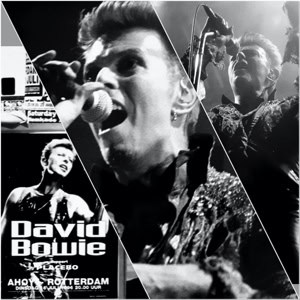
Front Cover Collage: Hilco Arendshorst
Audio Format: FLAC, 23 indexed files
Tracklisting
01. House Music
02. The Motel
03. Baby Universal
04. Look Back In Anger
05. We Prick You
06. Scary Monsters (And Super Creeps)
07. The Hearts Filthy Lesson
08. Outside
09. Aladdin Sane (1913-1938-197?)
10. The Voyeur Of Utter Destruction (As Beauty)
11. The Man Who Sold The World
12. Hallo Spaceboy
13. Breaking Glass
14. Telling Lies
15. Jump They Say
16. Under Pressure
17. "Heroes"
18. Moonage Daydream
Encore
19. A Small Plot Of Land
20. Strangers When We Meet
21. Lust For Life
22. White Light/White Heat
23. All The Young Dudes
Rotterdam – 16 July 1996
On Tuesday, 16 July 1996, David Bowie performed at Sportpaleis Ahoy in Rotterdam during the European section of his Outside Summer Festivals Tour. The concert came at a time when Bowie was continuing to develop the experimental direction introduced on 1. Outside, while already exploring the musical ideas that would shape his next album, Earthling.
The performance featured a compact five-piece touring band, allowing the musicians to concentrate on powerful arrangements and spontaneous interaction rather than the elaborate theatrical productions associated with some of Bowie's earlier tours.
The Rotterdam setlist combined contemporary songs with selections from different stages of Bowie's career. Material from the early 1970s appeared alongside compositions from the Berlin period, the Tin Machine years and his more recent albums.
This mixture reflected Bowie's approach to live performance in 1996. Rather than presenting a conventional greatest-hits concert, he treated his earlier catalogue as material that could be reshaped to fit his current musical interests.
The Outside Summer Festivals Tour
The Outside Summer Festivals Tour followed the main Outside Tour of 1995 and early 1996. The earlier concerts had supported 1. Outside, Bowie's ambitious collaboration with Brian Eno.
For the summer performances, Bowie reduced his touring group to five musicians. The smaller band consisted of himself, guitarist Reeves Gabrels, bassist and vocalist Gail Ann Dorsey, drummer Zachary Alford and keyboardist Mike Garson.
The tour began at the Nippon Budokan in Tokyo on 4 June 1996 before continuing through Japan, Russia and Europe. The Rotterdam appearance formed part of the European summer itinerary.
The musicians brought different strengths to the performances. Gabrels contributed unconventional guitar sounds, Garson introduced atmospheric keyboards and improvisational piano passages, while Dorsey and Alford provided a strong rhythmic foundation.
This combination allowed the band to perform both the aggressive material from 1. Outside and older Bowie compositions without losing the musical identity of the tour.
House Music – Before the Concert Begins
One of the distinguishing features of this particular recording is the opening file, identified as House Music.
Unlike the remaining tracks, this title does not represent a composition performed by Bowie and his touring band. It is listed separately before The Motel, the opening song of the concert.
The filename suggests that the recording preserves music heard in the venue before Bowie appeared on stage. However, the precise contents of this track have not been independently verified.
Its inclusion is nevertheless important when documenting this edition. The recording contains 23 indexed files, but only 22 correspond to songs in the concert setlist.
The opening track also helps distinguish this version from other circulating recordings of the same performance, which may begin at different points or divide the audio differently.
The Motel – An Atmospheric Opening
The concert opened with The Motel, one of the most atmospheric compositions from 1. Outside.
Its restrained introduction and gradual musical development created an unusual beginning for a rock concert. Rather than immediately presenting a familiar hit, Bowie established the darker and more experimental atmosphere associated with his contemporary music.
The composition gave Mike Garson and Reeves Gabrels considerable scope to explore the contrast between quieter passages and more forceful instrumental sections.
As an opening number, The Motel demonstrated Bowie's confidence in presenting challenging material to an audience rather than relying on the conventional structure of a greatest-hits performance.
Baby Universal – The Tin Machine Connection
Baby Universal originally appeared on Tin Machine II in 1991. Its inclusion in the Rotterdam setlist demonstrated that Bowie continued to draw on the repertoire developed during his years with Tin Machine.
The song's driving guitar arrangement was well suited to Reeves Gabrels, who had also been a member of Tin Machine.
The 1996 performances placed the composition within a different musical setting, allowing it to sit alongside songs from 1. Outside and Bowie's earlier solo albums.
Look Back In Anger and We Prick You
Look Back In Anger, originally released on Lodger in 1979, was one of the older compositions revived during the Outside period.
Its energetic rhythm and forceful vocal delivery made it suitable for the compact 1996 band. The song's experimental origins also provided a connection between Bowie's late-1970s work and his contemporary musical interests.
We Prick You, from 1. Outside, followed. Its mechanical rhythms and repeated vocal phrases reflected Bowie's growing interest in industrial and electronic music.
The contrast between these two compositions illustrated how the band could move between different stages of Bowie's career while maintaining a consistent sound.
Scary Monsters and The Hearts Filthy Lesson
Scary Monsters (And Super Creeps) was originally released in 1980 and remained one of Bowie's most distinctive rock compositions.
Its unconventional guitar sounds and aggressive arrangement made it particularly suitable for Reeves Gabrels' playing style.
The Hearts Filthy Lesson, released in 1995, represented the darker musical world of 1. Outside. Its distorted textures, fragmented lyrics and unsettling atmosphere were central to Bowie's mid-1990s artistic direction.
Hearing the two songs together reveals connections between the experimental approaches Bowie explored during different periods of his career.
Outside – The Nathan Adler World
The title track Outside belonged to the fictional narrative developed for Bowie's 1995 album. The project centred on the character Nathan Adler and a series of disturbing events involving art, crime and psychological investigation.
Although the album's complete narrative was primarily presented through its accompanying material, the songs retained their individual musical identities during live performances.
The Rotterdam concert demonstrated how the Outside material could function alongside older compositions without requiring the audience to follow the entire fictional story.
Aladdin Sane – Mike Garson's Piano
Aladdin Sane (1913-1938-197?), originally released in 1973, remains one of the compositions most closely associated with Mike Garson.
Garson's original piano solo brought elements of free jazz into Bowie's rock music and became one of the most recognisable features of the recording.
His return to Bowie's touring group during the 1990s allowed him to revisit the composition while continuing to explore new approaches to its improvisational passages.
Within the Rotterdam setlist, Aladdin Sane connected Bowie's early-1970s experimental work with the musical atmosphere of the Outside period.
The Voyeur Of Utter Destruction (As Beauty)
The Voyeur Of Utter Destruction (As Beauty) was one of the most intense compositions from 1. Outside.
Its distorted guitar textures, changing musical dynamics and unsettling lyrical imagery made it particularly effective in a live setting.
The song allowed the musicians to emphasise the harder side of Bowie's contemporary repertoire while maintaining the complex musical arrangements associated with the album.
The Man Who Sold The World
Originally released in 1970, The Man Who Sold The World had gained renewed attention during the 1990s, particularly following Nirvana's performance on MTV Unplugged.
Bowie continued to reinterpret the song during his own concerts, adapting its arrangement to the musical direction of the period.
Its inclusion at Rotterdam connected one of his earlier compositions with the darker, more experimental sound of the Outside touring band.
Hallo Spaceboy – Industrial Rock and Electronic Influences
Hallo Spaceboy was one of the most prominent songs associated with 1. Outside.
Its powerful rhythms, electronic textures and forceful vocal delivery made it a natural choice for the 1996 concerts.
The song received additional attention when Bowie collaborated with the Pet Shop Boys on a revised version released as a single in 1996.
Its presence in the Rotterdam performance reflected Bowie's interest in combining rock music with contemporary electronic dance influences.
Breaking Glass – Revisiting Low
Breaking Glass originally appeared on Low in 1977, during Bowie's period of collaboration with Brian Eno and Tony Visconti.
The song's compact arrangement and strong rhythmic structure made it suitable for reinterpretation by the five-piece touring group.
Its inclusion also connected the electronic experimentation of Bowie's Berlin-period recordings with the musical ideas he was exploring during the mid-1990s.
Telling Lies – The Road to Earthling
One of the most historically significant selections from the Rotterdam concert is Telling Lies.
The song belonged to the new material Bowie was developing during 1996 and would subsequently appear on Earthling, released in February 1997.
Its electronic rhythms and contemporary production influences pointed towards the next major development in Bowie's musical direction.
The Rotterdam performance therefore documents a period when Bowie was still presenting the music of 1. Outside while already moving towards the sound of his next album.
Jump They Say and Under Pressure
Jump They Say, originally released on Black Tie White Noise in 1993, brought another stage of Bowie's early-1990s work into the concert.
Under Pressure, the 1981 collaboration between Bowie and Queen, gave Gail Ann Dorsey an important vocal role.
During Bowie's 1990s concerts, Dorsey performed the vocal part associated with Freddie Mercury while continuing to play bass guitar.
Her contribution became one of the most recognisable features of the touring group's interpretation of the song.
"Heroes" and Moonage Daydream
The main set concluded with two compositions from different periods of Bowie's career.
"Heroes", released in 1977, had become one of his most enduring concert songs. Its gradual musical development and emotional intensity provided a strong contrast to the darker material from 1. Outside.
Moonage Daydream, originally released on The Rise and Fall of Ziggy Stardust and the Spiders from Mars in 1972, returned the performance to the glam-rock era.
The song's dramatic arrangement and prominent guitar passages allowed Reeves Gabrels to reinterpret material originally associated with Mick Ronson.
The Encore – A Small Plot Of Land
The encore opened with A Small Plot Of Land, one of the most experimental compositions from 1. Outside.
Its unusual structure and atmospheric passages made it an unconventional choice for the final section of a concert.
Rather than immediately returning with a familiar hit, Bowie continued to emphasise the challenging contemporary material that defined his artistic direction during 1996.
Strangers When We Meet
Strangers When We Meet first appeared on The Buddha Of Suburbia in 1993 before being re-recorded for 1. Outside in 1995.
Its melodic character provided a contrast to the darker compositions heard earlier in the evening.
The song's continued presence in the live repertoire demonstrated Bowie's interest in revisiting compositions and allowing them to develop through different arrangements.
Lust For Life – The Iggy Pop Connection
Lust For Life was originally recorded by Iggy Pop for his 1977 album of the same name.
Bowie co-wrote the song and played an important role in the album's creation during their period of collaboration in Europe.
Its appearance in the Rotterdam encore recalled one of the most important musical partnerships of Bowie's career.
White Light/White Heat – The Velvet Underground
White Light/White Heat was originally released by the Velvet Underground in 1968.
The group had been an important influence on Bowie during the years before his international breakthrough.
Bowie had performed the song during earlier stages of his career, including the Ziggy Stardust period.
Its return to the 1996 repertoire connected the raw experimental rock of the Velvet Underground with the aggressive guitar sound of Bowie's contemporary touring group.
All The Young Dudes – The Concert Finale
The concert concluded with All The Young Dudes, written by Bowie for Mott The Hoople in 1972.
The composition became one of the defining songs of the glam-rock era and remained closely associated with Bowie's songwriting.
Its appearance as the final song provided a familiar and energetic conclusion to a concert that had concentrated heavily on experimental material.
The 1996 Touring Band
The Rotterdam concert featured the five-piece line-up of the Outside Summer Festivals Tour.
David Bowie – Lead vocals
Reeves Gabrels – Guitar, backing vocals
Gail Ann Dorsey – Bass guitar, vocals
Zachary Alford – Drums
Mike Garson – Keyboards, backing vocals
Reeves Gabrels had been associated with Bowie since the Tin Machine period. His experimental guitar playing was central to the sound of the Outside performances.
Gail Ann Dorsey combined bass guitar with powerful vocals, taking a particularly prominent role during Under Pressure.
Zachary Alford supplied the rhythmic foundation, while Mike Garson brought his distinctive piano and keyboard style to both the older compositions and the contemporary material.
The smaller line-up allowed the musicians considerable freedom to reinterpret songs from different periods of Bowie's career while maintaining a consistent musical identity.
The Audience Recording – Sound and Lineage
This version of the Rotterdam concert is identified as an audience recording with a total running time of 1:57:10.
The original recording equipment, taper and transfer lineage are not documented in the supplied information.
The recording circulates as 23 FLAC files. FLAC is a lossless digital audio format, meaning that the files can preserve the audio data of a digital source without additional compression loss. However, the use of FLAC does not establish the quality or generation of the original recording.
The sound is described as very good, although some noise and dullness remain audible.
Because the original recording and transfer history are unknown, it is not possible to determine whether this version represents a separate master recording, a different transfer or an edited presentation of another circulating source without direct audio comparison.
Three Circulating Rotterdam Recordings
Three differently described versions of Bowie's 16 July 1996 Rotterdam performance are represented in this collection.
Version 1 – 1:49:06: An audience recording credited to ManOfStealth, with mastering by Dennis Orr. The stated recording equipment is a Sony WM-D3, and the documented lineage begins with the original master cassettes.
Version 2 – 1:57:24: A RAW audience recording with no individual track markers. The taper, recording equipment and lineage are unknown. Its sound is described as noisy and very dull.
Version 3 – 1:57:10: The version featured on this page. It circulates as 23 FLAC files, begins with a track identified as House Music and has a front-cover collage credited to Hilco Arendshorst.
The differences in running time, sound quality and track presentation are important for collectors. However, these details alone do not establish that all three versions originate from independent audience tapes.
A definitive comparison would require examination of the audio, including audience sounds, recording interruptions, tape characteristics and the precise timing of individual performances.
The Front Cover Collage – Hilco Arendshorst
The front-cover collage associated with this version is credited to Hilco Arendshorst.
Although no original commercial artwork is identified for the recording, the collage provides a visual presentation for this particular circulating edition.
Such artwork is an important part of the history of unofficial concert recordings. Collectors frequently created covers, photographs and tracklisting inserts for recordings that were originally distributed without conventional packaging.
The credit should be preserved when documenting the recording so that the creator of the collage remains identified.
Sportpaleis Ahoy and Bowie's Dutch Concert History
Sportpaleis Ahoy was one of the Netherlands' major indoor concert venues, hosting international artists and large-scale live performances.
Bowie had a long association with Dutch audiences, dating back to his earliest appearances in the Netherlands during the 1960s.
The Rotterdam concert of July 1996 represented a different stage of his career from the theatrical productions of the Ziggy Stardust, Diamond Dogs and Serious Moonlight periods.
By this time, the emphasis had shifted towards a smaller band, experimental arrangements and a repertoire that deliberately challenged expectations.
The reported attendance of approximately 9,000 gives an indication of the scale of the event, although the exact figure has not been independently confirmed.
Video – David Bowie in 1996
The following video accompanies this archive entry as additional material relating to David Bowie's 1996 live performances. Its inclusion does not establish that the footage was recorded at Sportpaleis Ahoy on 16 July 1996.
About David Bowie – Rotterdam, 16 July 1996 (FLAC Version)
This 1:57:10 audience recording of David Bowie's Rotterdam concert on 16 July 1996 is a distinct circulating edition of a performance from the Outside Summer Festivals Tour.
Its 23 FLAC files preserve the listed concert sequence together with an opening track identified as House Music. The recording is described as very good, with slight noise and some dullness, although its original taper, equipment and transfer lineage remain unknown.
The front-cover collage credited to Hilco Arendshorst provides another identifying feature of this version.
Musically, the concert documents an important transitional period in Bowie's career. The repertoire combined the dark experimental material of 1. Outside with songs from earlier decades, while Telling Lies anticipated the electronic direction of Earthling.
For collectors, the recording is especially interesting when considered alongside the other surviving Rotterdam sources. Differences in running time, sound characteristics and track division provide useful information for identifying editions, even though the precise relationship between the recordings remains unconfirmed.
As a document of Bowie's 1996 live performances, this version preserves a substantial concert from a period in which he was once again redefining his musical direction, combining established compositions with some of the most challenging material of his later career.
