
Mott the Hoople – David Bowie and All the Young Dudes
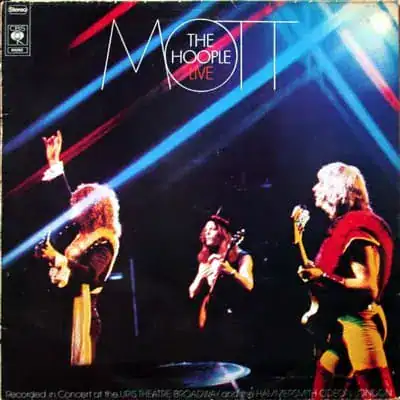
Mott the Hoople during the early 1970s.
Mott the Hoople were a British rock band formed in 1969 when the Hereford group Silence was joined by singer and pianist Ian Hunter.
The classic line-up also included guitarist Mick Ralphs, keyboard player Verden Allen, bassist Pete Overend Watts and drummer Dale Griffin.
The band developed a devoted following through its energetic live performances, but its first four albums failed to provide a major commercial breakthrough.
In early 1972, after a difficult period of touring and mounting financial pressure, the musicians decided to separate.
When David Bowie learned that Mott the Hoople intended to split up, he encouraged the band to continue. Bowie first offered them Suffragette City, which they declined, and then wrote All the Young Dudes specifically for the band.
Bowie subsequently produced both the hit single and the accompanying album. Released in 1972, All the Young Dudes reached No. 3 on the UK Singles Chart, transforming the band’s fortunes and launching the most successful period of its career.
- Band: Mott the Hoople
- Formed: 1969
- Origin: Hereford, England
- Founded from: Doc Thomas Group → Silence → Mott the Hoople
- Classic line-up: Ian Hunter, Mick Ralphs, Verden Allen, Pete Overend Watts and Dale Griffin
- Genres: Rock, hard rock, glam rock
- Bowie connection: David Bowie persuaded the band not to split up, wrote All the Young Dudes specifically for them and produced the 1972 album.
- Major Bowie-written recording: All the Young Dudes
- Highest-charting single: All the Young Dudes (UK No. 3)
- Original period: 1969–1976
Formation of Mott the Hoople
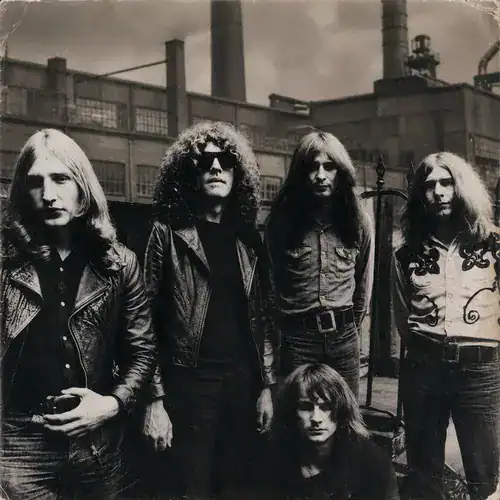
The origins of Mott the Hoople lay in a group of musicians from Hereford whose earlier bands included the Doc Thomas Group and Silence. By early 1969, Silence consisted of Stan Tippins on lead vocals, Mick Ralphs on guitar, Pete Overend Watts on bass, Dale “Buffin” Griffin on drums and Terry Allen—later known as Verden Allen—on organ.
The musicians had gained extensive experience performing in clubs and other venues in Britain, Hamburg and Italy, but had made little commercial progress. Their route towards Island Records began after Overend Watts unsuccessfully auditioned for the bass position in Free. Through that connection, the band became aware of Guy Stevens, the influential Island Records executive and producer associated with Free.
Mick Ralphs subsequently travelled to London with a Silence demo tape and persuaded Stevens to audition the band. The audition took place in May 1969. Stevens recognised the potential of the four instrumentalists and believed that their combination of guitar, organ, bass and drums could form the basis of the powerful rock group he wanted to develop.
Stevens was less convinced that Stan Tippins was the right frontman for the group he had in mind. Tippins accepted the decision and returned temporarily to Italy. He remained closely connected with his former bandmates, however, and returned in 1970 as Mott the Hoople’s road manager. In that role, he became an important and highly respected member of the organisation surrounding the band.
To find a replacement vocalist, Stevens placed an advertisement in Melody Maker seeking a singer and pianist who was both image-conscious and ambitious. Auditions were held at a small studio in Soho, London, but approximately two dozen applicants failed to convince Stevens and the musicians.
Studio engineer Bill Farley then suggested Ian Hunter, a Shropshire-born musician who had worked as a bassist, singer and songwriter. Hunter was initially reluctant to attend and needed several telephone calls from Farley before agreeing to travel to the audition.
Hunter arrived wearing dark glasses and initially described himself as primarily a bass player. When Stevens directed him towards the piano, Hunter performed Bob Dylan’s Like a Rolling Stone. Stevens immediately recognised the voice, personality and Dylan-influenced approach he had been seeking and offered Hunter the position.
Stevens also provided the band with its new name. While serving a prison sentence in 1967, he had read Mott the Hoople, a 1966 novel by American author Willard Manus. He had retained the title because he believed it would make a memorable name for a rock group. With Hunter now installed as the lead singer, Silence became Mott the Hoople.
The newly formed line-up consisted of Ian Hunter, Mick Ralphs, Pete Overend Watts, Dale Griffin and Verden Allen. After rehearsing together for several weeks, they entered the studio under Guy Stevens’ direction to record their self-titled debut album. Released by Island Records in 1969, Mott the Hoople marked the beginning of one of the most distinctive careers in British rock music.
The Island Records Years (1969–1972)
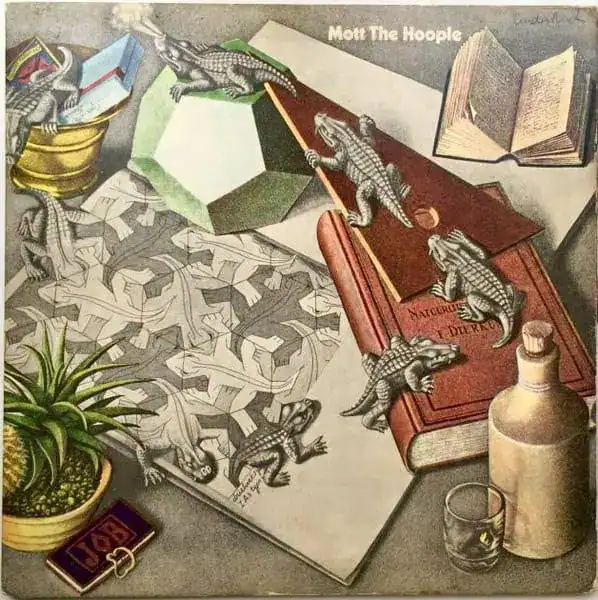
Mott the Hoople recorded its debut album during the summer of 1969 under the direction of Guy Stevens at Morgan Studios in London. Stevens’ production style was famously unconventional. Rather than pursuing technically perfect performances, he encouraged spontaneity and emotion, believing that a recording should capture the excitement of a live performance. His unpredictable methods often created tense recording sessions, but they also helped shape the raw sound that became one of the band’s trademarks.
Released on 8 November 1969, Mott the Hoople received enthusiastic reviews from the British music press. Although the album failed to achieve significant commercial success, critics praised the band’s originality and musicianship. Their interpretation of Doug Sahm’s At the Crossroads became one of the record’s standout tracks, while Ian Hunter immediately established himself as a distinctive songwriter and vocalist.
Unable to rely on record sales, the band built its reputation through constant touring. During 1970 they performed extensively throughout Britain and Europe, developing a loyal following thanks to their energetic concerts and powerful stage performances. While many contemporary groups relied heavily on blues standards, Mott the Hoople combined hard rock, rhythm and blues, folk influences and intelligent songwriting into a style that was increasingly recognised as their own.
Their second album, Mad Shadows, was released on 25 September 1970. Produced once again by Guy Stevens, the album reflected both his brilliance and his chaotic working methods. Songs such as Thunderbuck Ram, No Wheels to Ride and You Are One of Us demonstrated a darker and more adventurous musical direction than the debut album, but commercial success again proved elusive despite favourable reviews.
The band’s third studio album, Wildlife, followed on 26 March 1971. The record revealed a broader musical range, moving comfortably between straightforward rock songs and more reflective material while further demonstrating Ian Hunter‘s development as both a lyricist and composer. Once again, however, the album failed to achieve the sales that critics believed the band deserved.
Determined to succeed, Mott the Hoople returned to the studio later in 1971 to record Brain Capers, released on 6 November 1971. Produced by Guy Stevens, the album adopted a heavier and more aggressive sound than its predecessors and is now widely regarded as one of the strongest records of the band’s career. Tracks including Death May Be Your Santa Claus, The Moon Upstairs, The Wheel of the Quivering Meat Conception and The Journey captured much of the power that audiences had experienced during the band’s live performances.
Despite four critically respected albums, Mott the Hoople remained unable to translate their reputation into commercial success. Record sales continued to disappoint, financial pressures increased and years of relentless touring had left the musicians exhausted. Early in 1972 the members reluctantly agreed that, after fulfilling their remaining commitments, the band would come to an end. Before those plans could be carried out, however, one of their greatest admirers—David Bowie—decided to intervene.
David Bowie Saves the Band
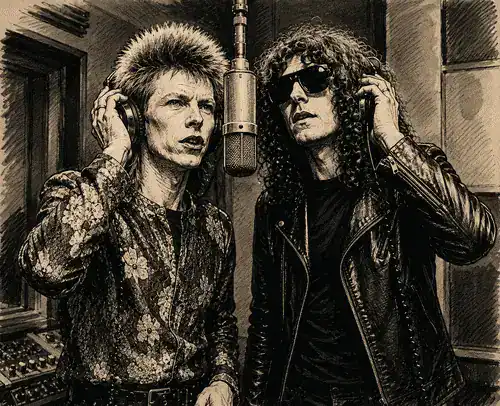
AI-generated artistic interpretation depicting David Bowie and Ian Hunter during the early 1970s.
By the beginning of 1972, Mott the Hoople stood on the verge of breaking up. Four critically acclaimed albums had failed to produce significant commercial success, despite the band earning a reputation as one of Britain’s finest live acts. Years of constant touring, disappointing sales and financial uncertainty convinced the members that they had reached the end of the road. Their decision was made: after completing their remaining commitments, Mott the Hoople would disband.
Unknown to the band, one of their greatest admirers had no intention of letting that happen. David Bowie, whose own career was rapidly gathering momentum following Hunky Dory and the forthcoming release of The Rise and Fall of Ziggy Stardust and the Spiders from Mars, regarded Mott the Hoople as one of the finest rock bands in Britain. He believed their lack of commercial success bore no relation to the quality of their music and was determined to help them.
After learning that the band intended to split up, Bowie contacted their management and arranged to meet Ian Hunter. During the meeting, Bowie offered them Suffragette City, a song that had already been recorded for his forthcoming Ziggy Stardust album but had not yet been released. Although Hunter immediately recognised the quality of the composition, he felt that it sounded too much like a David Bowie song and would not suit Mott the Hoople’s own musical identity.
Ian Hunter on Suffragette City
“I said, ‘It’s a great song, but it sounds like you. It doesn’t sound like us.'”
Ian Hunter reflects on Mott the Hoople’s remarkable rise during a television interview recorded in 1974.
Rather than taking offence, Bowie accepted Hunter’s judgement. He promised that if Suffragette City was not the right song for Mott the Hoople, he would write one especially for them. Within days, Bowie returned with a brand-new composition entitled All the Young Dudes, written specifically for the band.
When Ian Hunter first heard the song, he immediately recognised that Bowie had perfectly captured the spirit of the band while creating a record capable of reaching a far wider audience. The other members quickly shared Hunter’s enthusiasm, and the decision to disband was abandoned. Instead, Mott the Hoople signed a new recording contract with CBS Records, giving the band a fresh opportunity to rebuild its career.
Bowie also agreed to produce the recording sessions for All the Young Dudes, working alongside guitarist, arranger and musical director Mick Ronson. Their involvement extended beyond simply providing a hit single; they restored the band’s confidence at a moment when its future appeared hopeless. What had seemed certain to become the end of Mott the Hoople instead became the beginning of the most successful period in the band’s history.
All the Young Dudes
Recording sessions for All the Young Dudes began in June 1972 at Trident Studios in London. David Bowie produced the album, assisted by Mick Ronson, who also contributed guitar, piano, backing vocals and string arrangements. Rather than attempting to reshape Mott the Hoople in the image of Ziggy Stardust, Bowie focused on preserving the band’s own character while giving their sound greater clarity and commercial appeal.
Mott the Hoople performing All the Young Dudes, the David Bowie-written single that transformed the band’s career in 1972.
The title track, All the Young Dudes, was released as a single on 28 July 1972. Written specifically for Mott the Hoople after Ian Hunter decided that Suffragette City did not suit the band’s style, the song immediately attracted widespread attention. It reached No. 3 on the UK Singles Chart, becoming the band’s first major commercial success and transforming their career almost overnight.
The accompanying album, released on 8 September 1972, demonstrated that Mott the Hoople was far more than a one-hit wonder. Although Bowie wrote and produced the title track and also contributed Sea Diver, the majority of the album highlighted Ian Hunter‘s own songwriting. Tracks such as One of the Boys, Sucker, Ready for Love / After Lights and the band’s interpretation of Lou Reed‘s Sweet Jane reflected the confidence that had returned to the group.
Bowie’s production deliberately avoided overpowering the band’s identity. Instead, he emphasised the qualities that had already made Mott the Hoople one of Britain’s most respected live acts: Ian Hunter‘s distinctive voice, Mick Ralphs’ guitar work, the powerful rhythm section of Pete Overend Watts and Dale Griffin, and Verden Allen’s keyboards. Mick Ronson‘s tasteful musical contributions complemented the performances without overshadowing the band itself.
The success of both the single and the album established Mott the Hoople as one of Britain’s leading rock bands. Concert audiences grew dramatically, television appearances followed, and the group embarked on extensive tours in the United Kingdom, Europe and the United States. For the first time since their formation, commercial success finally matched the critical acclaim they had enjoyed throughout their Island Records years.
For David Bowie, All the Young Dudes demonstrated that he could successfully write and produce for another major artist without diminishing that artist’s own identity. For Mott the Hoople, the album marked the beginning of the most successful chapter of their career and remains one of the defining records of the glam rock era.
Building on Success (1973)
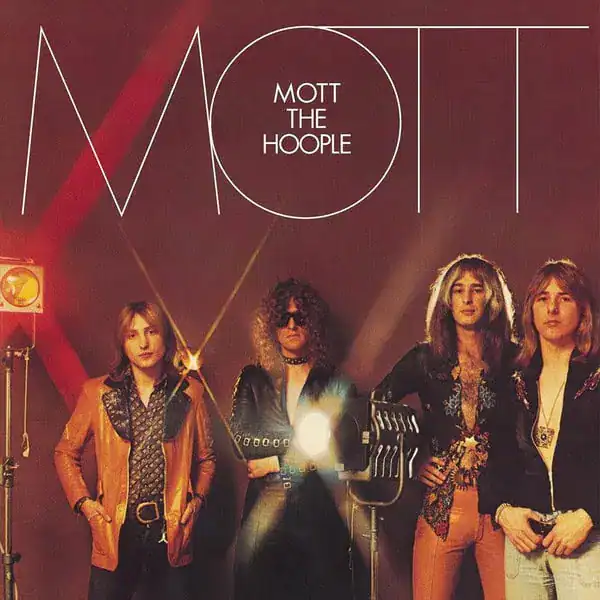
Following the success of All the Young Dudes, Mott the Hoople entered 1973 in a position they had never previously experienced. After years of critical acclaim but disappointing sales, they were now headlining larger venues, making regular television appearances and building a growing international audience. Just as importantly, the band wanted to demonstrate that their success would continue on the strength of their own songwriting rather than through David Bowie’s involvement alone.
The first major change came in the spring of 1973 when founding keyboard player Verden Allen left the band. Allen had played a vital role in shaping Mott the Hoople’s early sound, but musical differences and the pressures of constant touring led to his departure. During the transition the band worked with both Mick Bolton and Morgan Fisher, before Fisher became the group’s permanent keyboard player later that year.
On 20 July 1973, Mott the Hoople released their sixth studio album, Mott. Produced by the band, the album represented an important milestone in their career. It proved that Mott the Hoople could achieve both critical and commercial success without relying on material written or produced by David Bowie. Ian Hunter emerged as the band’s principal songwriter, while Mick Ralphs continued to make significant musical contributions during his final months with the group.
The album became Mott the Hoople’s highest-charting studio release in the United Kingdom, reaching No. 7 on the UK Albums Chart. It also established a stronger audience in the United States, confirming that the band’s breakthrough had not been a one-off success.
Two successful singles followed. Honaloochie Boogie, released in May 1973, reached No. 12 on the UK Singles Chart and became one of the band’s signature songs. It was followed by All the Way from Memphis, which climbed to No. 10. Ian Hunter later explained that the song was inspired by a real touring incident in which Mick Ralphs’ guitar was mistakenly shipped to Memphis instead of the band’s next concert destination.
Alongside its hit singles, Mott contained some of Ian Hunter‘s finest songwriting, including Violence, Drivin’ Sister, Ballad of Mott the Hoople (26th March 1972, Zürich) and I Wish I Was Your Mother. The album demonstrated that the group had developed far beyond the band David Bowie had rescued only a year earlier.
Despite the band’s growing success, guitarist Mick Ralphs had decided to pursue a different musical direction. In August 1973 he left Mott the Hoople to form Bad Company with former Free vocalist Paul Rodgers. Ralphs’ departure marked the end of the original guitar partnership that had helped define Mott the Hoople since 1969, but it also opened the next chapter in the band’s history.
The Final Years (1974–1976)
Mott the Hoople performing The Golden Age Of Rock And Roll during a UK television appearance in 1974.
Following Mick Ralphs’ departure in 1973, Mott the Hoople quickly appointed guitarist Luther Grosvenor, formerly of Spooky Tooth, who adopted the stage name Ariel Bender. Although Ralphs had been one of the band’s founding members and principal songwriters, Hunter had increasingly become the group’s dominant creative force, allowing Mott the Hoople to continue without losing its identity.
The first release by the new line-up was Roll Away the Stone, issued in November 1973. Although the song had originally been recorded during the Mott sessions with Mick Ralphs, the released version featured newly recorded guitar parts by Ariel Bender. The single reached No. 8 on the UK Singles Chart, giving the band another major hit and demonstrating that they could continue successfully after Ralphs’ departure.
Mott the Hoople entered 1974 with renewed confidence and released The Hoople on 29 March 1974. The album reached the UK Top 20 and produced another successful single, The Golden Age of Rock ‘n’ Roll, which climbed to No. 16 on the UK Singles Chart. The record balanced energetic rock songs with more reflective material and further established Ian Hunter as one of Britain’s finest rock songwriters.
Among the album’s highlights were The Golden Age of Rock ‘n’ Roll, Marionette, Alice, Crash Street Kidds and Pearl ‘n’ Roy (England). The latter, inspired by actor and musician Roy Wood, reflected Hunter’s growing confidence in combining autobiographical themes with observations about British popular culture.
During the American tour that followed, Ariel Bender left the band. In September 1974 he was replaced by Mick Ronson, whose musical relationship with Mott the Hoople already stretched back to All the Young Dudes. Ronson’s arrival reunited Ian Hunter with one of the musicians most closely associated with the band’s greatest commercial breakthrough and added another accomplished songwriter and arranger to the line-up.
The new line-up recorded Drive On, released on 9 February 1975. Although the album received generally favourable reviews and contained strong performances, it failed to equal the commercial impact of its predecessors. By the mid-1970s the popularity of glam rock had begun to decline, while audiences increasingly embraced harder rock and the emerging punk movement.
During the recording of Drive On, Ian Hunter decided that it was time to leave the band. After years of constant touring and recording, he wished to pursue a solo career and believed he had taken Mott the Hoople as far as he could creatively. His departure, announced shortly before the album’s release, effectively brought the classic era of Mott the Hoople to an end.
Rather than disband immediately, the remaining members continued under the shortened name Mott, recruiting former London vocalist Nigel Benjamin and guitarist Ray Major. Although this new line-up released two studio albums—Mott (1975) and Shouting and Pointing (1976)—it never matched the critical acclaim or commercial success achieved during Ian Hunter‘s tenure. By the end of 1976, the group had finally come to an end, closing one of the most distinctive chapters in British rock history.
Legacy and Influence
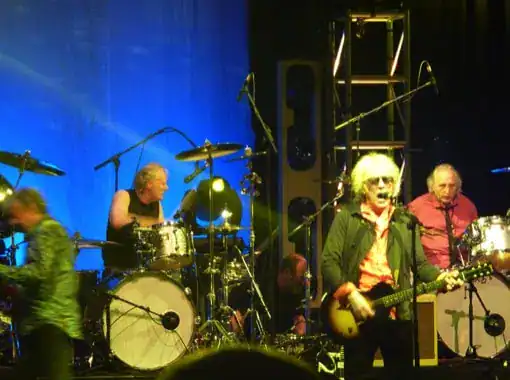
Photograph via Wikimedia Commons. Licensed under CC BY-SA 3.0.
Although Mott the Hoople’s period of mainstream commercial success lasted only a few years, the band’s influence on rock music has proved far more enduring. Their combination of intelligent songwriting, powerful live performances and uncompromising musicianship earned them a reputation that continued to grow long after the group had ceased recording. Albums that initially sold modestly, particularly Brain Capers, have since become recognised as classics of British rock.
Central to the band’s legacy was the songwriting of Ian Hunter, whose lyrics frequently explored ambition, disappointment, friendship, fame and life on the road. His ability to combine humour with emotional honesty distinguished Mott the Hoople from many contemporaries and gave their music a depth that continues to resonate with listeners decades later.
The band’s influence extended across several generations of musicians. Artists associated with punk, hard rock, heavy metal and alternative rock have acknowledged the importance of Mott the Hoople’s music, while Ian Hunter‘s songwriting has been praised for its literary quality and emotional authenticity. Their recordings demonstrated that commercially successful rock music could also be intelligent, reflective and uncompromising.
The careers of the individual members continued long after the band’s original breakup. Ian Hunter established a successful solo career, releasing a series of critically acclaimed albums and collaborating with numerous leading musicians. Mick Ralphs became a founding member of Bad Company, one of the most successful British rock bands of the 1970s. Morgan Fisher pursued an international career as a keyboard player, composer and multimedia artist, while Pete Overend Watts and Dale Griffin remained closely associated with preserving the band’s legacy.
Interest in Mott the Hoople increased significantly during the 1990s and 2000s as a new generation of listeners discovered their catalogue. Reissues of the Island Records albums and previously unreleased archive recordings introduced the band’s early work to audiences who had largely known them only through All the Young Dudes. Critics increasingly recognised the consistency of their catalogue, particularly the four Island albums, which came to be viewed as essential recordings of the period.
David Bowie, Ian Hunter, Mick Ronson and Queen performing All the Young Dudes at the Freddie Mercury Tribute Concert, Wembley Stadium, 20 April 1992.
In October 2009, the five members of the classic line-up—Ian Hunter, Mick Ralphs, Verden Allen, Pete Overend Watts and Dale Griffin—reunited for five sold-out concerts at London’s Hammersmith Apollo. Griffin, whose health had been affected by Alzheimer’s disease, was able to perform on several songs before being replaced for the remainder of the concerts by Martin Chambers of The Pretenders. The reunion received widespread critical acclaim and celebrated the band’s lasting contribution to British rock music.
A second series of reunion concerts followed in 2013 to mark the fortieth anniversary of Mott. These performances confirmed that Mott the Hoople’s music had lost none of its appeal and that the band’s reputation had continued to grow with time. Today, they are widely regarded as one of the defining British rock bands of the early 1970s, remembered not only for the success of All the Young Dudes but for a body of work that continues to influence musicians and inspire rock audiences around the world.
David Bowie and Mott the Hoople
Few relationships between a major artist and another band have had such a profound impact on rock history as that between David Bowie and Mott the Hoople. Although Bowie never became a member of the group, his admiration for their musicianship and songwriting, combined with his willingness to help at a critical moment, altered the course of their career. Without his intervention in 1972, Mott the Hoople would almost certainly have ended after the commercial failure of Brain Capers.
Bowie had admired the band since their Island Records years, particularly their powerful live performances and Ian Hunter‘s songwriting. Unlike many observers, he believed their lack of commercial success reflected changing musical tastes rather than any weakness in the band’s ability. When he learned that Mott the Hoople had decided to split up, he contacted their management and asked to meet Ian Hunter personally.
During their first meeting, Bowie offered the band Suffragette City, an unreleased song that he had originally written for The Rise and Fall of Ziggy Stardust and the Spiders from Mars. Hunter thanked Bowie but declined the song, believing that it sounded too closely associated with Bowie himself rather than with Mott the Hoople. Bowie accepted Hunter’s judgement without hesitation and promised to write another song specifically for the band.
Within a matter of days, Bowie returned with All the Young Dudes. The song perfectly matched Ian Hunter‘s voice and Mott the Hoople’s musical style while also capturing the spirit of a new generation of rock audiences. Produced by Bowie with significant musical contributions from Mick Ronson, the single became the band’s first major hit, reaching No. 3 on the UK Singles Chart and transforming their fortunes almost overnight.
Bowie’s support extended beyond providing a successful single. He produced the accompanying album, helped introduce the band to a much wider audience and restored their confidence at a moment when they had already decided to end their career. His belief in Mott the Hoople enabled the group to continue long enough to produce landmark albums such as Mott and The Hoople, establishing them among the leading British rock bands of the early 1970s.
The friendship between David Bowie and Ian Hunter continued long after their most intensive period of collaboration. The two artists remained in contact throughout the following decades, occasionally working together and publicly expressing their mutual admiration. Hunter frequently acknowledged that Bowie had rescued the band at its lowest point, while Bowie consistently praised Hunter as one of Britain’s finest rock songwriters.
Today, the story of David Bowie and Mott the Hoople remains one of the defining examples of artistic generosity in popular music. Rather than viewing another band as competition, Bowie recognised exceptional talent and used his own growing influence to help ensure that it reached the audience it deserved. The success that followed benefited both artists and secured Mott the Hoople’s place in the history of British rock.
Discography
Studio Albums
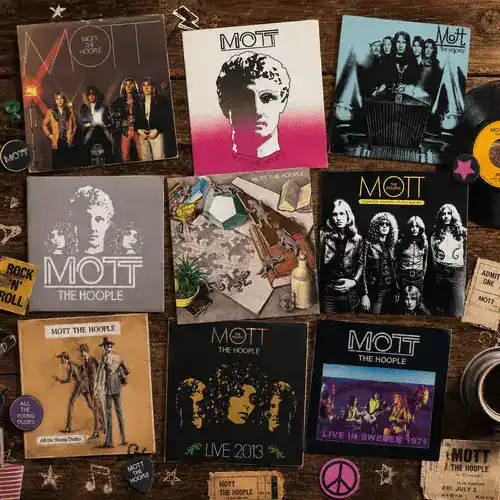
- Mott the Hoople (1969)
- Mad Shadows (1970)
- Wildlife (1971)
- Brain Capers (1971)
- All the Young Dudes (1972)
- Mott (1973)
- The Hoople (1974)
- Drive On (1975)
Selected Singles
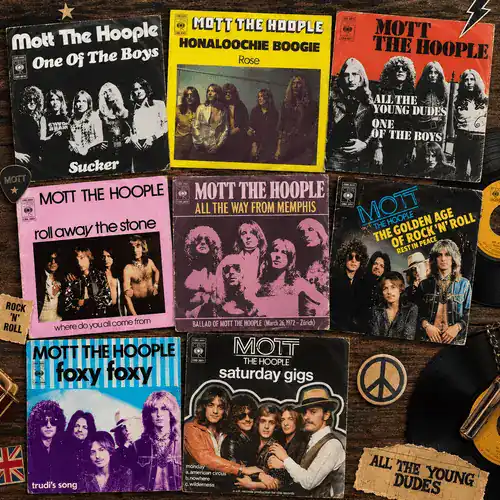
- Rock and Roll Queen (1969)
- Midnight Lady (1971)
- All the Young Dudes (1972)
- One of the Boys (1972)
- Honaloochie Boogie (1973)
- All the Way from Memphis (1973)
- Roll Away the Stone (1973)
- The Golden Age of Rock ‘n’ Roll (1974)
- Saturday Gigs (1974)
Classic Line-up
- Ian Hunter – lead vocals, piano, guitar (1969–1975)
- Mick Ralphs – lead guitar, vocals (1969–1973)
- Pete “Overend” Watts – bass guitar, vocals (1969–1976)
- Dale “Buffin” Griffin – drums, vocals (1969–1976)
- Verden Allen – organ (1969–1973)
Later Members
- Morgan Fisher – keyboards (1973–1976)
- Ariel Bender (Luther Grosvenor) – guitar (1973–1974)
- Mick Ronson – guitar (1974–1975)
- Nigel Benjamin – lead vocals (1975–1976, Mott)
- Ray Major – guitar (1975–1976, Mott)
Recognition
Although Mott the Hoople achieved its greatest commercial success during the early 1970s, the band’s reputation has continued to grow in the decades since. Their catalogue—particularly Brain Capers, All the Young Dudes and Mott—is now widely regarded as among the finest bodies of work produced by any British rock band of the period.
Critics have frequently highlighted Ian Hunter‘s songwriting for its intelligence, wit and emotional honesty, while the band’s powerful live performances have become part of rock folklore. Mott the Hoople successfully combined hard rock, rhythm and blues, folk influences and thoughtful lyrics at a time when many of their contemporaries relied primarily on image. This balance of substance and musical energy has ensured that their recordings continue to find new audiences.
The band’s influence extends across several generations of rock musicians. Their music has been cited as an inspiration by artists from glam rock, punk, hard rock and alternative rock, while David Bowie’s decision to rescue the group in 1972 remains one of the defining moments in British rock history. More than half a century after their breakthrough, Mott the Hoople continues to be recognised as one of the most important and distinctive British rock bands of the early 1970s.
Official Website & Further Information
Ian Hunter maintains the official website for his solo career and the continuing legacy of Mott the Hoople. The site includes news, tour dates, music releases, photographs, archival material and information covering more than five decades of his career.
Official website:
https://www.ianhunter.com/
DavidBowieWorld.com is dedicated to documenting the careers of David Bowie’s collaborators through carefully researched historical information and, where available, first-hand contributions from the artists themselves. This page will continue to be updated as new verified information becomes available.
Article Origin
This article has been researched and written exclusively for DavidBowieWorld.com. It is based on published biographies, contemporary interviews, official discographies, historical newspaper and magazine archives, and other verified reference sources relating to Mott the Hoople, Ian Hunter, David Bowie and their collaborators.
Every effort has been made to present historically accurate information by distinguishing documented facts from later recollections and by avoiding unsupported claims or speculation.
Return to:
David Bowie – Collaborators, Bands & Creative Partnerships
