
Jason Guess – Vocalist with David Bowie and The Astronettes
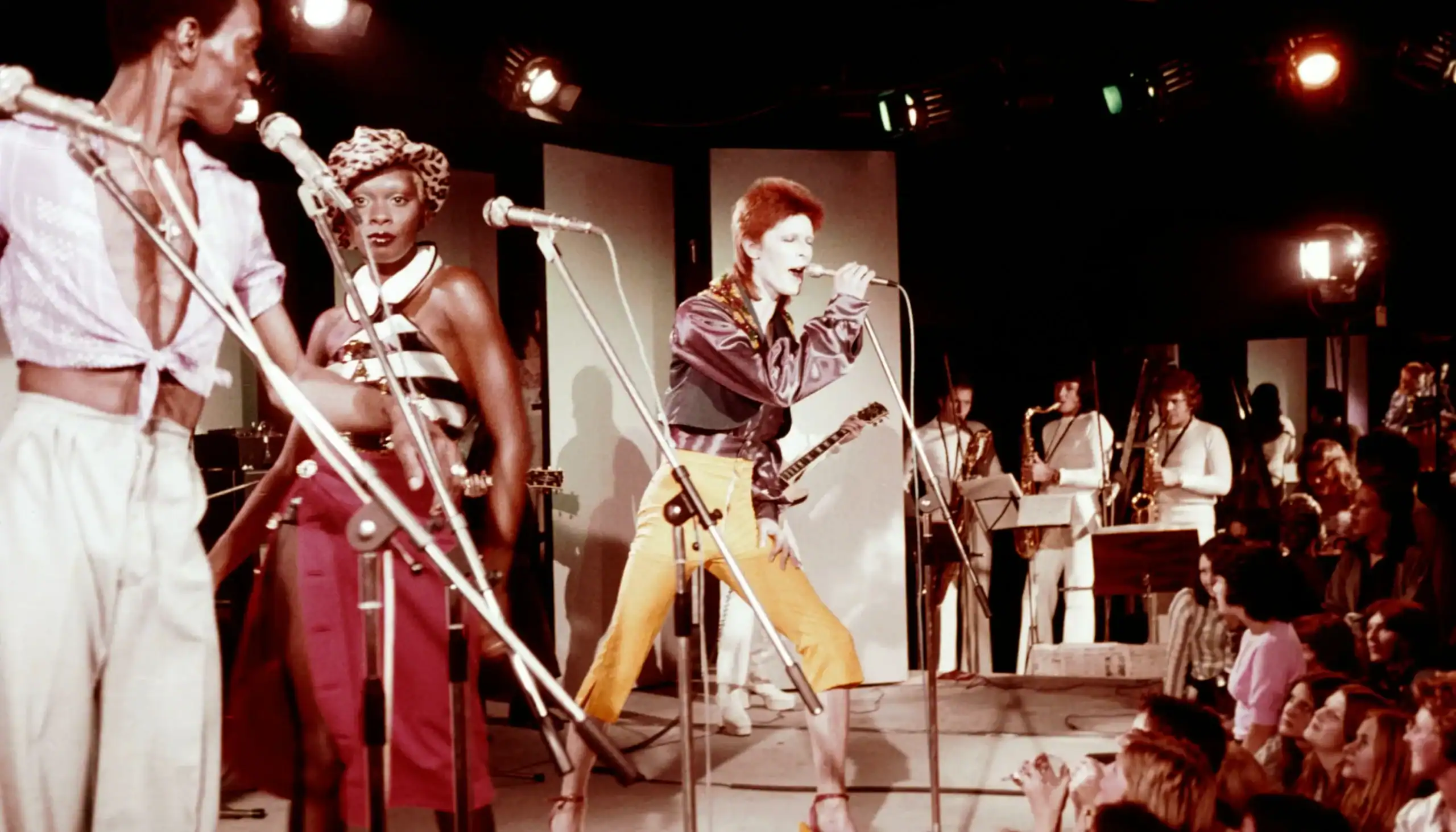
Ava Cherry and David Bowie during the 1973 period in which Jason Guess joined The Astronettes, 1973. Photographer unknown. David Bowie World collection / editorial use.
Jason Guess was an American vocalist best remembered as a member of The Astronettes, the short-lived vocal trio assembled around Ava Cherry, Geoff MacCormack and Guess during one of the most rapidly changing periods of David Bowie’s career.
Guess appeared with Bowie and the other Astronettes during The 1980 Floor Show in October 1973. He subsequently participated in the Astronettes recording sessions produced by Bowie in London during December 1973 and January 1974.
The planned Astronettes album was never completed or released during the 1970s. The surviving recordings nevertheless preserve an important transitional stage between Bowie’s glam-rock period, the creation of Diamond Dogs and his developing interest in soul, rhythm and blues and layered vocal arrangements.
Very little reliable biographical information about Jason Guess has entered the public record. His historical importance therefore rests principally on his documented work with The Astronettes and his brief but identifiable place within Bowie’s creative circle in 1973 and 1974.
- Name: Jason Guess
- Profession: Vocalist
- Nationality: American
- Known for: Member of The Astronettes
- Fellow members: Ava Cherry and Geoff MacCormack, also known as Warren Peace
- Bowie connection: Backing vocalist and participant in a Bowie-produced vocal-group project
- Television appearance: The 1980 Floor Show, recorded at the Marquee Club in London in October 1973
- Main recording period: December 1973 – January 1974
- Recording location: Olympic Sound Studios, Barnes, London
- Later releases: People From Bad Homes and The Astronettes Sessions
Jason Guess before The Astronettes
Published information about Jason Guess’s early life, family, musical training and professional career before meeting David Bowie is extremely limited. No dependable public record has been found that establishes his date or place of birth, education or a detailed discography preceding The Astronettes.
One later account described Guess as a soul-food chef who also possessed a strong ear for vocal harmony. Beyond that description, the circumstances through which he entered Bowie’s circle have not been documented in sufficient detail to support a fuller biographical account.
For that reason, Guess’s story cannot responsibly be reconstructed in the same detail as those of collaborators who gave interviews, published memoirs or maintained extensive professional archives. What can be established begins in 1973, when he became one of the three voices associated with The Astronettes.
Entering David Bowie’s creative circle

By the second half of 1973, Bowie was moving through several projects at exceptional speed. The final Ziggy Stardust concerts had taken place, Aladdin Sane had been released, and the covers album Pin Ups was completed during the summer.
At the same time, Bowie was exploring ideas outside his own established recording identity. His relationship with Ava Cherry became both personal and creative, while his childhood friend Geoff MacCormack was already working with him as a backing vocalist, travelling companion and collaborator.
Jason Guess entered this close working environment as the third member of a vocal trio that became known as The Astronettes. Unlike Cherry and MacCormack, his connection to Bowie before the group is not well documented. His surviving work nevertheless confirms that he was trusted with a place in a small and highly personal creative project.
The Astronettes
The Astronettes consisted of Ava Cherry, Jason Guess and Geoff MacCormack, who was also known professionally as Warren Peace. The name suggested a futuristic identity suited to Bowie’s late-glam visual world, but the group’s musical direction increasingly drew on soul, rhythm and blues, gospel-influenced harmony and American popular music.
The trio was more than a collection of unnamed studio singers. Bowie appears to have considered The Astronettes a separate act that could record and possibly perform under its own identity. Cherry was positioned as the principal featured voice, while Guess and MacCormack provided supporting vocals, ensemble passages and contrasting vocal textures.
The precise division of every vocal part has not been documented for all the surviving recordings. It would therefore be misleading to attribute individual lines to Guess unless confirmed by session documentation or audible identification. His participation as one of the three Astronettes vocalists, however, is consistently credited.
The 1980 Floor Show
One of Jason Guess’s clearest documented appearances in Bowie’s history came during The 1980 Floor Show. The television production was recorded at the Marquee Club in London between 18 and 20 October 1973 and was broadcast in the United States as part of The Midnight Special on 16 November 1973.
The programme captured Bowie at the end of his Ziggy and Aladdin Sane period. It combined music, costume, cabaret and television spectacle while also introducing elements that pointed toward his next creative transformation.
Guess appeared as one of The Astronettes alongside Cherry and MacCormack. The trio provided backing vocals within an ensemble that also included musicians such as Mick Ronson, Trevor Bolder, Mike Garson, Aynsley Dunbar and Mark Carr-Pritchett.
The programme is historically significant because it placed Guess visibly within Bowie’s professional performance world. His participation was not limited to an obscure studio project: he appeared as part of Bowie’s vocal presentation during a major televised production created for an American audience.
The Astronettes on The 1980 Floor Show

Video: Got You, Babe

Video: Salute to David Bowie

Video: The Midnight Special Episode
-
Video: Got You, Babe
I Got You, Babe - David Bowie & Marianne Faithfull | live November 16, 1973 on The Midnight Special. -
Video: Salute to David Bowie
Salute to David Bowie | live November 16, 1973 on The Midnight Special. -
Video: The Midnight Special Episode
Hosted by David Bowie from London England with his 1980 Floor Show and special guest appearance by Carmen, Dooshenka, Marianne Faithfull and The Troggs
Recording with David Bowie
Following The 1980 Floor Show, Bowie began producing recordings for The Astronettes in London. The principal sessions took place during December 1973 and January 1974 at Olympic Sound Studios in Barnes.
Guess, Cherry and MacCormack provided the vocals. Musicians associated with the sessions included bassist Herbie Flowers, pianist Mike Garson, drummer Aynsley Dunbar, guitarist Mark Pritchett and percussionist Luis Ramirez. Bowie produced the recordings and also contributed instrumentally.
The sessions took place during the same broad period in which Bowie was beginning concentrated work on Diamond Dogs. They should therefore be understood as part of a crowded creative schedule rather than as an isolated album project developed over many months.
Bowie brought original compositions, cover versions and unfinished ideas into the studio. Some tracks received comparatively developed arrangements, while others remained closer to demonstrations or working recordings.
Ava Cherry on David Bowie as a producer
“He’s a great producer of what he wanted you to do.”
— Ava Cherry, reflecting on The Astronettes sessions
Cherry’s recollection indicates that Bowie entered the sessions with specific ideas about the sound and performance he wanted. Within that process, Guess worked as an ensemble singer rather than as a separately promoted solo artist.
I Am a Laser
I Am a Laser — an Astronettes recording later reworked by Bowie as Scream Like a Baby
I Am a Laser is the best-known recording connected to The Astronettes. Ava Cherry delivers the principal vocal, supported by the group’s backing voices and Bowie’s developing production ideas.
The composition is especially important because Bowie later reworked it substantially as Scream Like a Baby, released on Scary Monsters (and Super Creeps) in 1980.
The two versions are not identical recordings, but the melodic and compositional relationship is unmistakable. The Astronettes performance therefore allows listeners to hear an early form of an idea Bowie retained for several years before returning to it in a different musical and lyrical setting.
Guess’s individual lines are not separately identified in the surviving documentation, but he is credited as part of the Astronettes vocal ensemble heard on the project.
The surviving songs
The Astronettes sessions produced a mixture of Bowie compositions and cover versions. Because the recordings were not prepared as a completed commercial album in the 1970s, published track lists have varied across later issues.
The principal songs associated with the project include:
- I Am a Laser — a Bowie composition later reworked as Scream Like a Baby.
- I Am Divine — an early Bowie song containing ideas later developed in Somebody Up There Likes Me.
- People From Bad Homes — a Bowie composition whose title later reappeared within his writing.
- Things to Do — an experimental recording combining rock, rhythm and Latin-influenced elements.
- Having a Good Time — a Bowie-written song with a lighter and more theatrical character.
- God Only Knows — a version of the Beach Boys composition, recorded years before Bowie made his own version for Tonight.
- How Could I Be Such a Fool — a composition originally written by Frank Zappa.
- Spirit in the Night — a version of Bruce Springsteen’s song.
These recordings demonstrate the breadth of material Bowie was considering for the group. They range from original sketches to reinterpretations of American songs that interested him during this transitional period.
I Am Divine and Bowie’s later work
I Am Divine is often discussed in relation to Somebody Up There Likes Me, which appeared on Young Americans in 1975. The earlier song is not simply the same recording under another title, but it contains recognisable compositional ideas that Bowie subsequently developed.
The relationship helps place The Astronettes sessions within Bowie’s gradual movement toward a stronger soul and rhythm-and-blues vocabulary. The project was not yet the Philadelphia sound of Young Americans, but several of the musical questions Bowie was asking were already present.
Guess’s role in this development should be stated carefully. There is no evidence that he wrote the songs or independently directed Bowie’s later musical choices. His documented contribution was vocal: he participated in the trio through which Bowie tested arrangements, harmonies and new material.
Experimental recordings rather than a finished album
Ava Cherry on the status of the recordings
“When I did those records, they were demos.”
Cherry’s description is essential when assessing the surviving material. The recordings should not automatically be judged as a completed album that Bowie and the singers considered ready for release.
Some performances contain working vocals and arrangements that might have been replaced or revised had the project continued. That unfinished status explains why certain tracks sound less polished than Bowie’s officially released studio work from the same period.
It also means that the recordings offer an unusually direct view of experimentation in progress. The listener hears Bowie, Guess, Cherry, MacCormack and the accompanying musicians testing possibilities rather than presenting a final artistic statement.
The project is set aside

The Astronettes project was abandoned before a finished album could be prepared. Bowie’s attention shifted toward Diamond Dogs, while his professional relationship with MainMan and manager Tony Defries was becoming increasingly difficult.
Ava Cherry later connected the end of the sessions with Bowie’s business problems. The surviving evidence therefore suggests that the project was interrupted by a combination of changing artistic priorities and the wider management circumstances surrounding Bowie.
It is not possible to establish from reliable public sources what Jason Guess thought about the decision or whether later plans for him were discussed. No verified interview with Guess addressing the end of the group has been located.
From The Astronettes to Diamond Dogs
After the separate recording project was set aside, The Astronettes remained associated with Bowie’s working environment for a limited period. Their existence overlapped with the creation of Diamond Dogs, an album that combined dystopian rock, theatrical narrative and the first clearer indications of Bowie’s movement toward a more rhythm-based sound.
Ava Cherry and Geoff MacCormack continued to have documented connections with Bowie after the original Astronettes sessions. MacCormack participated in the 1974 Diamond Dogs tour and remained part of Bowie’s recording circle into the Station to Station period.
Jason Guess does not have an equally extensive documented Bowie discography after the Astronettes recordings. His confirmed place in the story remains concentrated around The 1980 Floor Show and the 1973–1974 studio project.
The road toward Young Americans
The Astronettes are sometimes described as a bridge between Bowie’s glam period and the soul direction of Young Americans. That interpretation is reasonable when it is expressed as musical context rather than as a claim that the group directly created Bowie’s later album.
During the Astronettes sessions, Bowie was already experimenting with vocal harmonies, rhythmic arrangements and American soul influences. By the time he recorded Young Americans at Sigma Sound Studios in Philadelphia during 1974, those interests had developed into a much more focused musical language.
The personnel and circumstances changed. The later album involved musicians and singers including Carlos Alomar, Luther Vandross, Robin Clark and Ava Cherry. Jason Guess is not credited as a participant in the released Young Americans sessions.
His historical connection lies instead in the earlier experimental stage: he was one of the voices Bowie used while exploring ideas that preceded the fully developed Philadelphia recordings.
Rare Astronettes recordings
Rare material connected to The Astronettes and Bowie’s 1973–1974 transition
The surviving recordings are valuable historical documents, but their later circulation has sometimes obscured their original status. They were created as part of an unfinished project and were not issued with a conventional promotional campaign, completed album artwork or an accompanying Astronettes tour.
For Jason Guess, these recordings constitute the principal surviving evidence of his work as a vocalist. They preserve his participation in a project that might otherwise have remained little more than a footnote in Bowie’s history.
Their significance lies not in presenting a lost, completed Bowie masterpiece, but in documenting a musical experiment undertaken immediately before one of Bowie’s most dramatic stylistic transformations.
People From Bad Homes
The recordings remained unavailable as a regular commercial album for more than two decades. In 1995, material from the sessions appeared under the title People From Bad Homes, credited to Ava Cherry and The Astronettes.
That release finally brought Jason Guess’s work with the group into wider circulation. However, the appearance of unfinished recordings led to questions about authorisation, presentation and whether the material accurately represented the intentions of those originally involved.
For collectors, the release was important because it assembled recordings that had previously been difficult to hear. For historical interpretation, it must still be remembered that the original Astronettes project had been abandoned rather than completed and approved as an album in the 1970s.
The Astronettes Sessions
The recordings were subsequently reissued under the title The Astronettes Sessions. A later digital edition listed eleven tracks and presented the material under Ava Cherry’s name.
The revised title more accurately communicates the archival nature of the recordings. Rather than suggesting a fully completed album, it identifies them as surviving material from a specific series of sessions.
The reissues ensured that Guess, Cherry and MacCormack were recognised as the vocal trio involved in the project. They also allowed listeners to compare Bowie’s unfinished compositions with the later songs into which some of those ideas developed.
Jason Guess after The Astronettes
Reliable information about Jason Guess’s career after The Astronettes is exceptionally limited. No verified official website, extensive solo discography, memoir or substantial later interview has been identified.
It would therefore be inappropriate to construct a detailed later career from people with similar names, unconfirmed internet references or assumptions based on his brief association with Bowie.
The absence of a widely documented later career does not diminish the work that can be confirmed. It does, however, place a clear boundary around what a historically responsible account can say.
Until dependable first-hand material, professional records or archival documentation becomes available, Guess’s later activities should be regarded as undocumented rather than filled in through speculation.
Jason Guess in Bowie’s collaborative universe
Jason Guess belongs to a distinctive category of Bowie collaborator: someone whose documented time within Bowie’s circle was brief, but whose participation occurred at an important creative turning point.
He was not a featured instrumentalist on a major Bowie album, a long-term touring musician or a publicly promoted songwriting partner. He was one of three singers in a vocal group through which Bowie explored production, harmony, image and possible new musical directions.
The short lifespan of The Astronettes makes Guess easy to overlook. Yet his appearance in The 1980 Floor Show and his participation in the London sessions place him within the historical record of Bowie’s move beyond Ziggy Stardust.
His contribution should neither be exaggerated nor erased. The available evidence supports a specific and meaningful role: Jason Guess was a vocalist in The Astronettes and took part in a Bowie-produced project whose surviving recordings reveal an artist in transition.
Legacy
Jason Guess’s legacy is inseparable from The Astronettes. The trio existed only briefly, and its planned album remained unfinished, but the sessions have acquired lasting historical value.
Several recordings contain ideas that Bowie later revisited. I Am a Laser developed into Scream Like a Baby, while I Am Divine anticipated elements heard in Somebody Up There Likes Me. The group also recorded God Only Knows years before Bowie released his own interpretation of the Beach Boys song.
These connections have made the Astronettes material an important source for researchers studying Bowie’s working methods. They demonstrate that songs and arrangements could remain unfinished for years before returning in substantially altered forms.
Within that history, Guess represents one of the less documented but authenticated voices surrounding Bowie in late 1973. His work survives not through a large personal catalogue, but through a small group of recordings and a rare television appearance that capture Bowie’s transition from glam theatre toward a more soul-informed musical language.
Official Website & Further Information
No verified official website or authorised public archive dedicated to Jason Guess has been identified.
Most available information about his work comes from historical accounts of The Astronettes, documentation relating to The 1980 Floor Show, session credits and the later releases People From Bad Homes and The Astronettes Sessions.
Readers with verifiable first-hand information, original photographs, professional documentation or correspondence relating to Jason Guess are invited to contact DavidBowieWorld.com. Any new material should be supported by clear provenance before being added to this historical archive.
Related Article
For the complete history of the group, its members, recordings and place within Bowie’s transition from glam rock toward soul, visit:
The Astronettes – David Bowie’s Soul Trio Project (1973–1974)
Article Origin
This article has been researched and written exclusively for DavidBowieWorld.com. It is based on documented information concerning Jason Guess’s membership of The Astronettes, his appearance in The 1980 Floor Show, the Bowie-produced recording sessions of 1973–1974 and the later release history of the surviving recordings.
Because reliable personal information about Jason Guess remains limited, this article deliberately avoids unsupported claims concerning his early life, private life and later career. The page may be expanded when additional verifiable documentation or first-hand material becomes available.
© DavidBowieWorld.com — Bowie Collaborations Archive.
