
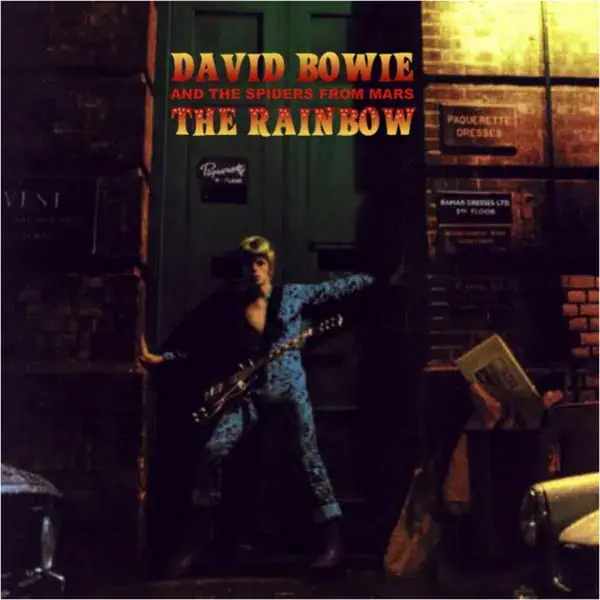
David Bowie 1972-08-19 London ,The Rainbow Theatre - The Rainbow - SQ -8
Label: Unknown / No label specified
Audio Source: Audience recording
Lineage: Unknown
Total running time: 1:30:26
Sound Quality: Considerable noise and dullness, but still listenable
Attendance: Approximately 3,000 (reported)
Artwork: Yes
Format: 2 discs
David Bowie 1972-08-19 London, The Rainbow Theatre – The Rainbow
David Bowie – The Rainbow documents the extraordinary performance at London's Rainbow Theatre on 19 August 1972, when Bowie and the Spiders from Mars presented an ambitious theatrical version of the Ziggy Stardust concert. Developed in collaboration with mime artist and choreographer Lindsay Kemp, the production combined live rock music with elaborate costumes, dancers, projected imagery and a multi-level stage. The surviving audience recording captures one of the most historically significant performances from Bowie's breakthrough year.
Presented across two discs with a combined running time of 1 hour, 30 minutes and 26 seconds, this unofficial recording preserves the music and some of the atmosphere of a remarkable evening. Although the sound contains considerable noise and dullness, its historical importance is substantial. The Rainbow concerts marked a decisive expansion of Ziggy Stardust from a rock-band performance into a fully developed theatrical spectacle, anticipating the increasingly elaborate productions Bowie would explore during the following years.
Sound Quality Rating
Title: The Rainbow
Recorded: 19 August 1972
Venue: Rainbow Theatre, Finsbury Park, London, England
Tour: Ziggy Stardust Tour
Special Guests: Lindsay Kemp and his theatrical company
Historical Significance: A surviving audience document of Bowie's August 1972 Rainbow theatrical production
Recording Note: The final track, Moonage Daydream, fades out. The recording should not be assumed to preserve the entire concert.
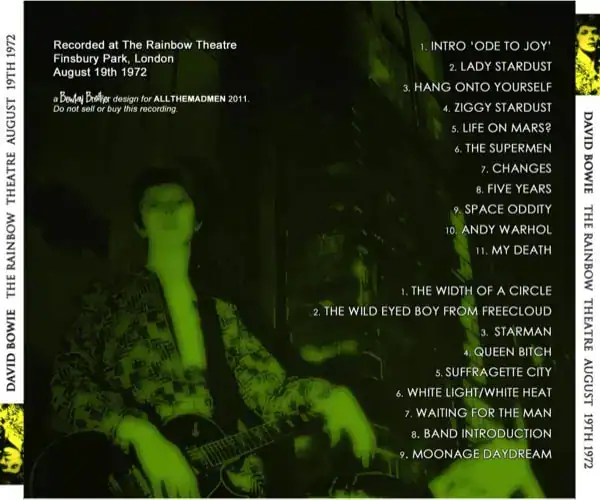
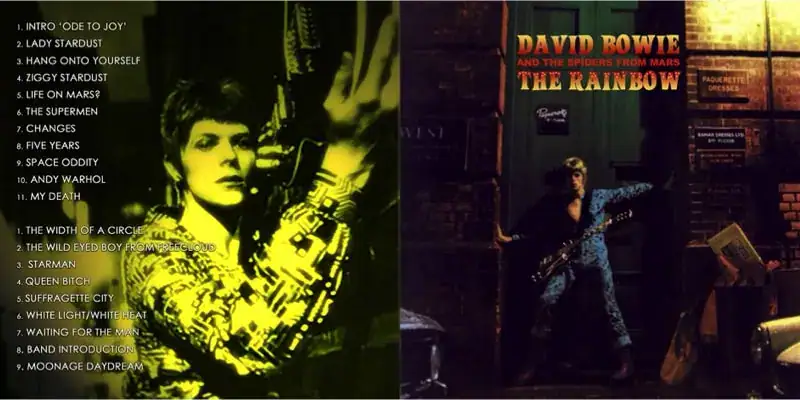
Tracklisting
Disc 1
01. Ode To Joy
02. Lady Stardust
03. Hang On To Yourself
04. Ziggy Stardust
05. Life On Mars?
06. The Supermen
07. Changes
08. Five Years
09. Space Oddity
10. Andy Warhol
11. My Death
Disc 2
01. The Width Of A Circle
02. Wild Eyed Boy From Freecloud
03. Starman
04. Queen Bitch
05. Suffragette City
06. White Light/White Heat
07. Waiting For The Man
08. Band Introduction
09. Moonage Daydream (Fades Out)
19 August 1972 – The Rainbow Theatre, London
By August 1972, David Bowie's career had undergone a remarkable transformation. The release of The Rise and Fall of Ziggy Stardust and the Spiders from Mars in June had consolidated the identity of Ziggy Stardust, the fictional rock star through whom Bowie was presenting his music.
The accompanying concerts had already attracted considerable attention for their theatrical appearance, but the Rainbow Theatre performances represented a more ambitious undertaking. Bowie wanted to explore the possibilities of combining a rock concert with mime, choreography, costume changes and visual storytelling.
The Rainbow Theatre, formerly the Astoria cinema in Finsbury Park, provided a suitable setting for this experiment. Its large stage and theatrical infrastructure offered opportunities beyond those available in many of the smaller venues Bowie had played earlier in the year.
The performances on 19 and 20 August became important milestones in the development of the Ziggy Stardust stage presentation.
Lindsay Kemp – The Theatrical Collaboration
The involvement of Lindsay Kemp was central to the Rainbow production. Bowie had studied mime and theatrical performance with Kemp during the late 1960s, and the experience had influenced his understanding of movement, character and stage presentation.
Kemp was known for an expressive theatrical style that combined mime, dance, elaborate costumes and striking visual imagery. His work encouraged performers to communicate through physical movement as well as spoken or sung words.
For the Rainbow concerts, Bowie brought these influences directly into the Ziggy Stardust presentation. Kemp and his company contributed choreographed sequences that accompanied the music, creating a production in which the musicians shared the stage with theatrical performers.
The collaboration demonstrated how Bowie was beginning to treat a concert as something more than a sequence of songs. The character of Ziggy Stardust could now exist within a visual environment populated by other performers, costumes and symbolic imagery.
The Rainbow Stage – Scaffolding, Projections and Dry Ice
The Rainbow production used a multi-level stage arrangement built around scaffolding, platforms and connecting ladders. This allowed Bowie and the theatrical performers to appear at different heights and move between sections of the stage.
Projected images formed another important part of the presentation. Visual material accompanied the music, adding further associations to the songs and strengthening the atmosphere of the performance.
Dry ice was used to create low-lying clouds of theatrical fog. Together with the lighting and costumes, these effects gave the concert a visual character that differed considerably from a conventional rock performance.
The elaborate staging also introduced practical difficulties. Costume changes and movement between platforms had to be coordinated with the music, requiring careful timing from both Bowie and the band.
Lady Stardust – An Unusual Opening
Following the introductory music, Bowie began the concert with Lady Stardust, accompanying himself on twelve-string guitar.
This was an unusual opening choice. Rather than beginning with a fast rock number, Bowie introduced the performance through one of the more reflective compositions from the Ziggy Stardust album.
The song's theatrical character made it particularly appropriate for the Rainbow production. Its portrait of a glamorous performer and an admiring audience reflected themes that were also present in Bowie's stage persona.
Contemporary accounts describe Bowie appearing through the darkness and theatrical fog, creating a striking opening image.
The performance is especially interesting because Lady Stardust was not a regular feature of the surviving Ziggy Stardust concert recordings. Its appearance at the Rainbow therefore gives this tape additional historical value.
The Contemporary Press – Bowie's Visual Impact
Contemporary coverage of the Rainbow performances emphasised the extraordinary visual effect of Bowie's appearance.
A report attributed to Petticoat magazine described the audience's reaction when the stage lighting revealed Ziggy Stardust, with his brightly coloured hair, pale makeup and distinctive costume.
"There's no getting away from it, the boy is beautiful..."
The description illustrates the importance of Bowie's appearance to the impact of the performance. The audience was responding not only to the music but also to a carefully constructed visual identity.
The theatrical elements challenged established expectations of what a rock singer should look like and how a concert should be presented.
Hang On To Yourself and Ziggy Stardust
After the restrained opening, the concert moved into the energetic rock arrangements of Hang On To Yourself and Ziggy Stardust.
These songs placed the Spiders from Mars at the centre of the performance. Mick Ronson's guitar, Trevor Bolder's bass and Mick Woodmansey's drums supplied the distinctive sound that had become associated with Bowie's breakthrough.
The contrast between the opening theatrical sequence and the band's powerful rock arrangements helped establish the production's combination of music and spectacle.
Life On Mars? and The Supermen
Life On Mars?, originally released on Hunky Dory in 1971, brought a different musical atmosphere to the concert.
Its dramatic composition and elaborate melodic structure made it well suited to the theatrical setting.
The Supermen, from The Man Who Sold The World, introduced darker imagery and a heavier musical character.
The inclusion of both songs demonstrated that the Rainbow performance was not limited to the Ziggy Stardust album. Bowie was drawing on several stages of his developing catalogue.
Changes and Five Years – A Carefully Timed Costume Change
One of the most revealing details preserved in accounts of the concert concerns the transition between Changes and Five Years.
Bowie used this section of the performance for a costume change, while Mick Woodmansey maintained the musical momentum with an extended drum introduction.
The arrangement allowed Bowie to move through the stage structure and reappear in a different costume.
This was an early example of the practical coordination required when Bowie combined live music with elaborate theatrical staging.
The recording is particularly valuable because it preserves the musical continuity of a production whose visual elements can otherwise only be reconstructed through photographs and contemporary descriptions.
Space Oddity – A Theatrical Journey
Space Oddity was already one of Bowie's best-known compositions by the summer of 1972.
The song's narrative about Major Tom provided opportunities for dramatic vocal effects and theatrical interpretation.
Contemporary descriptions of the Rainbow performance mention Bowie and Mick Ronson using their voices to imitate elements of the spacecraft launch sequence.
The moment illustrates the playful relationship between music and performance that characterised Bowie's early concerts.
Andy Warhol and My Death
Andy Warhol, originally released on Hunky Dory, was followed by a performance of My Death, Bowie's interpretation of Jacques Brel's La Mort.
The original French composition had been adapted into English by Mort Shuman and Eric Blau for the theatrical production Jacques Brel Is Alive and Well and Living in Paris.
Bowie's interest in Brel was consistent with his fascination with European cabaret, theatrical songwriting and emotionally direct performance.
The Rainbow recording preserves Bowie's spoken introduction:
"This is a Jacques Brel number..."
The song became an important part of Bowie's live repertoire during the Ziggy Stardust period.
Its restrained presentation contrasted sharply with the harder rock material and demonstrated Bowie's ability to command attention without relying on volume or elaborate instrumentation.
The Width Of A Circle – Mick Ronson's Guitar
The second disc begins with The Width Of A Circle, originally released on The Man Who Sold The World in 1970.
The composition had become an important live centrepiece for Bowie and the Spiders from Mars.
Its extended instrumental passages provided considerable scope for Mick Ronson's guitar playing, while the changing sections gave the band opportunities to develop the music beyond the structure of a conventional rock song.
The piece also fitted the theatrical atmosphere of the Rainbow production, with its dramatic contrasts and powerful instrumental passages.
Wild Eyed Boy From Freecloud – A Rare Performance
One of the most historically interesting songs in the Rainbow recording is Wild Eyed Boy From Freecloud.
Originally released on Space Oddity in 1969, the composition is one of Bowie's more ambitious early narrative songs.
Its elaborate imagery and unusual structure made it a natural candidate for a theatrical presentation, but it was not a regular feature of the Ziggy Stardust concerts.
The Rainbow recording is therefore an important surviving document of the song's rare appearance in Bowie's live repertoire.
It also demonstrates how the production allowed Bowie to explore compositions that would have been difficult to accommodate within a straightforward rock concert.
Starman – Lindsay Kemp Takes the Stage
The performance of Starman was one of the theatrical highlights of the Rainbow production.
Contemporary descriptions recount Lindsay Kemp appearing in costume, wearing wings and a wig as part of the visual interpretation of the song.
His appearance transformed the composition into a theatrical scene, bringing a physical representation of the mysterious visitor described in the lyrics onto the stage.
Bowie also made a playful reference to Over The Rainbow, connecting the song to the name of the theatre.
This moment illustrates the combination of humour, theatrical invention and musical performance that distinguished the Rainbow concerts from other appearances on the Ziggy Stardust Tour.
Queen Bitch and Suffragette City
The concert continued with Queen Bitch, from Hunky Dory, and Suffragette City, from the Ziggy Stardust album.
Both songs drew on the energy of early-1970s rock and provided a contrast to the more elaborate theatrical sequences.
Queen Bitch reflected Bowie's admiration for the Velvet Underground, while Suffragette City had become one of the most energetic compositions in the Spiders from Mars repertoire.
Their inclusion ensured that the performance retained the excitement of a rock concert even as its theatrical elements became increasingly ambitious.
White Light/White Heat and Waiting For The Man
The inclusion of two Velvet Underground compositions reflected the influence of Lou Reed and the New York underground music scene on Bowie's development.
White Light/White Heat, originally released by the Velvet Underground in 1968, became a recurring part of Bowie's early-1970s live repertoire.
Waiting For The Man, from the Velvet Underground's 1967 debut album, had also been performed by Bowie before the Ziggy Stardust period.
These songs provided an opportunity for the Spiders from Mars to emphasise their raw rock sound, contrasting with the more elaborate musical and theatrical arrangements elsewhere in the show.
The Band Introduction – Acknowledging the Performers
Near the end of the recorded performance, Bowie introduced and thanked the musicians and theatrical participants.
His acknowledgements included Trevor Bolder, Mick Woodmansey and Mick Ronson, as well as the dancers and Lindsay Kemp.
The introduction is an important part of the surviving recording because it identifies the collaborative nature of the production.
Although Ziggy Stardust was the central character, the Rainbow concerts depended on the contributions of musicians, dancers, theatrical designers and technical personnel.
Moonage Daydream – The Encore
The surviving recording concludes with Moonage Daydream, introduced by Bowie as a Ziggy Stardust composition.
"This is one of Ziggy's numbers."
The song was one of the defining compositions of the Ziggy Stardust album and provided an appropriate conclusion to the theatrical performance.
Its powerful arrangement and prominent guitar passages made it a showcase for Mick Ronson and the Spiders from Mars.
However, the final track fades out, meaning that the recording does not preserve the complete ending of the performance.
David Bowie Tour Band – The Rainbow Theatre, August 1972
The core touring band for the Rainbow performances consisted of David Bowie and the Spiders from Mars, with additional keyboard accompaniment.
David Bowie – Lead vocals, guitar, harmonica
Mick Ronson – Lead guitar, backing vocals
Trevor Bolder – Bass guitar
Mick "Woody" Woodmansey – Drums
Matthew Fisher – Piano, keyboards (Rainbow Theatre performances, 19–20 August 1972)
The Rainbow production also featured Lindsay Kemp and his theatrical company, whose contributions included mime, dance and choreographed stage sequences.
The Astronettes were also associated with the production's theatrical presentation.
This list is specific to the August 1972 Rainbow performances rather than a general personnel list covering the entire Ziggy Stardust Tour.
The Rainbow Production – Crew and Technical Support
The theatrical staging required substantial technical support, including sound, lighting, costumes, stage equipment and the coordination of performers.
Personnel associated with the wider Ziggy Stardust touring production included:
Robin Mayhew – Sound engineering
Mick Hince – Touring and technical support
Peter Hunsley – Stage equipment
Suzi Fussey – Hair and makeup
Other names appearing in touring crew documentation include Will Palin, Dean Heiser, Nigel Olliff, Nick Gilbey and Paul Normand. Their precise individual duties at the Rainbow performance have not been independently established here.
Video – David Bowie at the Rainbow Theatre
The following video accompanies this archive entry as additional material relating to Bowie's Rainbow Theatre performances in August 1972.
Photographs – The Rainbow Theatre Performances
The following photographic collection documents the visual world of Bowie's Rainbow Theatre performances, including the Ziggy Stardust stage presentation, costumes and theatrical atmosphere.


Starman Over The Rainbow – Archive Material
The Rainbow performances have continued to attract attention because of their unusual combination of live music, mime and theatrical staging.
The following archive material provides additional visual documentation of this important period in Bowie's career.
David Bowie – Starman Over The Rainbow


Concert Setlist – Rainbow Theatre, 19 August 1972
The following external setlist reference provides an additional resource for comparing the surviving audience recording with published concert documentation.
The Historical Importance of the Rainbow Concerts
The Rainbow Theatre performances represented a major step in the development of Bowie's live presentation. Although he had already incorporated mime, costumes and theatrical gestures into earlier appearances, the August 1972 production brought these elements together on a substantially larger scale.
The collaboration with Lindsay Kemp was especially important. It connected Bowie's earlier theatrical training with the emerging Ziggy Stardust phenomenon, demonstrating how a rock concert could be transformed into a carefully constructed visual performance.
The Rainbow concerts also showed that Bowie was willing to take artistic risks at a time when his commercial success was growing rapidly.
The production was ambitious and unusual, and not every contemporary observer responded positively to its theatrical approach. Nevertheless, it established possibilities that Bowie would continue to explore during later tours.
The surviving recording is therefore more than a document of individual songs. It preserves the musical component of a performance that helped redefine Bowie's relationship with the stage.
About The Rainbow – David Bowie, 19 August 1972
David Bowie – The Rainbow is an unofficial two-disc audience recording of the performance at London's Rainbow Theatre on 19 August 1972, during the Ziggy Stardust Tour.
With a stated running time of 1:30:26, the recording includes rare performances of Lady Stardust and Wild Eyed Boy From Freecloud, together with material from Hunky Dory, The Man Who Sold The World and The Rise and Fall of Ziggy Stardust and the Spiders from Mars.
The recording's sound quality is limited by substantial audience noise and dullness, and its final track fades out. Nevertheless, its historical value is considerable because it documents the musical side of Bowie's collaboration with Lindsay Kemp and the theatrical production presented at the Rainbow.
The combination of the Spiders from Mars, mime performers, elaborate costumes, projected images and multi-level staging marked an important development in Bowie's live work. The Rainbow performances demonstrated that Ziggy Stardust could function not only as a musical character but also as the centre of a larger theatrical experience.
For collectors and historians, this recording remains a valuable surviving document of one of the most ambitious and visually significant moments in Bowie's breakthrough year of 1972.
