
Peter Schwartz – David Bowie’s Outside Tour Musical Director
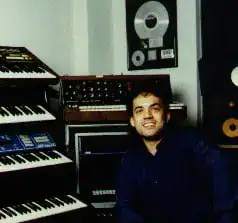
Peter Schwartz is a pianist, composer, arranger, synthesizer programmer and musical director whose work with David Bowie is closely associated with the Outside Tour of 1995–1996. Alongside his keyboard playing, he helped organise the electronic systems that brought the music of 1. Outside into live performance.
That combination of responsibilities gives Schwartz a particular place in Bowie’s touring history. A concert built from guitars, piano, bass, drums, vocals and electronic material required decisions about both musical arrangement and practical delivery. Schwartz worked at that meeting point, where the sound of a recording had to become something a band could perform before an audience.
His career also extends into instrument development, orchestral programming, television and film music, and education. Long associations with synthesizer manufacturers and music technology connect his touring work with a broader professional interest: finding ways for instruments and software to respond to musical intention. His Bowie contribution becomes clearer when considered within that wider career, rather than treated as an isolated name in a concert programme.
- Name: Peter Schwartz, also professionally known as Peter “Ski” Schwartz
- Roles: Pianist, synthesist, composer, arranger, programmer and musical director
- Education: Piano performance at Manhattan School of Music
- Bowie connection: Musical director, keyboards and synthesizers on the Outside Tour
- Documented Bowie recordings: The Man Who Sold the World (Live Eno Mix), Ouvrez Le Chien (Live Dallas 95) and No Trendy Réchauffé (Live Birmingham 95)
- Other touring work: Musical director for Pet Shop Boys‘ Nightlife Tour
- Other professional fields: Synthesizer sound design, screen music, MIDI programming and music technology instruction
Early life and classical piano studies
Schwartz began studying classical piano at the age of five and later earned a degree in piano performance from Manhattan School of Music. His professional biography dates his graduation to 1983. Piano study is therefore an established starting point for a career often described through synthesizers, computers and electronic equipment.
A keyboard can serve several different purposes. It can be an acoustic instrument, a controller for electronic sounds, or the means of entering notes into a recording system. The physical arrangement of the keys may remain familiar while the sound and the player’s responsibilities change considerably. Schwartz’s subsequent work encompasses all of these settings.
Classical training provides a concrete educational background against which to understand his work with musical structure, notation and orchestration. His later involvement with technology developed alongside that background. The resulting career brings instrumental performance into contact with the design and organisation of sound, while retaining the piano as an established part of his musical identity.
Entering the musical instrument business
An early professional connection came through Sam Ash in New York, where Schwartz worked in musical instrument sales. There he met Jack Hotop of Korg USA, who became a mentor and encouraged his involvement with Korg. This relationship connected a retail environment with the people developing and programming electronic instruments.
Such work occupies a different part of musical life from a concert engagement. An instrument must be demonstrated, understood and made useful to someone with a particular musical need. Questions about its controls, response and available sounds concern how a musician imagines using it. A demonstration can reveal whether an instrument offers an immediate musical response or requires further explanation before its possibilities become clear.
His entry into the instrument business also places him within a professional network beyond recording studios. Manufacturers, product specialists, programmers and performers contribute different kinds of knowledge to the same equipment. Schwartz’s subsequent work would cross those boundaries, allowing his name to appear both in accounts of major tours and in the history of synthesizer development.
The Synclavier and an expanding technical vocabulary
Schwartz worked as a product specialist for New England Digital, the company associated with the Synclavier. His professional profile also records his interest in writing MIDI software and designing MIDI hardware. These activities establish that his engagement with electronic instruments extended beyond selecting sounds and playing keyboard parts.
For a performer, the instrument is the immediate point of contact with the music. For a product specialist, the relationship also includes explaining what a system can do and understanding how its separate functions fit together. Programming introduces another level: a desired musical action must be translated into instructions that equipment can carry out.
These are distinct areas of knowledge. Playing a keyboard fluently does not automatically explain how information passes between electronic devices, while understanding a computer system does not determine the musical value of a phrase. Schwartz’s professional activities brought both subjects into his working life. His early technical experience forms an identifiable part of his career before the Outside Tour.
Korg and the development of playable sounds
Schwartz’s first Korg project involved programming 64 sounds for the DS-8. He subsequently contributed to instruments including the M1 and Wavestation. The work belongs to a collaborative manufacturing history, with sound programmers and development teams contributing to instruments that musicians would later encounter as finished products.
In an account of the M1’s development, Jack Hotop identified Schwartz among the international team involved in its sound library. That account also describes requests for features affecting how sounds responded to playing. A synthesizer’s character comes from more than its collection of source sounds: the relationship between a player’s gestures and the resulting sound is equally significant.
A preset determines what a musician hears on first playing the instrument and how the sound behaves as notes are held, repeated or released. Different responses can make the same underlying material suitable for different musical purposes. Schwartz’s instrument credits document his participation in that work, within teams responsible for developing the instruments and their musical resources.
The Wavestation and the identity of a programmed sound
Two Wavestation sounds associated with Schwartz are Ski Jam and Will I Dream. Their individual names make a programmer’s contribution visible within an instrument otherwise identified by its manufacturer and model. They are examples of authored sound design, separate from credits for a particular recording session.
The Wavestation, introduced in 1990, combined vector synthesis with wave sequencing. These approaches allow sounds to change through combinations of source material and movement between them. Instead of treating a keyboard sound as a fixed tone, the instrument offers ways to make its internal character develop over time.
That capability is relevant to the distinction between playing a melody and shaping a texture. A held note can contain motion; a relatively small keyboard gesture can initiate a more elaborate sonic event. The named presets belong to Schwartz’s instrument-development history. Their authorship does not establish their use in a specific Bowie song, and the documented touring equipment must be considered separately from individual sound assignments.
Session work, arranging and remix production
Alongside instrument work, Schwartz developed a career as a session keyboardist and arranger. He has described sessions with remix producers including David Morales, Frankie Knuckles and Shep Pettibone. In his recollection, a remix could involve creating substantial new musical material around an existing vocal, sometimes within a single working day.
That description makes the arranger’s task more concrete. A vocal recording carries its own phrasing, harmonic implications and dramatic shape. Building a different setting around it requires choices about rhythm, chord movement, instrumental register and the relationship between repetition and change. The new accompaniment must work with something already established while giving it a different musical environment.
Rearranging existing material and preparing it for a different setting are related activities, although studio and concert conditions differ. A studio offers opportunities to revise a result; a concert requires the arrangement to function in real time. Schwartz’s session experience establishes another professional setting in which his keyboard playing was combined with decisions about the construction of an arrangement.
Television music and James Mtume
During the 1990s, Schwartz also worked with James Mtume on music for New York Undercover. Discussing that work in his Outside-era interview, he described an opportunity to combine unusual harmonies and jazz elements with funk and hip-hop loops. Television scoring was already part of his experience when he spoke about Bowie’s tour.
Screen music introduces a relationship between musical structure and dramatic timing. A cue has to belong to the moment it accompanies, whether through tension, movement, atmosphere or a shift in emotional emphasis. Its development operates alongside the timing and meaning of the scene, creating a different set of demands from those of an independent song.
This work establishes a composing strand within Schwartz’s career before his later concentration on film music. His experience included contributing to an ongoing dramatic production as well as performing another artist’s repertoire. Composer, arranger, keyboardist and musical director consequently describe different responsibilities within his working history, rather than interchangeable labels for a single activity.
Joining David Bowie’s working band
Schwartz’s documented role with Bowie becomes especially clear during preparations for the Outside Tour. He identified himself as both musical director and keyboard player, with Mike Garson covering piano and occasional synthesizer. That description establishes a division of keyboard responsibilities within the band.
The circumstances of their first personal meeting are not established by the material used here. The professional connection is demonstrable through the touring work: Schwartz held a role combining performance with the preparation and operation of electronic resources. His account describes responsibilities that began before the band appeared in front of an audience.
The musical director title also needs to be understood within the collective production. It identifies an organisational responsibility while leaving room for the contributions of the other players. The touring arrangements involved musicians responding to one another as well as to prepared material. Schwartz’s position brought him into that ensemble as a performer with additional duties concerning how the show would function.
1. Outside: the album behind the tour
Released in September 1995, 1. Outside was produced by David Bowie, Brian Eno and David Richards. Its programme combined songs with spoken character passages, presenting a larger fictional setting. The studio project supplied the new repertoire around which the subsequent concerts were organised.
The distinction between the album and its live presentation is essential to Schwartz’s credit. His established work concerned the touring arrangements and performance systems. Preparing recorded sounds for a tour is a contribution with a different purpose from participating in the sessions that created them. His live role therefore needs to be identified through the touring and recording credits that actually name him.
The album also creates a practical question for live presentation. Songs can be selected and placed beside material from other periods, while the character passages and overall running order belong to the original recorded construction. A concert becomes a new arrangement of the music’s possibilities, with its own sequence and relationship between songs. That process formed the setting for Schwartz’s work with the Outside band.
Rehearsals and the work before the audience arrived
Surviving rehearsal material from the Outside period documents work on older songs as well as preparation surrounding the new project. Performances of material such as Breaking Glass, DJ and Look Back in Anger show the band exploring repertoire beyond the latest album. Rehearsal preserves music while decisions are still being tested.
A song known from a finished recording is not automatically ready for a particular touring band. Players need an agreed form, a beginning, a way through transitions and a clear ending. An arrangement also has to account for the musicians present. The process can involve trying material that does not subsequently appear at every concert, or that develops differently once the tour is underway.
For Schwartz, rehearsal stood between his preparatory work and public performance. It brought the organisation of the music into direct contact with the interaction of the players. The surviving material offers a view of that working process, complementing the finished concert recordings through which the band would later become more widely documented.
Preparing the electronic material
A contemporary report in Mix, published in January 1996, places pre-production in July 1995. It describes Schwartz preparing samples of processed instrumental sounds, vocal effects and loops for use in the concerts. The report gives the scale of the sample collection as more than 280 megabytes, a substantial working resource for the period’s equipment.
The task involved preserving characteristics of the recorded music that could not simply be reproduced by choosing a broadly similar keyboard sound. Processing can make a source difficult to separate from its effects: the identifiable musical event may be the whole combination. Using a sample can retain that event while allowing the surrounding arrangement to be performed by the touring musicians.
Schwartz’s preparation therefore involved decisions about which recorded details would remain within the live arrangement. A sample could preserve a particular texture, while the band supplied other parts around it. The resulting performance combined the resources of the original recording with the instrumentation and interaction of the touring ensemble.
Peter Schwartz on retaining the source material
“I wanted to have a lot of original source material”
— Peter Schwartz, interviewed by Sarah Jones for Mix, January 1996, p. 113. Read the contemporary tour report.
Keyboards, sound modules and the stage setup
The contemporary equipment account lists a Korg Wavestation keyboard, an M1 rack instrument, a Kurzweil K2000 and a prototype Korg Prophecy within Schwartz’s live rig. These names document a combination of instruments with different sound-generating capabilities.
The Prophecy provides a particularly clear connection with the period. Announced in 1995, it used modelling technology and was designed as a monophonic instrument. Its capabilities differed from those of a sample-based workstation. A rig containing several instruments could consequently provide contrasting resources for the arrangements, with different approaches to generating and controlling sound.
An equipment list establishes what was available within the setup, while the identification of an individual patch requires more detailed evidence. Its value here is as a record of Schwartz’s working resources. It also shows why the visible keyboard alone cannot describe the complete electronic arrangement: rack instruments and other connected devices formed part of the system through which the performance was delivered.
Vision, MIDI and access to the repertoire
Schwartz used Opcode Vision on a Macintosh PowerBook 165, with interfaces connecting the computer to the instruments. A remote keyboard, trackball and small monitor allowed him to operate the system from the stage while other equipment remained offstage. His explanation emphasised rapid access to songs as an important reason for choosing the software.
This was a practical requirement arising from Bowie’s approach to performance. A set list provided a plan, but the system also needed to accommodate a move to another prepared song without a lengthy loading delay. The organisation of the repertoire within the computer consequently affected how freely the concert could proceed.
The arrangement of equipment between stage and offstage locations is another significant detail. Schwartz needed access to the controls required during the performance while the wider system remained connected and available. His account describes a touring installation built around the job he had to do, including both direct keyboard playing and the initiation of prepared electronic events.
What sequencing contributed to a live performance
MIDI carries instructions rather than recorded audio. It can communicate information about notes, timing, sound selection and other aspects of performance, while the connected instrument produces the audible result. A sampler adds another possibility: recorded audio can be triggered in response to those instructions. This distinction helps explain the relationship between the computer and the audible electronic parts.
A sequencer can have several jobs within one show. It may coordinate events, select sounds or provide a timing reference, as well as initiate musical parts. The presence of sequencing therefore needs to be understood through the functions it performs within an arrangement. Some events concern the organisation of equipment; others contribute directly to what the audience hears.
The performers still supply the parts assigned to them, with the electronic system operating alongside their instruments and voices. This combined arrangement is the relevant context for Schwartz’s role. It required decisions about the relationship between the band and the prepared material, followed by the practical operation of those resources during the concert.
The Outside band as an ensemble
The touring line-up brought Schwartz together with Carlos Alomar and Reeves Gabrels on guitars, Gail Ann Dorsey on bass and vocals, Zachary Alford on drums, Mike Garson on piano and keyboards, and George Simms on vocals and keyboards. Bowie sang and played saxophone. The combination offered several instrumental and vocal resources within the same production.
An ensemble of this size also presents questions of space. Two guitarists can occupy related registers; piano and synthesizers can overlap; backing voices may need to remain distinct from sustained instrumental sounds. The distribution of parts determines how those resources contribute to the arrangement and how clearly individual elements can be heard.
The band brought together musicians with different histories and approaches. Some had worked with Bowie in earlier periods, while others entered his touring organisation during the 1990s. The released performances document the collective result. Within that ensemble, Schwartz held both a playing position and an explicitly credited responsibility for musical direction.
September 1995: opening the tour with Nine Inch Nails
The Outside Tour opened on 14 September 1995 at the Meadows Music Theatre in Hartford, Connecticut, before the album’s release. The American presentation included Nine Inch Nails, with an overlapping section connecting the two artists’ sets. Material in that exchange included Subterraneans, Scary Monsters, Reptile, Hallo Spaceboy and Hurt.
This format made continuity part of the concert’s design. The overlap created an area of shared repertoire and changing personnel. Bowie’s older catalogue, his new work and songs associated with Nine Inch Nails could appear within a connected sequence, giving the transition between the artists its own musical identity.
The opening also preceded the arrival of the complete new album in the shops. For some audience members, the concerts would therefore provide an early encounter with songs they had not yet heard on the released record. Bowie’s contemporary comments acknowledged the challenge of presenting unfamiliar new work alongside less obvious selections from his catalogue.
David Bowie on the tour’s approach
“How do you commit commercial suicide?”
— David Bowie, USA Today, opening day of the Outside Tour, quoted by DavidBowie.com.
1995: The Man Who Sold the World in a different setting
One especially useful recording is The Man Who Sold the World (Live Eno Mix). First released in 1995, it was based on the substantially reworked version performed during the Outside Tour. Its credits identify Schwartz on synthesizers, providing a named recording connection alongside the broader evidence of his touring role.
Brian Eno reshaped, overdubbed and mixed the live recording at Westside Studios in London on 30 October 1995. He also added backing vocals. That date belongs to the subsequent studio work. The released result combines a live performance with later intervention, giving the recording a production history extending beyond its original concert setting.
The track documents a touring arrangement through a deliberately shaped mix. Listeners encounter the band’s performance alongside Eno’s additions and treatment of the recorded material. Schwartz’s synthesizer credit remains part of that chain of work, with the responsibilities for performance and subsequent production identified separately.
The recording also illustrates how an older composition could be reconsidered within the Outside project. Its history left room for a different instrumental setting and rhythmic treatment. A familiar title became a vehicle for a contemporary arrangement, connecting Bowie’s catalogue with the musical resources of the band assembled around him in 1995.
October 1995: the Dallas concert
Ouvrez Le Chien (Live Dallas 95) documents Bowie’s performance at the Starplex Amphitheater in Dallas on 13 October 1995. Its personnel identify Schwartz on keyboards and synthesizers, placing him within a dated concert recording. The main performance belongs to the American leg of the Outside Tour.
The official release credits Bowie as producer and Steve Guest with recording the show. David Richards mixed the material at Mountain Studios in Switzerland, assisted by Sam Curtis. These credits describe the stages through which the performance became a released recording, from the work of the band to its capture and the preparation of the final mix.
A substantial concert recording places individual songs within a running sequence. It allows the ensemble to be considered across changes of pace and repertoire, preserving more of the programme than a brief promotional appearance could contain. Schwartz’s contribution belongs to that continuity as well as to the electronic sounds heard within individual arrangements.
The album title connects with the tour’s visual presentation. The French phrase appeared in the stage setting and had earlier associations within Bowie’s writing. Its use for the later release preserves a recognisable part of the period’s identity, while the recording documents the musicians who carried that presentation into a live concert.
December 1995: No Trendy Réchauffé in Birmingham
A second major document is No Trendy Réchauffé (Live Birmingham 95), recorded at the National Exhibition Centre on 13 December 1995. The official personnel explicitly credit Peter Schwartz as musical director, keyboardist and synthesizer player. This is a clear description of his combined responsibilities.
The concert included Jump They Say and Strangers When We Meet, as well as material such as Teenage Wildlife, Under Pressure and Moonage Daydream. Its range demonstrates how the tour placed recent work alongside songs from different stages of Bowie’s career. The programme extended across several periods of his writing and recording history.
The release also contains two performances of Hallo Spaceboy. The second was filmed in connection with plans to promote the song, although that intended video was not completed. The repeated title is a documented feature of this particular concert and its subsequent release.
The Birmingham recording offers a further point of reference because it comes from a different stage of the tour. Its repertoire and running order preserve the programme of that evening, allowing the performance to be considered alongside the earlier Dallas material. Together, the recordings establish Schwartz’s presence within two separately dated concerts by the larger Outside ensemble.
The boundary between tour phases
Schwartz’s place in the Outside line-up belongs to 1995 and the early 1996 touring period. The wider Outside era continued with a smaller band later in 1996. These phases should be distinguished when identifying musicians in photographs, broadcasts or recordings, especially where material is labelled only with the name of the tour.
A tour title can cover a longer period than the engagement of an individual player. Changes of personnel may also alter the distribution of keyboard parts, backing vocals and electronic responsibilities. A recording date and its accompanying credits consequently provide a firmer basis for identifying the musicians than the general name of the album campaign.
The earlier ensemble was a particular configuration, with two guitarists, several keyboard resources and additional vocal support. Its larger scale forms part of its historical identity. Schwartz’s contribution belongs within that configuration and the performances for which his participation is documented, while Bowie’s subsequent concerts form another stage in the development of the live arrangements.
1999: Pet Shop Boys and the Nightlife period
Schwartz later became musical director for Pet Shop Boys‘ Nightlife Tour. The associated album, Nightlife, was released on 11 October 1999. This engagement placed him within another production combining live performers with extensive electronic resources, with requirements arising from a different repertoire and stage presentation.
In a later interview, he described a Nightlife setup involving approximately twenty synthesizers, a PowerBook running Logic and a Mackie D8B mixing console. Physical faders and stored mixer settings helped manage changing levels between songs. These details belong to the Pet Shop Boys production, whereas the contemporary Bowie touring account describes a Vision-based system.
The two accounts show different solutions within Schwartz’s musical-director work. On Nightlife, the management of numerous sound sources made the mixing arrangement an important part of the setup. The system had to support changes between songs while allowing levels to be adjusted during rehearsal and soundcheck. His description gives a practical view of the preparation behind that production.
2000: concentrating on his own music
Schwartz has said that he stopped touring in 2000, at the end of the Nightlife engagement, to concentrate on his own music. He moved to upstate New York with the intention of developing his voice as a film composer. His explanation describes a conscious change in the allocation of his working time.
Years of session work and touring had involved substantial commitments to other artists’ projects. Concentrating on composition created a different starting point, allowing his own musical development to become the principal focus. This decision forms an important transition between the touring work associated with Bowie and Pet Shop Boys and the subsequent expansion of his screen-music career.
The change concerned emphasis within an already varied working life. His earlier experience with television music, arrangement and electronic instruments remained part of that background. Film composition brought those resources into a setting where the music’s shape and instrumental character would be developed in relation to a production’s dramatic requirements.
Peter Schwartz on changing direction
“I really wanted to focus on my own music”
— Peter Schwartz, interviewed by Rounik Sethi for macProVideo.
2001: Montage and the Nightlife concert film
The Nightlife period is represented by Pet Shop Boys Montage – The Nightlife Tour, released on 12 November 2001. Its programme brings songs from the associated album together with established repertoire, including West End Girls, Being Boring, Left to My Own Devices, It’s a Sin and Go West.
A concert film adds visual organisation to the musical record. The viewer can follow performers within a designed stage environment, although the final experience also reflects the choices of cameras and editing. It documents the presentation of a tour while creating a viewing object with its own sequence of images and points of attention.
For Schwartz’s career, the film belongs to the record of another substantial concert production in which he served as musical director. Its repertoire provides a setting distinct from the Outside concerts. The Bowie and Pet Shop Boys engagements involved separate musical identities, equipment arrangements and performing organisations, even where Schwartz held a related professional responsibility.
2006: film music and animation
Schwartz’s professional biography describes a meeting with animator Paul Beard in 2006. Beard, whose experience included Blue’s Clues, needed music for an independent animated short. Schwartz supplied an orchestral score for the six-minute production, an engagement his biography identifies as an important step towards further professional film work.
Animation provides a particular relationship between movement and music. A short production can move rapidly between changes of action, mood and pace, requiring the score to establish its ideas within a limited duration. Musical phrases must function within that overall structure, whether closely following events or providing a broader continuity across them.
The project belongs to Schwartz’s developing career as a screen composer. It also places orchestral writing within a professional history already involving electronic instruments and popular-music arrangements. Those areas coexist in his later work, which includes the creation of orchestral mock-ups alongside composition, sound programming and instruction.
2007: working with Jordan Rudess
A 2007 interview with Jordan Rudess provides another specific example of Schwartz’s sound programming. Rudess described employing him to help transfer and develop lead sounds for the Korg OASYS. The work involved exchanging program files and refining their response until the sounds met the player’s requirements.
This was a collaboration centred on the behaviour of an instrument. A musician’s characteristic sound can depend on several interacting features: tonal balance, the way harmonics enter, the response to controllers and the relationship between a gesture and its audible result. Moving to different equipment can therefore require detailed adjustments to preserve a useful playing response.
Rudess’s account shows Schwartz working to a performer’s specification, with revision forming part of the process. It provides a concrete example of his sound-design work beyond the manufacturing credits. The contribution concerned resources through which another musician would perform, with the exchange of files allowing the sounds to be tested and refined.
2010: moving to Los Angeles
Schwartz moved to Los Angeles in 2010 to pursue film scoring. His professional biographies identify work for companies including DisneyToons, Warner Bros., Fox and Mattel. These credits establish the continuation of his career after the touring engagements through which many Bowie listeners encountered his name.
The move belongs to the progression from his decision to concentrate on composition towards further work in screen production. His career during this period also continued to include orchestration, arranging and the preparation of sampled orchestral performances. The professional picture is therefore broader than a simple change from performing musician to composer.
The company names describe clients and production connections; individual projects can involve different responsibilities. A careful account preserves that distinction, identifying the fields in which Schwartz worked while reserving more specific claims for productions whose credits establish the exact contribution.
Teaching MIDI through explanation and demonstration
Schwartz’s educational work includes MIDI 101: MIDI Demystified for macProVideo and Ask.Video. He wrote, narrated and animated the course, using demonstrations and signal-flow diagrams to explain how MIDI systems work. Its scope includes connections, messages, channels and the relationships between controllers and sound-producing devices.
Teaching this subject involves making an invisible process understandable. A listener hears the result of a MIDI instruction, but the instruction itself is not audible. Diagrams can show where information travels, while musical examples demonstrate the consequences of changing it. The combination allows an abstract system to be understood through practical behaviour.
The course turns professional knowledge into material that other musicians can study. Understanding the path of information allows a learner to approach unfamiliar equipment with a set of principles, rather than relying entirely on memorised instructions. Schwartz’s work as an educator consequently provides another public record of his technical experience, separate from the recordings and tours on which he performed.
Logic and a musician’s choice of software
Logic became an important part of Schwartz’s later working and teaching activities. His interview descriptions distinguish that software from the Vision system used on Bowie’s tour. The distinction helps keep separate periods of his career in view, while his own explanation of his preference places musical usefulness at the centre of the choice.
A digital audio workstation brings several activities into one environment: composition, recording, editing, sound generation, mixing and notation may all be involved. Different musicians place different demands on those facilities. The useful measure is how effectively the software supports the work being attempted, including both familiar procedures and less usual musical ideas.
Schwartz’s published teaching covers specific areas of that environment in detail. It gives learners access to practical methods while also explaining why particular settings or operations matter. His choice of software belongs to that working experience and his stated relationship with the musical results he wants to achieve.
Peter Schwartz on choosing Logic
“I use Logic because it facilitates what I hear musically.”
— Peter Schwartz, interviewed by Rounik Sethi for macProVideo.
Notation and the Logic score editor
Another area of Schwartz’s teaching concerns Logic’s Score Editor. His courses address notation, the preparation of parts and the relationship between a musical performance held as MIDI information and its appearance on a page. His published writing in 2015 also considered the availability of the Bravura music font within Logic Pro X.
Notation introduces a different audience for musical information. A computer can store events with exact positions and durations, while a player needs a readable representation of the intended musical relationships. A score communicates through conventions that help musicians recognise rhythm, phrasing and structure, with its layout affecting how readily that information can be understood.
This part of Schwartz’s career connects his piano education with his work in software. Traditional musical literacy and electronic production meet in the preparation of a readable part. The subject also broadens the picture beyond synthesizer patches, documenting his attention to the movement between performed sound, editable information and written music.
2016: explaining synthesis through listening
In 2016, Schwartz published a four-part instructional series on analog synthesis. It began with the properties of sound, then examined synthesizer components, envelope generators and modulation. The sequence placed listening before the detailed operation of an instrument, establishing terms through which a reader could identify what needed to change.
A control panel can present many possibilities at once. Recognising a difference in pitch, tonal character, loudness or duration gives a purpose to an adjustment. A technical term becomes useful when the learner can connect it with something heard, allowing the controls to be understood as ways of altering recognisable musical properties.
The series preserves Schwartz’s own explanation of a craft in which he had worked professionally. It also demonstrates an educational sequence: identify the audible result, establish the relevant principle and then examine the components that produce it. Readers can approach the instrument through a set of relationships between sound and control, rather than treating every knob as an unrelated function.
Envelopes, modulation and the shape of a sound
Schwartz’s discussion of envelope generators considers the overall movement of a sound from the moment a key is played to the moment it is released. Attack, sustain and release settings can make a sound arrive quickly, remain present or disappear gradually. These changes affect its place within an arrangement even when its pitch stays the same.
His explanation of modulation considers how one part of a synthesizer controls another. A changing signal can alter pitch, loudness or timbre. The result may be obvious movement, but modulation also includes less conspicuous forms of control. The principle concerns a relationship between components and the audible consequences of that relationship.
A slowly arriving tone and a sharply articulated one can serve different purposes, even if they share the same note. These subjects therefore concern how sound unfolds within music. Schwartz’s teaching addresses the character of the musical event as well as the operation of the instrument, giving readers a vocabulary for describing both.
The MIDI orchestra and the question of realism
Schwartz developed courses including The MIDI Orchestra – Enhancing Realism and The MIDI Orchestra – Designing Templates. These address sampled orchestral instruments and the organisation of the systems through which they are played. The subjects bring orchestration into contact with programming and production.
A convincing orchestral mock-up requires attention to the shape of a phrase, differences between successive notes and the relationship between instrumental groups. A sample library supplies recorded possibilities; the musician organises them into a performance. Decisions about articulation and dynamics affect whether individual parts behave coherently and whether the ensemble conveys the intended musical movement.
Template design addresses the availability of those resources within a working project. A composer may need many instruments, articulations and control options ready for use. Their organisation affects how readily an idea can be tried, revised or developed. Schwartz’s courses treat the setup as part of a practical composing environment, with attention to the demands of orchestral writing.
SkiSwitcher2, ARTzID and articulation control
Schwartz developed SkiSwitcher2 and ARTzID, custom MIDI scripts for Logic Pro. His instructional material demonstrates their use for changing instrumental articulations, including changes associated with individual notes. These are identifiable software contributions within his orchestral programming and educational work.
Articulation describes how a note is performed: a sustained tone and a short detached note can have the same pitch while serving different musical purposes. Sampled instruments often provide several versions of that behaviour. Selecting the intended version becomes part of writing and editing the phrase, alongside the choice of notes and their timing.
The scripts address that selection process within Logic. Their significance lies in a specific practical function, rather than a general claim about software innovation. They document Schwartz creating tools for the control of musical resources and then explaining their operation to other users through demonstrations and instructional material.
2020: the touring work returns to the official catalogue
The release of Ouvrez Le Chien on streaming services on 3 July 2020, followed by the physical live-album programme, brought the Outside band back into the official release schedule. No Trendy Réchauffé followed on 20 November 2020 as part of Brilliant Live Adventures. The Live Eno Mix of The Man Who Sold the World also returned through Is It Any Wonder?.
These dates concern the circulation of archival recordings. Their importance for Schwartz’s biography is the renewed availability of performances made during his Bowie engagement. The releases brought the larger Outside ensemble into a later stage of the catalogue, accompanied by credits identifying the musicians and their responsibilities.
Performance date and release date consequently describe separate parts of the history. The music belongs to the Outside period, while its later presentation belongs to the development of Bowie’s archive. Keeping both visible allows the collaboration to be situated in its original setting while also explaining how listeners subsequently gained access to these recordings.
2021–2024: sound design and orchestral technology
Schwartz’s NAMM oral-history interview was recorded on 12 May 2021. The institutional record identifies his work in sound programming and synthesizer design consultancy, preserving the instrument-development side of a career that also included international touring. It places his experience within the wider history of the musical products industry.
A MIDI Association presentation on orchestral articulation, available in 2024, lists Schwartz among its contributors and identifies him as an orchestral mock-up instructor for the Film Scoring Academy of Europe in Sofia, Bulgaria. It also credits his music Lucy vs The Butterfly as its soundtrack, made using orchestral sample libraries.
The presentation considers ways of making articulation selection more consistent through MIDI 2.0. Its contributor list documents Schwartz’s participation within a wider group. The subject concerns a practical orchestral problem: controlling different instrumental resources through a more consistent set of messages within a composer’s working system.
In November 2024, he appeared in an interview with Ian Dixon for The Digital Lifestyle. The discussion revisited earlier instrument work and covered more recent projects involving the modwave, wavestate and an ARP 2600 plug-in. These activities document the continuation of his sound-design career beyond the period for which Bowie listeners may know him best.
Legacy
Peter Schwartz‘s place in David Bowie’s history rests on a documented combination of musical direction, keyboard performance and preparation for the Outside concerts. The live recordings preserve his work within the ensemble, while contemporary accounts describe responsibilities that are less immediately visible in a stage photograph.
His contribution forms part of the history of how Bowie presented the music of 1. Outside in concert. That presentation involved the relationship between a substantial touring band and electronic material drawn from the recorded project. Recognising Schwartz’s responsibilities adds detail to the account of the people who helped turn the album’s resources into a working live production.
The broader career supplies a further perspective. Instrument development, arranging, screen composition and education each produced their own forms of documented work. Taken together, they establish Schwartz as a musician whose Bowie engagement belonged to a sustained professional involvement with performance, sound and the practical tools through which music is created.
Official Website & Further Information
Further information about Peter Schwartz‘s professional work is available through his macProVideo instructor profile and course catalogue and his NAMM oral-history entry. These professional and institutional pages document his educational work and his involvement in the musical instrument industry.
For the Bowie connection, the officially released Outside-era recordings provide a direct listening context. Their dated performances and named personnel allow Schwartz’s contribution to be explored within the band and repertoire for which it was created.
Article Origin
This article has been researched and written exclusively for DavidBowieWorld.com as part of its David Bowie Collaborations & Creative Circle Archive. It draws on published first-person interviews, contemporary reporting, official recording credits and professional and institutional records documenting Peter Schwartz‘s career.
This independently researched archival profile distinguishes contemporary performances from later releases and separates documented credits from historical interpretation. Quotations are attributed to their published sources. Further verified information and documentary material can be incorporated as the archive develops.
© DavidBowieWorld.com — David Bowie Collaborations & Creative Circle Archive.
