
Michael Kamen – Musical Director of David Bowie’s Diamond Dogs Tour
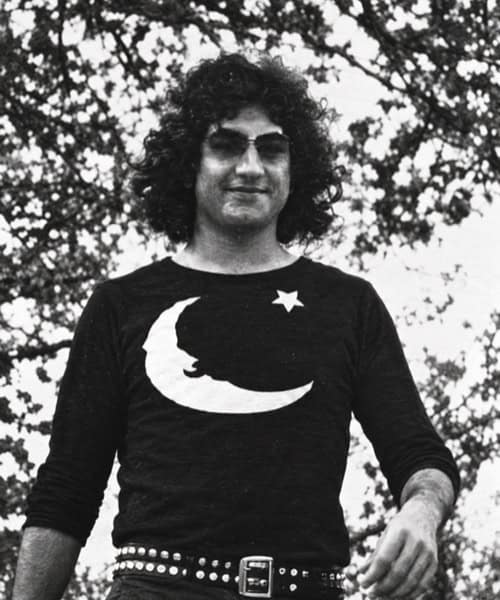
Michael Kamen brought an unusually broad musical background to David Bowie’s 1974 Diamond Dogs Tour. Trained as an oboist and already active in rock music and ballet, he served as the production’s musical director while playing electric piano, Moog synthesizer and oboe. His work formed part of a show in which a large band had to support Bowie’s songs, theatrical staging, dancers and changes of scene.
The tour was an important moment in Bowie’s live career. The elaborate early production presented material from Diamond Dogs alongside songs from earlier albums, often in arrangements far removed from the performances audiences had previously known. Kamen worked within that changing musical setting alongside players including pianist Mike Garson, guitarist Earl Slick, saxophonist David Sanborn and bassist Herbie Flowers.
Bowie’s first officially released live album, David Live, preserves performances recorded at Philadelphia’s Tower Theatre in July 1974. Kamen’s contribution to that recording gives listeners direct evidence of his place in the band. His oboe on “1984” was especially memorable to him: years later, he recalled meeting a younger musician who had been inspired by that very sound.
Kamen’s association with Bowie was one chapter in a much larger career as a performer, arranger, composer, orchestrator and conductor. It deserves attention on its own terms. He helped shape the demanding first incarnation of the Diamond Dogs stage production before Bowie’s touring music and presentation moved in another direction later in 1974.
- Full name: Michael Arnold Kamen
- Born: 15 April 1948, Queens, New York City, United States
- Died: 18 November 2003, aged 55
- Profession: Musician, composer, arranger, orchestrator and conductor
- Principal instrument during his studies: Oboe
- Early group: The New York Rock and Roll Ensemble
- Work with David Bowie: Musical director and musician on the 1974 Diamond Dogs Tour
- Tour instruments: Electric piano, Moog synthesizer and oboe
- Official Bowie live recording: David Live, recorded at the Tower Theatre in Philadelphia in July 1974
- Important distinction: Kamen’s documented work with Bowie on David Live concerns the July performances; the touring band changed later in 1974.
Early life in New York
Michael Kamen was born on 15 April 1948 in Queens, New York City, to Helen and Saul Kamen. Music became part of his life early. He attended New York’s High School of Music and Art, an environment in which serious musical study could exist beside the wider sounds of the city. The oboe became his formal field of study, but his interests extended well beyond a single instrument or repertoire.
Kamen subsequently studied oboe at the Juilliard School. That training matters when considering his later work with Bowie: the oboe was an instrument he could bring to a rock concert as a player, while his education also gave him experience with written music and the practical demands of an ensemble. It would be misleading, however, to describe his career as a straightforward move from classical music into rock. He was already exploring both areas while he was young.
His official biography describes a musician interested in a wide range of sounds and forms. Rather than treating an orchestra, a rock group and a stage production as unrelated worlds, Kamen developed ways of working across them. His later career made that breadth famous, but the combination was present before Bowie invited him onto the Diamond Dogs project.
The New York Rock and Roll Ensemble
During his years as a young musician, Kamen helped form The New York Rock and Roll Ensemble. The group brought musicians with classical training into a rock setting. Its significance for this story lies less in any claim that it anticipated Bowie’s work than in the experience it gave Kamen: he learned to move between instruments, musical traditions and the practical realities of performing with a band.
The ensemble also appeared in connection with Leonard Bernstein’s Young People’s Concerts and the New York Philharmonic. Kamen’s official biography identifies Bernstein as an important figure in introducing him to symphonic arranging and composing. This was an early indication of the career Kamen would build as someone who could both perform music and organise how a larger group played it.
A musical director on a rock tour needs more than technical knowledge. Songs must be prepared for the available players, rehearsals must turn ideas into repeatable performances, and the musicians must be able to respond to the structure of the show. Kamen’s combination of formal study and band experience helps explain why his background was relevant to Bowie’s unusually ambitious 1974 production. It does not, by itself, establish the details of every arrangement he made; those claims require separate evidence.
Ballet and the meeting with Bowie
Before the Diamond Dogs Tour, Kamen was also composing for dance. His official biography describes ballet as a major part of his early creative work. This experience is particularly relevant because Bowie’s new production was conceived as more than a band playing beneath stage lights. The music had to coexist with movement, characters, sets and visual effects.
According to the account published by Kamen’s family, Bowie and manager Tony Defries met Kamen after attending a presentation of his ballet Rodin in New York. The meeting led to Kamen’s involvement in the Diamond Dogs project. That account explains the introduction; it should not be expanded into an undocumented story about the exact words Bowie used, the terms of the appointment or decisions made at that first meeting.
Kamen’s family also states that he brought musicians and dancers into the project. Defries, who worked directly on the production, later remembered how much responsibility the young musician was given. Together, these first-hand accounts support a substantial role in organising the show. They do not make Kamen the sole creator of its music or staging. Bowie’s artistic direction and the work of the other musicians, dancers and production staff remain essential parts of the history.
“Michael was enormously helpful in making that work.”
Tony Defries, quoted on Michael Kamen‘s official website.
The challenge of Diamond Dogs
Bowie began the North American Diamond Dogs Tour in June 1974. The opening production presented an imagined urban world associated with the Diamond Dogs album. Its elaborate stage design, choreography and mechanical effects required an approach very different from simply reproducing the studio recordings. The band had to function within a tightly planned performance while still making the songs compelling as live music.
The material itself posed a challenge. Bowie was performing newer songs from Diamond Dogs alongside earlier work drawn from several stages of his recording career. Those songs had originally been made with different musicians and in different settings. A touring band needed to turn them into one coherent concert without pretending that they had all begun in the same style.
Kamen’s title of musical director identifies a responsibility for the musical operation of that production. The surviving credits and recollections establish the role, but they do not assign every individual arrangement or decision to him. A careful account therefore distinguishes his documented position from assumptions about precisely which note, transition or instrumental part he devised.
Tony Visconti later recalled seeing an early version of the show in New York. His description emphasised both its scale and the complex machinery surrounding Bowie’s performance. Visconti was describing what he witnessed, not supplying a complete technical record of how the band was directed. His recollection nevertheless helps show the environment in which Kamen and the other musicians were working.
Musical director and performing musician
Kamen’s participation had two connected sides. He was the musical director, and he was also a member of the performing band. The instrument credits list electric piano, Moog synthesizer and oboe. Each could contribute a different kind of sound: a keyboard part could sit inside the rhythm and harmony of a song; a synthesizer could add another colour; an oboe could bring a distinctive acoustic voice into a largely amplified ensemble.
These credits should be read accurately. They establish what Kamen played during this period, but they are not a song-by-song map of every instrument heard on every night. Mike Garson was also in the band on piano and Mellotron. Keeping the two keyboard players distinct is important when writing about the performances or listening to a recording. Neither man’s presence should be used to claim the other’s parts without evidence.
Garson later described performing on the Diamond Dogs tour under Kamen’s musical direction as a pleasure. That is valuable first-hand testimony from someone who shared the stage with him. Garson also recalled how the touring personnel changed as Bowie moved towards a more American band later in the year. His account helps place Kamen within a particular phase of the tour instead of treating every 1974 concert as if it had the same line-up.
Mike Garson on the Diamond Dogs Tour
“Doing the ‘Diamond Dogs’ tour when Michael Kamen was the musical director was a joy.”
Mike Garson, interview with All About Jazz.
The musicians around him
The early touring band brought together players with markedly different backgrounds. Alongside Kamen and Garson were guitarist Earl Slick, saxophonists David Sanborn and Richard Grando, bassist Herbie Flowers and drummer Tony Newman, among other contributors to the production. The precise personnel should always be matched to the date or recording being discussed, because Bowie’s 1974 line-up was not fixed throughout the tour.
That distinction is more than a technical footnote. David Live captures the sound of a particular band at a particular point. Later 1974 performances reflected changes in personnel, musical emphasis and staging. A reader who sees Kamen credited on the live album should not automatically assume that he occupied the same role at every concert through December.
The group had to carry both the weight of Bowie’s established songs and the demands of a new show. Garson’s piano, Slick’s guitar, the saxophones and the rhythm section all supplied identifiable parts of its sound. Kamen’s contribution belongs within that collective achievement. Calling him musical director recognises an important responsibility without reducing the other performers to supporting figures in his story.
David Live: the Philadelphia recording
David Live is the most direct official recording of Kamen’s work with Bowie. The album was assembled from performances at the Tower Theatre in Philadelphia in July 1974, during the Diamond Dogs Tour. It was Bowie’s first officially released live album. The recording documents an artist changing his live presentation after the end of the Ziggy Stardust stage era and before the full arrival of the soul-oriented work that followed.
The album is particularly useful because it allows Kamen’s credits to be connected with an actual surviving performance rather than with a retrospective list of tour personnel. At the same time, a released live record is a produced object. It is selected, mixed and presented after the concerts. It cannot be treated as a transparent record of everything that happened on stage at every show.
Tony Visconti, who later revisited the recordings, discussed the difficulties of the original live tapes and the work carried out on them. In an interview published by Bowie’s official website, he identified the final two nights of the Tower Theatre run, 11 and 12 July, as the recording dates. His account also described later technical work on some performances. Those details matter when a listener tries to use the album to establish exactly what was heard in the room.
The safest historical description is therefore clear and useful: Kamen was part of the July 1974 band represented on David Live; he is credited with electric piano, Moog and oboe; and the record offers an official way to hear the collaboration. Claims about an individual sound should be grounded in the recording and, where possible, in a musician’s own account.
The oboe on “1984”
One unusually specific first-hand account comes from Kamen himself. In a 1998 interview, he recalled meeting the younger musician Edward Shearmur, who told him that an oboe passage on a David Bowie record had helped him hear a connection between classical instrumentation and rock. Kamen recognised the passage as his own oboe playing on “1984” from David Live.
The story is valuable for two reasons. First, it identifies a particular recorded contribution in Kamen’s own words. Second, it shows that a detail within a much larger theatrical and musical production could have an independent life for a later listener. It would go too far to claim that the passage changed an entire genre. Kamen’s recollection establishes something more precise: it mattered to one young musician who later worked with him.
The oboe also makes Kamen’s range tangible. It was the instrument he had studied seriously, yet here it appeared inside a Bowie concert and a commercial live album. The result was neither a separate classical interlude nor proof that the whole production had become orchestral. It was a particular instrumental voice placed within a rock performance.
Michael Kamen on “1984”
“It was my playing oboe solo in ‘1984’, the song from the David Live album.”
Michael Kamen, 1998 interview reproduced by Movie Music UK.
A tour that changed during 1974
The title Diamond Dogs Tour can suggest a single stable production. In practice, Bowie’s North American shows changed during 1974. The elaborate early presentation associated with Hunger City gave way to a less elaborate stage format, while Bowie’s interest in American soul increasingly affected the music. Personnel changed as the year progressed.
It is especially important to keep the July Philadelphia recordings separate from the later shows. Mike Garson remembered an early band that included Kamen, Flowers and Newman and described a subsequent American-based line-up without them. Tony Visconti likewise wrote that Kamen was no longer present by the Los Angeles performance he later mixed for release as Cracked Actor. These are direct recollections from participants, although they should not be stretched into an exact departure date that the cited accounts do not establish.
Bowie’s official website has also published a list for the October 1974 shows that includes Kamen, while Visconti’s and Garson’s retrospective accounts describe his departure in the changing later line-up. That inconsistency means it would be careless to give an unqualified statement about every October concert. The firm points for this page are his musical direction of the earlier production and his presence on the July David Live recordings.
The changing tour also explains why later Bowie records should not automatically be added to Kamen’s discography. His work on David Live does not establish that he performed on the original Diamond Dogs studio album, on Young Americans, or on every live recording from 1974. Recording credits, concert dates and the membership of each band must be checked separately.
What musical direction meant in this production
Kamen’s position is sometimes reduced to a line in a personnel list. The production makes that line more meaningful. The 1974 show brought together songs, a large ensemble, choreography and mechanical stage effects. A musical director working in such a setting had to help make the performance playable and repeatable while responding to Bowie’s artistic plan.
Tony Defries‘s recollection supports the view that Kamen was trusted with considerable responsibility. Mike Garson‘s memory confirms that the musicians understood Kamen to be their musical director during the early tour. Kamen’s own instrument credits show that he also participated directly in the performance. Those three kinds of evidence — management recollection, fellow musician testimony and recorded credit — are stronger together than a vague claim that he “created the sound” of the entire tour.
There are limits to what can be reconstructed. A credit for arrangements on a recording does not necessarily identify who devised each live change, and a description of the stage show does not reveal every decision made at rehearsal. The available sources establish Kamen’s position and several concrete contributions. They leave room for the work of Bowie and the other participants without requiring invented behind-the-scenes detail.
From Bowie to arranging and film music
Kamen continued to build a career that crossed the boundaries he had already explored in New York. His official biography records work as a performer, composer, orchestrator and conductor. He became closely associated with film scores while continuing to collaborate with rock and pop musicians. The Diamond Dogs assignment was an early, visible example of his ability to work within a large production, but it was not the sole source of his later success.
His film work began to grow during the later 1970s. He subsequently composed for productions including the Lethal Weapon and Die Hard film series, Robin Hood: Prince of Thieves, The Iron Giant and Band of Brothers. These projects differed greatly in subject and musical demands. They demonstrate the breadth of his later career, while the focus of this page remains his documented collaboration with Bowie.
Kamen also worked with Pink Floyd. His official catalogue credits him with orchestration and conducting on the film version of The Wall. Decades after the Bowie tour, he arranged, orchestrated and conducted Metallica’s performances with the San Francisco Symphony for S&M. Such projects show a continuing interest in bringing musicians from different performance traditions into a shared work, although each collaboration had its own history and should not be presented as a direct continuation of Diamond Dogs.
Music education and his final years
In 1996 Kamen helped establish the Mr. Holland’s Opus Foundation with Richard Dreyfuss and Stephen Herek. Its purpose was to support music education and help schools obtain instruments. The foundation belongs in an account of his life because it shows an enduring commitment to young musicians, beyond his recordings and concert credits.
Kamen’s official biography states that he was diagnosed with multiple sclerosis in the mid-1990s. He continued working on projects across film, concerts and recorded music. He died suddenly on 18 November 2003, aged 55. His career should not be compressed into a list of famous soundtracks: his work as an oboist, band member and musical director was part of the same musical life.
For Bowie listeners, the most direct way to encounter that earlier side of Kamen remains David Live. The album does not contain every aspect of the original production, but it preserves the sound of musicians tackling an unusually ambitious show. Kamen’s role was both practical and audible: he helped direct the ensemble and played within it.
Michael Kamen‘s place in Bowie’s history
Kamen worked with Bowie at a point when the singer was rebuilding his stage presentation. The 1974 tour followed the retirement of Ziggy Stardust and accompanied the release of Diamond Dogs. It combined songs from different periods with a new theatrical setting and a substantially different band. Kamen’s experience across rock, composition and dance made him a fitting choice for that demanding early production.
His contribution is best described with precision. He served as musical director, performed on electric piano, Moog and oboe, and appears in the personnel of David Live. First-hand accounts from Defries and Garson speak to his responsibility and the experience of working with him. Kamen’s own recollection identifies his oboe on “1984”. Each piece of evidence says something useful; none requires an exaggerated claim that he alone designed Bowie’s 1974 sound.
The collaboration was relatively brief within two long and varied careers. That brevity does not make it minor. It places Kamen within one of Bowie’s most ambitious live productions and leaves a substantial official recording through which his contribution can still be heard.
Official Website
The official Michael Kamen website preserves information about his life, recordings, concerts and film work. Its account of the Diamond Dogs Tour confirms his position as musical director and lists his instruments as oboe, Moog synthesizer and electric piano. The site is maintained as a record of Kamen’s work; this article has not been presented as a personal statement or endorsement by his family or estate.
Article Origin
This article was researched and written for DavidBowieWorld.com by Diedrich Streuper. The account draws on Michael Kamen‘s official biography and tour entry, David Bowie’s official archive, and published first-hand interviews with Kamen, Mike Garson, Tony Visconti and Tony Defries. Where accounts of the changing 1974 tour differ, the text identifies what can be established without assigning Kamen undocumented performances or recording credits.
© 2026 DavidBowieWorld.com – Diedrich Streuper. All rights reserved.
