
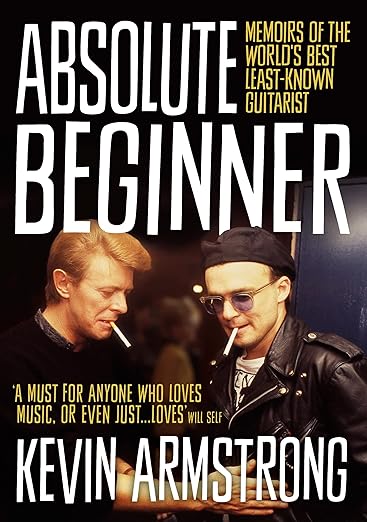
Absolute Beginner: Memoirs of the World’s Best Least-Known Guitaris
Author: Kevin Armstrong Category: 1987 - 1997, Album 1. Outside, Biography, Bowie colleague, Iggy Pop, Memories, The London Years Publisher: Jawbone Press Published: October 17, 2023 ISBN-13: 9781911036173 Pages: 288 Country: UK Language: English File Size: 15 x 2.2 x 21.5 cmKevin Armstrong: Absolute Beginner
Memoirs of the World’s Best Least-Known Guitarist
Absolute Beginner: Memoirs of the World’s Best Least-Known Guitarist is the autobiography of guitarist, songwriter and producer Kevin Armstrong, a musician whose career placed him alongside some of the most important figures in British popular music while his own name often remained outside the spotlight.
Published by Jawbone Press on 17 October 2023, the book tells the story of Armstrong’s journey from a self-taught young guitarist in London’s punk and pub-rock world to collaborations with artists including David Bowie, Iggy Pop, Paul McCartney, Thomas Dolby, Grace Jones, Sinéad O’Connor, Morrissey and many others.
For David Bowie followers, however, Absolute Beginner has particular importance.
Armstrong was not simply a session musician who briefly crossed Bowie’s path. From the recording of Absolute Beginners through Live Aid, Dancing in the Street, Tin Machine and finally 1. Outside, he repeatedly entered Bowie’s musical world at significant moments.
The result is a memoir that offers something different from a conventional Bowie biography: Bowie seen from the position of a working musician standing beside him.
Before David Bowie
Armstrong’s story begins far from stadium concerts and international stars.
He grew up fascinated by the guitar and developed largely as a self-taught musician. His early professional life emerged from the changing musical landscape of late-1970s and early-1980s London, where punk, pub rock, independent music and the remnants of the traditional recording industry existed alongside one another.
With Local Heroes SW9, Armstrong entered the professional music world and eventually secured a deal with EMI.
But the career he imagined for himself as a recording artist did not develop in the expected way.
Instead, Armstrong discovered that his greatest professional strength was his ability to enter other people’s musical worlds. He could learn quickly, arrange, adapt, contribute ideas and understand what a song needed.
Those qualities would eventually bring him into contact with David Bowie.
The Call That Changed Everything
In late 1984, Armstrong was asked to attend a recording session at Abbey Road Studios.
The identity of the artist was initially kept from him.
When Armstrong arrived, the mysterious artist turned out to be David Bowie.
For a relatively unknown guitarist, the circumstances were extraordinary. Bowie was then one of the world’s most recognisable music stars, following the enormous international success of Let’s Dance and the Serious Moonlight Tour.
Yet Armstrong’s approach was not simply to stand quietly and follow instructions.
He contributed as a musician.
That encounter became the beginning of a professional relationship that would repeatedly bring Armstrong back into Bowie’s orbit over the following decade.
Absolute Beginners
The song that gave Armstrong’s memoir its title was also central to the beginning of his relationship with Bowie.
Armstrong participated in the recording of Absolute Beginners, written by Bowie for Julien Temple’s film of the same name.
The sessions placed Armstrong inside Bowie’s working environment at a fascinating point in his career. Bowie was an international superstar, but the recording process still depended upon musicians responding quickly to ideas and helping transform them into finished arrangements.
Armstrong’s strength lay precisely in that environment.
His contribution went beyond simply reproducing predetermined guitar parts. He was able to respond to Bowie musically, suggest ideas and help shape arrangements.
For Armstrong, the experience opened a door that would soon lead somewhere even more extraordinary.
Live Aid
On 13 July 1985, David Bowie performed at Live Aid at Wembley Stadium.
Armstrong was part of the band.
The scale of the event was unprecedented. Live Aid connected concerts in London and Philadelphia through an enormous international television broadcast watched by audiences around the world.
Bowie’s Wembley performance included TVC 15, Rebel Rebel, Modern Love and Heroes.
Armstrong had gone in a remarkably short period from the uncertain life of a working London musician to performing guitar behind David Bowie at one of the most famous concerts in rock history.
But his role was more substantial than simply appearing on stage.
Armstrong helped assemble musicians for Bowie’s Live Aid band from people within his own professional circle. The resulting line-up included musicians such as Thomas Dolby and drummer Neil Conti.
For Armstrong, Live Aid represented one of those extraordinary moments when years of preparation suddenly became visible on the largest possible stage.
Dancing in the Street
Another remarkable Bowie episode followed almost immediately.
Bowie and Mick Jagger recorded a new version of Martha and the Vandellas’ Dancing in the Street for the Live Aid fundraising campaign.
Armstrong was again involved.
Before the recording session, he met Bowie and Jagger in Soho with his guitar and worked through the arrangement with them.
The actual recording was made at Westside Studios in London.
Armstrong has recalled that the other musicians were unaware that Jagger would be appearing. Bowie and Armstrong knew; the band did not.
Jagger’s arrival therefore produced exactly the reaction one might imagine.
The single became a major international hit and reached number one in the United Kingdom.
Armstrong had now found himself working not merely with Bowie but directly between two of the most famous performers in rock music.
From Bowie to Iggy Pop
Bowie also provided the connection that led Armstrong into another major musical relationship.
During work surrounding Iggy Pop‘s 1986 album Blah Blah Blah, Bowie introduced Armstrong to Iggy.
The introduction proved enormously important.
Armstrong became Iggy Pop‘s guitarist and bandleader, beginning a working relationship that would stretch across different periods for decades.
This is one of the recurring themes of Absolute Beginner: careers in music rarely develop according to a carefully designed plan.
One session leads to another. One musician recommends another. A telephone call can redirect years of a life.
Armstrong’s connection with Bowie opened precisely those kinds of doors.
Iggy Pop and Life on the Road
Armstrong’s experiences with Iggy Pop form another major strand of the memoir.
Working with Iggy required a different musical energy from working with Bowie. Armstrong found himself operating not only as guitarist but as bandleader, responsible for helping create the musical structure within which an famously unpredictable frontman could perform.
The relationship endured.
Decades after their first work together, Armstrong returned as Iggy’s bandleader from 2014 to 2019.
Those later tours also played an unexpected part in the creation of Absolute Beginner. Armstrong began writing memories during periods of downtime on the road — in cars, aircraft and hotel rooms — gradually organising the stories into a chronological account of his life.
Tin Machine
Armstrong’s relationship with Bowie took another turn at the end of the 1980s.
Bowie had become increasingly uncomfortable with the machinery of solo superstardom and formed Tin Machine with guitarist Reeves Gabrels and brothers Hunt Sales and Tony Sales.
Armstrong became closely involved with the group and is sometimes described as its unofficial fifth member during its early period.
The situation was very different from Live Aid.
At Wembley, Bowie had stood at the centre of a huge international spectacle. Tin Machine was deliberately conceived as a band in which Bowie attempted to function as one member among several.
For Armstrong, who had already experienced Bowie as a global star, the contrast offered a particularly revealing perspective.
He witnessed Bowie trying to escape expectations surrounding the name “David Bowie” and rediscover the immediacy of making loud, collaborative rock music within a band.
Inside the Tin Machine Experiment
Tin Machine remains one of the most debated periods of Bowie’s career.
For Bowie himself, however, the group represented an important reset.
Armstrong’s memories are valuable because they come from inside that experiment rather than from the later critical reassessment of it.
He saw the interpersonal relationships, rehearsals, musical decisions and practical realities involved in creating the band.
His position was unusual. He was close enough to participate directly but not one of the four official members whose identities defined Tin Machine publicly.
That gives his recollections a particularly interesting perspective.
The experience also demonstrates something that appears repeatedly throughout Armstrong’s memoir: professional musicians often occupy crucial positions in famous recordings and performances without becoming famous themselves.
Life as the Musician Behind the Music
That idea explains the subtitle of the book: Memoirs of the World’s Best Least-Known Guitarist.
It is deliberately self-deprecating, but it describes Armstrong’s career remarkably well.
Millions of people have heard performances to which he contributed without necessarily knowing his name.
His work has connected him with an extraordinary range of artists, including Paul McCartney, Grace Jones, Thomas Dolby, Morrissey, Sinéad O’Connor, Prefab Sprout, Brian Eno, Sandie Shaw and many others.
Absolute Beginner therefore also tells the story of a type of musician rarely given the central role in rock history.
Stars stand at the front of the stage.
Musicians such as Armstrong make the stage work.
Paul McCartney and Other Encounters
One of the pleasures of Armstrong’s memoir is the extraordinary number of musical worlds through which he passes.
The Bowie years alone would provide enough material for a conventional music memoir, but Armstrong’s career continually moves elsewhere.
He works with Paul McCartney.
He enters sessions with artists whose personalities and methods differ dramatically.
He becomes a producer and songwriter as well as a guitarist.
He experiences the strange mixture of glamour and routine that characterises professional music: famous names alongside long journeys, rehearsals, studios, telephone calls, contracts, hirings and sudden dismissals.
The result is less a parade of celebrity encounters than a description of what it actually means to survive for decades as a professional musician.
Humour Without Hero Worship
One of the strengths of Absolute Beginner is Armstrong’s tone.
He clearly respects many of the musicians with whom he worked, but the book is not written from the perspective of an awestruck fan.
Bowie, Iggy Pop, McCartney and the other famous names appear as people at work.
They can be brilliant, generous, difficult, funny, insecure, unpredictable or frustrating.
Armstrong also directs much of the humour towards himself.
The subtitle reflects that attitude. Rather than presenting himself as the forgotten genius behind famous artists, he frequently examines the insecurity involved in being a professional musician surrounded by extraordinary talent.
That self-awareness prevents the memoir from becoming an exercise in self-promotion.
Returning to Bowie for 1. Outside
Years after the Tin Machine period, Bowie contacted Armstrong again.
This time the project was 1. Outside, Bowie’s 1995 collaboration with Brian Eno.
There was an intriguing connection to their earlier work.
During a Tin Machine soundcheck, Armstrong had been playing a musical idea that attracted Bowie’s attention. That material subsequently developed into part of Outside, the title track of the 1995 album, with Armstrong receiving a writing credit.
Armstrong was also invited to contribute guitar to the album.
Among his performances were The Hearts Filthy Lesson and Thru’ These Architects Eyes.
The sessions completed a remarkable circle.
Armstrong’s first day working with Bowie had revolved around Absolute Beginners.
His work on 1. Outside became their final period together.
The Death of David Bowie
David Bowie’s death on 10 January 2016 eventually became one of the reasons Armstrong decided that his own story should be preserved.
For years he had lived with the memories without feeling a particular need to turn them into a book.
Bowie’s death changed that perspective.
People who had shaped Armstrong’s musical life were getting older and disappearing. Experiences that had once seemed simply part of everyday professional life were becoming history.
Armstrong began to recognise that his memories represented a perspective that nobody else could reproduce.
He had been there.
A Working Musician’s View of Bowie
For Bowie historians, this is the greatest value of Absolute Beginner.
Armstrong does not attempt to explain David Bowie as a cultural phenomenon.
He describes what it was like to work with him.
That distinction matters.
His Bowie is not merely the figure on album covers, concert stages and magazine photographs. He is a musician communicating ideas to other musicians, listening to suggestions, arranging songs, rehearsing, joking and making practical decisions inside studios and rehearsal rooms.
Armstrong’s perspective also helps demonstrate Bowie’s ability to recognise useful collaborators.
He repeatedly surrounded himself with musicians who could contribute something beyond technical proficiency.
Armstrong was one of them.
More Than a Bowie Book
Although David Bowie occupies an important position in Absolute Beginner, the memoir should not be mistaken for a Bowie biography.
Its real subject is Kevin Armstrong‘s life in music.
Bowie is one of the most significant figures in that life, but the story continues through Iggy Pop, McCartney, Dolby, Morrissey, Sinéad O’Connor and countless sessions, tours and projects.
That broader perspective actually makes the Bowie material more interesting.
Armstrong does not view Bowie in isolation. He can compare Bowie’s working methods and personality with those of other major artists because he experienced all of them from the same basic position: guitarist, collaborator and fellow professional.
Historical Importance of Absolute Beginner
Absolute Beginner belongs to an important category of music memoir: history told not by the star at the centre of the photograph but by somebody standing just outside the spotlight.
That position can reveal things conventional biographies cannot.
Armstrong experienced the machinery of popular music from inside. He saw how musicians were hired, how bands were assembled, how arrangements developed, how relationships changed and how careers could turn on apparently insignificant encounters.
His Bowie recollections cover an especially interesting period.
They begin during Bowie’s mid-1980s commercial peak, pass through Live Aid and Dancing in the Street, continue into the radical change represented by Tin Machine and conclude with the experimental world of 1. Outside.
Few musicians were present at such different points in Bowie’s career.
Conclusion
Absolute Beginner is not the autobiography of a conventional rock star.
That is precisely why it is valuable.
Kevin Armstrong spent more than four decades working inside popular music while frequently remaining invisible to the audiences hearing his guitar. His memoir reveals the skill, adaptability, humour and persistence required to build that kind of career.
For David Bowie readers, the book provides something particularly valuable: memories from a musician Bowie trusted enough to call back at very different moments in his career.
From Absolute Beginners and Live Aid to Dancing in the Street, Tin Machine and 1. Outside, Armstrong witnessed Bowie not simply as an icon but as a working musician.
And that is ultimately what makes Absolute Beginner such a worthwhile addition to the Bowie bookshelf.
It allows us to see David Bowie from the other side of the microphone.
