
Ola Hudson – David Bowie’s Thin White Duke Costume Designer

Ola Hudson was an American fashion and costume designer whose work belongs directly within David Bowie’s creative history. She made suits for his appearance as Thomas Jerome Newton in The Man Who Fell to Earth and designed the black waistcoat and trousers associated with his Thin White Duke image. Her contribution helped give a recognisable physical form to one of the most distinctive periods of his career.
Her Bowie connection centres on the mid-1970s, particularly the relationship between the film, Station to Station and the 1976 Isolar tour. This was a period of sharp visual change. The elaborate colour and ornament of earlier performances gave way to a more restrained appearance, in which proportion, movement and the contrast between black and white carried much of the theatrical effect.
Hudson’s life extended well beyond this collaboration. A trained dancer, designer and multidisciplinary artist, she worked in a creative environment that brought clothing, music and performance into close contact. She was also the mother of guitarist Saul Hudson, known as Slash, and artist and designer Albion “Ash” Hudson. These family connections form part of her story, alongside a body of professional work that deserves attention in its own right.
- Name: Ola Hudson, born Ola J. Oliver
- Born: 12 October 1946, Los Angeles, California
- Died: 5 June 2009, Santa Monica, California
- Fields: Fashion design, costume, dance and other forms of creative expression
- Bowie connection: Direct professional collaboration during the mid-1970s
- Film credit: Suits for David Bowie in The Man Who Fell to Earth (1976)
- Stage clothing: Black waistcoat and trousers associated with the Thin White Duke and the 1976 Isolar tour
- Other clients: The Pointer Sisters, John Lennon, Ringo Starr and Diana Ross
- Children: Saul “Slash” Hudson and Albion “Ash” Hudson
- Historical importance: A named contributor to Bowie’s transition towards the restrained tailoring of 1975–1976
Early life: an artistic foundation in Los Angeles
Ola Hudson was born in Los Angeles on 12 October 1946. Her birth surname was Oliver. The artistic life that followed would encompass several disciplines, but dance was an important early foundation. This background places her within the world of performance before her better-known association with rock musicians and their clothing.
Her training included study at the Lester Horton School of Modern Dance and work with Bella Lewitzsky and Linda Gold. The obituary published after her death also records studies in Paris, London and Switzerland. It describes an education extending across dance and theatre arts, rather than a career beginning solely at a sewing machine or in a fashion boutique.
Dance offers a useful starting point for considering costume because clothing on a performer is continually changing shape. A trouser leg responds to a stride; a sleeve follows an arm; a waistline changes the apparent balance of the body. These are practical relationships between fabric and movement. They also become expressive relationships when an audience watches a performer.
London, marriage and a family connected with the arts
During her time in London, Ola met Anthony Hudson, the British artist and graphic designer whom she married. Their family life connected Britain and California, bringing together two adults whose professional interests lay in visual culture. Anthony’s work included record-cover illustration and design, while Ola developed her own career in clothing and performance.
Their older son, Saul, was born in Britain in 1965. He later became internationally known as Slash, the guitarist associated with Guns N’ Roses. Their younger son, Albion, known as Ash, also pursued a creative career. The family therefore links several forms of artistic work, including illustration, fashion, graphic design and music.
Los Angeles: a boutique and a career dressing musicians
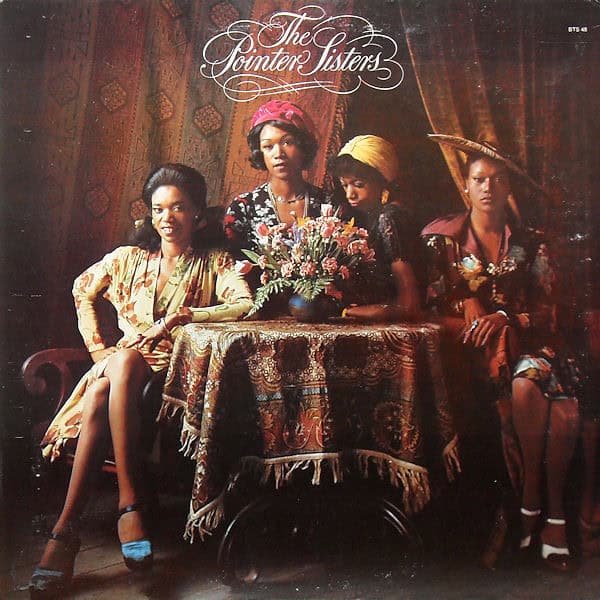
Hudson’s clothing career developed in Los Angeles, where her activities included a Sunset Strip boutique called Skitzo. Fashion historian Paul Gorman has documented this part of her work using material supplied from the Hudson family archive. The boutique places her within the practical business of designing and presenting clothes, beyond the later visibility of celebrity commissions.
A boutique and a performance commission involve different encounters with clothing. A customer may see a garment close enough to examine its construction, while an audience might recognise it only as a silhouette at a distance. Both situations depend on proportion and wearability, but they place different demands on colour, detail and the relationship between the individual and the garment.
For a designer working around musicians, those boundaries can overlap. Something intended for personal wear can enter a publicity photograph; an outfit associated with a recording artist can attract attention beyond the original occasion. Clothing becomes part of a public image through its use, even when its starting point is familiar everyday dress.
The names associated with Hudson’s work include The Pointer Sisters, John Lennon, Ringo Starr and Diana Ross. Her obituary also identifies a broader range of entertainment clients. These connections demonstrate that she worked within a musical world extending beyond one performer, one album campaign or one interpretation of rock fashion.
It is therefore misleading to describe Hudson simply as a specialist in extravagant glam costumes. Her most familiar Bowie work has an immediately different character: a controlled, tailored appearance whose effect comes largely from restraint. Her place in music fashion includes that contrast, and it should leave room for differences between individual commissions.
Before Hudson: Bowie’s earlier costume partnerships
By the time Hudson worked with Bowie, his appearance had already passed through several distinctive phases. Freddie Burretti had played a central role in the clothing associated with Ziggy Stardust, while Kansai Yamamoto supplied some of the extraordinary stage designs that became closely linked with Bowie’s early-1970s performances.
A change of costume can indicate a change in artistic emphasis, but the transition is rarely the work of clothing alone. Music, photography, physical performance and the setting of an appearance all contribute. Hudson’s work belongs within that collaborative process: a specific professional contribution to a recognisable new image, made in dialogue with the performer wearing it.
A direct working relationship with David Bowie
Hudson and Bowie’s association was professional as well as personal. The evidence does not support presenting her as someone who merely shared his cultural surroundings. Her name appears in the production record of The Man Who Fell to Earth, and the attribution of his black waistcoat and trousers is also recognised by Bowie’s official website.
In a radio interview reported by NME in 2012, Slash recalled that his mother’s working relationship with Bowie had preceded their romance. In the same interview, he qualified that sequence as his understanding of how the association began. His recollection does not establish the exact date or circumstances of their first meeting.
Slash on how the association began
“My mum started working with David professionally at first.”
— Slash, Triple M interview, reported by NME, 28 August 2012.
1975: preparing Thomas Jerome Newton
The Man Who Fell to Earth (1976) — official 35th anniversary trailer, released by Rialto Pictures in 2011.
Nicolas Roeg’s The Man Who Fell to Earth gave Bowie his first leading role in a feature film. Based on Walter Tevis’s novel and adapted for the screen by Paul Mayersberg, it cast him as Thomas Jerome Newton, an extraterrestrial whose arrival in America becomes a story of wealth, isolation and human vulnerability.
Filming took place in New Mexico in 1975, with the film released in 1976. Keeping those years separate matters. The clothes were part of a production made before the public release of Station to Station, even though the film and album became closely associated in the imagery of the following year.
Newton’s wardrobe presents an unusual design problem. He needs to appear sufficiently ordinary to move through the human world, yet the film also asks the viewer to perceive his estrangement from it. Familiar clothes can contribute to that tension when they sit on an unfamiliar figure or acquire an unexpected significance within a scene.
Ola Hudson and May Routh: the credits matter
The film’s clothing history involves more than one named contributor. May Routh was its credited costume designer. Ola Hudson received a separate credit for the suits made for Bowie. The British Film Institute’s programme notes reproduce both roles, providing a clear basis for describing the relationship accurately.
Those credits acknowledge different responsibilities within the same production. They do not justify replacing Routh’s name with Hudson’s as the designer of the entire film. Equally, the overall costume-design credit does not remove Hudson’s separately acknowledged work. Both women belong in an account of Newton’s appearance, with their contributions identified as precisely as the record allows.
Ordinary clothes and an extraordinary presence
In a 2016 interview with Dazed, May Routh described Bowie’s wish for a simple appearance. Her recollection concerns the intention behind Newton’s clothing, and it helps explain why the film’s visual identity can be so memorable without relying entirely on visibly futuristic garments.
May Routh on Bowie’s approach to Newton
“David wanted a look that was very simple”
— May Routh, interviewed by Daisy Woodward, Dazed, 12 September 2016.
Routh explained that Newton was supposed to avoid attracting attention. The result contains a productive contradiction: the clothes can be relatively unremarkable while the person wearing them remains striking. The drama comes from that mismatch. An audience recognises the social language of a suit without necessarily feeling that Newton belongs comfortably inside the society it represents.
Creating Newton’s complete screen appearance
Newton’s screen presence depends on more than what hangs on a clothes rail. Bowie’s posture, stillness and movement alter the way the garments appear. The same general category of clothing can communicate authority in one scene and exposure in another, depending on the body inside it and the camera observing that body.
In a separate interview with SciFiNow, Routh recalled Bowie helping resolve a difficult fitting for a special-effects costume. Her account concerns a different aspect of the production from Hudson’s credited suits, but it demonstrates Bowie’s practical engagement with how clothing worked on his body.
Clothing formed one part of Newton’s appearance. Hairstylist Martin Samuel and makeup artist Linda DeVetta also contributed to the film’s visual world. Samuel later discussed the production alongside Routh, recalling his work with Bowie on the distinctive hairstyle and the wider demands of the characters’ changing appearances.
From the film set to television
David Bowie – Golden Years, Soul Train, 1975.
Bowie’s Soul Train appearance in 1975 provides another point of connection between clothing and musical performance. Paul Gorman identifies the blue suit worn for that appearance as Hudson’s work. Bowie’s official website also documents the television engagement and an Andrew Kent photograph taken while he performed Golden Years.
Television changes the audience’s relationship with stage clothing. The camera can move close enough to show a collar, a fastening or the interaction between a shirt and jacket. At the same time, the performer must remain legible in a wider shot. The garment is therefore seen both as an object and as part of a moving whole.
1976: Station to Station and a changing musical setting
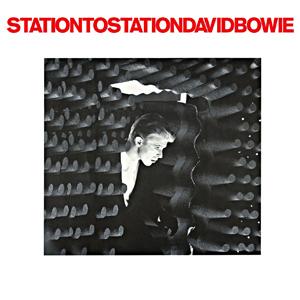
Station to Station was released on 23 January 1976. The album belongs to a period in which Bowie’s music combined elements of soul, funk, rock and increasingly expansive structures. Its six tracks offer a concentrated programme, with the extended title composition sharing space with songs such as Golden Years and Stay.
Nevertheless, visual presentation affects the way listeners remember an album era. A record can be recalled through its sleeve, its publicity photographs and the stage appearance used to present its songs. Clothing participates in that memory even when it has no place in the recorded sound itself.
The Thin White Duke: silhouette before decoration
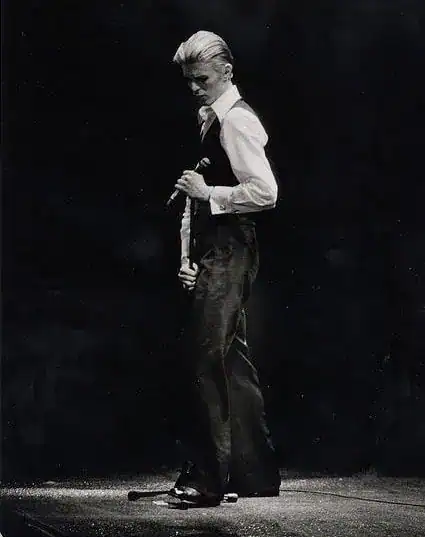
The best-known clothing associated with the Thin White Duke combines a white shirt with a dark waistcoat and wide black trousers. Hudson’s attribution for the waistcoat and trousers is explicitly recorded in a 2003 report on Bowie’s official website, published when Kate Moss wore items from his archive for British Vogue.
The same official account separately attributes the white shirt shown in the Vogue feature to Paul Smith. Hudson’s named contribution in that source is the black waistcoat and trousers.
As a visual construction, the outfit draws attention to the relationship between its parts. The pale shirt separates the arms from the dark torso. The fitted upper body meets a broader trouser line. Instead of distributing attention across embroidery, pattern or elaborate surface detail, the clothes establish a clear outline around the performer.
Calling the result simple should not imply that it is visually neutral. Small differences in fit or proportion can alter the balance of such an outfit considerably. Without a dense decorative surface to occupy the eye, the cut of the clothes and the posture of the wearer become especially prominent. This is one of the reasons the Duke remains so easy to recognise from relatively little visual information.
The Thin White Duke offers a useful example of theatricality achieved through reduction. A stage image does not need an extravagant costume to feel constructed. Formal clothes can appear equally deliberate when their proportions, colour relationships and manner of wear are carefully controlled.
One way to understand the effect is through the absence of visual distraction. The face, hands and outline of the performer become more exposed. A small gesture can acquire significance because the surrounding image is relatively spare. The clothes provide a framework in which movement and expression can be seen clearly.
The Isolar tour: taking the image onto the stage
David Bowie on stage during the 1976 Isolar tour.
The 1976 Isolar tour opened at the Pacific Coliseum in Vancouver on 2 February and concluded at the Pavillon de Paris on 18 May. Bowie’s official website confirms those endpoints. The tour carried the music of Station to Station through North America and Europe, establishing the Duke’s appearance in a sustained live setting.
An outfit worn across concert performances enters a different relationship with the public from one seen in a single publicity photograph. It becomes associated with repeated gestures, changing songs and the physical demands of a show. For different audience members, the same clothing can therefore acquire memories tied to entirely different moments.
The tour also placed new songs alongside material from earlier periods of Bowie’s career. That creates an interesting separation between repertoire and appearance: older songs are presented by a performer whose visual identity has changed. The clothing helps establish the present-tense setting through which the audience encounters the earlier material.
The V&A characterises the 1976 tour through its minimalist setting and stark lighting. This is an important context for considering the clothes. A garment is never seen independently of illumination: black can merge into a background, while a white shirt can become a highly visible shape within the same frame.
The result should be understood as an interaction between costume and presentation. Lighting does not make the designer irrelevant, and the costume does not account for the entire stage picture. Each changes how the other is perceived. A restrained outfit can become highly dramatic when the performer is sharply separated from the surrounding space.
Album sleeves and the afterlife of a screen character
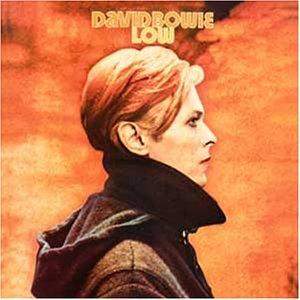
Images associated with The Man Who Fell to Earth also entered Bowie’s record-sleeve history. The relationship is especially familiar through Low, released in January 1977. Bowie’s official website has discussed how the sleeve reused imagery already associated with the film’s American promotion.
This circulation makes the boundary between actor and recording artist unusually porous. Someone encountering a sleeve may read the image as a portrait of Bowie, while another viewer recognises Newton. The same appearance acquires different meanings depending on the context in which it is presented.
The personal relationship: Slash’s recollections
Hudson and Bowie also had a romantic relationship. Slash’s recollections have made this one of the most frequently repeated aspects of her biography, sometimes attracting more attention than the work that brought the two adults together. Those memories belong to the record, but their prominence can distort the balance of an account devoted to her career.
A child’s experience of a parent’s partner is different from a colleague’s experience of a professional collaborator. Both can be sincere, and neither automatically describes the whole person. Slash’s later comments are valuable as family recollections, especially when clearly attributed, rather than treated as comprehensive evidence about the design process.
The distinction also affects the handling of dates. A recollection made many years later should not be used to calculate an exact chronology when the age or timing is uncertain. There is sufficient evidence for the association itself without inventing precision about its beginning, duration or private circumstances.
Slash recalls the connection between his mother, Ola Hudson, and David Bowie.
This interview clip preserves a family perspective on Bowie’s association with Hudson. It gives the reader an opportunity to hear Slash’s recollection in his own voice, alongside the separate documentary evidence for his mother’s professional work.
The personal recollection adds a domestic perspective to a story most often represented through public images of Bowie. It is presented alongside the professional history, with the interview’s memories kept separate from the documented clothing credits.
Her artistic life beyond the Bowie years
Hudson’s creative activities continued beyond her most visible Bowie work. Her 2009 obituary describes interests and practice across poetry, song, dance, design and photography. This broader record is important because the surviving celebrity images can otherwise create the misleading impression that her artistic life ended with a particular album era.
The same obituary records her connection with Santa Monica College, where she studied and worked. It identifies choreography, costume design and creative consultation among the areas associated with that relationship. These activities belong to a different scale of artistic exchange from international rock touring, but they are part of the same life of creative practice.
2003: the clothes return through Kate Moss
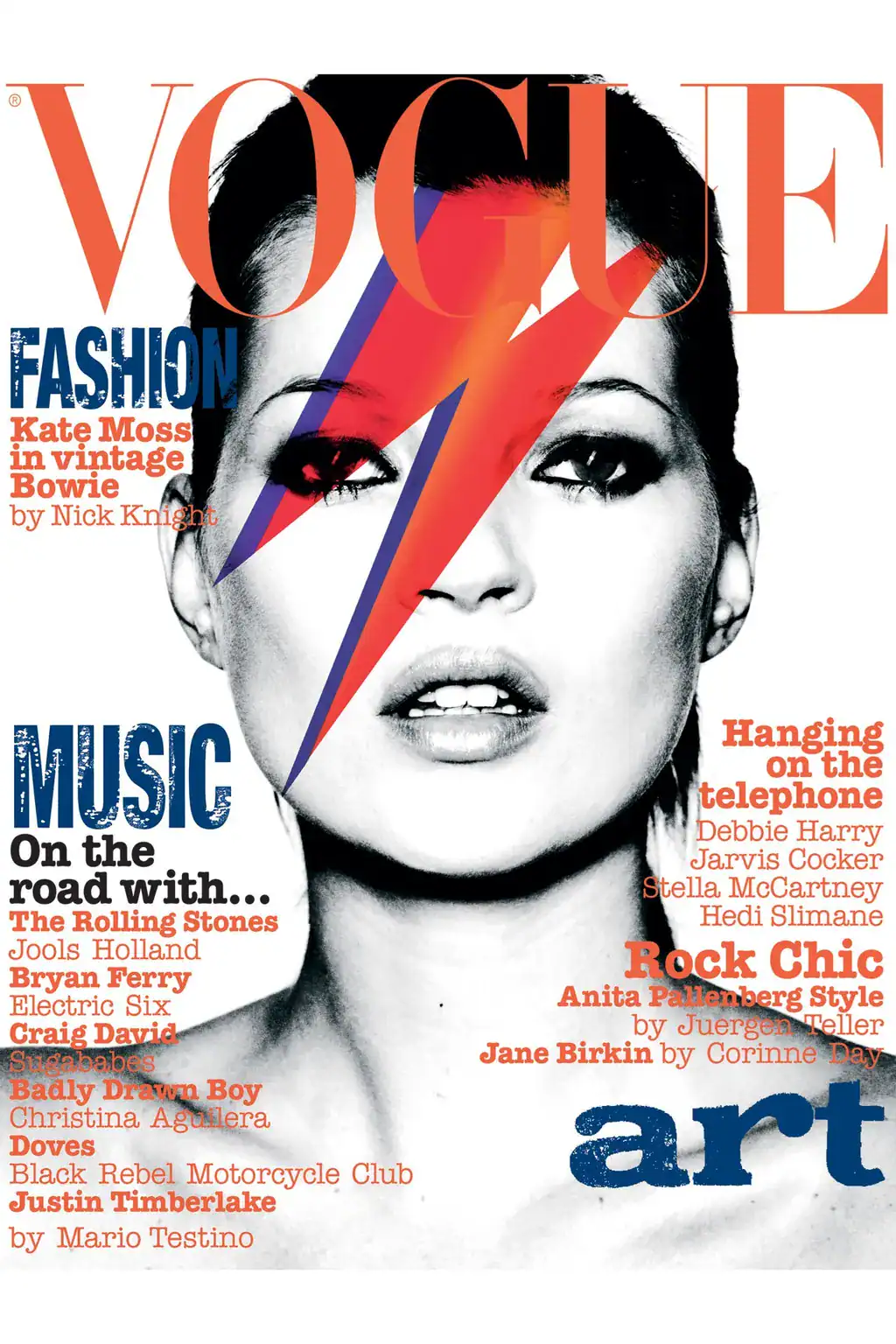
In 2003, Kate Moss wore clothing from Bowie’s archive for a feature photographed by Nick Knight for the May issue of British Vogue. Bowie’s official website publicised the feature and identified Hudson as the designer of the black waistcoat and trousers from 1976.
The magazine cover shown here presents Moss with an Aladdin Sane-inspired lightning bolt. The photographs of her wearing Hudson’s waistcoat and trousers appeared inside the issue.
The change of wearer invites a new reading of the silhouette. Clothing associated with a male stage character was presented on a female model while retaining its recognisable relationship with Bowie. The photographs demonstrate the outfit’s versatility across different bodies and settings; they do not establish a statement by Hudson about the original design’s intended meaning.
2009: loss, remembrance and an artistic inheritance
Ola Hudson died on 5 June 2009, aged 62, after suffering from lung cancer. Slash publicly paid tribute to her warmth, creativity and importance in his upbringing. His statement described exposure to music and other art forms as a central part of what she had given him.
Slash remembers Ola Hudson
“She really was all things artistic and creative personified”
— Slash, public statement reproduced by Blabbermouth, 9 June 2009.
The tribute brings the different sides of her life together without requiring them to be identical. The mother who introduced her son to creative expression was also a working designer with her own clients, training and ambitions. A family memory can illuminate that wider personality while remaining distinct from a professional credit.
2013 and after: recognising the designer in Bowie’s archive

The David Bowie is exhibition, which opened at the V&A in 2013, placed stage clothing within a broader account of Bowie’s creative work. Contemporary coverage identified Hudson’s Thin White Duke outfit among the objects through which visitors could encounter his changing appearance.
An exhibition makes a different kind of attention possible. Onstage, clothing is experienced through performance and distance. Display allows viewers to consider construction, scale and the garment’s physical existence. It can also restore a designer’s name to something that audiences previously recognised only through the person who wore it.
Legacy: giving Ola Hudson her place in the story
Her position also complicates a familiar way of telling rock history. The performer stands at the centre of the image, but the image carries the work of people whose names are less frequently repeated. When Hudson is named, the Thin White Duke becomes more than another example of Bowie’s ability to change. It also becomes evidence of a collaboration with a designer whose own artistic experience mattered.
As a Black American woman working in fashion and entertainment, Hudson belongs in histories that extend beyond Bowie scholarship. Recognising that place does not require inventing a political statement for a particular garment or claiming that every aspect of her career has been recovered. It begins with accurately identifying what she made and considering her work within the broader record of creative labour.
Her family relationships remain important, but they need not define the limits of her identity. She can be remembered as Slash’s mother and as Bowie’s partner while also being recognised as an artist whose professional contribution survives independently of those descriptions. The different aspects of her life add depth when they are allowed to coexist.
Within DavidBowieWorld.com’s collaborators archive, Hudson therefore belongs among the people who directly helped give Bowie’s work its visible form. Her place is secured by the surviving evidence, and her legacy becomes clearer each time the clothes are accompanied by the name of the woman who designed them.
Official Website & Further Information
A dedicated official website for Ola Hudson has not been verified for this article. The resources below provide further information about her clothing, film work and place in Bowie’s creative history.
The British Film Institute’s programme notes for The Man Who Fell to Earth reproduce the film’s production credits. They offer a useful starting point for distinguishing Hudson’s suits for Bowie from May Routh’s overall costume-design role.
David Bowie’s official website documents the 2003 Vogue feature and names Hudson in connection with the 1976 waistcoat and trousers. The V&A’s Bowie collection resources provide broader context for the artist’s clothes, images and collaborative working methods.
For a family-archive perspective, Paul Gorman’s illustrated account of Ola Hudson includes material supplied by Ash Hudson. The photographs and sketches are valuable research references; their appearance online should not be taken as permission to reproduce them. Together, these resources support further investigation while keeping the evidence attached to the people and institutions presenting it.
Article Origin
This article has been researched and written for DavidBowieWorld.com as part of its archive of David Bowie’s collaborators and creative circle. Its account of Ola Hudson’s work draws on published production credits, Bowie’s official archive reporting, museum interpretation, documented family recollections and research incorporating material from the Hudson family archive.
The article also includes visual interpretation of clothing and performance. Such passages discuss how a silhouette, a contrast or a screen image can be understood by a viewer. They are not presented as undocumented statements of Hudson’s intentions. Personal recollections are attributed to their speakers, and the short quotations retain a clear connection with their published sources.
No direct contribution from Ola Hudson or her family to this particular DavidBowieWorld.com article is claimed. Material shared with another researcher remains credited through that published work. Future additions should be based on identifiable evidence, with careful attention to dates, garment attribution and the difference between professional documentation and memories of private life.
© DavidBowieWorld.com — David Bowie Collaborations & Creative Circle Archive.
