
Giorgio Moroder – Producer of David Bowie’s Cat People
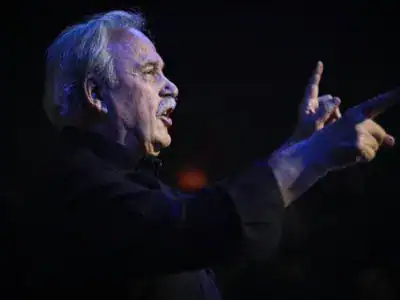
Photograph: Andy Witchger / Wikimedia Commons / CC BY 2.0. Editorial use.
Giorgio Moroder is an Italian composer, songwriter, producer and electronic music pioneer whose work helped transform disco, film music and modern dance production. His collaboration with David Bowie produced one of Bowie’s most dramatic soundtrack recordings: Cat People (Putting Out Fire), written for Paul Schrader’s 1982 film Cat People.
Moroder composed and produced the original soundtrack version, while Bowie wrote the lyrics and delivered one of the most intense vocal performances of his early 1980s career. Recorded in Montreux, Switzerland, the song combined cinematic atmosphere, slow-burning tension and rock power in a way that differed sharply from Bowie’s later re-recording for Let’s Dance.
Although their collaboration was brief, it stands as an important moment in Bowie’s transition between Scary Monsters and his global commercial breakthrough with Let’s Dance. It also connected Bowie with one of the most influential producers in modern popular music, a figure whose electronic innovations had already reshaped the sound of the late twentieth century.
- Full name: Giovanni Giorgio Moroder
- Born: 26 April 1940, Ortisei, South Tyrol, Italy
- Profession: Composer, songwriter, producer and electronic music pioneer
- Bowie connection: Composer and producer of Cat People (Putting Out Fire)
- Bowie contribution: David Bowie wrote the lyrics and sang the original soundtrack version
- Recording location: Mountain Studios, Montreux, Switzerland
- Film connection: Theme song for Paul Schrader’s Cat People (1982)
Early Life and Musical Beginnings
Giorgio Moroder was born Giovanni Giorgio Moroder on 26 April 1940 in Ortisei, a town in the South Tyrol region of northern Italy. Growing up in a multilingual Alpine environment, he developed an early interest in music and began performing as a guitarist and bassist before moving into songwriting, production and studio work.
During the 1960s Moroder worked across Europe as a touring musician and recording artist. He gradually settled in Munich, where he began developing the production methods that would eventually make him one of the most influential figures in electronic popular music.
His early recordings under the name Giorgio brought him European chart success, including the 1969 single Looky Looky. Although these early pop records were far removed from the futuristic productions that later made him famous, they gave Moroder valuable experience as a performer, songwriter and studio craftsman.
Electronic Innovation and Donna Summer
Giorgio Moroder‘s international breakthrough came during the 1970s through his work with Donna Summer and lyricist Pete Bellotte. Together they created a series of recordings that changed the direction of disco and electronic music, including Love to Love You Baby, I Feel Love, Hot Stuff and Bad Girls.
The 1977 recording I Feel Love became especially important. Built around sequenced synthesizer patterns and a relentless electronic pulse, it pointed far beyond disco toward the future of synth-pop, techno, house music and electronic dance music. The record was widely admired by musicians interested in the possibilities of technology, including artists working far outside the disco world.
By the end of the 1970s Moroder had become one of the defining producers of the decade. His Munich-based studio work showed that electronic sound could be sensual, emotional, commercial and radically modern at the same time.
From Disco Pioneer to Hollywood Composer
While Giorgio Moroder‘s influence on popular music continued to grow, he increasingly expanded into film composition. His ability to combine memorable melodies with electronic textures made him one of Hollywood’s most sought-after soundtrack composers during the late 1970s and early 1980s.
His breakthrough film score came with Midnight Express (1978), for which he won the Academy Award for Best Original Score. Further success followed with films including American Gigolo (1980), Cat People (1982), Flashdance (1983), Scarface (1983), The NeverEnding Story (1984) and Top Gun (1986). Throughout this period Moroder demonstrated that electronic instruments could create music that was both emotionally powerful and commercially successful.
His growing reputation attracted collaborations with many of the world’s biggest artists, including Donna Summer, Blondie, Philip Oakey, Freddie Mercury, Elton John, Barbra Streisand, Cher and, in 1981, David Bowie.
Giorgio Moroder on recording with David Bowie
“It was one of my easiest, fastest and greatest recordings ever.”
Creating Cat People (Putting Out Fire)
In 1981 director Paul Schrader invited Giorgio Moroder to compose the soundtrack for his remake of Cat People. Moroder completed much of the score before turning his attention to the film’s title song. Looking for an artist capable of capturing the mysterious and sensual atmosphere of the film, he approached David Bowie.
Moroder composed the music before sending the instrumental track to Bowie, who immediately recognised its dramatic potential. Bowie wrote an entirely new lyric inspired by the themes of transformation, desire and hidden danger that run throughout the film. The result became Cat People (Putting Out Fire), one of the darkest and most theatrical recordings of Bowie’s early 1980s output.
The recording session took place at Mountain Studios in Montreux, Switzerland, where Bowie was then living. According to Moroder, Bowie arrived fully prepared, having already completed the lyrics. The vocal was recorded in only a handful of takes, making it one of the quickest recording sessions Moroder ever experienced.
The recording also featured drummer and percussionist Keith Forsey, one of Giorgio Moroder‘s regular musical collaborators. Forsey would later become an important member of David Bowie’s own creative circle, contributing to several of Bowie’s major recordings during the 1980s. His presence on Cat People forms another link between Moroder’s world and Bowie’s evolving sound of the decade.
Released in 1982, Cat People (Putting Out Fire) became one of the highlights of both the soundtrack album and Bowie’s catalogue. Rather than following contemporary pop trends, the recording built its drama slowly, beginning with sparse percussion, synthesised textures and an atmosphere of suspense before erupting into one of Bowie’s most powerful vocal climaxes.
Moroder deliberately avoided filling every musical space. The restrained arrangement allowed Bowie’s voice to dominate the recording, creating an intensity that perfectly matched the psychological tension of Schrader’s film. The combination of electronic atmosphere, cinematic pacing and explosive rock dynamics gave the song a character unlike almost anything else released in 1982.
Although written specifically for the film, Cat People quickly developed a life beyond the cinema and became recognised as one of the finest soundtrack collaborations of Bowie’s career.
Two Versions, Two Interpretations
Although the original soundtrack version of Cat People (Putting Out Fire) was highly acclaimed, David Bowie decided to revisit the song only a year later while recording Let’s Dance with producer Nile Rodgers.
The 1983 version, included on Let’s Dance, featured a faster tempo, a brighter production and a far more conventional rock arrangement. Guitarist Stevie Ray Vaughan added powerful blues-influenced lead guitar, while Rodgers reshaped the song into something that better suited Bowie’s new commercial direction.
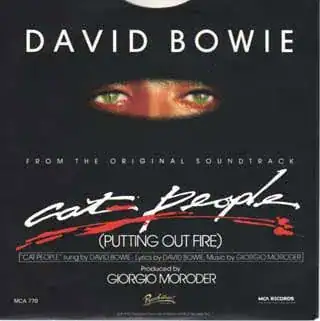
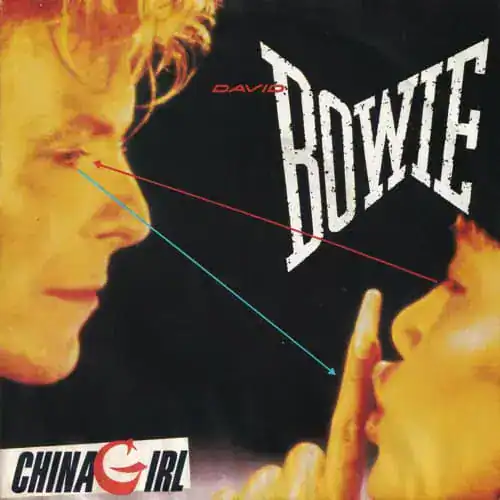
Although Bowie preferred to reinterpret many of his older songs throughout his career, many listeners and critics continue to regard Giorgio Moroder‘s original soundtrack recording as the definitive version. Its gradual build-up, dramatic atmosphere and cinematic production remain unique within Bowie’s catalogue.
The two recordings perfectly illustrate how the same composition could be transformed by different producers. Moroder emphasised suspense, space and emotion, while Nile Rodgers focused on rhythm, clarity and commercial energy. Together they demonstrate Bowie’s remarkable ability to reinterpret his own work without losing its essential identity.
The Montreux Connection
The recording of Cat People also occupies an important place within David Bowie’s wider career. During his time at Mountain Studios in Montreux he renewed friendships with members of Queen, who were also recording there. Those meetings would soon lead to one of the most celebrated collaborations in rock history: Under Pressure, recorded later in 1981 with Freddie Mercury, Brian May, Roger Taylor and John Deacon.
Although the sessions for Cat People and Under Pressure were separate recordings, they belong to the same remarkably productive period in Bowie’s career and underline how significant Montreux had become as a creative base during the early 1980s.
A Song Rediscovered
Nearly three decades after its original release, Moroder’s version of Cat People (Putting Out Fire) found a new audience when director Quentin Tarantino used it in his 2009 film Inglourious Basterds. Rather than placing the song over the end credits, Tarantino built one of the film’s most memorable sequences around Bowie’s recording, introducing it to an entirely new generation of cinema audiences.
Tarantino later explained that he had always admired the song and believed it deserved a far more prominent place within a film than it had originally received. The scene became one of the defining musical moments of Inglourious Basterds and further cemented the enduring reputation of Bowie’s collaboration with Moroder.
Giorgio Moroder‘s Place Within Bowie’s Creative Universe
Although Giorgio Moroder and David Bowie worked together on only one original composition, its impact has proved remarkably enduring. Cat People (Putting Out Fire) remains one of Bowie’s finest soundtrack recordings and one of the most successful fusions of cinematic storytelling and popular music produced during the early 1980s.
Moroder’s pioneering use of electronic production techniques complemented Bowie’s willingness to experiment with new musical forms. Their collaboration united two artists who constantly looked towards the future, creating a recording that still sounds powerful, dramatic and unmistakably original more than four decades after its release.
Legacy
Giorgio Moroder‘s influence reaches far beyond disco. His pioneering work with synthesizers, sequencers and electronic production techniques helped shape the future of popular music, influencing generations of artists working in synth-pop, new wave, electronic dance music and contemporary film composition.
His collaboration with David Bowie remains one of the defining moments of Bowie’s early 1980s career. Although they worked together only once, Cat People (Putting Out Fire) demonstrated how two visionary artists from different musical backgrounds could create something timeless by combining cinematic storytelling, electronic innovation and powerful songwriting.
Soon after working with Bowie, Moroder completed his celebrated restoration and contemporary soundtrack for Fritz Lang’s Metropolis (1984). Bowie later revealed that he had long hoped to create a new musical interpretation of the silent film himself, making Moroder’s project an intriguing parallel in the creative histories of both artists.
More than forty years after its release, the original soundtrack recording continues to be celebrated by Bowie fans, film historians and music critics alike as one of the finest soundtrack collaborations of its era.
Official Website & Further Information
Giorgio Moroder continues to compose, perform and appear at concerts and special events around the world. His pioneering work in electronic music and film composition remains hugely influential, and his official website documents both his remarkable career and his latest projects.
For more information about Giorgio Moroder‘s music, film scores and current activities, please visit his official website: www.giorgiomoroder.com
Article Origin
This article has been researched and written for DavidBowieWorld.com as part of the site’s ongoing project documenting the musicians, producers, artists and creative collaborators who helped shape David Bowie’s extraordinary career. It is based on documented historical research, published interviews, official releases and contemporary accounts relating to Giorgio Moroder, David Bowie and the creation of Cat People (Putting Out Fire).
