
Clare Shenstone & David Bowie | Artist, Friend, Berlin Witness and Heroes Connection
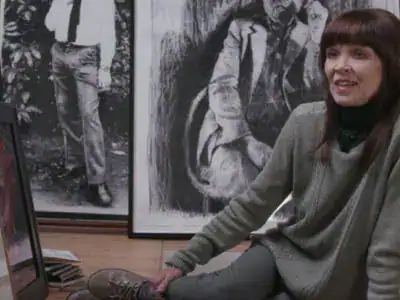
Photo: Unknown photographer / Wikimedia Commons / Unknown (editorial use)
Clare Shenstone is an English artist, former actress and long-time friend of David Bowie. Her Bowie connection belongs to the private and artistic side of his life rather than to the conventional world of studio credits or stage performances.
Shenstone knew Bowie before he became a global star, witnessed his 1970 marriage to Angela Barnett, visited him in Berlin during the Low period, painted members of his private world and later became linked to one of the most evocative images associated with “Heroes”: the dream of swimming with dolphins.
- Name: Clare Noel Shenstone
- Born: 27 October, late 1940s or early 1950s, Essex, England
- Profession: Artist, painter and former actress
- Bowie connection: Long-time friend, early witness, Berlin visitor and artistic confidante
- Important Bowie moment: Witness at Bowie and Angela Barnett’s wedding in 1970
- Berlin connection: Visited Bowie in Berlin during the Low period
- Known for: Portraits, cloth heads, Francis Bacon studies and paintings connected with Bowie and Iman
An artist close to Bowie’s private world
Clare Shenstone’s importance in David Bowie’s story is not based on a conventional musical collaboration. She did not play on Bowie’s records, produce his albums or appear as a public member of his creative team. Her importance lies elsewhere: in friendship, trust, art, memory and the private emotional landscape around Bowie during several key periods of his life.
She belongs among the rare Bowie figures whose influence is difficult to measure through credits but impossible to ignore once the personal history is understood. Shenstone knew Bowie as David Jones as well as David Bowie, and that distinction matters. She encountered him before the full machinery of fame had transformed his life.
Meeting David Bowie before fame
Shenstone first came into Bowie’s circle in the late 1960s. Her brother Simon had met Calvin Lee, who then introduced Clare to David. She later recalled being taken to see Bowie perform at Beckenham College, where he sang his own songs in a small room for a modest audience.
Her memory of that early performance is important because it captures Bowie before superstardom: talented, natural, ambitious and still close to the ordinary world of small rooms, family houses and local performances. After that meeting, Bowie invited her back to his house, where she met members of his family, including his half-brother Terry Burns and his mother Margaret.
John Jones, Hermione and a vulnerable young Bowie
Shenstone’s early friendship with Bowie deepened around a painful moment in his life. After the death of Bowie’s father, John Jones, Bowie asked her to come back to the family house after the funeral. She later remembered sitting with him in his room while he spoke about grief, ambition and the emotional impact of Hermione Farthingale leaving him.
This places Shenstone close to Bowie at a time when he was still forming himself, both personally and artistically. It also shows why her role should be described carefully. She was not a public collaborator, but she was present in the human life underneath the emerging Bowie identity.
Witness at Bowie and Angela Barnett’s wedding
One of Shenstone’s clearest documented places in Bowie history is her role as a witness at the wedding of David Bowie and Angela Barnett in 1970. Bowie and Angela arrived at her flat shortly before the wedding and asked whether they could stay the night and whether she would accompany them to the registry office as a witness.
Shenstone agreed, bought Angela flowers and attended the ceremony. Bowie’s mother Margaret was also present as the other witness. This moment gives Shenstone a direct place in one of the defining private events of Bowie’s early adult life.
Angela Bowie and the early image-making years
Shenstone also knew Angela during the early phase of Bowie’s career. She later described Angela as strong, energetic and important to the practical and visual development of Bowie’s early public image. In Shenstone’s memory, Bowie and Angela were not simply a conventional romantic couple; they were also a partnership that helped Bowie move forward professionally.
This observation is valuable because it comes from someone close enough to see the early household and social world around Bowie before the Ziggy Stardust explosion made those relationships part of a larger public mythology.
Theatre, performance and identity
Before focusing fully on visual art, Shenstone had trained and worked as an actress. Her background included theatre and classical performance, including work connected with the Royal Shakespeare Company. That theatrical experience gave her a natural understanding of role-playing, stage presence, discipline and emotional transformation.
Bowie’s own development drew deeply on theatre, mime, costume, voice, gesture and constructed identity. Shenstone and Bowie did not use these tools in the same way, but both understood that art could involve entering a role while also revealing something hidden beneath it.
From acting to painting
Shenstone eventually placed painting at the centre of her life. She studied at Central School of Art and Design, Chelsea School of Art and the Royal College of Art. Her work became associated with portraits, cloth heads, psychological intensity and a deep interest in the emotions beneath the visible surface of a person.
Her artistic language is relevant to Bowie because she was not simply a social friend. She was someone who understood image, mask, vulnerability and transformation as serious artistic concerns. Those same concerns run throughout Bowie’s work, from Ziggy Stardust to The Man Who Fell to Earth, from Berlin to Outside and Blackstar.
Francis Bacon and artistic recognition
Shenstone’s career as an artist gained major validation when Francis Bacon encountered her work at her Royal College of Art degree exhibition and bought one of her cloth heads. Bacon later commissioned her to make a cloth head portrait of himself, and Shenstone went on to produce a series of studies of him.
Bacon became a mentor and close friend. This is important because it places Shenstone within a serious British art context rather than reducing her to a footnote in Bowie’s private life. She was an artist of substance in her own right, connected not only to Bowie but also to one of the most important painters of the twentieth century.
Bowie, Bacon and visual influence
Shenstone later discussed Bowie’s interest in visual art, including his awareness of painters such as Francis Bacon and Damien Hirst. She was cautious about making simple claims, but she recognised that certain visual devices in Bowie’s later work could be read in relation to wider modern art imagery, including Bacon-like enclosed spaces and references to flesh, bodies and containment.
This makes her a useful witness to Bowie’s visual imagination. She could speak about him not only as a friend but also as a painter thinking about another artist’s eye.
Berlin, 1976
One of the most important episodes in Shenstone’s Bowie story took place in Berlin in 1976. Bowie contacted her in London and asked her to come to Berlin. According to Shenstone, Coco Schwab also made clear that Bowie needed her presence. At the time, Shenstone had recently begun at the Royal College of Art while also working at night with the Royal Shakespeare Company, but she travelled to Berlin as soon as she could.
Bowie met her, drove her back to the flat and spoke about his troubles. He then played her Low and talked about Kraftwerk, Brian Eno and Iggy Pop. This places Shenstone at the edge of one of Bowie’s most important creative transitions: the movement away from the chaos of the mid-1970s and toward the radical new sound-world of the Berlin period.
Low and the private listening moment
The fact that Bowie played Low to Shenstone is highly significant. Low was not just another album; it marked a profound shift in Bowie’s language, mood and creative method. Its fragmented songs and instrumental pieces reflected emotional dislocation, recovery, European electronic influence and collaboration with Brian Eno and Tony Visconti.
Shenstone’s memory of hearing the album from Bowie himself gives her a rare position as a private witness to the Berlin transformation. She was not one of the musicians who made the record, but she was present close to the moment when Bowie was beginning to understand and share what he had created.
Coco Schwab, Iggy Pop and the Berlin circle
During the Berlin visit, Shenstone encountered part of Bowie’s inner circle. Coco Schwab was present, and Iggy Pop was staying at the flat. Bowie, Coco and Clare also went out together in Berlin, including an evening at a club where performers staged a private cabaret for Bowie and his companions.
This episode shows that Shenstone was not merely a distant acquaintance. She was someone Bowie could call into his private world during a period of illness, low mood and creative change. Her presence belongs to the human history behind the Berlin mythology.
The dolphin dream and Heroes
Clare Shenstone is also connected with one of the most discussed images associated with “Heroes”. She later recalled that during a day with Bowie in Berlin, Bowie asked whether she dreamed about him because he dreamed about her. She told him about a dream in which she was swimming with dolphins.
The lyric “I wish you could swim like the dolphins can swim” has often been discussed in connection with that memory. This should be handled carefully. Shenstone’s recollection does not mean that every part of “Heroes” can be reduced to one private conversation. The song has multiple layers, including Berlin, the Wall, lovers, danger, defiance and myth. But Shenstone’s dolphin dream is a credible and meaningful part of the song’s background.
Walking by the Wall
In the same recollection, Shenstone described spending a day with Bowie in Berlin, walking by the Wall and going through Checkpoint Charlie to the East. This matters because “Heroes” is inseparable from Berlin’s geography and atmosphere.
The famous story of lovers by the Wall has its own well-known history, but Shenstone’s memory adds another private layer to Bowie’s Berlin life: conversation, dreams, walking, borders and the strange emotional charge of a divided city.
Not the sole meaning of Heroes
It is important not to overstate Shenstone’s role in “Heroes”. She should not be presented as the sole subject of the song or as the only source of its imagery. Bowie’s songwriting often combined personal memory, observation, literary ideas, sound, accident and emotional instinct.
The safest and most historically honest description is that Shenstone later identified her dolphin dream and a day in Berlin with Bowie as part of the background to the song’s imagery. That makes her connection important without turning a complex Bowie masterpiece into a single-source anecdote.
Painting Bowie and Iman
Shenstone’s later connection with Bowie also included visual art. She painted and drew figures in Bowie’s world, including Iman. She described wanting to paint Iman and remembered sittings in London and at her studio. Bowie and Iman owned works by Shenstone, including images connected with Francis Bacon and Iman.
This gives the relationship an artistic dimension beyond friendship. Shenstone was not simply someone from Bowie’s past. She remained someone whose art entered the private world Bowie shared with Iman.
The fiftieth birthday book
In 1996, Iman contacted Shenstone about a personal project for Bowie’s fiftieth birthday. She sent Japanese paper to Bowie’s special friends and asked them to create a page that could be bound into a book for him.
Shenstone responded by preparing a painted head image and a personal message for Bowie. She also included a small photograph connected with the 1969 Free Festival. This episode shows the lasting personal connection between Shenstone and Bowie’s inner circle decades after their first meetings.
Discretion and privacy
One reason Clare Shenstone has remained a relatively mysterious Bowie figure is that she did not turn her closeness to Bowie into a public career. Even when writers sought her story, she was cautious about how much she wanted to tell.
That discretion is part of her importance. Like Coco Schwab, Shenstone belonged to the private Bowie world rather than the public publicity machine. Her value lies partly in the fact that she protected the personal reality behind the famous image.
What she adds to the Bowie story
Clare Shenstone adds a different kind of depth to Bowie history. Through her, we see Bowie before fame, Bowie at his wedding, Bowie in grief, Bowie in Berlin, Bowie listening to and talking about Low, Bowie moving through the city that would help reshape his music, and Bowie remembered by someone who understood both art and performance.
Her story also reminds us that Bowie’s creative life was not built only by famous collaborators. It was also shaped by people who offered conversation, memory, honesty, friendship and artistic sensitivity at moments when he needed more than professional help.
Place within Bowie’s universe
Within David Bowie’s universe, Clare Shenstone should be understood as an artist, witness and trusted friend rather than as a conventional collaborator. Her importance is not found in album credits but in the private architecture of Bowie’s life.
She stands close to several essential Bowie moments: the pre-fame period, the 1970 marriage, the Berlin transformation, the emotional landscape around Low and the imagery associated with “Heroes”. That makes her a significant figure in Bowie’s wider story.
Legacy
Clare Shenstone’s legacy is twofold. As an artist, she belongs to a serious visual tradition connected with portraiture, psychological depth and the influence of Francis Bacon. As a Bowie figure, she belongs to the intimate, largely hidden history behind the public mythology.
Her place on this site is therefore justified not because she was a musician, producer or performer in Bowie’s band, but because she witnessed and shaped parts of the human world from which Bowie’s art emerged. For a collection about Bowie’s collaborators, friends and artistic connections, that is a meaningful and historically grounded role.
