
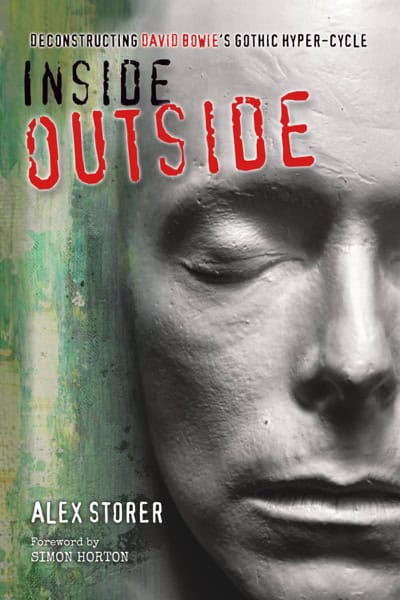
Inside Outside: Deconstructing David Bowie’s Gothic Hyper-Cycle
Author: Alex Storer Category: 1994–1996, Album 1. Outside, Brian Eno, Colleagues, Memories, studio albums Publisher: Independently published Published: July 17, 2026 ISBN-13: 9798184078618 Pages: 184 Country: United Kingdom Language: English Dimension: 15.24 x 1.12 x 22.86 cm File Size: PaperbackInside Outside: Deconstructing David Bowie’s Gothic Hyper-Cycle
Alex Storer’s Deep Exploration of David Bowie’s 1. Outside
Inside Outside: Deconstructing David Bowie’s Gothic Hyper-Cycle is the first book devoted entirely to one of the most ambitious, complex and still debated projects of David Bowie’s career: the 1995 album 1. Outside.
Written by artist, musician and Bowie researcher Alex Storer and published on 16 July 2026, the book reconstructs the extraordinary creative journey that led Bowie from his early-1990s artistic reawakening to the experimental sessions with Brian Eno, the abandoned Leon project, the creation of 1. Outside and the tour that followed.
Storer combines extensive research with archival material and interviews with people connected to the project. He also consulted David Bowie’s surviving notes, lyrics and studio documentation held in the David Bowie archive in London.
The result is not simply an album guide. Inside Outside examines an entire creative period in which Bowie deliberately moved away from the expectations surrounding his past and once again placed experimentation, collaboration and risk at the centre of his work.
David Bowie at the Beginning of the 1990s
To understand 1. Outside, the story has to begin before the album itself.
The beginning of the 1990s found Bowie emerging from a complicated decade. The enormous commercial success of Let’s Dance in 1983 had transformed him into a global stadium star, but the scale of that success eventually became creatively restrictive.
Tin Machine offered one route out.
By placing himself within a working rock band rather than presenting himself exclusively as a solo star, Bowie began dismantling some of the expectations that had accumulated around his name.
His 1993 solo album Black Tie White Noise demonstrated another change. Bowie was once again engaging directly with contemporary music, electronic textures, jazz and experimentation.
The conditions were developing for something considerably more radical.
The Return of Brian Eno
One of the decisive developments was Bowie’s reunion with Brian Eno.
Their earlier collaborations on Low, “Heroes“ and Lodger had become among the most celebrated experimental recordings in Bowie’s catalogue.
But neither man was interested in recreating the 1970s.
When they began working together again in the 1990s, the objective was not nostalgia. They wanted to establish a working environment in which accidents, improvisation and unexpected combinations could generate new material.
This philosophy became fundamental to the sessions that eventually produced 1. Outside.
Montreux and the Birth of a New Project
Bowie and Eno began intensive experimental work at Mountain Studios in Montreux, Switzerland, during 1994.
The musicians entered an unusually open recording environment. Rather than arriving with a conventional collection of completed songs, they improvised extensively and allowed characters, sounds, fragments of dialogue and musical structures to develop together.
Eno employed methods designed to disrupt familiar musical habits.
Musicians could be given roles or instructions intended to make them approach their instruments from unfamiliar perspectives. Bowie responded by improvising lyrics and voices, gradually developing a cast of characters around the music.
The sessions generated a remarkable quantity of material.
And from that material emerged something much larger than an ordinary album.
The Leon Project
At the heart of the story explored by Storer is the project generally known as Leon.
The Montreux improvisations developed into an extended musical and narrative work combining experimental music, spoken dialogue, character voices and fragments of story.
It was unconventional even by Bowie’s standards.
Rather than presenting a conventional sequence of individual songs, the material operated more like an extended sound environment or performance piece.
Bowie and Eno were enthusiastic about what they had created, but releasing such an uncompromising project presented obvious commercial difficulties.
The original conception was therefore transformed.
Elements from the experimental sessions survived, while other material was reshaped into more recognisable songs.
The journey from these sessions to the finished 1. Outside album forms one of the central narratives of Inside Outside.
The Diary of Nathan Adler
Bowie constructed an elaborate fictional world around the music.
At its centre was Detective Professor Nathan Adler, an investigator working for the Art-Crime organisation in a dystopian version of 1999.
Adler investigates the murder of fourteen-year-old Baby Grace Blue, whose body has been transformed into a grotesque work of art.
The investigation introduces a collection of characters including Leon Blank, Ramona A. Stone, Algeria Touchshriek and the mysterious Artist/Minotaur.
Bowie performed the voices of these characters himself.
The narrative deliberately refuses to operate like a conventional detective story. Information arrives through diary fragments, monologues, songs and disconnected observations.
The listener is required to enter Bowie’s world rather than simply follow a linear plot.
Art, Murder and the End of the Millennium
The fictional investigation allowed Bowie to explore questions that increasingly interested him during the 1990s.
Where does art end and transgression begin?
What happens when shock itself becomes an artistic commodity?
Can violence be transformed into art simply because somebody declares it to be art?
These ideas were connected to Bowie’s continuing interest in contemporary visual culture, outsider art, performance and the increasingly unstable relationship between physical and digital identity.
The approaching millennium provided an ideal landscape for those concerns.
Bowie’s imagined 1999 is recognisable but distorted — a world in which technology, ritual, art, identity and violence have begun to merge.
Outside and Outsider Art
The word Outside carries several meanings within the project.
It suggests life outside conventional society, artistic activity outside accepted cultural boundaries and Bowie’s own desire to move beyond the expectations attached to his career.
During this period Bowie was deeply engaged with contemporary art.
Rather than treating visual art as decoration surrounding his music, he increasingly allowed ideas from painting, performance and conceptual art to enter the structure of his musical work.
1. Outside became one of the clearest expressions of that convergence.
Creating 1. Outside
The experimental material ultimately developed into an album containing both conventional songs and narrative segues.
The musical cast included several important Bowie collaborators.
Brian Eno returned as collaborator and creative catalyst, while musicians including Reeves Gabrels, Mike Garson, Carlos Alomar, Erdal Kızılçay, Sterling Campbell and others contributed to the sessions.
The combination was significant.
Alomar represented a connection with Bowie’s work stretching back to the 1970s. Garson brought the distinctive piano language associated with some of Bowie’s most adventurous earlier recordings. Gabrels represented the more recent experimental energy of Tin Machine and Bowie’s early-1990s work.
Rather than returning to a previous Bowie sound, these musicians helped construct something new from different periods of his musical history.
The Songs
Released in 1995, 1. Outside contains some of Bowie’s most powerful recordings of the decade.
Outside establishes the album’s unsettling atmosphere, while The Hearts Filthy Lesson introduces a harsh combination of rock, electronics and industrial textures.
Hallo Spaceboy became one of the album’s most explosive performances.
Elsewhere, I Have Not Been to Oxford Town, The Motel, No Control, We Prick You, Thru’ These Architects Eyes and I’m Deranged move between aggression, melancholy, paranoia and abstraction.
Strangers When We Meet provides one of the album’s most immediately emotional moments.
Between the songs, Bowie’s character pieces keep returning the listener to Nathan Adler’s disturbing investigation.
The Hearts Filthy Lesson
The Hearts Filthy Lesson became the first major public indication of Bowie’s new direction.
Its abrasive production and unsettling atmosphere were dramatically removed from the polished mainstream pop associated with much of his 1980s output.
The accompanying video, directed by Samuel Bayer, pushed the imagery even further through disturbing combinations of ritual, sculpture, decay and performance.
This was clearly not an attempt to recover the audience of Let’s Dance.
Bowie was once again willing to make audiences uncomfortable.
Hallo Spaceboy
Hallo Spaceboy became another important part of the album’s afterlife.
Its relentless rhythm and fragmented lyric made it one of the strongest live pieces from the period.
A later remix created with the Pet Shop Boys transformed the song again and brought it to a wider singles audience.
The connection with Major Tom introduced by that version also created an unexpected dialogue between Bowie’s 1990s work and one of the oldest characters in his catalogue.
The Outside Tour
Bowie took the new material on the road during the Outside Tour of 1995–96.
The concerts were notable for Bowie’s refusal to turn them into conventional greatest-hits performances.
Large sections of the shows concentrated on 1. Outside and other less predictable material.
In North America, Bowie toured with Nine Inch Nails, creating a striking meeting between an artist who had influenced generations of alternative musicians and one of the most important industrial rock acts of the 1990s.
Rather than simply presenting Bowie as the senior star followed by a younger support act, the concerts included a transition in which the two bands and artists overlapped.
The arrangement symbolised something important about Bowie’s position in the 1990s.
He was not interested merely in celebrating his influence on contemporary music. He wanted to participate in it.
An Album That Divided Listeners
1. Outside was never designed to be easy.
Its length, spoken segues, unresolved narrative and dense production divided listeners.
For some, it represented Bowie’s strongest creative resurgence in years.
For others, the concept overwhelmed the songs.
That disagreement has never entirely disappeared.
But the passage of time has changed the context in which the album can be understood. What once appeared deliberately strange now stands as evidence of Bowie once again refusing to behave like an established artist protecting his legacy.
The Unfinished Hyper-Cycle
The title of Storer’s book refers to Bowie’s much larger ambition for the project.
1. Outside was conceived as the beginning of a possible sequence rather than necessarily as an isolated work.
Bowie discussed continuing the narrative and creating further instalments around the approaching millennium.
Those plans were never completed in the form originally imagined.
Instead, Bowie moved rapidly onward. Earthling appeared in 1997 and embraced another set of contemporary musical influences.
The absence of a completed continuation has helped make 1. Outside even more fascinating.
Its story remains deliberately and historically unfinished.
Researching Inside Outside
One of the most important aspects of Alex Storer’s book is the research behind it.
Storer did not approach 1. Outside simply as a fan revisiting a favourite record.
He researched the development of the project, consulted archival sources and interviewed collaborators connected with the period.
His research also took him to the David Bowie archive in London, where he was able to examine surviving notes, lyrics and paperwork connected with the sessions.
That material allows Inside Outside to follow the creative process behind the finished album rather than beginning only with the record that appeared in shops in 1995.
Why Inside Outside Matters
Many Bowie books necessarily move quickly through 1. Outside.
A biography covering more than five decades cannot devote unlimited space to one album, however complicated that album might be.
Storer’s book reverses that approach.
By concentrating entirely on the Outside period, it can investigate the abandoned ideas, collaborators, recording methods, visual concepts, narrative experiments and performances surrounding the album in considerably greater depth.
That makes the book particularly valuable for listeners who have always suspected that the released album represents only one visible section of a much larger creative process.
A Personal Connection
There is also a personal dimension to Storer’s investigation.
He has described the profound effect 1. Outside had on him when it originally appeared, as well as the experience of seeing Bowie perform during the period.
That long fascination ultimately developed into the book.
The album’s thirtieth anniversary in 2025 provided an obvious moment to revisit the project, while 2026 — ten years after Bowie’s death — gave the investigation additional historical perspective.
Historical Importance
Inside Outside arrives at an interesting moment in the reassessment of David Bowie’s later career.
For many years, popular accounts of Bowie concentrated most heavily on the period between Hunky Dory and Scary Monsters.
The extraordinary reception of The Next Day and Blackstar encouraged a broader reconsideration of his later work.
Within that reassessment, 1. Outside occupies an increasingly important position.
It demonstrated that Bowie in his late forties was still prepared to risk confusing his audience, abandon commercially obvious choices and immerse himself in an experimental project whose meaning could not be explained by a single hit song.
That willingness to risk failure was itself one of the qualities that had always distinguished his best work.
Conclusion
Inside Outside: Deconstructing David Bowie’s Gothic Hyper-Cycle is more than a book about the making of an album.
It is an examination of a period in which David Bowie rediscovered the creative value of uncertainty.
The collaboration with Brian Eno, the experimental Montreux sessions, the sprawling Leon material, Nathan Adler’s investigation, the finished 1. Outside album and the confrontational tour that followed all belonged to the same determination to move forward rather than retreat into Bowie’s past.
Alex Storer’s decision to devote an entire book to this single creative cycle allows that story to be examined with a depth impossible in a conventional Bowie biography.
For listeners fascinated by 1. Outside, the Leon sessions and Bowie’s extraordinary mid-1990s resurgence, it documents one of the strangest, darkest and most creatively fearless chapters of his career.
Thirty years later, the murder investigation remains unresolved, the promised cycle remains unfinished and the world Bowie imagined remains disturbing.
Perhaps that is exactly why Outside continues to invite us back inside.
Book information
Title: Inside Outside: Deconstructing David Bowie’s Gothic Hyper-Cycle
Author: Alex Storer
Published: 16 July 2026
Language: English
Subject: David Bowie – 1. Outside, the Leon project and the Outside era
ISBN: 979-8184078618
