
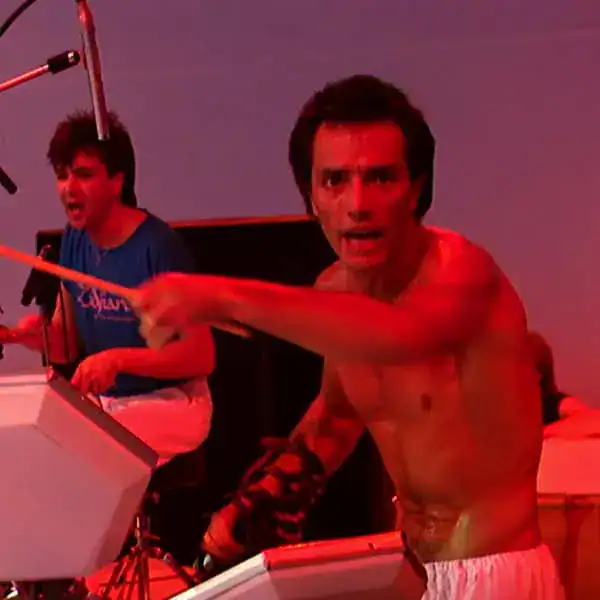
Pedro Ortiz – Percussion at Live Aid 1985
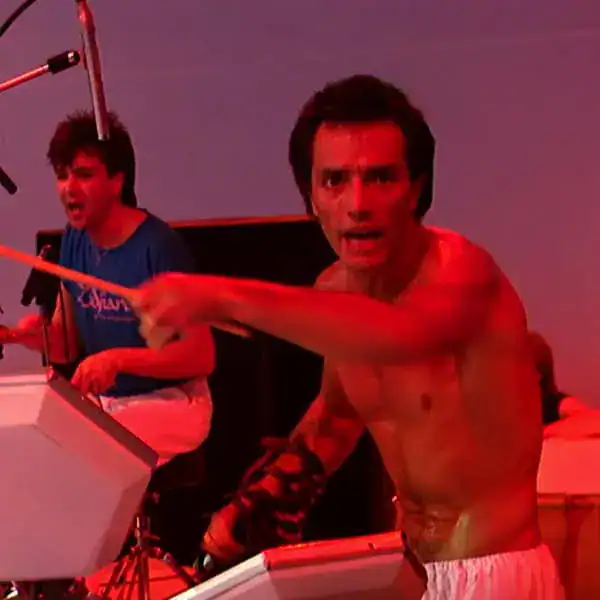
Pedro Ortiz played percussion in David Bowie’s band at Live Aid, held at Wembley Stadium, London, on 13 July 1985. Alongside drummer Neil Conti and bassist Matthew Seligman, he formed part of the rhythm section supporting Bowie’s four-song performance: TVC 15, Rebel Rebel, Modern Love and “Heroes”.
His connection with Bowie also extended to the recording studio. Ortiz contributed percussion to Dancing in the Street, the Bowie and Mick Jagger duet associated with the Live Aid fundraising campaign.
Before appearing at Wembley, Ortiz had already worked in the British rock and post-punk scene. His documented credits include drums and vocals with the Billy Karloff Band and percussion with Shriekback. Recordings with Johnny Thunders and Patti Palladin reveal another side of his session work, connecting his career with musicians exploring older rock and rhythm-and-blues material.
- Name: Pedro Ortiz
- Documented roles: Drummer, percussionist and vocalist
- Bowie live appearance: Live Aid, Wembley Stadium, London, 13 July 1985
- Role at Live Aid: Percussion
- Bowie-related studio recording: Dancing in the Street, David Bowie and Mick Jagger, 1985
- Earlier work: Billy Karloff Band and Shriekback
- Other recording connections: Johnny Thunders, Patti Palladin and Richard Strange & The Engine Room
- Live Aid set: TVC 15, Rebel Rebel, Modern Love, “Heroes”
Early life and the beginning of the documented record
Pedro Ortiz’s early life is less extensively documented than his professional career. His date and place of birth and musical education have not been reliably established for this article. His identifiable recording credits provide a starting point for following his work before his appearance with David Bowie.
The Billy Karloff Band and The Maniac
An early documented credit appears on The Maniac by the Billy Karloff Band. The band’s own presentation of the 1978 album credits Ortiz with drums and vocals, alongside Billy Karloff on vocals, Chris Pye on lead guitar and vocals, Julian on guitar and Ed Duane on bass.
This establishes that Ortiz’s professional background included playing the drum kit, rather than percussion alone. For readers who know him only through Bowie’s Wembley appearance, the distinction broadens the picture: his earlier recorded role placed him within the central rhythm section of a rock band.
The album’s listed material includes The Maniac, TV Personality, Heavy Rock and Relics from the Past. The release belongs to the punk-era part of his documented career, several years before the Shriekback appearances that brought him into a different musical setting.
Shriekback and the move into post-punk percussion
By 1983, Ortiz was performing with Shriekback, the group associated with Barry Andrews, Dave Allen and Carl Marsh. Contemporary music-press coverage named him as the percussionist augmenting the group alongside drummer Martyn Barker.
A February 1983 tour announcement in New Musical Express placed Ortiz within the live line-up assembled around the release of Lined Up and the album Care. The announced itinerary included clubs, colleges and polytechnics, showing the working circuit in which this phase of his career developed.
A subsequent contemporary feature in Record discussed Shriekback’s transition from a studio-centred project to live performance. Ortiz was identified as part of the touring group. The article described a band thinking carefully about rhythm, arrangement and communication with its audience, providing useful context for the musical environment in which he was working.
The relationship between a drummer and an additional percussionist is particularly relevant to this part of his career. The two roles can divide the rhythmic work: a drum kit establishes a framework, while other percussion supplies contrasting attacks, accents and textures. Ortiz would later appear in another ensemble with that division of responsibilities when he played alongside Neil Conti at Live Aid.
Recording with Johnny Thunders and Patti Palladin
Ortiz’s work with Johnny Thunders and Patti Palladin provides a documented connection between the Shriekback period and the records for which he later received percussion credits. Jungle Records identifies him among the musicians on the Crawfish and Tie Me Up sessions recorded at Olympic Studios in 1984.
The personnel named by the label include Jerry Nolan on drums, Billy Rath on bass, John Perry on guitar, John Earle on saxophone and Judd Lander on harmonica. Ortiz’s percussion credit places him within an ensemble drawing on musicians from several overlapping rock backgrounds.
These sessions also illustrate why recording dates and release dates need to be kept separate. Tie Me Up subsequently appeared on Thunders’ Que Sera, Sera in 1985, while Crawfish became part of the 1988 Thunders and Palladin album Copy Cats. Their later release history does not mean that the original performances were recorded after Live Aid.
Entering Bowie’s 1985 musical circle
The documented Bowie connection includes Dancing in the Street, recorded with Mick Jagger during preparations for Live Aid. The recording involved musicians whose names would also appear in Bowie’s Wembley ensemble, including Kevin Armstrong, Matthew Seligman, Neil Conti, Tessa Niles and Helena Springs.
Dancing in the Street: the studio contribution
The Bowie–Jagger version of Dancing in the Street reworked the Motown song written by Marvin Gaye, William Stevenson and Ivy Jo Hunter. The project was conceived for the Live Aid cause, with the two singers eventually recording together in London rather than attempting a simultaneous transatlantic performance.
The 2025 anniversary release announcement identifies Westside Studios and 29 June 1985, with Clive Langer and Alan Winstanley involved in production. Winstanley’s account published that November is especially valuable for Ortiz’s biography because it discusses his actual contribution to the recording rather than merely reproducing a general personnel list.
Winstanley described Ortiz arriving with an extensive collection of equipment. His account says that the parts ultimately used included bells and tambourine. It also identifies Ortiz as the source of the finger whistle heard at the beginning, which was treated with stereo placement and repeats.
Alan Winstanley on Pedro Ortiz’s finger whistle
“He also did that whistle at the beginning with his fingers”
— Alan Winstanley, interviewed by Tony Horkins, International Musician & Recording World, November 1985. Excerpt.
From the recording studio to the Live Aid broadcast
Following the recording, Bowie and Jagger made the promotional film with David Mallet in London’s Docklands. The anniversary announcement describes the recording and filming as a rapidly completed undertaking, with the two performers moving from the studio to the video location.
For Live Aid, the duet reached the audience as a filmed recording. It was not part of the four songs Bowie’s band played live at Wembley. Ortiz contributed to the studio recording and then appeared separately with Bowie’s live ensemble.
The single’s subsequent success extended the reach of the project beyond the concert itself. It spent four weeks at number one in the United Kingdom and reached number seven in the United States. For Ortiz, the recording credit therefore connects his work with both the benefit campaign and a widely circulated commercial release.
Assembling Bowie’s Live Aid band
Bowie’s Wembley ensemble was assembled for the occasion rather than simply reproducing the line-up of an earlier world tour. Kevin Armstrong and Thomas Dolby have both described their involvement in bringing musicians together while Bowie was occupied with filming Labyrinth.
In a published interview, Armstrong explained that the selection drew on friends and musicians with whom he was already working. He named Dolby, Seligman and Clare Hirst, and connected Neil Conti’s involvement with the Prefab Sprout circle. His account describes a practical network of existing musical relationships.
Kevin Armstrong on assembling the band
“It was just a selection of friends and people who I was working with at that time”
— Kevin Armstrong, interview with David Bowie News, October 2021. Excerpt.
Rehearsals and Bowie’s changing choice of songs
Dolby’s recollections describe a short preparation period and a set list that changed as the scale of Live Aid became clearer. He recalled Bowie initially considering his current single, Loving the Alien, before moving towards songs suited to a large shared occasion.
Bowie fitted rehearsals around his film commitments. Dolby remembered an encouraging atmosphere, describing Bowie as a welcoming presence in the rehearsal room.
Thomas Dolby on rehearsing with Bowie
“He was a perfect gentleman. He would just walk into the room and shine.”
— Thomas Dolby, interview with The Giving Arts.
Wembley Stadium, 13 July 1985
Live Aid took place on Saturday, 13 July 1985, with its principal concerts at Wembley Stadium in London and John F. Kennedy Stadium in Philadelphia. Organised by Bob Geldof and Midge Ure, the event raised funds for famine relief in Ethiopia and was broadcast internationally.
Ortiz appeared with Bowie at the London concert. The official Live Aid presentation of Bowie’s performances identifies Wembley’s audience as approximately 72,000. The international broadcast carried the performance far beyond the people inside the stadium.
The band comprised Bowie on lead vocals, Armstrong on guitar, Seligman on bass, Conti on drums, Ortiz on percussion, Hirst on saxophone, Dolby on keyboards, and Niles and Springs on backing vocals. The line-up brought together rock instrumentation, keyboards, saxophone, supporting voices and a separate percussion role.
The rhythm section: Neil Conti, Matthew Seligman and Pedro Ortiz
The personnel distinction between Neil Conti on drums and Pedro Ortiz on percussion is essential. Although the drum kit belongs to the percussion family, the concert credits identify two separate positions within the ensemble. Describing both musicians simply as drummers obscures that arrangement.
Seligman’s bass completed the core rhythmic partnership. A useful way to approach such an ensemble is to listen for the relationship between low-frequency movement, the main drum pattern and higher or contrasting percussion sounds. In the full-band broadcast mix, individual percussion sounds can overlap with the drum kit and other instruments.
TVC 15: the opening number
Bowie opened with TVC 15, originally released on Station to Station in 1976. Choosing it placed a song from his mid-1970s catalogue at the beginning of a set that would span several periods of his career.
The opening also provides a useful starting point for following the band through the complete set. Listening in sequence preserves the programme Bowie actually presented, instead of allowing the fame of the closing “Heroes” performance to eclipse the earlier songs.
Rebel Rebel: a second period of Bowie’s catalogue
The second song was Rebel Rebel, first released as a single in 1974 and subsequently included on Diamond Dogs. Its recognisable guitar riff brought a different point of reference into the programme after TVC 15.
The song already had a history of different recorded and live treatments before 1985. The official Bowie archive distinguishes the original single from the shorter American version, which incorporated additional elements. That history is a reminder that a familiar title does not imply a single unchanging arrangement.
Modern Love: the most recent song in the set
Modern Love followed as the third number. It came from Let’s Dance, Bowie’s 1983 album produced with Nile Rodgers, and was the most recent of the four songs performed during his principal Live Aid set.
Its inclusion linked the Wembley programme with the commercially prominent early-1980s chapter of Bowie’s career. Following two selections from the 1970s, it brought the set forward to the period of Let’s Dance.
“Heroes”: the closing performance
Bowie concluded his set with “Heroes”, the song credited to Bowie and Brian Eno and first released in 1977. Its position at the end of the programme gave the performance a different context from its original studio setting.
Bowie’s official biographical account recalls the dedication to his son. The wider setting of Live Aid also connected the song with the event’s humanitarian purpose. These circumstances help explain why the Wembley performance is remembered as a distinct moment in the song’s performance history.
Making room for the Ethiopian famine film
After the musical set, the programme turned to film of the Ethiopian famine accompanied by The Cars’ Drive. Bowie’s official archive recounts promoter Harvey Goldsmith’s memory of watching the footage with Bowie before the concert and of Bowie’s insistence that it should be included.
The official account confirms that Bowie gave up a song to make room for the film. His musical performance was therefore followed by footage that brought the purpose of the benefit directly back into focus.
Harvey Goldsmith on the film’s impact
“That was probably one of the most evocative things in the whole show and really got the money rolling in.”
— Harvey Goldsmith, recollection reproduced by DavidBowie.com, 13 July 2025.
For Ortiz’s story, this explains the event in which his appearance took place. The musicians’ performance formed part of a fundraising programme whose purpose extended beyond the presentation of a conventional Bowie concert.
Richard Strange & The Engine Room
Ortiz’s recording history also includes Richard Strange & The Engine Room. Credits associated with Going Gone, released in 1986, identify percussion work, while the track-level documentation for Banco Celestial lists him on drums, percussion and vocals.
The track-level credits show Ortiz contributing in more than one capacity within the project. His work with Strange adds a further recording connection to the period following Live Aid.
Copy Cats and the later release of earlier work
The 1988 album Copy Cats, credited to Johnny Thunders and Patti Palladin, includes Ortiz among its contributing musicians. Published album credits identify tambourine, maracas and percussion among his contributions.
The album revisited material associated with earlier decades of American popular music. Ortiz’s presence connects him with a project whose ensemble included a broad range of instrumental and vocal contributors. The percussion formed part of that broader instrumental palette.
The inclusion of Crawfish connects the album with the earlier Olympic Studios sessions. Ortiz’s credit on the 1988 release therefore preserves part of a recording history that began before Live Aid.
Archival releases and the surviving Shriekback performances
Shriekback’s 3 NYC Shows 83–5 provides an additional archival route into this period of Ortiz’s career. Its published credits name him on percussion, while the collection brings together performances associated with New York venues including Danceteria, the Peppermint Lounge and the Ritz.
The release description explains that the audio was sourced from a bootlegged cassette. That provenance matters when assessing recording quality: an archival performance can preserve valuable musical evidence without offering the clarity of a multitrack studio production.
Pedro Ortiz in Bowie’s collaborative universe
Pedro Ortiz’s contribution belongs to a distinctive moment in Bowie’s career: the studio and live projects surrounding Live Aid in 1985. His work links the Bowie–Jagger charity recording with the ensemble assembled for Wembley, giving him a place in both the recorded and concert history of the event.
His earlier and other credits give that moment a wider professional setting. The Billy Karloff Band, Shriekback, Johnny Thunders, Patti Palladin and Richard Strange represent different projects within a career that cannot be reduced to a single afternoon at Wembley.
Official Website & Further Information
No personal official website or social-media account has been reliably identified for the Pedro Ortiz discussed in this article. Links belonging to other people with the same name are therefore not presented as his official channels.
For the wider history of the Wembley ensemble, continue to the Live Aid All-Star Ensemble page on DavidBowieWorld.com.
First-Hand Contributions
This page draws on published first-hand accounts by Alan Winstanley, Kevin Armstrong, Thomas Dolby and Harvey Goldsmith, alongside documented recording and concert credits.
No direct interview, correspondence or personal contribution from Pedro Ortiz has been used in preparing this version.
Article Origin
This article has been researched and written for DavidBowieWorld.com as part of its David Bowie Collaborations & Creative Circle Archive. It brings together Pedro Ortiz’s documented Live Aid appearance, his contribution to Dancing in the Street and relevant recording history before and after 1985.
© DavidBowieWorld.com — David Bowie Collaborations & Creative Circle Archive.
