
Kansai Yamamoto – David Bowie’s Japanese Fashion Designer

Photo: Unknown photographer / Wikimedia Commons / CC BY-SA 3.0 (editorial use)
Kansai Yamamoto was a Japanese fashion designer whose extraordinary clothes became an important part of David Bowie’s visual world during the early 1970s. His designs are closely associated with Bowie’s Ziggy Stardust and Aladdin Sane period, when costume, make-up, movement and theatrical presentation became central elements of Bowie’s live performances.
Their relationship did not begin as a conventional commission between a rock star and a costume designer. Bowie first wore garments Yamamoto had already created as fashion, including clothing originally designed for women. Yamamoto subsequently saw Bowie performing in his designs and experienced how differently the garments functioned within a rock concert.
The connection developed into direct collaboration, with Yamamoto creating stage clothing for Bowie. His designs combined bold colour, asymmetry, sculptural silhouettes and elements influenced by Japanese visual and theatrical traditions.
Among the best documented pieces associated with Bowie are the Woodland Creatures jumpsuit, the sculptural Tokyo Pop costume and an asymmetric one-shoulder knitted ensemble.
- Full name: Kansai Yamamoto
- Japanese name: 山本寛斎
- Born: 8 February 1944, Yokohama, Japan
- Died: 21 July 2020
- Profession: Fashion designer and event producer
- International breakthrough: London, 1971
- Bowie connection: Fashion and stage costumes worn by David Bowie during the Ziggy Stardust and Aladdin Sane period
- Principal period of collaboration: 1972–1973, with the direct costume collaboration particularly documented in 1973
- Important Bowie designs: Woodland Creatures jumpsuit, Tokyo Pop costume and asymmetric one-shoulder knitted costume
- Performance influence: Japanese visual culture and theatrical techniques, including the kabuki rapid-change technique known as hikinuki
- Later career: International fashion collections and large-scale Kansai Super Shows
Early life and career
Kansai Yamamoto was born in Yokohama, Japan, on 8 February 1944. He entered the Japanese fashion industry during the 1960s and gained professional experience working with established designers, including Junko Koshino and Hisashi Hosono.
Yamamoto developed a visual language that differed strongly from restrained forms of fashion design. His work became known for vivid colour, graphic patterns, unusual proportions and garments capable of altering the apparent shape of the body.
Japanese imagery and cultural references appeared throughout his work, but Yamamoto did not simply reproduce traditional clothing. He transformed historical motifs, theatrical ideas and decorative forms into contemporary fashion.
This approach would later prove particularly effective in his work with David Bowie. The garments Bowie wore were modern fashion designs created by a Japanese designer who combined references to his own culture with an international and highly theatrical approach.
Fashion as spectacle
From early in his career, Yamamoto treated fashion as something that could extend beyond the garment itself. Presentation, movement and the relationship between clothing and the person wearing it were important parts of his work.
His designs often used strong silhouettes that remained visually effective at a distance. Bright colour, enlarged patterns and unconventional construction allowed the clothes to communicate immediately to an audience.
This quality later made his work particularly suitable for David Bowie’s live performances. On a concert stage, clothing needed to function together with movement, lighting and music rather than simply appear as a static fashion object.
Kansai in London – 1971
Yamamoto achieved his major international breakthrough in 1971, when he presented his first collection in London.
The presentation established him as an important new figure in international fashion. His use of intense colour, layered garments and theatrical presentation attracted attention at a time when London remained an important centre for fashion, music and youth culture.
The 1971 presentation is also important to the Bowie story because it demonstrates that Yamamoto’s interest in theatrical fashion existed before his direct collaboration with Bowie.
Bowie did not create Yamamoto’s visual language. He encountered a designer who had already developed a distinctive approach to fashion and performance.
David Bowie before Kansai Yamamoto
Yamamoto did not introduce Bowie to theatrical clothing or gender ambiguity. Bowie had already explored both before the two men became associated.
His experience with performer and mime artist Lindsay Kemp had contributed to his interest in theatre, movement and constructed stage identity.
Bowie had also challenged conventional menswear before wearing Yamamoto’s designs. On the British cover of The Man Who Sold the World, for example, he appeared in a dress designed by Michael Fish.
By the time Ziggy Stardust emerged publicly in 1972, Bowie was already using hair, make-up, clothing and performance to create a deliberately constructed stage identity.
Yamamoto therefore entered an existing process and supplied Bowie with a powerful new design language rather than originating Bowie’s interest in theatrical or gender-challenging clothing.
Ziggy Stardust and Bowie’s changing wardrobe
During 1972, Bowie’s Ziggy Stardust character became central to his public image.
Clothing was an essential part of that transformation. Ziggy’s appearance combined bright colour, make-up, unusual fabrics and increasingly dramatic silhouettes.
Several designers contributed to Bowie’s wardrobe during this period. Freddie Burretti, in particular, created important Ziggy-era clothing. Yamamoto’s designs formed one distinctive part of a larger visual environment.
Accurate attribution is therefore important. Not every unusual outfit Bowie wore during the Ziggy Stardust period was designed by Kansai Yamamoto.
Bowie discovers Yamamoto’s clothes
The Bowie-Yamamoto relationship initially developed through existing Yamamoto garments rather than through a direct costume commission.
Yamamoto later recalled that his stylist Yasuko Hayashi was working with Bowie and supplied him with some of Yamamoto’s clothes.
Some of those garments had originally been designed for women. Bowie’s decision to wear them on stage placed the clothing in a very different performance context.
Kansai Yamamoto on discovering David Bowie
“I actually had no idea who David Bowie was until I saw him wearing my clothes onstage at Radio City Music Hall in New York City.”
Yamamoto’s recollection confirms that Bowie was already wearing his designs before the relationship developed into a more direct collaboration.
The Woodland Creatures jumpsuit
One of the best documented garments connecting Yamamoto and Bowie is the Woodland Creatures jumpsuit.
Yamamoto’s official archive identifies the design as part of his Kansai in London presentation of 1971. The imagery was inspired by the Japanese legend of Inaba no Shiro Usagi, commonly known in English as the White Hare of Inaba.
Bowie subsequently wore the garment as stage clothing during his early-1970s touring period.
The jumpsuit is particularly useful in establishing the chronology of the relationship because it existed as a Yamamoto fashion design before Bowie adopted it for performance.
It therefore illustrates the first phase of their creative connection: Bowie encountered an existing Yamamoto design and gave it a new context on the concert stage.
Gender and Yamamoto’s designs
Bowie’s use of Yamamoto garments originally designed for women became an important aspect of their early connection.
Yamamoto himself later recalled his surprise at seeing Bowie wearing those clothes. His account provides direct evidence that the original gender classification of the garments changed when Bowie incorporated them into his stage presentation.
The designs were particularly effective because they did not depend on conventional Western menswear silhouettes. Their shapes could expose, conceal or restructure the body in ways that suited Bowie’s already androgynous stage image.
This should not be interpreted as Yamamoto creating Bowie’s interest in gender ambiguity. Bowie had already challenged conventional masculine dress before their association.
Radio City Music Hall and direct collaboration
A significant moment in Yamamoto’s recollection of Bowie was seeing him perform at Radio City Music Hall in New York.
Seeing the clothing within a concert allowed Yamamoto to experience how Bowie used his designs through movement, music and stage presentation.
The relationship subsequently developed beyond Bowie selecting existing fashion pieces. Yamamoto created stage costumes for Bowie, bringing his knowledge of fashion construction together with the practical and visual requirements of live performance.
This distinction is important. The Bowie-Yamamoto story includes both existing Yamamoto fashion adopted by Bowie and clothing subsequently created specifically for Bowie’s stage performances.
The 1973 touring period
The most important period of direct collaboration occurred during 1973, as Bowie continued touring while moving visually and musically from Ziggy Stardust into the Aladdin Sane period.
The Victoria and Albert Museum identifies Yamamoto designs worn by Bowie during the 1973 Aladdin Sane touring period.
DavidBowie.com also records that new Yamamoto outfits were part of Bowie’s stage presentation at Earl’s Court in London in May 1973.
Because Ziggy Stardust and Aladdin Sane overlapped within Bowie’s 1973 live activity, individual costumes are sometimes described differently in later sources. For an archival account, the documented date and specific garment are more useful than attempting to assign every outfit to a single persona.
Japan – 1973
Bowie toured Japan for the first time in April 1973, during the same period in which Yamamoto’s designs were becoming increasingly prominent in his stage wardrobe.
Japanese visual culture had already entered Bowie’s creative world before the tour, and Yamamoto was one of the most important Japanese artists directly connected with his early-1970s stage image.
Yamamoto’s work was contemporary rather than an attempt to reproduce traditional Japanese costume. He used Japanese references as material for new fashion and performance designs.
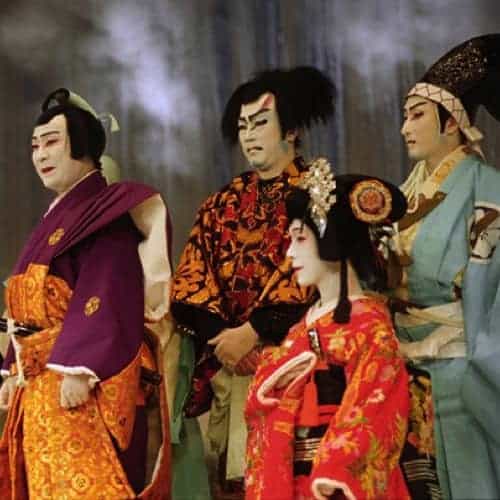
Kabuki and hikinuki
Japanese kabuki theatre was an important influence on specific Yamamoto designs associated with Bowie.
The clearest documented example is hikinuki, a rapid costume-change technique in which one costume can be removed to reveal another underneath.
Traditional hikinuki costume transformation in kabuki theatre
Yamamoto explicitly connected this technique with the clothing he created for Bowie.
Kansai Yamamoto on the Bowie costumes
“The clothes were influenced by hikinuki, the method of changing costumes quickly in kabuki.”
The technique allowed costume transformation itself to become visible to the audience rather than requiring every clothing change to take place backstage.
The Tokyo Pop costume
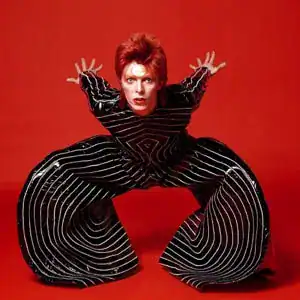
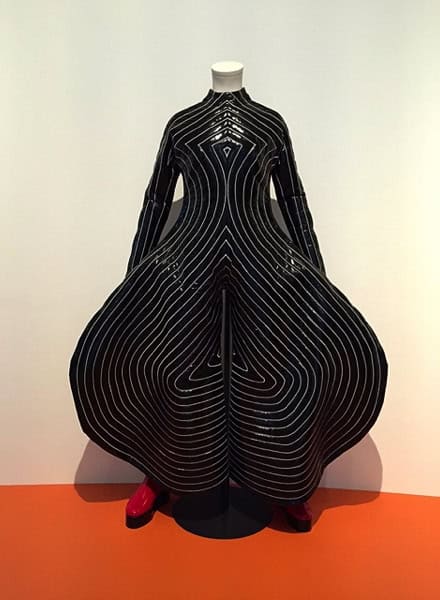
Among the most famous pieces associated with the collaboration is the Tokyo Pop costume.
Its broad lower section dramatically altered Bowie’s silhouette, demonstrating Yamamoto’s use of clothing as a sculptural form rather than simply as a covering for the body.
Yamamoto’s official archive directly connects the costume with hikinuki. The outer garment could be removed rapidly during the performance to reveal another costume underneath.
The design therefore combined visual impact with a practical theatrical function.
Its exaggerated shape also made the costume effective in a large concert environment, where a strong silhouette could be recognised from a distance.
The one-shoulder knitted costume
Another important Yamamoto design worn by Bowie was the asymmetric one-shoulder knitted costume created in 1973.
Yamamoto’s archive explains that the design developed from his study of layered pattern and clothing construction. Rather than reproducing a traditional Japanese garment, he translated those ideas into contemporary knitwear.
The asymmetry was central to the visual effect. The two sides of Bowie’s body were treated differently, creating a silhouette far removed from conventional menswear.
The original 1973 garment was retained within Bowie’s collection. Yamamoto later produced a replica of the piece in 2008.
Costume as part of the performance
Yamamoto’s work with Bowie demonstrates that stage clothing has practical as well as visual requirements.
A concert costume must allow movement and must function under stage conditions. In some of Yamamoto’s Bowie designs, the method by which the garment could be removed was itself incorporated into the performance.
David Bowie performing “1984 / Dodo” during The 1980 Floor Show, 1973
The use of hikinuki meant that a costume change could become part of what the audience saw.
Bowie’s movement was equally important to the visual effect. The garments changed shape as he turned, posed and moved across the stage.
This relationship between design, movement and transformation is one of the reasons Yamamoto’s Bowie costumes remain significant within both fashion history and the history of rock performance.
Photography and the surviving image
Photography gave Yamamoto’s stage designs a cultural life beyond the original concerts.
Images of Bowie wearing the costumes appeared in magazines, books and later museum exhibitions, allowing audiences who had never seen the original performances to encounter the designs.
Japanese photographer Masayoshi Sukita became one of Bowie’s important long-term photographic collaborators and forms part of the broader Japanese creative context surrounding Bowie.
Photographs preserve the way Bowie wore and moved in a garment, while surviving physical costumes provide evidence of construction, materials and design. Together they help document the collaboration.
Aladdin Sane and Bowie’s evolving image

Bowie released Aladdin Sane in April 1973, during the period in which his collaboration with Yamamoto was most visible.
The album’s famous cover image was created separately through Bowie’s work with photographer Brian Duffy and make-up artist Pierre La Roche. It should not be attributed to Yamamoto.
Yamamoto’s contribution was primarily in clothing and stage presentation. His costumes became part of a broader visual environment created through the work of several independent collaborators.
Accurate attribution
Because Yamamoto became so closely associated with Bowie’s flamboyant early-1970s appearance, costumes from the period are sometimes attributed to him simply because they resemble his work.
Such attribution should be avoided unless the designer can be documented.
Freddie Burretti created important clothing for the Ziggy Stardust period, while Michael Fish was responsible for Bowie’s earlier dress on the British cover of The Man Who Sold the World.
Likewise, Yamamoto was not responsible for the famous lightning-bolt make-up on the Aladdin Sane cover.
Yamamoto’s documented contribution is substantial without attributing other designers’ work to him. His confirmed Bowie-related designs should therefore remain the basis for assessing his place in Bowie’s visual history.
The end of the Ziggy Stardust period
On 3 July 1973, Bowie famously announced the end of the Ziggy Stardust touring period during the concert at the Hammersmith Odeon in London.
Yamamoto’s best-known Bowie costumes are closely associated with this concentrated period of Bowie’s career, when his international audience was expanding rapidly and his stage presentation had become increasingly theatrical.
Bowie subsequently moved into different visual periods, and Yamamoto’s costumes remained particularly associated with the Ziggy Stardust and Aladdin Sane years.
Yamamoto’s career beyond David Bowie
Kansai Yamamoto’s career extended far beyond his collaboration with Bowie.
Following his international breakthrough in London, he continued to present fashion internationally and developed a distinctive reputation for sculptural design, bright colour and bold pattern.
His work differed from the restrained aesthetic sometimes associated with Japanese design. Yamamoto embraced colour, scale and theatricality.
These qualities remained visible throughout his later career and eventually expanded beyond conventional fashion shows.
The Kansai Super Shows
Yamamoto increasingly developed large-scale productions known as Kansai Super Shows, combining fashion with music, dance, lighting and mass performance.
These productions took place in major international locations, including Red Square in Moscow, Nehru Stadium in New Delhi and Tokyo Dome.
The Super Shows extended an interest already visible in Yamamoto’s earlier career: fashion could function as part of a larger performance rather than existing only within a conventional runway presentation.
His work with Bowie fits naturally within that history. It demonstrated how a garment could acquire additional meaning when combined with music, movement and a large live audience.
Basara
Yamamoto later used the Japanese concept of basara when explaining his approach to design.
In connection with his Victoria and Albert Museum presentation, he described basara as dressing freely and with stylish extravagance, contrasting it with the understated qualities associated with wabi-sabi.
The concept provides useful context for the flamboyance of his work. Strong colour, dramatic scale and visual excess were deliberate elements of his design philosophy rather than accidental features of a particular Bowie costume.
Museum recognition
Yamamoto’s Bowie designs later entered the context of major museum exhibitions and fashion presentations.
Kansai Yamamoto – Fashion in Motion at the Victoria and Albert Museum
The Victoria and Albert Museum has documented Yamamoto’s designs worn by Bowie during the 1973 Aladdin Sane touring period.
In 2013, the V&A presented Yamamoto as part of its Fashion in Motion programme. The presentation included archive and specially made pieces from his career as well as recreations of designs worn by Bowie.
The museum described Yamamoto’s work in terms of sculptural tailoring, layered dressing, bright colour and pattern, characteristics clearly visible in his Bowie-related designs.
Museum presentation also allows the costumes to be examined as fashion objects in their own right rather than solely as memorabilia associated with a famous musician.
David Bowie Is
Yamamoto’s designs also formed part of the wider museum reassessment of Bowie’s creative archive.
The major David Bowie Is exhibition opened at the Victoria and Albert Museum in London in 2013 and presented costumes, photography, film, handwritten material and other objects from Bowie’s archive.
After London, the exhibition travelled internationally. From December 2015 until April 2016, David Bowie Is was presented at the Groninger Museum in the Netherlands.
The inclusion of fashion within the exhibition demonstrated how important clothing and costume were to Bowie’s creative practice.
Designers such as Yamamoto were not simply suppliers of celebrity clothing. Their independently created work became part of Bowie’s visual presentation through collaboration and performance.
