 2 AFBEELDINGEN MET LINK NAAR EEN PAGINA
 5 AFBEELINGEN
 4 AFBEELDINGEN
 3 AFBEELDINGEN
2 AFBEELDINGEN
1 AFBEELDING
3 AFBEELDINGEN
2 AFBEELDINGEN
1 AFBEELDING
tEST pAGINA ENVIRA NAAR SNIPPED
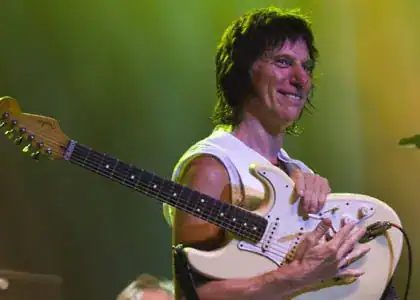
Jeff Beck was an English guitarist whose work with the Yardbirds, the Jeff Beck Group and as a solo recording artist made him one of the most distinctive electric guitarists of his generation. His documented collaboration with David Bowie was brief but historically important: Beck appeared as a guest during the final concert of Bowie’s Ziggy Stardust tour at the Hammersmith Odeon in London on 3 July 1973.
Beck joined Bowie, Mick Ronson, Trevor Bolder, Woody Woodmansey and the additional touring musicians during the closing section of the concert. He performed on The Jean Genie / Love Me Do / The Jean Genie and remained on stage for Bowie’s version of Chuck Berry’s Round and Round.
The concert was filmed by American documentary filmmaker D.A. Pennebaker. Beck’s two performances were omitted from the editions of the concert film that became familiar to audiences during the following decades. Both appearances were reinstated for the fiftieth-anniversary edition of Ziggy Stardust and the Spiders from Mars: The Motion Picture, released in 2023.
- Full name: Geoffrey Arnold Beck
- Born: 24 June 1944, Wallington, Surrey, England
- Died: 10 January 2023
- Profession: Guitarist and recording artist
- Bowie connection: Guest guitarist at the Hammersmith Odeon in London
- Date of collaboration: 3 July 1973
- Performances with Bowie: The Jean Genie / Love Me Do / The Jean Genie and Round and Round
- Concert film: Ziggy Stardust and the Spiders from Mars: The Motion Picture
- Official restoration: Both Jeff Beck performances reinstated in 2023
- Documented collaboration: One concert appearance; no completed studio recording together has been documented
Early Life and Musical Development
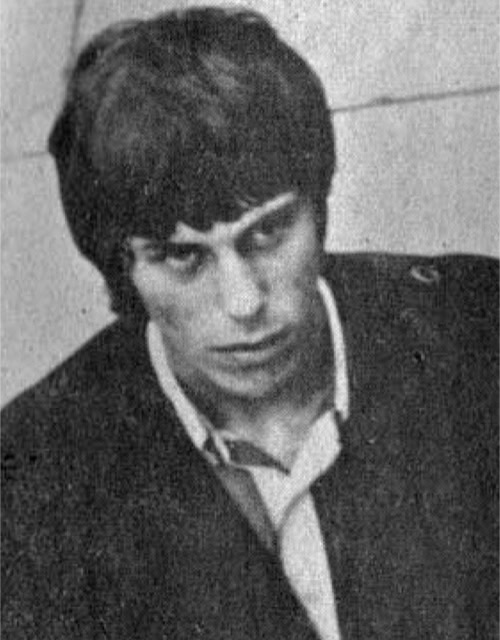
Jeff Beck in 1965. Cropped from a photograph of The Yardbirds published by KRLA Beat, 2 October 1965. Photo: Beat Publications, Inc. / Wikimedia Commons / Public Domain — Wikimedia file page.
Geoffrey Arnold Beck was born on 24 June 1944 in Wallington, Surrey, on the southern edge of London. He became interested in the electric guitar while growing up during the development of British rock and rhythm and blues.
Among the musicians who influenced his early understanding of the instrument were Les Paul, Cliff Gallup, B.B. King, Gene Vincent and American blues and rock-and-roll performers whose records reached Britain during the 1950s.
Before he could afford a professionally manufactured electric guitar, Beck experimented with building and modifying instruments. His interest was not limited to conventional guitar playing. He became increasingly fascinated by distortion, feedback, string bending, sustained notes and the different sounds that could be produced through amplification.
During his youth, Beck became acquainted with fellow guitarist Jimmy Page. Both musicians would later become closely associated with the Yardbirds, although Beck joined the group before Page became one of its guitarists.
The Yardbirds
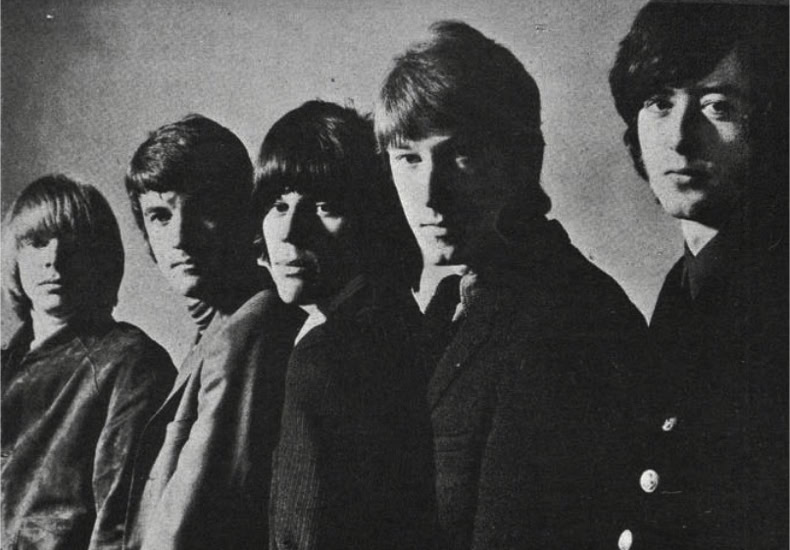
The Yardbirds in 1966 with Jeff Beck and Jimmy Page. Photo: ABC Television / Wikimedia Commons / Public Domain — Wikimedia file page.
In 1965, Beck replaced Eric Clapton in the Yardbirds. Jimmy Page had recommended him for the position. The Yardbirds had begun as a rhythm-and-blues group but were increasingly moving towards experimental pop and rock recordings.
Beck played on recordings including Heart Full of Soul, Evil Hearted You, Shapes of Things and Over Under Sideways Down. His use of controlled feedback, distortion and unconventional phrasing became an identifiable part of the Yardbirds’ mid-1960s sound.
Jimmy Page later joined the Yardbirds, initially playing bass before moving to guitar. For a short period, Beck and Page performed together in the group.
Both musicians appeared with the Yardbirds in Michelangelo Antonioni’s 1966 film Blow-Up. The film included a staged club performance during which Beck destroyed a guitar after an amplifier appeared to malfunction.
Beck left the Yardbirds in 1966. The group was inducted into the Rock and Roll Hall of Fame in 1992, with Beck recognised as a member of the line-up responsible for several of its most experimental recordings.
Beck’s Bolero and the Jeff Beck Group
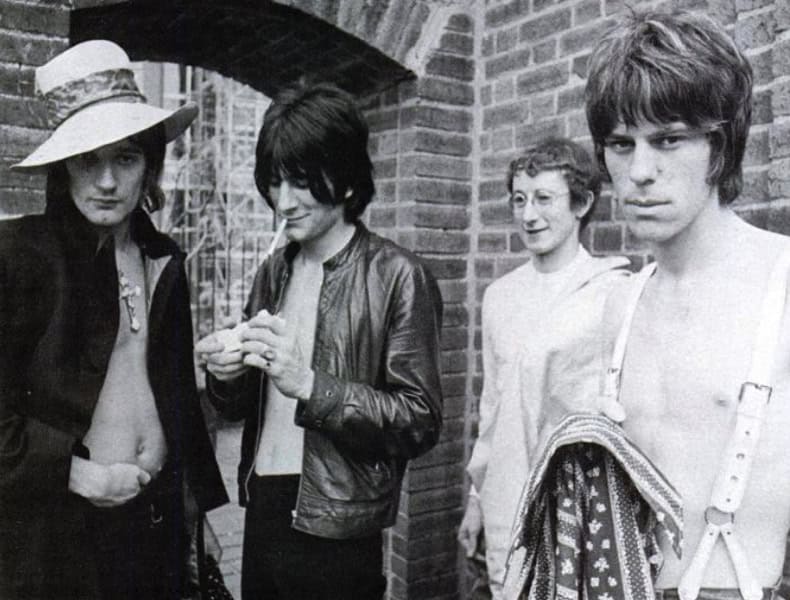
The Jeff Beck Group in 1970. From left to right: Rod Stewart, Ron Wood, Jeff Beck and Mick Waller. Photo: RCA Records / Wikimedia Commons / Public Domain — Wikimedia file page.
One of Beck’s most important early recordings outside the Yardbirds was Beck’s Bolero. The instrumental featured Beck and Jimmy Page on guitars, John Paul Jones on bass, Keith Moon on drums and Nicky Hopkins on piano.
Recorded in 1966 and released the following year, it brought together musicians who would become prominent figures in British rock during the late 1960s and 1970s.
Beck subsequently formed the Jeff Beck Group. Its best-known early line-up included Rod Stewart as lead vocalist, Ronnie Wood on bass, Micky Waller on drums and Nicky Hopkins on piano.
The group’s first album, Truth, was released in 1968, followed by Beck-Ola in 1969. The combination of amplified blues, heavy arrangements and extended instrumental performances established Beck as an important figure in the development of British blues rock.
David Bowie, Mick Ronson and Jeff Beck
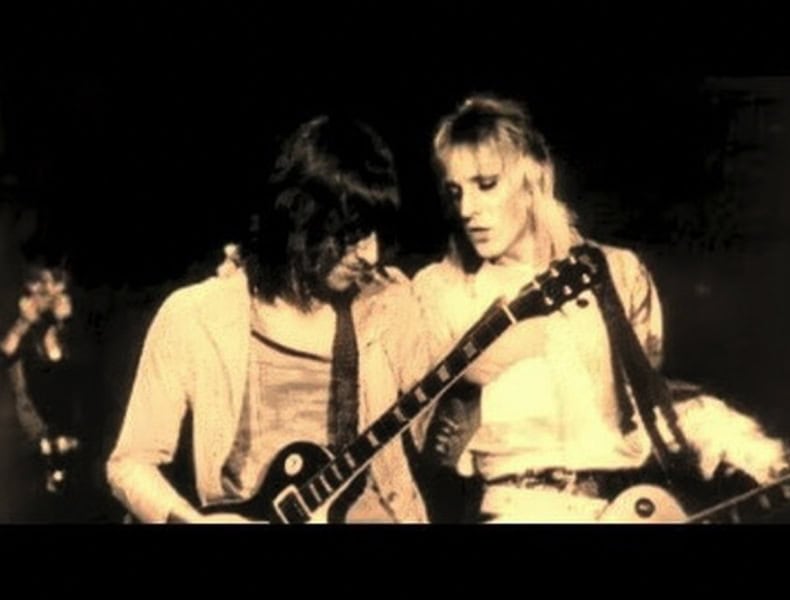
Jeff Beck performing at the Hammersmith Odeon, London, 3 July 1973. Photo from the DavidBowieWorld.com collection.
Jeff Beck‘s recordings with the Yardbirds and the Jeff Beck Group were already known within British rock music before his documented stage appearance with David Bowie in 1973.
Beck later recalled that Bowie had originally wanted him to become part of his band. According to Beck’s own account, Bowie eventually began working with Mick Ronson and described Ronson as his “own Jeff Beck.”
No surviving contract, correspondence or other primary documentation has been identified that independently confirms that Bowie formally offered Beck a permanent position. The statement should therefore be understood as Beck’s personal recollection rather than as a separately documented appointment or rejected contract.
Bowie began working with Hull guitarist Mick Ronson in 1970. Ronson subsequently became Bowie’s principal guitarist, arranger and musical partner during the period that produced The Man Who Sold the World, Hunky Dory, The Rise and Fall of Ziggy Stardust and the Spiders from Mars and Aladdin Sane.
Ronson developed a recognisable style of his own and made substantial contributions to Bowie’s arrangements, recordings and concerts. Beck’s later quotation documents Bowie’s respect for Beck’s playing, but it should not be interpreted as suggesting that Ronson merely copied or imitated him.
Jeff Beck on David Bowie and Mick Ronson
“Bowie originally wanted me to be in the band but he got Mick Ronson, who he always said was his own Jeff Beck.”
— Jeff Beck, recalling his connection with Bowie
Beck, Bogert & Appice
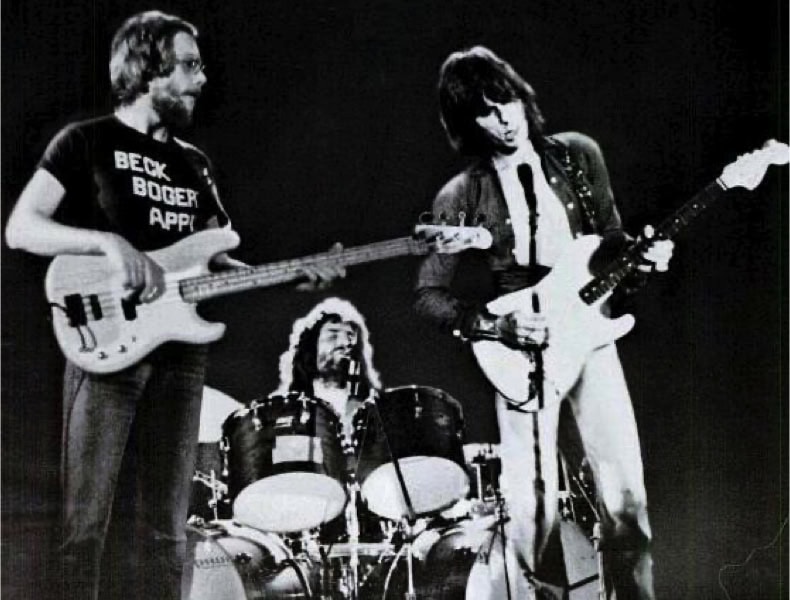
Advertisement promoting Beck, Bogert & Appice, published by Epic Records in Billboard, 1973. Public domain (United States). Source: Wikimedia Commons.
By 1973, Beck was no longer leading the original Jeff Beck Group. After a serious road accident in 1969 and the end of the first version of the group, he had formed a second Jeff Beck Group before beginning a new project with bassist Tim Bogert and drummer Carmine Appice.
The trio performed as Beck, Bogert & Appice and released its self-titled studio album in 1973. The record included the group’s version of Stevie Wonder’s Superstition.
Beck’s guest appearance with Bowie therefore occurred during an active period of his own recording and touring career. He was not joining the Spiders from Mars as a replacement guitarist or beginning a permanent new band with Bowie.
His participation was a guest appearance during one concert. No evidence has been identified of an agreement for Beck to join a subsequent Bowie tour or recording project.
The Final Concert of the Ziggy Stardust Tour
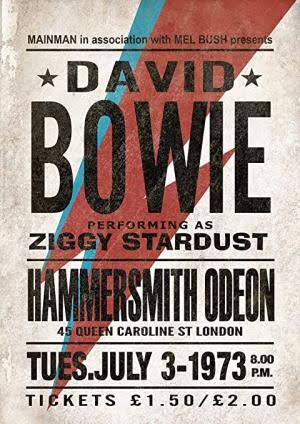
David Bowie and the Spiders from Mars performing at the Hammersmith Odeon, London, on 3 July 1973 during the final concert of the Ziggy Stardust Tour. Photo from the DavidBowieWorld.com collection.
On 3 July 1973, David Bowie and his touring musicians performed at the Hammersmith Odeon in London. The concert concluded the extensive Ziggy Stardust tour that had begun in Britain in early 1972 and had taken Bowie through the United Kingdom, the United States and Japan.
By the time the tour reached Hammersmith, Bowie’s stage repertoire extended beyond the Ziggy Stardust album. The concert included material from Hunky Dory, The Rise and Fall of Ziggy Stardust and the Spiders from Mars and Aladdin Sane, together with cover versions and songs Bowie had written for other artists.
The core Spiders from Mars line-up consisted of Mick Ronson on guitar and piano, Trevor Bolder on bass and Woody Woodmansey on drums.
The touring ensemble had been expanded by pianist Mike Garson, saxophonist Ken Fordham and backing vocalists Geoff MacCormack and John Hutchinson.
American filmmaker D.A. Pennebaker and his crew filmed the performance. Pennebaker was already known for music documentaries including Dont Look Back, which followed Bob Dylan during his 1965 British tour, and Monterey Pop.
The filming captured concert performances and backstage material. The resulting footage became the basis of Ziggy Stardust and the Spiders from Mars: The Motion Picture, although the complete concert was not initially made available in the form in which it had been performed.
Jeff Beck Joins Bowie and the Spiders from Mars
Jeff Beck appeared during the closing section of the Hammersmith concert. Bowie introduced him to the audience before the musicians began The Jean Genie.
Beck performed beside Mick Ronson rather than replacing him. The surviving footage therefore documents Beck as a guest guitarist within Bowie’s established touring ensemble.
Beck and Ronson both contributed electric guitar to the two performances. The event is sometimes described as a guitar battle or duel, but those descriptions are retrospective interpretations rather than official descriptions of the performance.
No evidence has been identified that Beck was auditioning for the group, replacing Ronson or beginning a longer collaboration. His role that evening was that of a guest musician.
The Jean Genie / Love Me Do / The Jean Genie
The first performance featuring Beck began with The Jean Genie, Bowie’s 1972 single later included on Aladdin Sane.
During the performance, the musicians moved into a brief passage from the Beatles’ Love Me Do before returning to The Jean Genie.
The official title used for the restored release is The Jean Genie / Love Me Do / The Jean Genie. Love Me Do should therefore not be counted as a separate complete third performance involving Beck. It formed part of the longer Jean Genie medley.
Beck later remembered that one of Pennebaker’s cameras focused on his wah-wah pedal and the white platform shoes he was wearing. His recollection became central to his explanation of his initial objection to appearing in the concert film.
Video: The Jean Genie / Love Me Do
David Bowie and Jeff Beck performing The Jean Genie / Love Me Do at the Hammersmith Odeon, 3 July 1973.
The footage documents the first of Jeff Beck‘s two guest appearances during the closing section of the concert. Bowie performs with the Spiders from Mars and the expanded touring ensemble, while Beck adds a second guitar part beside Mick Ronson.
The brief inclusion of Love Me Do connects Bowie’s own composition with the Beatles’ 1962 debut single. The musicians then return to The Jean Genie.
The official 2023 release identifies the complete track as The Jean Genie / Love Me Do / The Jean Genie, featuring Jeff Beck.
Round and Round
Beck remained on stage for Round and Round, Bowie’s version of Chuck Berry’s song Around and Around.
Bowie had recorded the song during the sessions that produced The Rise and Fall of Ziggy Stardust and the Spiders from Mars. It was not included on the original album.
Bowie’s recording was later released as the B-side of Drive-In Saturday in April 1973 under the title Round and Round.
Its appearance at Hammersmith therefore occurred only a few months after that release. Beck and Ronson both played guitar during the performance.
Once the song had ended, Beck left the stage. The official restored running order places Round and Round immediately before Bowie’s farewell speech and the final encore, Rock ‘n’ Roll Suicide.
Video: Round and Round
David Bowie and Jeff Beck performing Round and Round at the Hammersmith Odeon, 3 July 1973.
Round and Round was the second and final documented concert performance shared by David Bowie and Jeff Beck.
Although Chuck Berry’s original composition is usually titled Around and Around, Bowie’s recording and the official Hammersmith release use the title Round and Round.
The performance was absent from the familiar earlier editions of Pennebaker’s film. It was reinstated for the restored fiftieth-anniversary release in 2023.
Jeff Beck‘s Memory of the Hammersmith Audience
The Hammersmith appearance placed Beck before an audience whose response differed from many of the blues and rock audiences he had previously encountered.
The concert took place at the height of the public attention surrounding Bowie’s Ziggy Stardust presentation. Beck later remembered the volume and pitch of the screaming inside the venue.
His recollection is one of the clearest first-hand descriptions of how the event sounded from his position on stage.
Jeff Beck on the Hammersmith audience
“The pitch of teenage screaming at that gig was unbelievable. I’d never experienced that.”
— Jeff Beck, recalling the concert of 3 July 1973
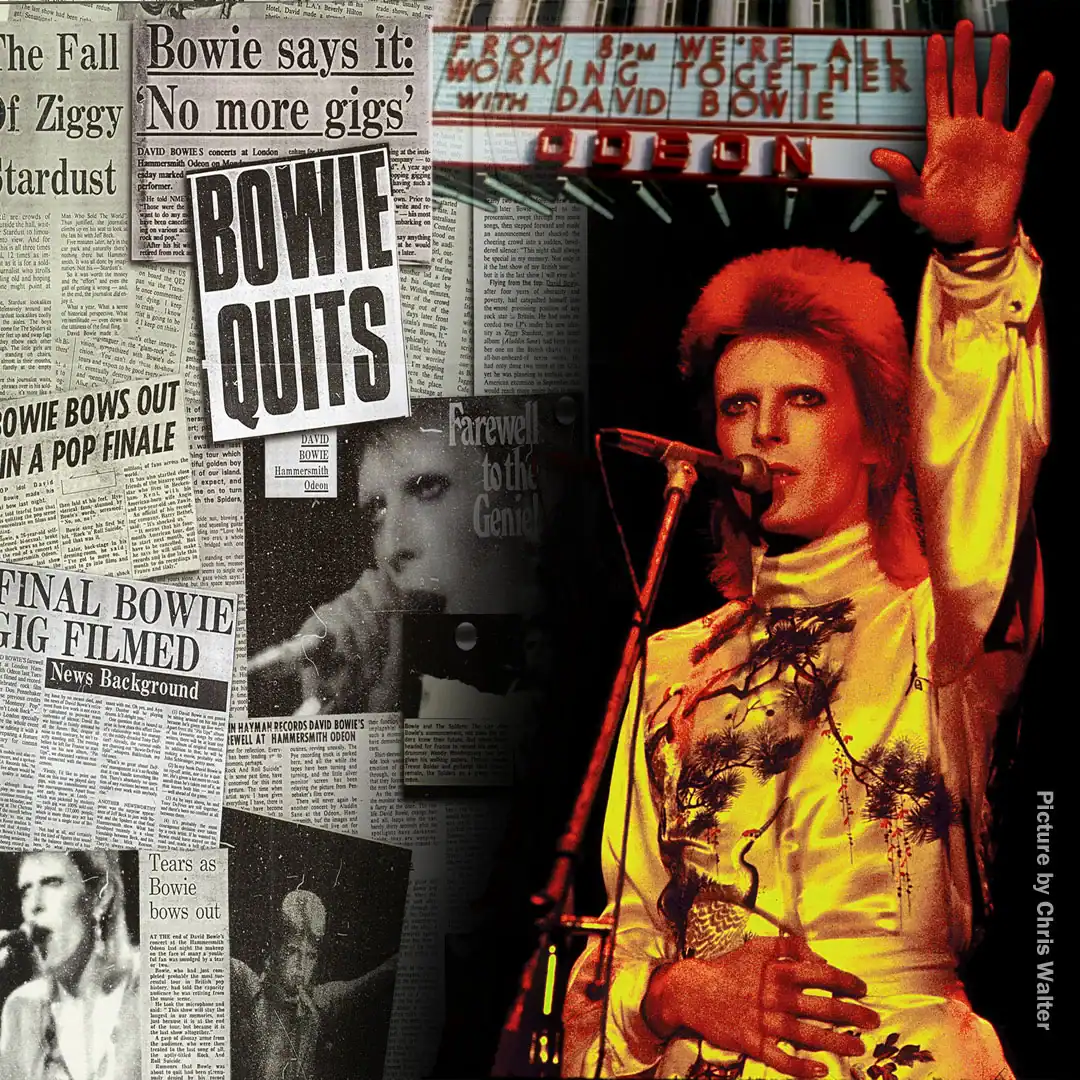
Bowie’s Farewell Announcement
David Bowie at the Hammersmith Odeon, London, on 3 July 1973 during the final concert of the Ziggy Stardust Tour. Photo from the DavidBowieWorld.com collection.
Beck’s guest appearance took place shortly before the most famous spoken moment of the Hammersmith concert.
Following Round and Round, Bowie returned to the stage and addressed the audience before the final encore. He explained that the concert was special not only because it was the final show of the tour but because it would be the last show that “we’ll ever do.”
The statement surprised the audience and members of the band. Bowie then performed Rock ‘n’ Roll Suicide.
The announcement has become associated with the public retirement of the Ziggy Stardust persona and the end of the touring configuration known as the Spiders from Mars.
The statement did not mean that Bowie permanently retired from live performance. Nor did it immediately end every professional association with the musicians who had taken part in the tour.
It is therefore historically more precise to describe Hammersmith as the final concert of the Ziggy Stardust tour and the public retirement of the Ziggy stage persona, rather than the final occasion on which Bowie ever performed with any musician associated with the Spiders from Mars.
D.A. Pennebaker’s Concert Film
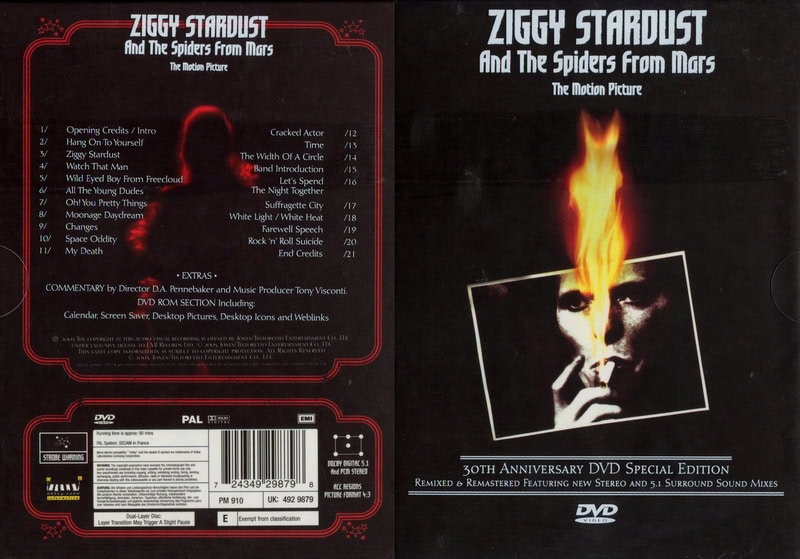
David Bowie performing at the Hammersmith Odeon, London, on 3 July 1973 during the concert filmed by D.A. Pennebaker. Photo from the DavidBowieWorld.com collection.
Pennebaker’s cameras recorded the Hammersmith performance, including Beck’s two appearances. The resulting film did not immediately receive a conventional worldwide theatrical release.
A version of the film was screened in 1979, and it became more widely available during the 1980s. Subsequent cinema, television and home-video editions established it as the principal visual document of Bowie’s final Ziggy Stardust tour concert.
Those familiar editions did not contain Beck’s performances. The film therefore moved from the regular concert programme towards Bowie’s farewell without showing the two guest performances that had taken place immediately beforehand.
Beck’s Initial Objection to the Footage
Beck later recalled that he disliked the way he appeared in the filmed material. In particular, he remembered the camera focusing on his wah-wah pedal and the dirty white platform shoes he had worn on stage.
According to Beck’s account, he became angry when he learned that the footage was intended for use and initially refused to sign a release.
Beck also recalled Bowie attempting to persuade him to approve the material by pointing out that an unofficial version was already being shown. In the same interview, Beck said that he eventually agreed.
His recollection therefore confirms an initial refusal, followed by later agreement. It does not by itself fully explain every production, legal or editorial decision that kept both performances out of the familiar authorised editions for several decades.
The continued omission should consequently not be attributed solely to a permanent refusal by Beck. The complete circumstances have not been fully documented in the publicly available first-hand material.
The Surviving Recordings
Audio and film recordings of the Hammersmith concert circulated in different official and unofficial forms during the following decades.
Because the Beck performances were absent from the familiar concert film and soundtrack editions, they became especially sought after among collectors.
The circulation of unofficial copies did not make the performances part of the authorised complete concert release. Their official restoration required the surviving film and audio to be prepared and approved for a new edition.
Moonage Daydream and the Return of the Footage
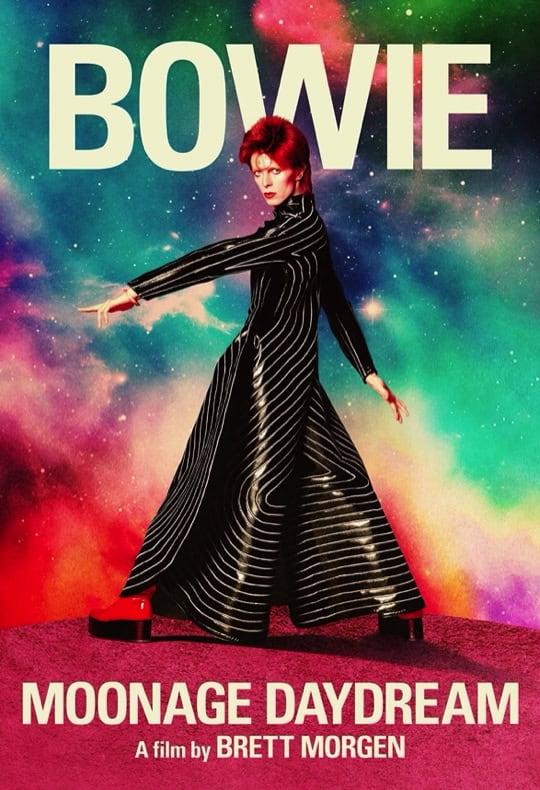
David Bowie and Jeff Beck performing at the Hammersmith Odeon, London, on 3 July 1973. The performance was later featured in Moonage Daydream (2022). Photo from the DavidBowieWorld.com collection.
Footage of Bowie and Beck performing the Jean Genie / Love Me Do medley appeared in Brett Morgen’s 2022 film Moonage Daydream.
Its inclusion brought restored images from the collaboration to an international cinema audience before the complete Hammersmith concert received its fiftieth-anniversary release.
This appearance did not yet present both Beck performances in their complete original position within the concert. That followed with the restored edition of Pennebaker’s film in 2023.
The 2023 Fiftieth-Anniversary Restoration
In 2023, Ziggy Stardust and the Spiders from Mars: The Motion Picture was restored for the fiftieth anniversary of the Hammersmith concert.
The digital film restoration was overseen by Frazer Pennebaker, the son of D.A. Pennebaker, and the soundtrack was newly remastered.
The restored film returned to the former Hammersmith Odeon, now the Eventim Apollo, during the fiftieth-anniversary celebrations in July 2023. It was also shown in cinemas internationally.
The new edition reinstated both Jeff Beck performances in their correct position within the concert:
- The Jean Genie / Love Me Do / The Jean Genie
- Round and Round
Tony Visconti prepared new stereo and surround mixes of the Beck performances. The restored film and soundtrack were released on Blu-ray, CD, vinyl and digital formats in August 2023.
Rhino’s official release announcement described the restored edition as the first time the complete concert had been made available in this form. It also stated that the Hammersmith performance of Round and Round was making its first official appearance.
The official track sequence places the two Beck performances immediately before Bowie’s farewell speech and Rock ‘n’ Roll Suicide.
No Documented Studio Collaboration
No completed studio recording featuring both David Bowie and Jeff Beck has been documented.
Beck did not become a member of the Spiders from Mars, and he is not credited as a musician on Bowie’s known studio albums.
Their documented professional collaboration is therefore confined to Beck’s guest appearance during the Hammersmith concert on 3 July 1973.
No verified evidence has been identified of a planned Bowie–Beck album, a subsequent joint tour or an agreement for a longer musical partnership.
Later Meeting in New York
Bowie and Beck remained part of the same wider musical world after 1973. A documented later meeting occurred in New York on 8 June 2010, when both attended a celebration marking guitarist and inventor Les Paul’s ninety-fifth birthday at the Iridium Jazz Club.
Photographs from the event show Bowie and Beck together. The occasion was a social and commemorative appearance rather than a renewed musical collaboration.
Les Paul was an important figure in the development of the electric guitar and had influenced Beck from an early age. Beck later recorded and performed a programme celebrating Paul and the music associated with him.
Jeff Beck‘s Later Career
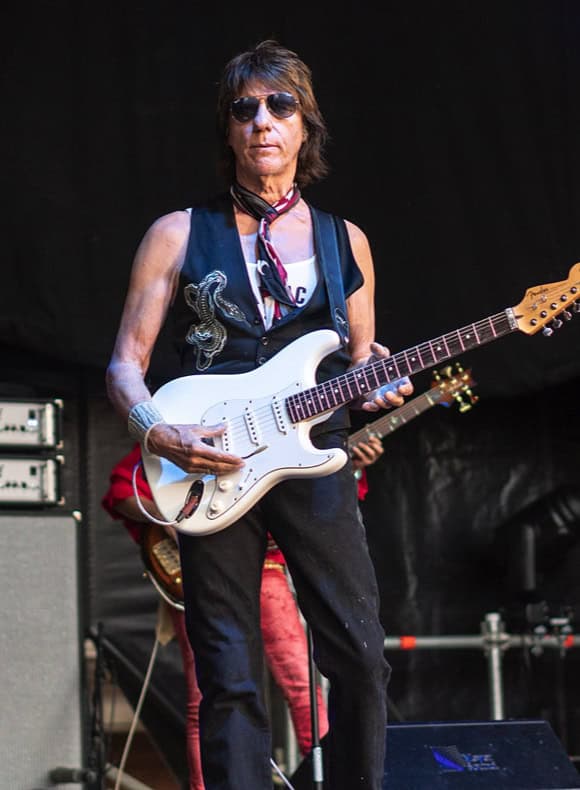
Jeff Beck performing at the Chelsea at The Cosmopolitan, Las Vegas, Nevada, 15 June 2018. Photograph by Raph_PH, licensed under CC BY 2.0. Source: Wikimedia Commons.
After Beck, Bogert & Appice ended, Beck concentrated increasingly on instrumental music.
His 1975 album Blow by Blow, produced by George Martin, combined rock, jazz and funk and became one of the most commercially successful instrumental guitar albums of its period.
Beck continued this direction on Wired in 1976, working with musicians including Jan Hammer and Narada Michael Walden.
These albums established a career path that differed from the singer-led blues rock of the original Jeff Beck Group. Beck’s guitar frequently carried the principal melodic role.
He continued to release solo albums while also appearing on recordings and concerts by other artists. His documented collaborations included work with Stevie Wonder, Tina Turner, Mick Jagger, Rod Stewart, Kate Bush, Jon Bon Jovi, Roger Waters, Imelda May, Joss Stone, Ozzy Osbourne and Johnny Depp.
Beck’s playing continued to evolve. Although he remained associated with blues rock, he also worked with jazz fusion, electronic production, orchestral arrangements, rockabilly and vocal-led music.
He increasingly relied on fingerstyle playing, the vibrato arm and the guitar’s volume control. These techniques allowed him to alter pitch, attack and volume while sustaining notes.
In 2007, performances by Beck and his band at Ronnie Scott’s Jazz Club in London were professionally filmed. The group included bassist Tal Wilkenfeld, drummer Vinnie Colaiuta and keyboard player Jason Rebello.
His 2016 album Loud Hailer was created with singer Rosie Bones and guitarist Carmen Vandenberg. The album used lyrics addressing subjects including political division, inequality and social frustration.
Beck remained professionally active during the final years of his life. In 2022 he released the album 18 with Johnny Depp and appeared on Ozzy Osbourne’s album Patient Number 9.
Awards and Recognition
Jeff Beck received eight Grammy Awards during his career. Several recognised his instrumental performances.
He was inducted into the Rock and Roll Hall of Fame twice: as a member of the Yardbirds in 1992 and as a solo artist in 2009.
Jimmy Page delivered the induction speech at Beck’s second ceremony. The honour recognised Beck’s career beyond his earlier membership of the Yardbirds.
Death

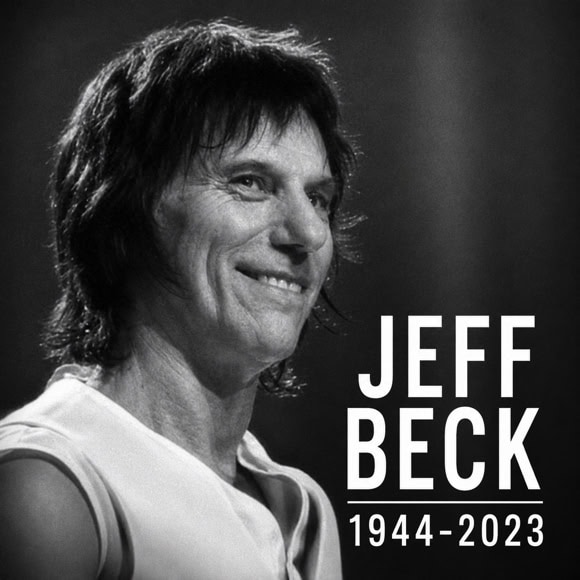
Jeff Beck died on 10 January 2023 at the age of 78 after contracting bacterial meningitis. His family announced his death the following day.
The official David Bowie website marked Beck’s death and referred to his guest appearance at the Hammersmith concert.
Beck’s death occurred several months before the fiftieth-anniversary restoration of the concert film was released.
The 2023 edition therefore made his complete guest appearance officially available shortly after his death, restoring both performances to their original position within the concert.
Legacy
Jeff Beck‘s career extended from the British rhythm-and-blues movement of the 1960s through blues rock, hard rock, jazz fusion and later instrumental music.
He was known for continually changing his technique and sound rather than remaining permanently associated with one band or musical style.
His work with the Yardbirds, the Jeff Beck Group and his solo ensembles influenced several generations of guitarists.
Within David Bowie’s career, Beck’s role was much more limited. He was a guest musician during two performances at one historically important concert.
Historical Importance of the Bowie Collaboration
Jeff Beck‘s appearance at Hammersmith documents a genuine, professionally filmed collaboration between Bowie, Beck and Mick Ronson.
It brought Beck onto the stage with Bowie’s established band during the closing section of the final Ziggy Stardust tour concert.
The appearance should not be exaggerated into a long-running creative partnership. Beck contributed to two connected performances during one concert, and no completed Bowie studio recording featuring him has been documented.
Its historical importance also comes from its position within the concert. Beck appeared immediately before Bowie delivered the farewell announcement associated with the retirement of the Ziggy Stardust persona.
For decades, viewers of the familiar authorised concert film could not see this section of the performance. The 2023 restoration reinstated the two songs and established the complete official running order.
The surviving evidence does not establish that Beck was auditioning for the Spiders from Mars, that he was intended to replace Mick Ronson or that a further Bowie–Beck project was planned.
What is securely documented is more specific: Jeff Beck joined David Bowie and his musicians for The Jean Genie / Love Me Do / The Jean Genie and Round and Round at the Hammersmith Odeon on 3 July 1973.
Official Website & Further Information
The official Jeff Beck website contains biographical information, archive news, photographs and information about his recorded work: JeffBeck.com.
Official information about the restored fiftieth-anniversary edition of Ziggy Stardust and the Spiders from Mars: The Motion Picture is available through the official David Bowie website and Rhino’s authorised release material.
DavidBowieWorld.com is dedicated to documenting the careers of David Bowie’s collaborators through carefully researched historical information and, where available, first-hand contributions from the artists themselves. This page will continue to be updated as new verified information becomes available.
Article Origin
This article has been researched and written exclusively for DavidBowieWorld.com. It is based on verified historical information, official release documentation, contemporary concert records and published first-hand recollections relating to Jeff Beck‘s appearance with David Bowie at the Hammersmith Odeon on 3 July 1973.
No personal contribution from Jeff Beck was made directly to DavidBowieWorld.com. The quotations included on this page originate from a previously published interview in which Beck personally discussed David Bowie and the Hammersmith concert.
© DavidBowieWorld.com.