
Mark Guiliana – David Bowie’s Blackstar Drummer

Photo: Serguei Trouchelle / Wikimedia Commons / CC BY-SA 3.0 — Wikimedia file page
Mark Guiliana is an American drummer and composer whose playing became an essential part of David Bowie’s final studio album, Blackstar. His connection with Bowie began before that album. Guiliana played drums on the original recording of “Sue (Or in a Season of Crime),” made with the Maria Schneider Orchestra and released in 2014.
Bowie subsequently worked with Guiliana again as part of a smaller group centred on saxophonist Donny McCaslin. Together with bassist Tim Lefebvre and keyboard player Jason Lindner, Guiliana brought the experience of a band that already knew how to play together. On Blackstar, his acoustic drums could suggest a programmed beat one moment and respond to the other musicians the next.
His contribution is particularly revealing because it can be traced through the recordings and through Guiliana’s own account of the sessions. Bowie supplied songs and rhythmic ideas; Guiliana and the band helped turn them into performances. Their work provides a clear picture of collaboration during Bowie’s last creative period.
- Name: Mark Guiliana
- Profession: Drummer, composer and bandleader
- First recording with Bowie: “Sue (Or in a Season of Crime)” (2014)
- Bowie studio album: Blackstar (2016)
- Album credit: Drums and percussion
- Principal fellow musicians: Donny McCaslin, Tim Lefebvre and Jason Lindner
- Album producers: David Bowie and Tony Visconti
- Bowie touring role: None; Bowie did not tour Blackstar
A drummer before the Bowie connection
Guiliana had a substantial musical career before his name appeared on a Bowie recording. His work crossed acoustic jazz, electric ensembles and music informed by electronic production. Those descriptions identify different parts of his practice, but they do not describe separate musical personalities. A repeated pattern could be played with the precision associated with a machine, while a live performance could still change in response to another musician.
This ability to move between approaches helps explain why his playing suited the music Bowie was developing. Guiliana could hold a groove steadily without making it feel static. He could add small rhythmic details without obscuring the song. When the music called for greater force, he could build intensity through repetition and interaction rather than relying only on a conventional drum fill.
His recordings as a leader also show that he was more than a session drummer brought in to follow instructions. My Life Starts Now. and Beat Music: The L.A. Improvisations, both released in 2014, document different sides of his interest in rhythm and electronic sound. In the duo Mehliana, he worked with pianist and keyboardist Brad Mehldau on Taming the Dragon. These projects are useful context for his Bowie work because they establish that acoustic and electronic ideas were already central to his music.
At the same time, it would be misleading to suggest that Guiliana alone supplied the concept of Blackstar. Bowie had his own songs, demos and musical intentions, and Tony Visconti played a major production role. Guiliana’s importance lies in what happened when those starting points met the abilities of a musician who could interpret them in real time.
2014: “Sue (Or in a Season of Crime)”

The first documented Bowie recording on which Guiliana played was the original “Sue (Or in a Season of Crime)”. Bowie recorded the song in New York with the Maria Schneider Orchestra. Schneider arranged and conducted it; Bowie and Visconti produced the recording. The official musician credits list Guiliana on drums, while Donny McCaslin appears among the saxophonists and is credited as a tenor soloist.
This first version matters for two reasons. It establishes that Guiliana’s work with Bowie did not begin at the Blackstar sessions, and it places him within the musical connection that led to Bowie’s later choice of band. It is also a recording with a different ensemble and arrangement from the version eventually heard on Blackstar. The two performances should not be treated as if they were the same master recording.
The 2014 “Sue” was made for the period surrounding the compilation Nothing Has Changed. Its large-ensemble setting gave Bowie an opportunity to work with musicians from a contemporary jazz world. Guiliana was one member of that larger group. His later, more prominent role developed when Bowie returned to this musical circle for a new album.
An important distinction is the route from the first recording to the next collaboration. McCaslin’s involvement in “Sue” connected Bowie to the saxophonist, and Bowie and Visconti later heard McCaslin’s quartet perform. The quartet included Guiliana on drums, Lefebvre on bass and Lindner on keyboards. Bowie did not simply assemble four unfamiliar players at the last minute; he chose musicians who already shared a working relationship.
From McCaslin’s quartet to Bowie’s band
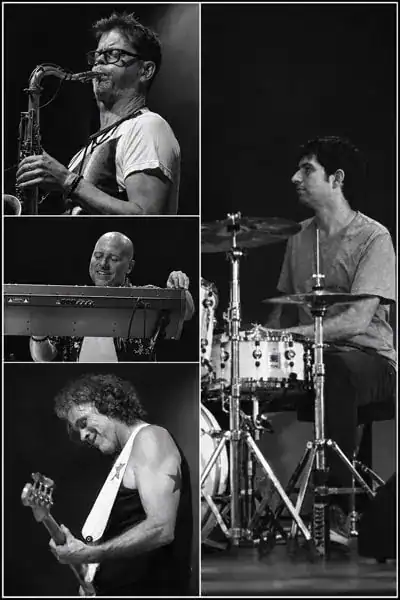
Donny McCaslin’s group provided a useful foundation for the next recordings because its members were accustomed to reacting to one another. A rhythm section is more than the sum of separate credits. A bassist knows where a drummer may leave space; a keyboard player recognises when a repeated figure can be developed; a saxophonist can change the intensity of a phrase because the others will hear and answer it.
Tony Visconti later recalled Bowie deciding that McCaslin’s group would form the band for Blackstar. That account gives proper weight to Bowie’s choice while recognising the musicians’ existing identity. Guitarist Ben Monder also contributed to the album. His presence is important in describing the final record, but he should not be confused with one of the four musicians in McCaslin’s quartet that Bowie and Visconti went to hear.
Describing the players as a jazz band is accurate as a starting point, although it does not explain every sound on Blackstar. Their recorded work drew on varied rhythmic and electronic influences. Bowie, meanwhile, had explored jazz sounds and musicians at other points in his career. The significance of this collaboration is therefore more specific than the claim that he suddenly discovered jazz: he chose this particular group and used its character in service of these particular songs.
The decision also changed the practical shape of the sessions. Guiliana, Lefebvre, Lindner and McCaslin brought a shared sense of time and momentum into the room. Bowie could present material to an ensemble capable of making decisions together. That capacity did not replace his authorship. It gave him musicians who could develop the material while he listened, sang and directed.
Bowie’s demos and Guiliana’s task
Guiliana’s account of Blackstar begins with Bowie’s demos. Several contained programmed drum parts. The drummer’s task was not to imitate a drum machine perfectly, nor to discard the patterns in favour of unrelated improvisation. He had to understand what the programmed parts contributed to each composition and find an acoustic performance that carried the same intent.
In his discussion of the title track, Guiliana explained that his aim was to bring the programmed rhythms to his kit and play them “in the most organic and musical way” he could. The remark is valuable because it comes from the person who played the part. It describes a specific working method rather than a general claim that Bowie wanted the album to sound modern.
“The core groove is true to the demo.”
— Mark Guiliana, Modern Drummer, 2016This does not make the finished drum performance a copy. The acoustic kit has its own sounds and physical limitations. The weight of a kick drum, the length of a cymbal sound and the tiny differences between repeated strokes all affect the result. Guiliana could preserve the central groove and still change the music through touch, emphasis and interaction with the band.
The presence of programmed ideas also helps explain a common impression of the album. Some passages appear almost electronic even when Guiliana is playing drums. Elsewhere, an electronic sound is genuinely present alongside live instruments. It is more accurate to hear Blackstar as a combination of methods than to assign its entire rhythmic identity to either programming or acoustic performance.
“Blackstar”: holding the centre of a changing song
David Bowie – “Blackstar” (official video)
The title track moves through contrasting musical sections. Its rhythms do not merely supply a regular pulse beneath an unchanging arrangement. They help define transitions and sustain tension while the song changes around them. Guiliana explained that the opening groove followed Bowie’s programmed idea closely. That detail gives Bowie’s demo a clearly documented place in the final recording.
Guiliana also described choices of drum sound intended to sit within an electronic palette. Such decisions matter because a performance is shaped by more than the notes played. A low, dampened snare can alter the perceived weight of a beat; a sound that is short and controlled may sit beside keyboards differently from an open, ringing drum. These details help account for the record’s unusual balance between live ensemble playing and studio construction.
The track was recorded in sections that were subsequently joined. That fact is another reminder that Blackstar was both a set of performances and a produced album. Its musicians played together, while Bowie, Visconti and the recording team made decisions about how those performances would become the finished work. Guiliana’s part remains recognisably his, but the final sound belongs to the entire recording process.
The strongest claim one can make about his role here is also the simplest: he translated a rhythmic idea supplied by Bowie into a performance that suited the band and the recording. Describing him as the sole architect of the track would give him credit that the evidence does not support. Treating him as a replaceable accompanist would overlook the judgement heard in the performance.
“’Tis a Pity She Was a Whore”: repetition and intensity
On “’Tis a Pity She Was a Whore,” Guiliana faced a different version of the same problem. Bowie’s demo contained a driving, repeated groove. A player can perform a one-bar figure accurately and still fail to give a song forward movement. Guiliana’s account stresses the need to maintain the repetition while allowing its intensity to grow.
The musicians played together, with Bowie singing during the takes. That shared performance shaped the result. Guiliana remembered Bowie’s vocal energy as a source of inspiration and direction. The relationship was immediate: a drum accent could answer a phrase, while the force of the singing could push the group towards a more urgent take.
Guiliana also added sounds using a Roland SPD-SX percussion pad loaded with electronic drum sounds. According to his account, the additions were retained in the finished recording. This is a documented example of electronic percussion in his contribution, rather than a reason to label every unusual drum sound on the album as electronic.
The result illustrates why repetition became such a powerful element in this group’s work. A recurring rhythm establishes something firm enough for the musicians to test. Their choices within and around it create the pressure. On this track, the drum part helps make the performance feel progressively less settled without abandoning its basic pulse.
“Lazarus”: an arrangement found in the room
David Bowie – “Lazarus” (official video)
“Lazarus” provides a particularly clear example of the group developing an arrangement during a session. Guiliana recalled an initial take that was musical but restrained. Bowie encouraged the musicians to go further, and the version selected for the record came from the following take, in which the players took more chances.
Guiliana was careful about how he reported Bowie’s words: he said Bowie had said something like the phrase he remembered. It should therefore be presented as Guiliana’s recollection, not as a verified word-for-word transcript of Bowie speaking in the studio.
“He was always pushing us.”
— Mark Guiliana, Modern Drummer, 2016Another important change emerged after the first take. Lefebvre played a bass line that Bowie liked and wanted to use as an introduction. The recorded opening therefore was not simply a detail copied from a completed Bowie demo. It arose from a musician’s idea, heard and adopted by Bowie while the track was being made.
These recollections show how two apparently different descriptions of the sessions can both be true. Bowie had prepared songs and musical material; the band was also able to contribute ideas that changed an arrangement. Guiliana’s testimony supports a picture of active guidance and genuine response, without requiring the exaggerated claim that Bowie dictated every note or gave the players unlimited control.
Returning to “Sue” for Blackstar
Bowie and the musicians returned to “Sue (Or in a Season of Crime)” for Blackstar. Guiliana had already played on the original 2014 recording with the Maria Schneider Orchestra, giving him an unusually direct connection between Bowie’s earlier experiment and the later album. The newer performance was a different recording with a different ensemble character.
Guiliana described the Blackstar version as having more edge and urgency. The smaller group could give the composition a different kind of pressure from the large orchestra. Those qualities are audible in the way the rhythm section drives forward, but it is important to identify the basis of the comparison: two released versions of the same song and a musician who participated in both.
This return to “Sue” also prevents a misleading account of Bowie’s final period. The relationship with these players did not appear suddenly when work began on the album. It developed through the earlier recording, Bowie and Visconti’s interest in McCaslin’s group, and the decision to make a further record with musicians from that circle.
The two “Sue” recordings belong to different stages of that development. Keeping them distinct gives Guiliana’s contribution its proper chronology: first an orchestral session in 2014, then the smaller-group work that became part of Blackstar.
“Girl Loves Me”: fitting two loops into one performance
On “Girl Loves Me,” Bowie’s demo contained two overlapping loops. Guiliana explained that he could not reproduce every part of that layered pattern simultaneously on the kit. He chose instead to capture its overall feel: the weight of a slower backbeat alongside quicker rhythmic detail underneath.
This is one of the clearest examples of interpretation in his Blackstar work. A programmed demo can ask for events that one drummer cannot physically play at once. The musical question then becomes which features matter most to the song. Guiliana’s solution retained the tension between the broad pulse and the busier surface without pretending that an acoustic player was identical to a computer sequence.
He also described sound from his snare entering Bowie’s vocal microphone while they performed in the same room. Microphone spill is sometimes treated as a recording problem, yet Guiliana recalled that it produced interesting sonic results here. The detail makes the record’s mixture of apparent control and live presence more concrete: some sounds reflect musicians sharing a physical space, not merely separate tracks assembled afterwards.
“Girl Loves Me” therefore shows a different side of the group from “Lazarus.” The focus is less on a newly discovered introduction than on a drummer deciding how to embody a densely layered idea. Bowie’s loops supplied the starting point; Guiliana selected a playable combination of pulse, detail and feel.
“Dollar Days”: making a song without a demo
Guiliana identified “Dollar Days” as the one song on the album that did not arrive with a demo. According to his account, Bowie taught it to the musicians in the studio by playing guitar and singing. The group ran through it several times before recording the take.
That exception matters. It would be inaccurate to say that Guiliana translated programmed drums on every Blackstar track. On “Dollar Days,” the musicians worked from a song demonstrated to them in the room. The contrast reveals the range of practical methods within the same album sessions.
Guiliana recalled that James Murphy was present while the song was recorded and helped him develop the tom-based groove heard in its verses. Bowie’s official album credits also list Murphy on percussion. Mentioning Murphy here recognises another contribution without confusing it with Guiliana’s credited role across the album.
“Dollar Days” is a useful reminder that the making of a song cannot always be reduced to a single creator handing a finished arrangement to a band. Bowie introduced the material; Guiliana and the other musicians learned and performed it; another musician offered a rhythmic suggestion. The released track grew out of those connected actions.
“I Can’t Give Everything Away”: restraint and response
The closing track, “I Can’t Give Everything Away,” begins with a loop taken directly from Bowie’s demo, according to Guiliana. Here the challenge was to live alongside a simple repeated part while still interacting with the rest of the group and allowing the performance to develop.
That challenge can be easy to overlook. Elaborate playing is immediately noticeable; measured playing may reveal its value only over the course of a song. Guiliana had to consider what the loop was doing for Bowie’s composition and where the live drums could add motion without crowding the vocal or the other instruments.
His own account draws attention to contributions from McCaslin and Monder and to Bowie’s singing. It is an appropriately collective description of the recording. Even on a page devoted to the drummer, the closing track is best understood through the balance of the ensemble. Guiliana’s part helps carry the song, while the full emotional and musical effect depends on the players listening across it.
This also provides a useful ending to a track-by-track look at his role. The defining feature of the Blackstar drums is not constant complexity. It is Guiliana’s judgement about when to hold a pattern, when to change its weight and when another sound should take the foreground.
What the musicians’ accounts establish
First-hand accounts are especially helpful for understanding how Blackstar was recorded, provided they are used with care. Guiliana can describe the demos he heard, the parts he played and the moments he remembers in the studio. Visconti can describe the decision to use McCaslin’s group and the production process. Bowie’s official album credits establish who is credited on the finished record.
These forms of evidence answer different questions. A credit confirms a recorded role but does not explain every decision made in a session. A musician’s memory offers insight into a particular moment but should not automatically be treated as a complete account of everyone else’s intentions. Listening to the record helps describe its effect, though an impression about how a passage sounds is not proof of how it was technically created.
That distinction is particularly important for an album released so close to Bowie’s death. It can be tempting to read every musical choice as a deliberately coded farewell. The release dates and circumstances are documented. The private meaning of every rhythm, sound or lyric is not. Guiliana’s testimony is most illuminating when it is allowed to describe the musicians’ work without being made to prove a larger story it does not establish.
What the evidence does support is already compelling: Bowie brought prepared ideas to a group of musicians he had chosen deliberately; they performed and developed the songs together; and the finished record retained both his direction and their identifiable contributions.
Release, loss and the absence of a Bowie tour
Blackstar was released on 8 January 2016, Bowie’s sixty-ninth birthday. Bowie died on 10 January 2016. Those dates unavoidably changed how the record was received. Listeners encountered the music first as a new Bowie album and, almost immediately afterwards, as his final studio album.
Guiliana’s contribution exists on the recordings rather than in a subsequent Bowie touring band. Bowie did not take Blackstar on tour. The absence of concerts by Bowie with this group places particular weight on the recorded performances and on reliable accounts from people who took part in making them.
The musicians’ later performances and projects have their own value, but they should not be presented as if they were Bowie concerts or as proof that he had planned a live version of the album. The studio record documents the collaboration that actually happened. Other artists’ later interpretations belong to the album’s continuing life after its release.
The timing of Bowie’s death also calls for restraint in describing the sessions themselves. Guiliana’s recollections concern people working on songs, discussing arrangements and responding to takes. They are evidence of musical activity in the room. They do not require us to imagine that every player knew how soon the recordings would become a final chapter.
Guiliana’s work beyond Bowie
Mark Guiliana performing music beyond his work with David Bowie
Guiliana’s career continued beyond Blackstar and cannot be reduced to that album. His own discography records projects under his name, work with his jazz quartet and the electronic direction of Beat Music. It also documents his collaboration with Brad Mehldau in Mehliana. These recordings show different arrangements of musicians, instruments and rhythmic ideas.
Later releases continued that range. His jazz quartet recorded Jersey; Beat Music! Beat Music! Beat Music! developed another side of his work; and subsequent albums include the sound of listening, Mischief and MARK. The titles matter here as a documented continuation of his own practice, rather than as evidence that each project was directly influenced by Bowie.
Guiliana’s official biography also identifies work with artists including Brad Mehldau, St. Vincent, M83 and Meshell Ndegeocello. Such collaborations place the Bowie recordings within a broader career involving different bands and musical settings. They do not diminish the significance of Blackstar; they help explain why Bowie was able to draw on an already developed musical voice.
For listeners who first discovered Guiliana through Bowie, his own recordings offer a way to hear more of that voice. Some foreground the drum kit in an acoustic ensemble; others give electronic textures a larger role. The relationship between those approaches was present before Bowie invited him into the studio and continued after the album was released.
Mark Guiliana within Bowie’s collaborative universe
Bowie’s recorded history includes musicians whose contributions became inseparable from a particular song or period. Guiliana belongs in that story because Blackstar would sound different without his playing. That observation should not turn the album into a one-person achievement. McCaslin, Lefebvre, Lindner, Monder, Murphy and Visconti each had distinct roles, while Bowie remained the singer, songwriter, producer and central decision-maker.
Guiliana’s particular contribution was to negotiate between a composed or programmed rhythmic starting point and the unpredictable detail of live ensemble performance. He could make a repeating beat feel deliberate without emptying it of movement. He could follow a demo closely on one track and help build a song from an in-room demonstration on another.
His own words make that work easier to understand. The title track preserved the centre of Bowie’s programmed groove. “Girl Loves Me” required a choice about how to play overlapping loops. “Dollar Days” required a different response because there was no demo. Those are three concrete examples of musical judgement, and together they say more about his importance than an unsupported claim that he transformed Bowie’s entire final era single-handedly.
The earlier recording of “Sue” completes the picture. Guiliana was present at one point where Bowie’s work with the Maria Schneider Orchestra connected to the musicians who would make Blackstar. He then took part in the later, smaller-group recording of the same composition. Few details show the continuity of this period as clearly as that pair of performances.
Historical legacy
Mark Guiliana’s place in Bowie’s history rests on two documented collaborations: the original 2014 recording of “Sue (Or in a Season of Crime)” and the recordings that became Blackstar. His account of the sessions shows how he worked with Bowie’s ideas, from interpreting programmed rhythms on an acoustic kit to developing songs with the other musicians in the room.
His drumming gives Blackstar much of its movement and tension while leaving space for Bowie’s voice and the character of the ensemble. It is a contribution that can be heard clearly without separating it from the people who made the record together.
Official Website & Further Information
Mark Guiliana – Official Website contains information about his recordings and other work. Bowie’s official Blackstar album page provides the album’s release details, track list and musician credits.
For Guiliana’s first recording with Bowie, see the official 2014 “Sue” musician credits. Guiliana’s track-by-track account in Modern Drummer describes his approach to the Blackstar recordings in his own words.
Article Origin
This article was prepared for DavidBowieWorld.com using official recording credits, release information and Mark Guiliana’s published first-hand account of the Blackstar sessions. Those sources establish the chronology and the musicians’ documented contributions. Descriptions of how the music sounds are interpretations of the recordings.
© DavidBowieWorld.com — David Bowie Collaborations & Creative Circle Archive.
