
Ivo van Hove – Theatre Director and David Bowie Collaborator
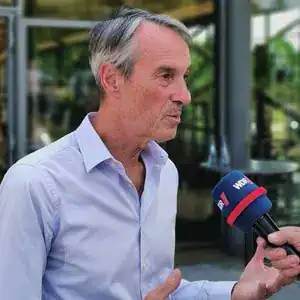
Photo: Unknown photographer / Wikimedia Commons / CC BY-SA 4.0 (editorial use)
Ivo van Hove is a Belgian theatre and opera director whose career has extended from experimental theatre in Flanders to major productions in Amsterdam, London and New York. He became internationally known for productions that combine psychologically intense acting with minimalist stage environments, live video, music and the scenography and lighting of his long-time creative collaborator Jan Versweyveld.
Within David Bowie’s creative history, Van Hove occupies a distinctive position as the director of Lazarus. Written by Bowie and Irish playwright Enda Walsh, the music theatre work was inspired by Walter Tevis’ novel The Man Who Fell to Earth and centred on Thomas Newton, the alien character portrayed by Bowie in Nicolas Roeg’s 1976 film adaptation. The original production began performances at New York Theatre Workshop in November 2015 and officially opened the following month.
Van Hove became one of Bowie’s most important theatrical collaborators during the final period of the artist’s life. While Bowie and Walsh developed the work and its characters, Van Hove was responsible for translating the material into a complete stage production. Working with Versweyveld and the wider creative team, he shaped the acting, visual environment, movement, projections and dramatic presentation through which Bowie’s new and previously recorded songs became part of Newton’s fragmented psychological world.
Although Van Hove and Bowie came from different artistic disciplines, their work shared recurring interests in identity, transformation, isolation, memory and the unstable boundary between reality and imagination. In Lazarus, Bowie’s songs were not presented as a sequence of familiar concert performances. They were placed within a dramatic structure in which individual compositions expressed the memories, desires and emotional conflicts of the characters. The resulting production deliberately avoided the straightforward structure of a biographical or catalogue musical and instead continued the story of Thomas Newton through a fragmented work of music theatre.
- Full name: Ivo van Hove
- Born: 28 October 1958, Kwaadmechelen, Belgium
- Nationality: Belgian
- Profession: Theatre director, opera director and former artistic director
- Long-time creative collaborator: Jan Versweyveld
- David Bowie collaboration: Director of Lazarus, written by David Bowie and Enda Walsh
- Original production: New York Theatre Workshop, 2015–2016
- Bowie significance: Directed the original stage production of Bowie’s final music theatre work
Early Life and Education
Ivo van Hove was born on 28 October 1958 in Kwaadmechelen, a village in the Belgian province of Limburg. He grew up in Kwaadmechelen and, from the age of eleven, attended the Klein Seminarie in Hoogstraten as a boarding-school pupil. He remained there until completing his secondary education.
Van Hove later studied at the Sint-Lucas Institute in Brussels. During this period he met Jan Versweyveld, who would become his long-term scenographer, lighting designer and creative collaborator. Their partnership would eventually shape the visual identity of productions presented throughout Europe and North America, including the original staging of David Bowie and Enda Walsh’s Lazarus.
Van Hove’s formal education took place during a period in which experimental theatre was developing rapidly in Belgium and the Netherlands. Rather than beginning his professional career within one of the established repertory companies, he entered the theatre world by creating and directing his own work. This allowed him to develop his approach outside the conventions of the larger institutions that he would later lead.
In 1981, Van Hove began working professionally as a theatre-maker through his own productions. This marked the beginning of a career that would take him from experimental Flemish theatre companies to Het Zuidelijk Toneel, Toneelgroep Amsterdam, Internationaal Theater Amsterdam and major international stages in London and New York.
The Beginning of a Directorial Career
Ivo van Hove began his career as a theatre director in 1981 with productions of his own making. Among his earliest works were Ziektekiemen (Germs) and Geruchten (Rumours). These productions marked the beginning of his professional work within the experimental Flemish theatre scene.
Rather than entering an established company immediately, Van Hove developed his early career through smaller organisations in which new productions could be created outside the structures of the major repertory theatres. He subsequently became artistic leader of AKT, Akt-Vertikaal and De Tijd.
These successive appointments gave Van Hove experience not only as a director but also as an artistic leader responsible for the wider direction of a theatre company. During this period he worked on original productions and established dramatic texts while building the professional foundations for his later appointments in the Netherlands.
From 1984, Van Hove was also involved in the artistic leadership of the Department of Dramatic Art at the Antwerp higher-education institution now associated with the Royal Conservatoire Antwerp. His work in theatre education developed alongside his directing career and placed him in regular contact with new generations of actors and theatre-makers.
The 1980s therefore formed an important period of practical development. Van Hove progressed from creating his own productions to leading several Flemish theatre organisations, acquiring the artistic and organisational experience that preceded his appointment at Het Zuidelijk Toneel in Eindhoven in 1990.
Building a Reputation in Belgium
Following his first independent productions, Ivo van Hove became increasingly involved in the artistic leadership of several influential Flemish theatre companies. During the 1980s he successively worked with AKT, Akt-Vertikaal and De Tijd, organisations that played an important role in the development of contemporary theatre in Belgium.
These appointments allowed Van Hove to expand his work beyond individual productions. As artistic leader, he became responsible not only for directing plays but also for shaping the broader artistic direction of each company. This combination of creative and organisational responsibility would later become one of the defining characteristics of his career.
During these years Van Hove directed productions ranging from classical drama to contemporary works. Rather than adopting a single theatrical tradition, he explored different dramatic styles while gradually developing an approach that placed strong emphasis on the emotional lives of the characters. His productions increasingly became known for their visual clarity, carefully structured movement and close collaboration with scenographer and lighting designer Jan Versweyveld, whose work became inseparable from Van Hove’s productions.
By the end of the 1980s, Van Hove had established himself as one of the leading theatre directors of his generation within Belgium. His growing reputation attracted attention beyond the country’s borders and led to opportunities in the Netherlands, where larger companies offered the possibility of directing more ambitious productions for wider audiences.
That growing recognition resulted in his appointment as artistic director of Het Zuidelijk Toneel in Eindhoven in 1990. The move marked an important turning point, taking his career from the Flemish theatre world onto a broader international stage.
Het Zuidelijk Toneel (1990–2000)
In 1990, Ivo van Hove became artistic director of Het Zuidelijk Toneel in Eindhoven. He remained in that position until 2000. The appointment marked an important transition in his career, taking him from the Flemish companies through which he had developed his early work to the leadership of a major Dutch theatre organisation.
Van Hove had already worked with Het Zuidelijk Toneel before formally assuming its artistic leadership. In March 1989, he directed Eugene O’Neill’s Rouw siert Electra for the company. His first production there after the beginning of his directorship was Het zuiden, which premiered in September 1990.
During the following decade, Van Hove directed a broad range of classical and modern drama for the company. His productions included Ajax / Antigone, John Ford’s Toch zonde van die hoer, Eugene O’Neill’s Het begeren onder de olmen, Edward Bond’s Gered and William Shakespeare’s Hamlet.
The repertoire demonstrated Van Hove’s continuing interest in stories centred on family conflict, desire, power, violence and psychological isolation. Rather than limiting the company to one theatrical period or dramatic tradition, he worked with texts by classical playwrights as well as twentieth-century authors.
Among the later productions from this period were Jean Genet’s Splendid’s, Tennessee Williams’ De tramlijn die Verlangen heet, Albert Camus’ Caligula, Romeo en Julia (studie van een verdrinkend lichaam), Marguerite Duras’ India Song, De dame met de camelia’s and Susan Sontag’s Alice in bed.
The years at Het Zuidelijk Toneel also strengthened Van Hove’s long-term collaboration with scenographer and lighting designer Jan Versweyveld. Their work developed through close coordination between direction, performance, stage design and lighting. Versweyveld’s visual environments became an essential part of the theatrical language associated with Van Hove’s productions.
Van Hove’s responsibilities extended beyond the direction of individual plays. As artistic director, he was involved in determining the company’s repertoire and overall artistic identity. The position gave him the opportunity to work over several seasons with actors, designers and other theatre-makers while developing productions on a larger institutional scale.
During this period, Van Hove’s work was also presented beyond Eindhoven. His productions increasingly reached theatres and festivals outside the Netherlands, contributing to the international recognition that would become a defining feature of his later career. His growing reputation was therefore built not through a single production, but through a sustained body of work created across the ten years of his leadership.
Alongside his position at Het Zuidelijk Toneel, Van Hove was appointed director of the Holland Festival in 1998. He led the international performing-arts festival until 2004. The appointment further expanded his involvement in international theatre, music, opera and interdisciplinary performance.
Van Hove’s final season with Het Zuidelijk Toneel included De dame met de camelia’s, which premiered in March 2000, and Alice in bed, which followed in June. Together, these productions concluded a decade in which he had directed works by Shakespeare, O’Neill, Williams, Genet, Camus, Duras and other major dramatists.
After leaving Het Zuidelijk Toneel, Van Hove directed the Dutch production of Jonathan Larson’s musical Rent, which premiered in October 2000. In 2001, he succeeded Gerardjan Rijnders as general director of Toneelgroep Amsterdam. That appointment began the next major phase of his career and eventually placed him at the head of one of Europe’s most internationally visible theatre companies.
Toneelgroep Amsterdam and International Recognition
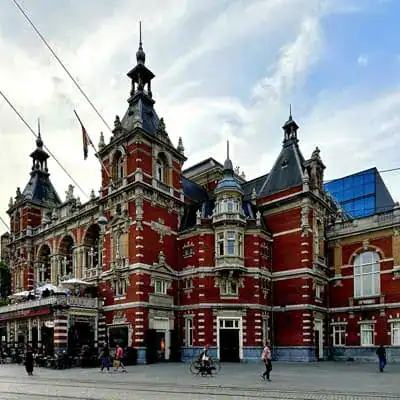
The Stadsschouwburg Amsterdam at Leidseplein, the principal home of Toneelgroep Amsterdam during Ivo van Hove‘s leadership.
Photo: APK / Wikimedia Commons /
CC BY-SA 4.0 (editorial use)
In 2001, Ivo van Hove succeeded Gerardjan Rijnders as general director of Toneelgroep Amsterdam. The appointment placed him at the head of one of the Netherlands’ most prominent theatre companies and began a period of leadership that would continue for more than two decades.
Van Hove combined his responsibilities as general director with his continuing work as a stage director. He was therefore involved both in determining the company’s artistic direction and in creating many of its major productions. His first years included works such as The Massacre at Paris, True Love, Con amore, Carmen, Othello and Three Sisters.
The appointment gave Van Hove the opportunity to develop a long-term repertoire with a permanent acting ensemble. Instead of bringing together a new cast for each production, he could work repeatedly with the same performers over several seasons. This continuity allowed productions to develop through an established working relationship between director, actors and designers.
His collaboration with scenographer and lighting designer Jan Versweyveld remained central to this work. Versweyveld created stage environments in which scenery, architecture, lighting and performance were closely connected. Their productions often removed conventional historical decoration and placed the actors within spaces designed to make the psychological and physical conflicts of the drama immediately visible.
Van Hove’s repertoire at Toneelgroep Amsterdam ranged across classical drama, twentieth-century theatre and adaptations of film and literature. Among the productions he directed during the following years were Scenes from a Marriage, The Taming of the Shrew, Opening Night, Hedda Gabler, Roman Tragedies, Angels in America, Cries and Whispers, Rocco and His Brothers and Teorema.
Several of these productions were based on works originally created for cinema. Van Hove did not attempt to reproduce the films scene by scene. Instead, the source material was reinterpreted for live performance, using actors, cameras, video projections, sound and stage design to create a specifically theatrical experience.
The company’s work increasingly travelled beyond Amsterdam. Productions were presented at international festivals and theatres across Europe, North America and other parts of the world. Van Hove’s work appeared at venues and festivals including the Edinburgh International Festival, the Wiener Festwochen, the Ruhrtriennale, the Festival d’Avignon and the Venice Biennale.
International touring became an important part of Toneelgroep Amsterdam’s identity. The company was no longer presented only as a leading Dutch ensemble, but increasingly as a theatre organisation whose productions could reach audiences beyond the Dutch-speaking world. This international presence also brought Van Hove into closer contact with producers, actors and theatre institutions in London and New York.
Alongside his Amsterdam work, Van Hove continued directing for other institutions. He worked in opera and theatre in Belgium, Germany, France, the United Kingdom and the United States. His productions were presented in cities including Paris, London, New York, Rome, Lisbon, Montréal and Sydney.
His relationship with the New York Theatre Workshop became particularly important. There he directed productions including Henrik Ibsen’s Hedda Gabler in 2004 and Molière’s The Misanthrope in 2007. These projects strengthened his connection with New York theatre and introduced his work to American performers, producers and audiences.
Van Hove also remained director of the Holland Festival until 2004, having taken up that position in 1998. His leadership of the festival developed alongside his first years at Toneelgroep Amsterdam and further expanded his involvement with international theatre, music, opera and performance.
During the following decade, Van Hove’s productions attracted growing recognition outside the Netherlands. His international reputation was built through the combination of Toneelgroep Amsterdam’s touring repertoire and his work as a guest director for major theatre and opera organisations.
In 2018, Toneelgroep Amsterdam and the Stadsschouwburg Amsterdam were brought together under the name Internationaal Theater Amsterdam, commonly abbreviated to ITA. Van Hove continued as the organisation’s general director until 2023.
By the time the ITA name was introduced, Van Hove had already established extensive professional connections in both London and New York. Those relationships would become essential to the next phase of his career, including his Broadway productions and his collaboration with David Bowie and Enda Walsh on Lazarus.
Broadway, Opera and International Theatre
PBS NYC-ARTS profile of theatre director Ivo van Hove.
By the early 2010s, Ivo van Hove had become one of the most internationally recognised theatre directors of his generation. Alongside his continuing work with Toneelgroep Amsterdam, he regularly accepted invitations from major theatre and opera companies throughout Europe and North America. His productions combined psychological realism with contemporary visual design and increasingly reached audiences far beyond the Netherlands.
Van Hove maintained a close relationship with the New York Theatre Workshop, where he directed productions including Henrik Ibsen’s Hedda Gabler and Molière’s The Misanthrope. These productions strengthened his reputation within the American theatre community and established New York as one of the principal centres of his international work.
At the same time, he continued directing opera for leading European companies. His productions included works for the Dutch National Opera, the Flemish Opera, the Paris Opera, the Deutsches Schauspielhaus Hamburg and the Staatstheater Stuttgart. Whether working in theatre or opera, Van Hove remained committed to productions that explored the emotional and psychological complexity of the characters rather than relying on elaborate historical spectacle.
His long-standing collaboration with scenographer and lighting designer Jan Versweyveld continued to define the visual identity of these productions. Together they developed theatrical environments in which architecture, lighting, live performance and, increasingly, video projection became integral parts of the storytelling. Their creative partnership became one of the most influential collaborations in contemporary European theatre.
Ivo van Hove on contemporary theatre
“The theatre is not a museum. It has to speak to the audience of today.”
International recognition accelerated following Van Hove’s acclaimed productions of Arthur Miller’s A View from the Bridge. First staged in Europe before transferring to New York, the production received widespread critical praise for its stripped-back staging and emotionally intense performances. In 2015, Van Hove received the Olivier Award for Best Director for the London production.
The following year, the Broadway transfer earned further international recognition. At the 2016 Tony Awards, Van Hove received the Tony Award for Best Direction of a Play, while the production itself won the Tony Award for Best Revival of a Play. These honours firmly established him among the leading theatre directors working internationally.
His productions continued to tour internationally and were presented at major theatres and festivals throughout Europe, North America and Australia. By combining classical texts with contemporary theatrical language, Van Hove developed a body of work that appealed both to traditional theatre audiences and to new generations of theatregoers.
By the middle of the 2010s, Van Hove had become one of the world’s most respected theatre directors. His international reputation led to new artistic collaborations in New York, where he would soon begin discussions with David Bowie about an ambitious theatrical project that would eventually become Lazarus.
Meeting David Bowie
The collaboration began when producer Robert Fox contacted Ivo van Hove by email and asked whether he would be interested in discussing a theatrical project with David Bowie. The message was so unexpected that Van Hove initially suspected that someone was playing a joke on him.
Ivo van Hove on being contacted about David Bowie
“I thought sincerely that someone was making a joke.”
Van Hove allowed the email to remain unanswered for several days before replying cautiously that they could discuss the proposal. Fox immediately telephoned him and confirmed that the invitation was genuine. Three weeks later, Van Hove travelled to New York to meet Bowie at his premises on Lafayette Street.
Fox had suggested Van Hove because the production was not intended to become a conventional Broadway musical. Bowie and playwright Enda Walsh were developing a new piece of music theatre and needed a director capable of treating the material as an original dramatic work rather than as a retrospective built around Bowie’s best-known songs.
Van Hove approached the meeting with considerable nervousness. He had admired Bowie for many years and had travelled to New York in 1980 to see him perform in The Elephant Man. During their first conversation, however, Van Hove discovered that Bowie had prepared carefully and was familiar with his theatrical work.
Ivo van Hove on his first meeting with David Bowie
“He was such a gentleman, very open, very well-informed. He was so well prepared for our first meeting that he made me immediately calm.”
The conversation quickly developed into a professional exchange between artists. Bowie was not looking for a director who would simply agree with every suggestion. He wanted a collaborator who could respond critically to the developing material and help transform it into a complete theatrical production.
At this first meeting, Bowie revealed relatively little about the project itself. Van Hove was invited back to New York several weeks later, when he joined Bowie and Enda Walsh for a reading of the developing script. Bowie and Walsh read the first act aloud while Van Hove listened without having received the text beforehand.
That reading gave Van Hove his first detailed understanding of the work that would become Lazarus. Inspired by Walter Tevis’s novel The Man Who Fell to Earth, the production would continue the story of Thomas Newton while combining Bowie’s existing catalogue with new songs written specifically for the stage.
The meeting established the foundations of a close creative collaboration between Bowie, Walsh and Van Hove. From that point onward, the project moved from an initial concept towards the development of its script, music, staging and visual language.
The Origins of Lazarus
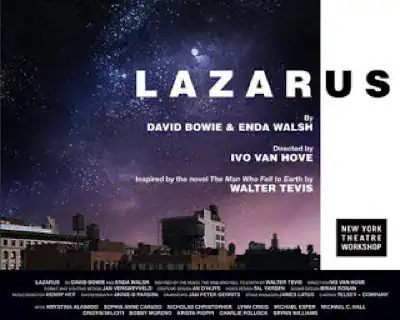
The idea for Lazarus emerged from David Bowie’s long-standing fascination with Walter Tevis’s novel The Man Who Fell to Earth. Bowie had portrayed the novel’s protagonist, Thomas Jerome Newton, in Nicolas Roeg’s acclaimed 1976 film adaptation. Although the film ended ambiguously, Bowie remained intrigued by the character for decades and often reflected on Newton’s loneliness, isolation and inability to return home.
Rather than adapting either the novel or the film for the stage, Bowie wanted to imagine what might have happened to Newton many years later. The result was not intended as a sequel in the traditional sense, but as a new theatrical work inspired by the same character. Newton would once again become the central figure, now trapped in his New York apartment, unable to die and haunted by memories, dreams and hallucinations.
To develop the story, Bowie invited acclaimed Irish playwright Enda Walsh to collaborate on the script. Walsh brought extensive experience in experimental theatre and shared Bowie’s interest in psychologically complex characters. Together they created an original narrative that combined elements of science fiction, memory, fantasy and human emotion while remaining faithful to the spirit of Tevis’s original character.
From the outset, Bowie was determined that Lazarus should not become a conventional jukebox musical. Instead of constructing a storyline around his greatest hits, he wanted every song to serve the drama. Existing compositions were carefully selected because they reflected the emotional journey of the characters, while several completely new songs were written specifically for the production.
Among the new compositions created for Lazarus were Lazarus, No Plan, Killing a Little Time and When I Met You. These songs became an essential part of the narrative rather than separate musical performances, helping to express Newton’s emotional state and the wider themes of mortality, identity and hope.
When Ivo van Hove joined the project, he immediately recognised that Bowie was creating something fundamentally different from a traditional Broadway production. Together with Bowie and Walsh, he developed a theatrical language in which music, dialogue, movement, lighting, stage design and video would function as equal storytelling elements. Their shared ambition was to create a work of contemporary music theatre rather than a retrospective celebration of Bowie’s career.
The creative team was further strengthened by several of Van Hove’s long-standing collaborators. Jan Versweyveld designed the minimalist set and lighting, Tal Yarden created the video projections, An D’Huys designed the costumes, Annie-B Parson was responsible for choreography, and Henry Hey became musical director. Their combined work helped transform Bowie’s ideas into a visually immersive theatrical production.
Throughout the development process, Bowie remained closely involved. He participated in creative meetings, discussed the dramatic interpretation of individual songs and worked alongside Walsh and Van Hove as the production gradually evolved from an initial concept into a fully realised stage work. The collaboration reflected a genuine partnership in which each artist contributed their own expertise while sharing a common artistic vision.
With the script completed, the music taking shape and the visual concept established, the production entered its rehearsal phase at the New York Theatre Workshop, where the creative team would prepare Lazarus for its world premiere in late 2015.
Choosing Ivo van Hove
By 2015 Van Hove had established himself as one of the world’s most respected theatre directors. His productions of A View from the Bridge, The Crucible, Kings of War and numerous other works had demonstrated that emotionally demanding theatre could reach international audiences while receiving widespread critical acclaim. His ability to combine text, music, visual imagery and performance into a single theatrical language made him an ideal collaborator for David Bowie’s theatrical ambitions.
Rather than imposing his own personality upon every production, Van Hove encouraged close collaboration between writers, actors, designers and musicians. This working method appealed strongly to Bowie, who had always preferred collaborative creativity over rigid hierarchy. Throughout his career Bowie surrounded himself with artists capable of challenging his ideas rather than simply executing them, and Van Hove shared that same philosophy.
An equally important figure in the developing production was Jan Versweyveld, Van Hove’s long-time creative partner and one of Europe’s most respected stage designers and lighting designers. Together, Van Hove and Versweyveld had spent decades refining a visual language that relied upon carefully controlled architecture, projections, lighting and movement instead of elaborate theatrical spectacle. Their aesthetic proved perfectly suited to the dreamlike world Bowie hoped to create.
Ivo van Hove on David Bowie
“After the workshop in December he said to me that this was what he had always wanted: ‘a theatre play with my music.'”
Van Hove later recalled that Bowie’s remark confirmed the importance of the project. Lazarus was never intended as a retrospective celebration of his career. Instead, Bowie viewed it as an opportunity to create an original work of music theatre in which his songs became inseparable from the dramatic action rather than existing as stand-alone performances, reflecting an ambition he had explored for many years.
Developing the Production
During the early development of the production, David Bowie, Ivo van Hove, Enda Walsh and Jan Versweyveld worked together to explore how music, dialogue and visual storytelling could be combined into a single theatrical experience. Rather than working from a fully completed script, the production continued to evolve through discussion, experimentation and rehearsal. Bowie introduced existing songs that acquired entirely new meanings within the developing narrative, while simultaneously composing new material specifically for the stage production.
Several of those new compositions—including Lazarus, No Plan, Killing a Little Time and When I Met You—would later appear on the No Plan EP following Bowie’s death. During rehearsals, however, they existed purely as dramatic elements written to illuminate the emotional lives of the characters rather than as future recordings.
Van Hove encouraged performers to approach the songs as extensions of spoken dialogue instead of conventional musical numbers. Characters did not simply stop to sing; they expressed thoughts and emotions that ordinary speech could no longer communicate. This approach fundamentally distinguished Lazarus from most jukebox musicals and reflected Bowie’s determination to create something entirely new.
As rehearsals progressed, the collaboration developed into a genuine exchange of ideas between equals. Bowie remained deeply involved in discussions surrounding structure, pacing and emotional tone, while trusting Van Hove and Walsh to shape the theatrical form. The resulting production combined Bowie’s music, Walsh’s script and Van Hove’s theatrical direction into a unified artistic vision, supported throughout by Jan Versweyveld’s visual design.
Rehearsals and David Bowie’s Commitment
As rehearsals for Lazarus progressed during 2015, only a very small circle of collaborators knew that David Bowie was seriously ill. Publicly, there was no indication that anything was wrong. Bowie had returned to recording after the success of The Next Day in 2013 and appeared fully engaged with his latest creative projects. Privately, however, he had already been diagnosed with liver cancer, a fact he shared only with family members and a handful of trusted collaborators, including Ivo van Hove.
Van Hove later revealed that Bowie told him about the diagnosis shortly after receiving the news himself. The disclosure was not intended to alter the production but to explain that there might be occasions when medical treatment prevented him from attending rehearsals. Even then, Bowie insisted that work on Lazarus should continue exactly as planned.
Despite the physical demands of his illness and treatment, Bowie remained closely involved throughout the creative process. He attended rehearsals whenever his health allowed, discussed scenes with Van Hove and Enda Walsh, reviewed musical arrangements and continued refining newly written songs. Members of the company repeatedly commented on his calm presence and his determination to focus entirely on the work rather than on his medical condition.
For Van Hove, the experience was unlike any previous collaboration. While rehearsals often involved practical discussions about staging, music and character development, they also carried an emotional weight that only a handful of people understood. Bowie was creating one of the most personal works of his career while simultaneously confronting the reality of a terminal illness, yet he rarely allowed that struggle to dominate the rehearsal room.
Ivo van Hove on David Bowie’s illness
“He told me that because he knew he might not always be able to be there.”
— Ivo van Hove (NOS, January 2016)
Van Hove later explained that Bowie never used his illness as an excuse or sought sympathy from those around him. Instead, he wanted everyone involved to continue working towards the best possible production. The director recalled that Bowie’s focus never shifted away from the artistic challenges of Lazarus, even during periods when treatment affected his ability to attend rehearsals.
The World Premiere of Lazarus
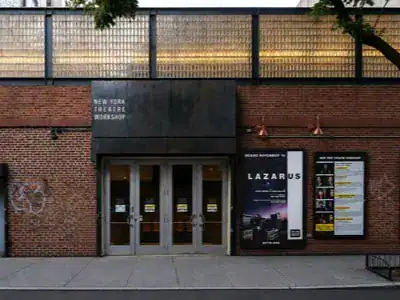
The New York Theatre Workshop in Manhattan, New York, where Lazarus received its world premiere on 7 December 2015.
Photo: Ajay Suresh / Wikimedia Commons /
CC BY 2.0 (editorial use)
Lazarus received its world premiere at the New York Theatre Workshop on 7 December 2015. Directed by Ivo van Hove, with a script by Enda Walsh and music by David Bowie, the production starred Michael C. Hall as Thomas Jerome Newton alongside a supporting cast that included Sophia Anne Caruso, Michael Esper, Cristin Milioti and Charlie Pollock. Rather than presenting a conventional narrative, the production unfolded as a dreamlike psychological journey in which memory, fantasy and reality continually merged.
Audience reactions reflected the production’s originality. Some viewers found its fragmented structure deliberately challenging, while others regarded it as one of the boldest theatrical experiences of the decade. Many critics praised the visual world created by Van Hove and Jan Versweyveld, whose minimalist design, carefully choreographed movement and striking use of projections allowed Bowie’s music to become fully integrated into the dramatic action.
Bowie himself attended the opening night. To those present, he appeared cheerful, engaged and delighted by the audience’s response. Few realised that the occasion would become one of his final public appearances. Standing alongside Van Hove, Enda Walsh and the cast during the curtain call, Bowie celebrated the successful premiere of a project that had occupied much of his creative attention during the previous year.
Ivo van Hove reflects on David Bowie and Lazarus.
For Van Hove, however, the evening carried a deeper emotional significance. Unlike almost everyone else in the theatre, he understood the immense physical effort Bowie had invested simply to reach opening night. The celebration marked the completion of a project that had become one of the most significant creative collaborations of Bowie’s later career.
Ivo van Hove on opening night
“A few weeks ago I was standing beside him on stage after the premiere of Lazarus. When I got into the car I realised it might be the last time I would ever see him.”
— Ivo van Hove (NOS, January 2016)
Those words, spoken only hours after Bowie’s death became public on 11 January 2016, captured the extraordinary emotional burden Van Hove had carried throughout the final months of the production. While audiences experienced Lazarus as an innovative piece of music theatre, Van Hove understood that it also represented the final major artistic collaboration of one of the twentieth century’s most influential musicians.
David Bowie’s Final Weeks
Less than five weeks after the opening of Lazarus, David Bowie released his final studio album, Blackstar, on 8 January 2016, his sixty-ninth birthday. Although critics immediately recognised the album as one of the strongest works of his later career, few people outside Bowie’s closest circle realised that it had been created alongside Lazarus during the same intensely productive period. Together, the album and the stage production explored many of the same themes, including mortality, memory, transformation and acceptance.
Only two days later, on 10 January 2016, David Bowie died at his New York home after an eighteen-month battle with liver cancer. The announcement shocked the world. Fans, musicians, actors, artists and journalists had been completely unaware of the seriousness of his illness. The news was reported prominently by media organisations across the world, marking the passing of one of modern music’s most influential figures.
For Ivo van Hove, the loss was both professional and deeply personal. During the previous year they had worked together almost continuously, discussing scripts, rehearsals, staging, music and the emotional direction of Lazarus. While millions of people were only beginning to understand the significance of Bowie’s final works, Van Hove already knew that the production had represented one of Bowie’s final and most significant artistic collaborations.
Reflecting on David Bowie
Speaking to Dutch broadcaster NOS shortly after Bowie’s death, Van Hove described David Bowie as an exceptionally generous and collaborative artist. Rather than focusing on Bowie’s international fame, he recalled a creative partner who approached rehearsals with curiosity, kindness and genuine enthusiasm for the ideas of others.
Ivo van Hove on David Bowie
“He was unbelievably generous. He never behaved like a superstar. He was completely open to ideas from everyone involved.”
Van Hove repeatedly emphasised that Bowie viewed theatre as a collaborative art form. Rather than dictating creative decisions, he encouraged discussion and carefully considered suggestions from actors, musicians and the production team. This openness created an atmosphere in which everyone involved felt able to contribute to the development of Lazarus.
The director also recalled Bowie’s remarkable sense of humour. Throughout the development of Lazarus, he continued to joke with colleagues, remained fascinated by new creative ideas and displayed an extraordinary determination to keep working. Those qualities left a lasting impression on everyone involved in the production.
The Continuing Life of Lazarus
Following David Bowie’s death, Lazarus assumed an even greater significance. What had originally been presented as an ambitious new theatrical work was now recognised as the final major artistic collaboration of Bowie’s life. Audiences returned to the production with a deeper understanding of its themes, while critics increasingly viewed it alongside Blackstar as part of Bowie’s final creative period.
Following its original engagement at the New York Theatre Workshop, Lazarus received its European premiere at King’s Cross Theatre in London in 2016. In the years that followed, licensed productions were staged in several countries, including the Netherlands, Germany and other international theatre venues, demonstrating that the work possessed a theatrical life well beyond its original New York production.
Van Hove remained closely associated with Lazarus and repeatedly emphasised that it should first be understood as a fully realised work of theatre rather than simply as David Bowie’s farewell. Although Bowie’s death inevitably influenced the way audiences interpreted the production, Van Hove believed its artistic value extended far beyond the circumstances surrounding its creation.
Today, Lazarus occupies a distinctive place within contemporary music theatre. It brought together David Bowie’s music, Enda Walsh’s script and Ivo van Hove‘s direction in a production that blurred the boundaries between rock music, drama and visual performance. Its continuing international productions demonstrate the lasting impact of one of Bowie’s most ambitious theatrical projects.
Legacy
Today, Ivo van Hove is widely regarded as one of the leading theatre directors of his generation. His productions have fundamentally influenced contemporary theatre through their combination of psychological realism, visual minimalism and emotional intensity. Rather than relying upon spectacle for its own sake, Van Hove has consistently demonstrated that powerful storytelling emerges from the relationship between actors, text, music and carefully considered stage design.
Throughout a career spanning more than four decades, he has directed productions ranging from Greek tragedy and Shakespeare to Arthur Miller, Ayn Rand, Ingmar Bergman, Tony Kushner and contemporary opera. His work has appeared at many of the world’s leading cultural institutions, including Broadway, London’s West End, the Metropolitan Opera, the Paris Opera, the Comédie-Française and major international theatre festivals. His productions have received numerous international awards and nominations, recognising both his artistic achievements and his lasting influence on modern performance.
Among this remarkable body of work, Lazarus occupies a unique place. Unlike many productions that reinterpret an existing work, it originated through an exceptionally close collaboration between three artists from different creative disciplines. David Bowie’s music, Enda Walsh’s script and Van Hove’s direction became inseparable components of a single theatrical vision, with each artist contributing a distinct creative discipline to the finished production.
For David Bowie, Lazarus represented the realisation of his ambition to create an original work of music theatre rather than a conventional stage musical built around previously released songs. For Van Hove, the collaboration became one of the defining artistic experiences of his career. Their partnership demonstrated how musicians and theatre directors from different artistic traditions could create something entirely original while remaining faithful to their individual creative identities.
More than a decade after its premiere, Lazarus continues to be studied as one of the most important theatrical works associated with David Bowie. It is performed internationally, discussed in academic research and recognised as an innovative fusion of rock music, drama and visual storytelling. The production also remains one of the clearest demonstrations of Van Hove’s belief that theatre should challenge audiences emotionally rather than simply entertain them.
Within David Bowie’s extraordinary network of collaborators, Ivo van Hove occupies a distinctive position. While many musicians, producers and performers helped shape Bowie’s recorded legacy, Van Hove became the director entrusted with translating Bowie’s final theatrical vision into reality. Their collaboration stands as one of the defining creative partnerships of Bowie’s final years and ensured that his lifelong fascination with theatre found its fullest expression on the stage.
Official Website & Further Information
For readers wishing to explore Ivo van Hove‘s work in greater depth, the official website of Internationaal Theater Amsterdam provides biographies, production information and details of its productions and artistic programme. Additional information about Lazarus can also be found through the New York Theatre Workshop, where the production received its world premiere in December 2015.
DavidBowieWorld.com is dedicated to documenting the careers of David Bowie’s collaborators through carefully researched historical information and, where available, first-hand contributions from the artists themselves. This page will continue to be updated as new verified information becomes available.
Article Origin
This article has been researched and written exclusively for DavidBowieWorld.com using verified historical sources, official theatre archives, published interviews, production documentation, contemporary reports and first-hand statements by Ivo van Hove relating to the development of Lazarus. Every effort has been made to distinguish documented historical fact from interpretation while presenting an accurate account of one of David Bowie’s final major artistic collaborations.
