
David Bowie at Earls Court 1978
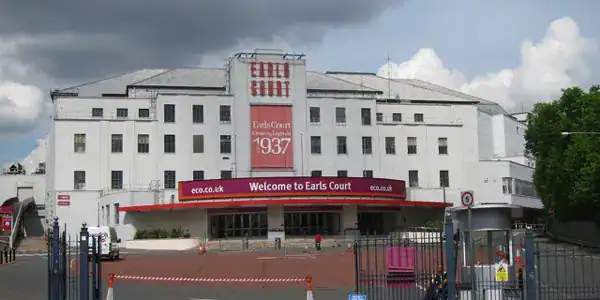
Image: David Bowie World collection / editorial use
David Bowie’s performances at Earls Court in June and July 1978 stand among the most important British concerts of his late-1970s career. Taking place during the Isolar II World Tour, the three London shows brought the musical world Bowie had developed around Low and “Heroes” into one of Britain’s major indoor concert venues.
Bowie performed at Earls Court on 29 June, 30 June and 1 July 1978. The concerts combined his recent experimental material with songs from several earlier phases of his career, all interpreted through the distinctive sound of the 1978 touring band.
The final two concerts acquired particular historical importance. The performances of 30 June and 1 July were professionally recorded and eventually formed the basis of Welcome to the Blackout (Live London ’78).
The Earls Court engagement therefore survives as an important document of a period in which Bowie had moved away from the elaborate stage characters of earlier years and placed increasing emphasis on musicianship, arrangements, sound and atmosphere.
- Artist: David Bowie
- Venue: Earls Court Exhibition Centre, London
- Dates: 29 June, 30 June & 1 July 1978
- Tour: Isolar II World Tour
- Associated albums: Low and “Heroes”
- Lead guitar: Adrian Belew
- Rhythm guitar / musical director: Carlos Alomar
- Bass: George Murray
- Drums: Dennis Davis
- Additional musicians: Roger Powell, Sean Mayes and Simon House
- Recorded concerts: 30 June and 1 July 1978
- Official Earls Court live release: Welcome to the Blackout (Live London ’78)
- Original 1978 tour live album: Stage
- Film connection: The Earls Court performances were professionally filmed under the direction of David Hemmings
1978: A defining Bowie moment
By 1978, David Bowie had undergone one of the most radical transformations of his career. The albums Low and “Heroes” had introduced electronic textures, atmospheric instrumental pieces and unconventional song structures into his work.
Tony Visconti and Brian Eno played important roles in the development of this music, while Bowie’s experiences in Europe during the second half of the 1970s helped shape recordings that were dramatically different from the glam-rock and soul periods that had preceded them.
The Isolar II Tour gave Bowie the opportunity to translate this music into a large-scale concert setting. Rather than simply reproducing the studio recordings, the touring musicians gave the material a powerful live character while retaining many of its unusual structures and textures.
At Earls Court this approach was presented to a huge London audience. Songs from Bowie’s newest work appeared alongside material reaching back to the Ziggy Stardust years and his mid-1970s albums.
The Isolar II Tour sound
David Bowie live at Earls Court, London, 29 June 1978
The Isolar II Tour was markedly different from Bowie’s earlier theatrical productions. The elaborate characters and narrative stage concepts associated with periods such as Ziggy Stardust and Diamond Dogs had largely disappeared. The emphasis was increasingly placed on music, lighting, atmosphere and the precision of the performances.
The concerts brought together remarkably different parts of Bowie’s catalogue. Experimental and atmospheric material from Low and “Heroes” could appear alongside songs such as Ziggy Stardust, Station to Station, Fame and Rebel Rebel.
Rather than presenting Bowie’s career chronologically, the arrangements allowed different periods to coexist within the distinctive musical language of the 1978 touring band.
The band and performance style
The Isolar II band brought together musicians from several different periods of Bowie’s career and combined them with important new collaborators.
Adrian Belew handled lead guitar, while longtime Bowie collaborator Carlos Alomar played rhythm guitar and served as musical director. The rhythm section consisted of George Murray on bass and Dennis Davis on drums and percussion.
The band was expanded by Roger Powell on keyboards and synthesizer, Sean Mayes on piano and string ensemble and Simon House on electric violin.
Belew’s highly individual guitar playing added an unpredictable element to the arrangements, while Alomar, Murray and Davis supplied the tightly controlled rhythmic foundation that had become central to Bowie’s music during the mid-to-late 1970s.
Bowie himself adopted a comparatively restrained stage presence. Rather than introducing another strongly defined theatrical persona, he placed increasing emphasis on his performance, the songs and the musicians surrounding him.
Earls Court in 1978
Earls Court, London, during David Bowie’s 1978 Isolar II Tour engagement
Earls Court was already one of London’s best-known large indoor venues when Bowie arrived for three consecutive concerts during the summer of 1978.
The engagement began on 29 June and continued on 30 June and 1 July. The London concerts came during the European leg of an extensive tour that had already taken Bowie and his band through North America and continental Europe.
Audiences encountered a very different Bowie from the performer who had toured Britain during the Ziggy Stardust years. The elaborate personas had receded and the musicians themselves had become a central part of the presentation.
The scale of Earls Court also demonstrated that Bowie’s newer and more experimental material could function successfully in a major arena without abandoning the unusual qualities that had defined the studio recordings.
The final two concerts were recorded
The Earls Court performances on 30 June and 1 July 1978 were professionally recorded, preserving the Isolar II band during one of the major London engagements of the tour.
Tony Visconti was involved in recording the concerts. The resulting tapes would eventually provide the source for one of the most important archival live releases in Bowie’s catalogue: Welcome to the Blackout (Live London ’78).
For many years, however, the complete Earls Court recordings remained unavailable as an official standalone concert album.
A rare performance of Sound and Vision
The final Earls Court concert on 1 July 1978 included one particularly unusual performance: Sound and Vision.
Although the song had become one of the best-known tracks from Low, it was not a regular part of the Isolar II set. Its appearance at Earls Court therefore became one of the distinctive moments associated with the London engagement.
The performance was preserved on the recordings made that evening and later appeared on Welcome to the Blackout (Live London ’78).
The David Hemmings concert film
The Earls Court concerts were also professionally filmed under the direction of British actor and filmmaker David Hemmings.
The intention was to create a substantial filmed document of Bowie and the Isolar II band. The resulting project, however, was never commercially released as a complete concert film.
Some of the Earls Court footage survived and portions have appeared publicly, providing rare visual documentation of Bowie and the band during the London concerts.
The existence of both professional audio recordings and filmed material makes Earls Court one of the most extensively documented engagements of the 1978 tour, even though the complete Hemmings film remains unreleased.
From Earls Court to Welcome to the Blackout
The recordings from 30 June and 1 July 1978 eventually became the basis of Welcome to the Blackout (Live London ’78).
For decades the recordings remained in the archive before finally appearing as a complete official concert release.
In 2018, Welcome to the Blackout was first issued as a three-LP set for Record Store Day, followed by wider availability.
Its release finally allowed Bowie’s Earls Court performances to be experienced as a distinct live document rather than simply as part of the wider history of the Isolar II Tour.
Stage and the 1978 tour
Bowie had already released an official live album from the Isolar II Tour during 1978: the double album Stage.
It is important to distinguish Stage from the Earls Court recordings. Stage documented performances recorded elsewhere during the tour, while Welcome to the Blackout comes directly from the London concerts of 30 June and 1 July.
The two releases nevertheless document the same remarkable touring ensemble and the same basic artistic concept.
Both demonstrate how Bowie and his musicians integrated recent experimental material with dramatically different music from earlier stages of his career.
Historical importance of Earls Court 1978
The Earls Court concerts stand as one of the major British showcases of Bowie’s late-1970s musical transformation.
They demonstrated that music developed through unusual and often experimental studio techniques could be transferred successfully to a large concert environment without losing its distinctive character.
At the same time, Bowie did not abandon his earlier catalogue. Songs associated with Ziggy Stardust, his mid-1970s soul period and Station to Station were reinterpreted by the Isolar II musicians and placed alongside the newer material.
The concerts were therefore not simply retrospective performances. Earlier songs were being presented through the musical language and discipline of Bowie’s 1978 band.
After Earls Court
The Earls Court concerts did not mark the end of the Isolar II World Tour. Bowie continued touring later in 1978, eventually taking the production to Australia, New Zealand and Japan.
The tour finally concluded in December 1978, bringing one of the most extensive and musically adventurous touring periods of Bowie’s career to an end.
Bowie would not undertake another comparable international concert tour until the Serious Moonlight Tour in 1983. By then his music, visual presentation and commercial position had changed dramatically once again.
Legacy
The Earls Court performances remain an important part of the history of David Bowie’s Isolar II World Tour.
They brought the experimental musical language of Low and “Heroes” into a major London arena while simultaneously revisiting important parts of Bowie’s earlier catalogue.
Their historical importance increased considerably with the eventual release of Welcome to the Blackout (Live London ’78), which finally allowed the performances from 30 June and 1 July to be heard as an official Earls Court live document in their own right.
Together with the surviving David Hemmings film footage and contemporary recordings, the concerts preserve Bowie at one of the most musically adventurous points of his live career.
The three nights at Earls Court capture an artist who was no longer dependent on the theatrical personas that had first made him famous, but who was still constantly reshaping both his music and the way it could be presented on stage.
