
Life on Mars? — The Story Behind the Song

“Life on Mars?” begins with a young girl seeking escape and grows into a sweeping encounter with cinema, popular culture and disappointment. First released on Hunky Dory in 1971, it became a UK hit single in 1973, when David Bowie’s public image had changed dramatically.
The recording brings together Rick Wakeman‘s piano, Mick Ronson‘s string arrangement and guitar, and a vocal that moves from intimate storytelling to a soaring refrain. Mick Rock’s later promotional film gave the song an equally memorable visual identity.
Its history also includes an unsuccessful English adaptation of a French song, Bowie’s response to “My Way” and a studio telephone that rang at exactly the wrong moment. These separate stories reveal how a composition, a recording and a filmed performance became connected.
- Songwriter: David Bowie
- Recorded: 1971, Trident Studios, London
- First album release: Hunky Dory (1971)
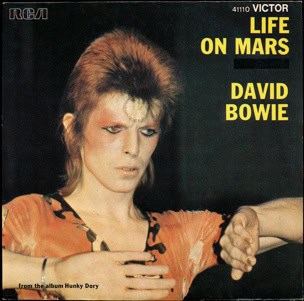
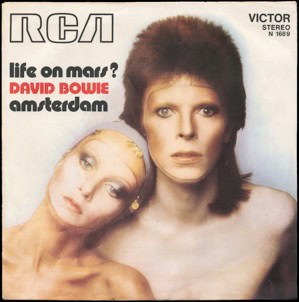
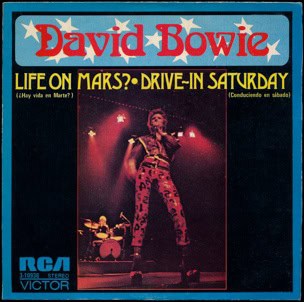
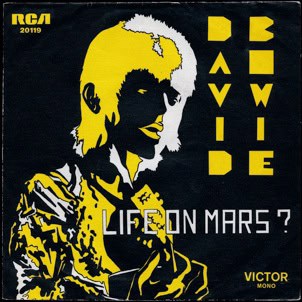
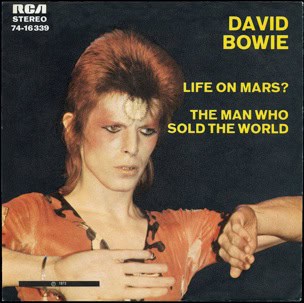
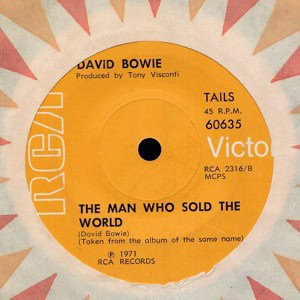
- UK single release: 22 June 1973, RCA
- Production: David Bowie and Ken Scott
- Piano: Rick Wakeman
- Guitar and string arrangement: Mick Ronson
- Bass: Trevor Bolder
- Drums: Mick “Woody” Woodmansey
- UK singles chart peak: No. 3
- Promotional film: Directed by Mick Rock, 1973
Before “Life on Mars?”: the “My Way” connection
In 1968, Bowie wrote English lyrics for the French song “Comme d’habitude”. His version, “Even a Fool Learns to Love”, remained a demo. Paul Anka subsequently supplied different English words, creating “My Way”, which became associated with Frank Sinatra.
Bowie later acknowledged that “Life on Mars?” grew partly out of his reaction to that experience. He described it as his own modern response to “My Way”, with deliberately related passages of melody. On the back of Hunky Dory, he signalled the connection with the handwritten note “Inspired by Frankie”.
The relationship is musical and historical: “Life on Mars?” is credited to Bowie as a separate composition. Its heroine, fragmented scenes and unresolved question give it a narrative very different from the retrospective declaration of “My Way”.
“there are clutches of melody in it that were definite parodies of My Way”
David Bowie, interview excerpt reproduced on his official website, February 2008.
A melody on the way back to Haddon Hall
In a recollection published in 2008, Bowie described a sunny day in Beckenham, sitting near a park bandstand, followed by an intended shopping trip to Lewisham. A musical idea stayed with him so insistently that he abandoned the bus journey after two stops and returned to his home on Southend Road.
At Haddon Hall, he worked at the grand piano in a sparsely furnished room. According to that account, he completed the words and melody by late afternoon. This is Bowie’s retrospective memory of the writing process, rather than a contemporary session diary.
“had the whole lyric and melody finished by late afternoon”
David Bowie, iSELECT recollections, reproduced on his official website, June 2008.
Recording at Trident Studios
“Life on Mars?” was recorded at Trident Studios in London during the 1971 Hunky Dory sessions, with Bowie and Ken Scott responsible for production. Trevor Bolder played bass and Woody Woodmansey played drums, alongside Wakeman and Ronson.
The recording moves from the exposed piano-and-voice opening towards a fuller ensemble sound. Rather than maintaining one level of intensity, the musicians support a succession of rises and releases, giving the refrain its dramatic scale.
Rick Wakeman and the piano part
Bowie’s account credits Rick Wakeman with embellishing the piano part after the song had been written. That distinction matters: Bowie supplied the composition, while Wakeman helped shape the piano performance heard on the record.
The piano does more than accompany the singer. Its changing chords and decorative phrases help guide the listener between sections, sometimes supporting the vocal quietly and sometimes pressing the music forward. The performance lets the song retain a sense of movement even before the arrangement reaches its largest moments.
Mick Ronson‘s strings and guitar
Mick Ronson supplied the string arrangement as well as guitar. Bowie later singled out the orchestral contribution for praise, identifying it as an important early example of Ronson’s arranging work.
The strings give the refrain breadth, while the guitar introduces a different texture within the same performance. Heard together, these parts show how Ronson could contribute both the physical sound of an instrumentalist and the larger shape of an arrangement.
The result is theatrical without needing an elaborate story outside the song. Piano, strings, rhythm section and voice provide the shifts of scale themselves, turning the girl’s visit to the cinema into something much larger.
The girl, the cinema and the media
Bowie’s handwritten notes described the song in terms of a young girl’s reaction to the media. An earlier wording referred more specifically to songs such as “My Way”, films such as Love Story and newspapers. The surviving annotation provides a useful starting point for reading the lyric.
The girl looks towards entertainment as an escape, but the spectacle before her offers little comfort. The lyric then moves through abrupt images of public life and popular culture. These transitions can be read as a montage: the audience encounters one scene after another without receiving a reassuring explanation.
From that perspective, the title’s question suggests a wish for somewhere beyond a disappointing world. This is an interpretation of the song’s imagery, rather than a claim that Bowie provided one definitive explanation for every line.
From “Hunky Dory” to the 1973 single
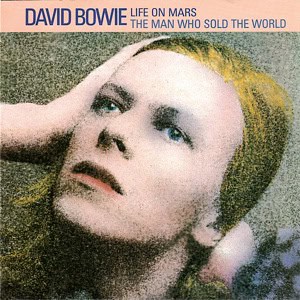
“Life on Mars?” first reached listeners on Hunky Dory in 1971. Its release as a UK single followed on 22 June 1973, after the success of Ziggy Stardust and Aladdin Sane had substantially increased Bowie’s audience.
Official Charts records its UK chart debut on 30 June 1973 and a peak of No. 3. The single brought an earlier album recording into Bowie’s current success: the music belonged to 1971, while its promotion belonged to the later glam period.
Mick Rock’s film: the blue suit and the white background
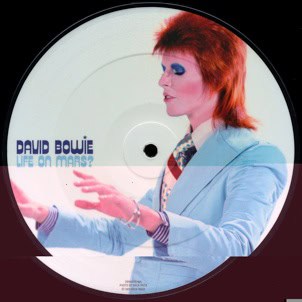
Mick Rock directed the promotional film in 1973. Bowie performs against a white background in a turquoise-blue suit associated with designer Freddie Buretti, with striking make-up by Pierre Laroche.
The film concentrates on Bowie’s face, gestures and appearance instead of illustrating each scene in the lyric. The clean background makes the colours and expressions especially prominent, giving a visually restrained setting to a highly dramatic performance.
Although the recording predates Ziggy Stardust’s breakthrough, this is the Bowie image of 1973. The film therefore connects two stages of his career without changing the age of the underlying song.
The telephone hidden in the ending
Ken Scott recalled a telephone ringing during an earlier take, its sound entering the piano microphones. The musicians recorded another take, but a surviving fragment of the interrupted performance was later heard when they were working on the orchestral overdubs.
They liked the effect and retained the earlier material at the end. The released fade curtailed Ronson’s frustrated language. The strange closing sounds therefore preserve a real studio interruption rather than a specially scripted scene.
“Much to our surprise, it sounded great, so we decided that we had to use it.”
Ken Scott, recollection quoted by the Independent Society of Musicians.
Revisiting the recording: “Divine Symmetry”
The Divine Symmetry box set, released in 2022, included the song’s demo and an “original ending version”. Its credits identify the latter as a mix prepared by Ken Scott in 2021.
These versions offer different views of the same work: the demo brings the listener closer to the composition, while the alternative ending exposes more of the studio recording. They are archival presentations, not new performances by Bowie.
“Life on Mars?” on stage
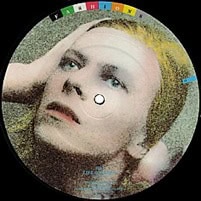
A live recording from the Music Hall in Boston on 1 October 1972 was used for the song’s 2013 anniversary picture disc. It documents the song during the Ziggy touring period, before its original UK single release.
Another notable performance came at Glastonbury on 25 June 2000. “Life on Mars?” formed part of Bowie’s headline set, officially released as Glastonbury 2000 in 2018. Placed beside songs from later decades, it remained an important part of the repertoire.
A question carried by the music
The song’s emotional force comes from the relationship between its uneasy scenes and its expansive music. The words keep changing the picture, while the performance gives those changes a continuous dramatic shape.
Following its history reveals several distinct contributions: Bowie’s composition, Wakeman’s piano, Ronson’s arrangement, Scott’s production and Rock’s film. Each helps explain how a song first heard on Hunky Dory acquired such a lasting identity.
Single releases and editions
Sources and further reading
- David Bowie — the “My Way” connection and interview excerpt.
- David Bowie — his recollections of writing the song, Wakeman and Ronson.
- David Bowie — handwritten notes and the 1973 single.
- Independent Society of Musicians — musicians, recording and Ken Scott‘s telephone recollection.
- Official Charts — UK singles chart history.
- Life on Mars? — reference overview and bibliography for the promotional film.
- David Bowie — Divine Symmetry track listing and recording credits.
- David Bowie — single anniversary and the Boston live recording.
- David Bowie — Glastonbury 2000 release details.
Original article text © DavidBowieWorld.com — Diedrich Streuper. Quoted material belongs to its respective rights holders.
← Back to Song Stories
Leave a comment