
Les Mighall – Drums with Davie Jones and The Lower Third
Les Mighall was a drummer with The Lower Third, the Margate group joined by Davie Jones – the future David Bowie – in the spring of 1965.
Together with guitarist Denis “Tea-Cup” Taylor and bassist Graham Rivens, Mighall was part of the Lower Third line-up that was already established before Jones joined the group. His time alongside Jones was short: within a few months Mighall had left and Phil Lancaster took over on drums.
Mighall therefore belongs to a very specific point in Bowie’s early history: the first stage of his association with The Lower Third, before the better-documented later line-up and before David Jones publicly established the name David Bowie.
- Name: Les Mighall
- Born: 10 March 1943
- Died: 11 March 2008
- Instrument: Drums
- Band: The Lower Third
- Worked with Davie Jones: 1965
- Lower Third colleagues: Denis “Tea-Cup” Taylor and Graham Rivens
- Replaced on drums by: Phil Lancaster
- Bowie period: The earliest months of Davie Jones and The Lower Third
The Lower Third before Davie Jones
The history of The Lower Third began in Margate, Kent, before David Jones became involved with the group.
The band’s early history is sometimes described differently in retrospective sources, particularly concerning its beginnings under the name Oliver Twist and The Lower Third. What is firmly relevant to Mighall’s Bowie connection is that, by the time the musicians decided to pursue professional work in London, the core group included guitarist Denis Taylor, bassist Graham Rivens and drummer Les Mighall.
They therefore had an established musical relationship before meeting Davie Jones. Bowie did not originally assemble The Lower Third as his own backing band; he joined musicians who were already working together.
Moving towards London
The Lower Third emerged from the lively music scene around Margate and the Kent coast. As their ambitions developed, Taylor, Rivens and Mighall moved towards professional work and increasingly focused their activities on London.
This placed the group within the rapidly changing British music scene of the mid-1960s, when rhythm and blues, beat music and the developing mod culture were reshaping clubs and live venues across the capital.
At the same time, Davie Jones was reaching the end of another stage of his own musical apprenticeship.
Davie Jones before The Lower Third
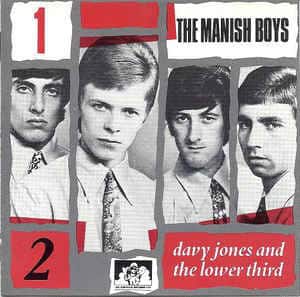
The Manish Boys with Davy Jones – “I Pity the Fool”, released in 1965.
By the spring of 1965, Jones had already worked with several groups, including The Konrads, The King Bees and The Manish Boys.
The young singer and saxophonist was ambitious but had yet to achieve commercial success. His early recordings were heavily influenced by American rhythm and blues, while his musical interests were continuing to develop alongside the changing British beat scene.
After his period with The Manish Boys came to an end, Jones was again looking for musicians with whom he could continue performing and developing his own material.
Davie Jones joins The Lower Third
The Lower Third held auditions at La Discotheque in Soho, London, and Davie Jones successfully joined the group in the spring of 1965.
The resulting line-up featured Davie Jones on vocals and saxophone, Denis “Tea-Cup” Taylor on guitar, Graham Rivens on bass and Les Mighall on drums. Neil Anderson is also documented as contributing occasional vocals during this period.
For Mighall, this marked the beginning of his brief direct association with the musician who would later become David Bowie.
Davie Jones and The Lower Third on stage
The Mighall line-up belongs to the earliest live period of Davie Jones and The Lower Third.
One documented appearance took place at the Grand Hotel in Littlestone, Kent, on 17 May 1965. Further performances followed during the spring and early summer as Jones established himself as the group’s frontman.
The surviving documentation for these early appearances is less complete than it is for Bowie’s later career, and not every performance from this period can be reconstructed with certainty. What can be established is that Mighall was the drummer during the first months of Jones’s association with the band.
A new direction for Davie Jones
Davy Jones – “You’ve Got a Habit of Leaving”, 1965. The recording illustrates the harder musical direction associated with the later Lower Third period.
The Lower Third arrived at an important transitional point in Jones’s development.
His earlier groups had drawn heavily on American rhythm and blues. The Lower Third also worked from an R&B foundation, but Jones increasingly wanted to adapt that music to the harder sound of contemporary British beat groups.
Looking back on The Lower Third in a 1983 interview, Bowie described the group as attempting to be a rhythm-and-blues band and recalled that they played a considerable amount of material associated with John Lee Hooker, trying to adapt it to the “big beat”.
That recollection helps place Mighall’s short period with Jones in its proper musical context. This was still an exploratory stage, before Bowie had developed the distinctive songwriting and artistic identity that would define his later career.
Les Mighall leaves The Lower Third
Mighall’s time alongside Davie Jones did not last long.
By the summer of 1965, Phil Lancaster had taken over as drummer in The Lower Third. Sources commonly place the change around July 1965.
The surviving published evidence does not provide enough reliable detail to reconstruct Mighall’s personal reasons for leaving. It is therefore better to record the personnel change without attaching an undocumented explanation to it.
His departure created an important dividing line in Bowie’s Lower Third history: Mighall belonged to the first months with Jones, while Lancaster became the drummer during the subsequent and better-documented phase of the group.
The recording question
The distinction between Mighall and Lancaster is important when discussing recordings by Davie Jones & The Lower Third. Both drummers contributed to material now represented in the released catalogue.
The digital credits for The Shel Talmy Recordings identify Phil Lancaster on “You’ve Got a Habit of Leaving” and “Baby Loves That Way”. These recordings belong to the later lineup.
The same release credits Les Mighall on five other Lower Third tracks. His recorded contribution can therefore be distinguished from Lancaster’s through individual track credits.
The 2026 collection provides a fuller account of the group’s recording history, preserving performances featuring both drummers.
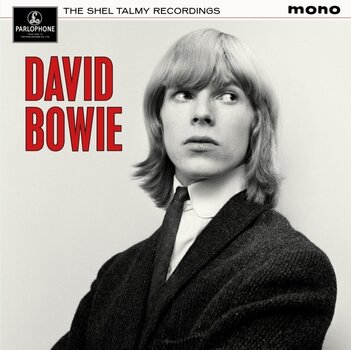
David Bowie – The Shel Talmy Recordings
Released on 18 September 2026, David Bowie – The Shel Talmy Recordings brings together early recordings associated with producer Shel Talmy. The collection includes material by Davie Jones, The Manish Boys and Davie Jones & The Lower Third.
The original announcement listed both Les Mighall and Phil Lancaster among the Lower Third personnel, without assigning individual recordings to each drummer. The track-by-track credits accompanying the digital release provide that distinction.
David Bowie – The Shel Talmy Recordings, released in 2026, includes five tracks crediting Les Mighall on drums.
The digital release credits Les Mighall on drums on five recordings by Davie Jones & The Lower Third:
- “Cupid”
- “Keep Up With The Jones” — instrumental
- “Leave Her To Me”
- “You Gotta Tell Her”
- “Certain Woman”
These credits identify specific recordings on which Mighall’s contribution can be heard, giving his early association with Jones a documented place in the released catalogue.
The same digital credits identify Phil Lancaster as the drummer on recordings including “You’ve Got a Habit of Leaving”, “Baby Loves That Way” and “I’ll Follow You”. The collection therefore preserves material featuring both Lower Third drummers, with their contributions distinguished at track level.
For Mighall’s biography, the five credited tracks add an audible record of his work alongside the young Davie Jones. They allow listeners to explore his contribution through the recordings themselves, alongside the accounts of his membership in the group.
The Lower Third after Mighall
David Bowie with The Lower Third – “Can’t Help Thinking About Me”, released in 1966, after Les Mighall had left the group.
With Phil Lancaster on drums, The Lower Third continued working with Jones through the second half of 1965.
During this later phase the group became more closely associated with Jones as frontman, while his songwriting and ambitions continued to develop.
Jones also adopted the professional name David Bowie during this period, avoiding confusion with another increasingly prominent performer named Davy Jones.
In January 1966, Can’t Help Thinking About Me was released under the credit David Bowie with The Lower Third.
Les Mighall was no longer a member of the band by that stage and should not be associated with this later Lower Third recording period.
Mighall’s place in the story
The importance of Les Mighall does not depend on extending his role beyond the evidence.
His documented place in Bowie’s history is already clear: he was the drummer in The Lower Third when Davie Jones first became associated with the group in 1965.
That placed Mighall alongside Bowie during a formative moment, after The Manish Boys but before the later Lower Third line-up, before the David Bowie name appeared on record, and years before Bowie’s breakthrough.
Mighall was therefore part of the working environment in which the young Jones continued learning how to lead a band, develop his songwriting and move beyond the rhythm-and-blues influences that had dominated his earliest recordings.
Later life: continuing behind the drums
Les Mighall continued playing drums after his time with The Lower Third. His daughter Sam, who contacted DavidBowieWorld.com, identified him as the drummer with The Geoff Howell Sound, which she described as the resident band at Butlin’s in Margate.
Dates for this engagement have not yet been established. Sam explained that she was born after the Lower Third period. Her recollections concern her father’s later musical life rather than the 1965 line-up with Davie Jones.
She remembers accompanying her father to Butlin’s and other places, predominantly across Thanet. These childhood memories add a personal perspective to his continued activity as a drummer beyond The Lower Third.
Her memories also extend to music at home, where she recalls her father playing a drum kit set up in the family kitchen.
Mighall died on 11 March 2008. According to Sam, several musicians performed in his memory at his wake in Broadstairs, Kent. Their names have not yet been established for this article.
Legacy
Les Mighall‘s association with David Bowie was brief, but it belongs to a genuine and important part of Bowie’s formative history.
He was already playing with Denis Taylor and Graham Rivens when Davie Jones entered their musical world. For a short period in 1965, the four musicians worked together as Jones began another stage in the long process of becoming David Bowie.
Mighall left before The Lower Third entered its later and better-known phase with Phil Lancaster, but that does not diminish his place in the chronology. He remains part of the earliest Lower Third line-up to work directly with Davie Jones.
Family testimony
Sam, Les Mighall’s daughter, has contributed information directly to DavidBowieWorld.com. Her correspondence provides a family perspective on the years following his membership of The Lower Third.
At the time of her correspondence, Sam was contacting musicians who had worked with her father to ask whether photographs had survived. She offered to share any suitable material if permission could be obtained.
Sam also explained that her brother had a photograph of their father playing drums in his later years. She planned to ask him whether he had photographs or further information that could be shared.
These are possible sources for future additions; the photographs and musicians’ names have not yet been supplied for this article. Sam’s childhood recollections concern Mighall’s later life and are presented separately from the documentation of his work with Davie Jones in 1965.
No direct quotation from Les himself concerning Davie Jones has been established for this article.
Official Website & Further Information
No verified official website for Les Mighall has been identified.
More about this period of David Bowie’s career can be found on David Bowie World:
David Bowie and The Lower Third
The official David Bowie website provides the personnel and track information for the 2026 archival release David Bowie – The Shel Talmy Recordings:
David Bowie – The Shel Talmy Recordings
Article Origin
This article was researched and written exclusively for DavidBowieWorld.com as part of the David Bowie Collaborations & Creative Circle Archive.
Surviving biographical information about Les Mighall is limited, and published accounts of The Lower Third’s earliest history do not agree in every detail. This article distinguishes documented events from details that remain uncertain.
Particular care has been taken with the early recording history. The original announcement for David Bowie – The Shel Talmy Recordings named both Les Mighall and Phil Lancaster among the Lower Third personnel. The track-by-track credits accompanying the digital release identify Mighall as drummer on “Cupid”, “Keep Up With The Jones”, “Leave Her To Me”, “You Gotta Tell Her” and “Certain Woman”. These individual credits are reflected in this article.
Additional information about Mighall’s later musical life was supplied directly to DavidBowieWorld.com by his daughter, Sam. Her correspondence is the source for the account of his work with The Geoff Howell Sound, her childhood memories and the musicians’ tribute at his wake in Broadstairs. These family recollections are attributed to her and distinguished from the published documentation concerning The Lower Third.
Further photographs, documents and personal recollections may help establish dates and expand the account of Mighall’s later career. Such additions can preserve his wider musical history alongside his documented association with the young Davie Jones.
© DavidBowieWorld.com – David Bowie Collaborations & Creative Circle Archive.

Thank you; I have sent you a private email.
Greetings,
Diedrich
Les was my dad. I was not born during the lower third time but my dad continued playing drums after this time and was the drummer for the Geoff Howell sound who was the resident band at Butlins in Margate. Happy to share anything with you.