
Ian Hunter – David Bowie, Mott the Hoople and All the Young Dudes
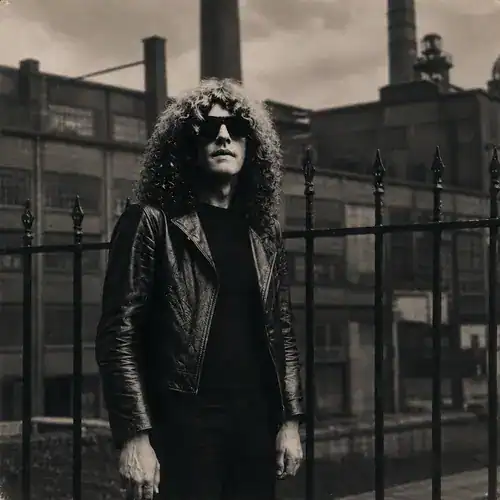
Ian Hunter performing on stage.
Ian Hunter is an English singer, songwriter, musician and author best known as the lead singer and principal songwriter of Mott the Hoople. His distinctive voice, sharply observed lyrics and commanding stage presence made him one of the most recognisable figures in British rock during the early 1970s.
Mott the Hoople built a devoted live following during four demanding years with Island Records, but commercial success remained limited. In 1972, when the group was preparing to separate, David Bowie offered them All the Young Dudes and subsequently produced both their recording of the song and the album that carried its title. The single became the band’s breakthrough and brought Hunter’s voice and stage identity to an international audience.
After leaving Mott the Hoople at the end of 1974, Hunter began an extensive solo career with guitarist, arranger and producer Mick Ronson. His solo catalogue includes albums such as Ian Hunter, All American Alien Boy, You’re Never Alone with a Schizophrenic, Rant, Fingers Crossed and the two-part Defiance project.
Among Hunter’s best-known solo compositions are Once Bitten, Twice Shy, Cleveland Rocks, Ships and Just Another Night. Across a recording career extending through seven decades, he has remained admired for songwriting that combines humour, autobiography, social observation and an enduring commitment to rock and roll.
Hunter’s connection with David Bowie began during a decisive moment in Mott the Hoople’s history. It continued through their shared appearance at the Freddie Mercury Tribute Concert in 1992 and was remembered by Hunter in Dandy, his 2016 song honouring Bowie.
- Full name: Ian Hunter Patterson
- Born: 3 June 1939, Oswestry, Shropshire, England
- Occupation: Singer, songwriter, musician and author
- Instruments: Vocals, piano, guitar and bass guitar
- Best known for: Lead singer and principal songwriter of Mott the Hoople
- Member of Mott the Hoople: 1969–1974, with later reunion appearances and tours
- Solo career: 1975–present
- David Bowie connection: Bowie offered Mott the Hoople All the Young Dudes in 1972 and produced the band’s recording of the song and the accompanying album.
- Documented shared performance: All the Young Dudes at the Freddie Mercury Tribute Concert, Wembley Stadium, 20 April 1992
- Important musical partnership: Mick Ronson
- Selected solo songs: Once Bitten, Twice Shy, Cleveland Rocks, Ships, Just Another Night and Dandy
Early Life
Ian Hunter was born Ian Hunter Patterson on 3 June 1939 in Oswestry, Shropshire, England. His mother was English and his father was Scottish. When Hunter was only a few months old, shortly after the outbreak of the Second World War, he was taken to Hamilton, Lanarkshire, where members of his father’s family lived.
Hunter remained in Hamilton until he was approximately six years old. He later remembered those early Scottish years with great affection and explained that they remained an important part of his identity. After the war, the family returned to England and lived in several villages in and around Shrewsbury.
As a teenager, Hunter attended school in Shrewsbury before entering employment. His early working life included a series of industrial and technical jobs, experiences that later informed the working-class perspective found throughout much of his songwriting. Music was initially pursued alongside regular employment rather than as an immediately realistic career.
An important turning point came in 1957, when Hunter met musicians Colin York and Colin Broom while staying at a Butlin’s holiday camp in Pwllheli, Wales. The three entered a talent competition and performed Blue Moon using acoustic guitars. Their performance won the competition.
York and Broom were members of a Northampton-based group called The Apex Group. After maintaining contact with them, Hunter moved to Northampton and joined the band as a rhythm guitarist. He continued working during the day while performing with the group during evenings and weekends.
The Apex Group gave Hunter valuable experience in dance halls, clubs and local venues. During this period he developed as a guitarist, pianist and performer, although he had not yet established himself primarily as a lead singer. The group underwent several personnel changes, and Hunter’s involvement was interrupted more than once as he balanced music with employment and family responsibilities.
During the early 1960s, Hunter performed with a succession of groups and musicians, including Hurricane Henry and the Shriekers. He also spent time performing in Germany, where British rock and rhythm-and-blues groups could find regular work in clubs catering to young audiences and servicemen.
Bob Dylan became one of Hunter’s most important artistic influences. Dylan’s records demonstrated that an unconventional voice could become a strength when combined with individual phrasing and distinctive songwriting. Hunter gradually developed his own vocal identity, combining a conversational delivery with humour, vulnerability and close observation of everyday life.
By the middle and late 1960s, Hunter had accumulated considerable experience without achieving a major breakthrough. He worked with several groups, performed in Britain and continental Europe and continued accepting jobs outside music when necessary. Those years of uncertainty later became an important source for his songs about ambition, disappointment, employment and survival.
In 1968, Hunter played bass with rock-and-roll pianist Freddie “Fingers” Lee, including performances in Germany. By the following year, he was an experienced musician approaching thirty, but he still lacked a permanent group or recording career. That changed when he was invited to audition for a Herefordshire-based band called Silence.
Joining Silence and the Birth of Mott the Hoople
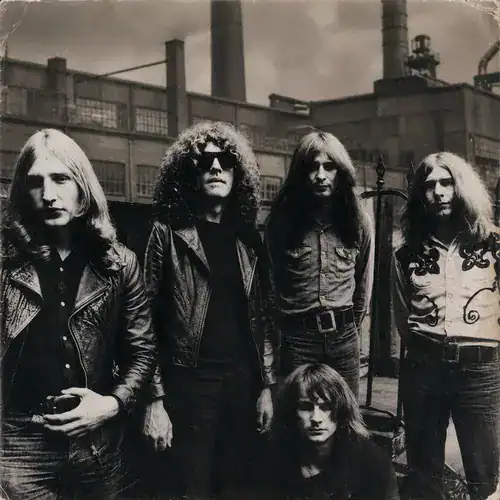
By 1969, the Herefordshire group Silence consisted of guitarist Mick Ralphs, organist Verden Allen, bassist Pete Overend Watts, drummer Dale “Buffin” Griffin and singer Stan Tippins. Several members had previously worked together in the Doc Thomas Group and the Shakedown Sound before adopting the name Silence.
The band came to the attention of producer and Island Records adviser Guy Stevens, whose enthusiasm for American rhythm and blues and forceful British rock helped shape his ideas for a new group. Stevens recognised the musicians’ potential but believed that Silence needed a different singer and pianist before recording for Island Records.
An advertisement was placed in Melody Maker seeking a singer and pianist who was ambitious and visually distinctive. A number of musicians were auditioned at Regent Sound Studios in Denmark Street, London, but Stevens remained dissatisfied with the candidates.
Studio engineer Bill Farley knew Ian Hunter from previous recording work and suggested that he should audition. Hunter had seen the advertisement but did not attend solely because of it. Farley telephoned him and encouraged him to come to the studio, although Hunter initially showed little enthusiasm after years of unsuccessful attempts to establish a permanent musical career.
When Hunter finally arrived, he found the members of Silence and Guy Stevens waiting in the studio. Hunter later recalled that he did not immediately know which of the men belonged to the group or who was in charge, although Stevens conducted most of the conversation.
During the audition, Hunter accompanied himself on piano and performed Bob Dylan‘s Like a Rolling Stone together with Sonny Bono’s Laugh at Me. His unconventional vocal delivery, piano playing and individual appearance appealed to Stevens, who believed that Hunter could provide the personality the group was missing.
Hunter was accepted primarily as a pianist and vocalist rather than as an already established frontman. The group did not initially operate around a single dominant stage figure, and Hunter continued to play substantial amounts of piano during its earliest performances. As the band developed, however, Stevens encouraged him to assume a more visible role at the front of the stage, where he increasingly combined lead vocals with guitar and piano.
The change created an uncertain situation for Stan Tippins, whom Hunter was effectively replacing as lead singer. Tippins nevertheless remained closely associated with the musicians and later returned as Mott the Hoople’s road manager, becoming a trusted and important member of the band’s touring organisation.
Guy Stevens also insisted that Silence adopt a new name. While serving a prison sentence during the late 1960s, he had read the 1966 novel Mott the Hoople by American writer Willard Manus. Stevens remembered the unusual title and believed it would look striking on concert posters and theatre marquees.
The musicians were not immediately enthusiastic about abandoning the name Silence, but Stevens prevailed. With Ian Hunter joining Mick Ralphs, Verden Allen, Pete Overend Watts and Dale Griffin, the group became Mott the Hoople.
The new line-up began rehearsing and developing material under Stevens’ direction. Hunter and Ralphs gradually emerged as the principal songwriters, while the combination of Allen’s organ, Ralphs’ guitar and the powerful rhythm section of Watts and Griffin established the band’s characteristic early sound.
Mott the Hoople entered the studio during 1969 to record its first album for Island Records. Hunter had reached the opportunity at the age of thirty, after more than a decade of intermittent performing, industrial employment and unsuccessful attempts to build a professional musical career. His arrival completed the line-up that would create the band’s first seven studio albums and become one of the most celebrated British rock groups of the early 1970s.
The Island Records Years (1969–1972)
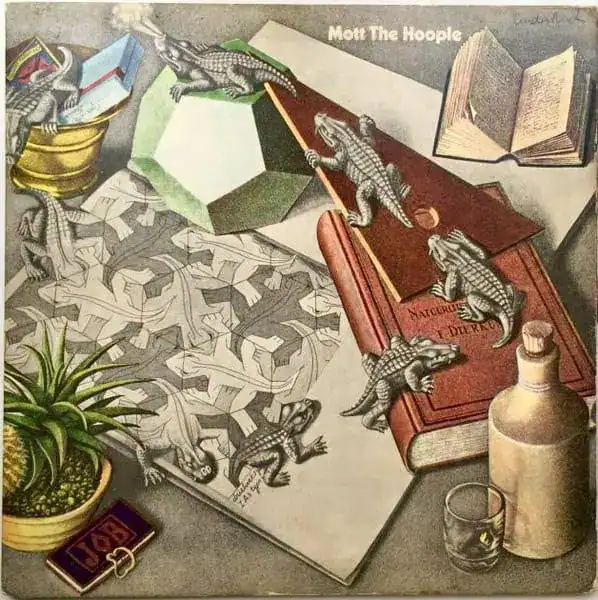
Mott the Hoople’s self-titled debut album was released by Island Records in November 1969. Produced by Guy Stevens, the record combined hard rock, rhythm and blues, Dylan-inspired songwriting and powerful interpretations of songs by artists such as Doug Sahm and Sonny Bono. Although critics quickly recognised the band’s originality, commercial success remained elusive.
Ian Hunter gradually emerged as the group’s principal lyricist while sharing songwriting duties with guitarist Mick Ralphs. Together they developed a distinctive musical identity that differed from most British rock bands of the period, balancing thoughtful lyrics with energetic performances and a powerful live sound.
The follow-up, Mad Shadows (1970), again produced by Guy Stevens, further expanded the band’s reputation among critics. Stevens encouraged emotionally charged performances, believing that capturing spontaneity and intensity was more important than technical perfection. Although the album received enthusiastic reviews, sales once again failed to match the band’s growing reputation.
By this stage Mott the Hoople had become one of Britain’s most admired live bands. Constant touring throughout Britain and Europe earned the group an exceptionally loyal audience, while Ian Hunter‘s charismatic stage presence increasingly became the focus of their concerts. Despite this growing popularity, record sales remained disappointing.
Released in 1971, Wildlife demonstrated the band’s growing confidence as songwriters and performers. Although the album failed commercially, it has since become regarded as one of the most underrated releases of Mott the Hoople’s Island Records period.
Later that same year the band released Brain Capers, their fourth studio album and today widely regarded as one of the finest recordings of the early 1970s British rock scene. Once again produced by Guy Stevens, the album captured Mott the Hoople at its rawest and most uncompromising, with Hunter delivering some of the strongest lyrics of his career. Although later praised as a classic, the record again failed to sell in significant numbers.
By the spring of 1972, four critically acclaimed albums had failed to produce the commercial breakthrough Island Records had hoped for. Years of relentless touring, financial pressure and disappointing sales convinced the band that its future had reached an end. A farewell concert was arranged at Swiss Cottage Hall in London, after which the members intended to go their separate ways.
One of the people most disappointed by the news was David Bowie. Bowie had admired Mott the Hoople for several years and had attended their concerts long before becoming an international star himself. He regarded them as one of Britain’s finest live rock bands and refused to accept that they should simply disappear. His decision to contact the band would permanently alter both Mott the Hoople’s future and Ian Hunter‘s career.
David Bowie Saves the Band
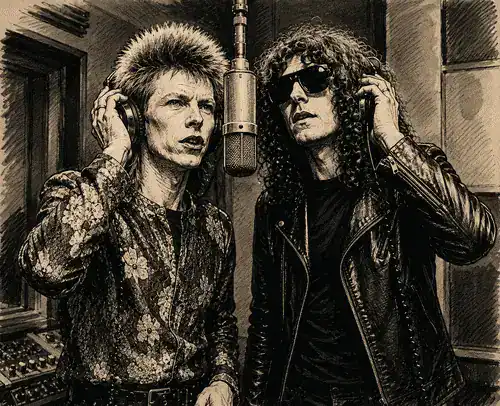
AI-generated artistic interpretation depicting David Bowie and Ian Hunter during the early 1970s.
By the beginning of 1972, Mott the Hoople stood on the verge of breaking up. Four critically acclaimed albums had failed to produce significant commercial success, despite the band earning a reputation as one of Britain’s finest live acts. Years of constant touring, disappointing sales and financial uncertainty convinced the members that they had reached the end of the road. Their decision was made: after completing their remaining commitments, Mott the Hoople would disband.
Unknown to the band, one of their greatest admirers had no intention of letting that happen. David Bowie, whose own career was rapidly gathering momentum following Hunky Dory and the forthcoming release of The Rise and Fall of Ziggy Stardust and the Spiders from Mars, regarded Mott the Hoople as one of the finest rock bands in Britain. He believed their lack of commercial success bore no relation to the quality of their music and was determined to help them.
After learning that the band intended to split up, Bowie contacted their management and arranged to meet Ian Hunter. During the meeting, Bowie offered them Suffragette City, a song that had already been recorded for his forthcoming Ziggy Stardust album but had not yet been released. Although Hunter immediately recognised the quality of the composition, he felt that it sounded too much like a David Bowie song and would not suit Mott the Hoople’s own musical identity.
Ian Hunter on Suffragette City
“I said, ‘It’s a great song, but it sounds like you. It doesn’t sound like us.'”
Ian Hunter reflects on Mott the Hoople’s remarkable rise during a television interview recorded in 1974.
Rather than taking offence, Bowie accepted Hunter’s judgement. He promised that if Suffragette City was not the right song for Mott the Hoople, he would write one especially for them. Within days, Bowie returned with a brand-new composition entitled All the Young Dudes, written specifically for the band.
When Ian Hunter first heard the song, he immediately recognised that Bowie had perfectly captured the spirit of the band while creating a record capable of reaching a far wider audience. The other members quickly shared Hunter’s enthusiasm, and the decision to disband was abandoned. Instead, Mott the Hoople signed a new recording contract with CBS Records, giving the band a fresh opportunity to rebuild its career.
Bowie also agreed to produce the recording sessions for All the Young Dudes, working alongside guitarist, arranger and musical director Mick Ronson. Their involvement extended beyond simply providing a hit single; they restored the band’s confidence at a moment when its future appeared hopeless. What had seemed certain to become the end of Mott the Hoople instead became the beginning of the most successful period in the band’s history.
All the Young Dudes – The True Story
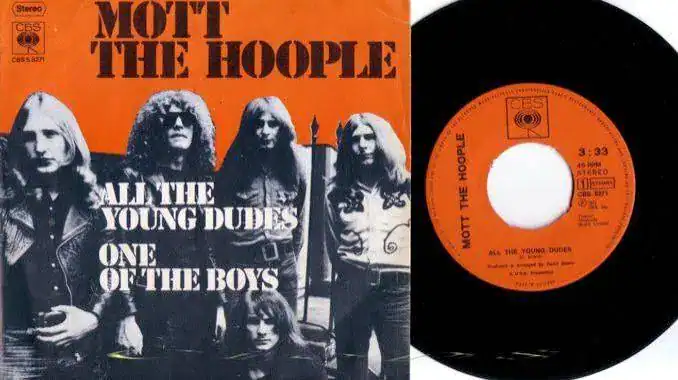
When David Bowie contacted Mott the Hoople for a second time, he returned with All the Young Dudes. Contrary to one of the best-known stories in rock history, Bowie did not write the song overnight after the band rejected Suffragette City. He had already written the composition and recorded a demo before offering it to Mott the Hoople.
Ian Hunter has repeatedly corrected the popular myth, explaining that Bowie already had the song available and simply realised that it suited Mott the Hoople far better than Suffragette City. Hunter immediately recognised its potential and the band agreed to record it.
During rehearsals, Mott the Hoople made several important contributions that helped shape the finished recording. Guitarist Mick Ralphs developed the now-famous opening guitar riff, while Ian Hunter wrote the spoken bridge beginning with the line “I wanted to be with you there…”. The band also decided to raise the key from C major to D major, giving the song greater energy and allowing it to sit more comfortably within Hunter’s vocal range.
The recording sessions took place at Olympic Studios in London during the summer of 1972. David Bowie produced the sessions while Mick Ronson contributed guitar, arrangements and musical ideas that complemented the band’s own sound. Bowie deliberately encouraged Mott the Hoople to sound like themselves rather than imitate the Ziggy Stardust recordings.
Hunter later revealed another fascinating detail from the sessions. Bowie initially believed that Hunter’s own composition One of the Boys should become the lead single. After further discussion, everyone agreed that All the Young Dudes possessed the strongest commercial potential.
Released on 28 July 1972, All the Young Dudes reached No. 3 on the UK Singles Chart and became Mott the Hoople’s first major hit. The success transformed the band’s fortunes almost overnight, establishing them as one of the leading British rock groups of the glam era and bringing Ian Hunter to an international audience.
The success of the single was followed by the album All the Young Dudes, also produced by David Bowie. Although Bowie contributed the title track and produced the album, he deliberately ensured that Ian Hunter‘s songwriting remained at the heart of the record. The result was an album that combined Bowie’s guidance with Mott the Hoople’s own musical identity.
For Ian Hunter, All the Young Dudes marked the beginning of one of the most enduring musical friendships in British rock. What started as an act of generosity from David Bowie developed into a relationship based on mutual respect, admiration and decades of shared history.
Building Success After Bowie
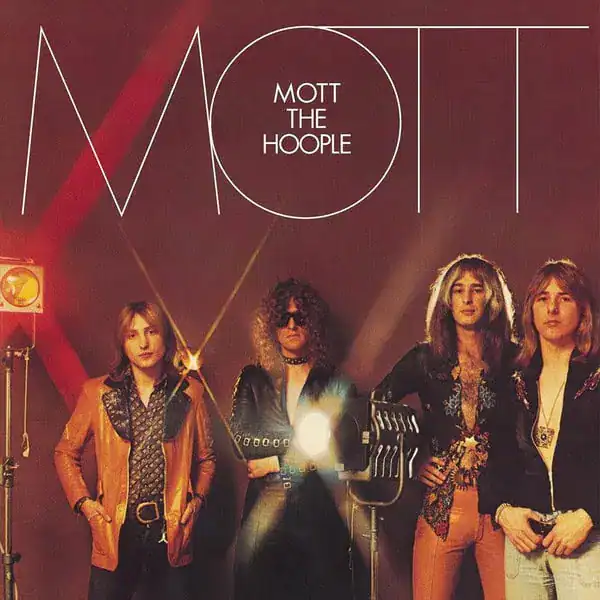
The success of All the Young Dudes transformed Mott the Hoople almost overnight. After years of struggling to achieve commercial recognition, the band suddenly found itself playing larger venues, making regular television appearances and touring successfully throughout Britain, Europe and the United States. For Ian Hunter, it marked the beginning of the most successful period of his career with Mott the Hoople.
Although David Bowie had rescued the band at a crucial moment, he never intended Mott the Hoople to become dependent upon him. Instead, Bowie encouraged Hunter to continue developing as the band’s principal songwriter, believing the group should establish its own musical identity rather than remain associated solely with his own work.
That philosophy was immediately reflected on the All the Young Dudes album. Apart from contributing the title song and producing the record, Bowie deliberately left the majority of the songwriting to Ian Hunter. Songs such as One of the Boys, Ready for Love / After Lights, Sea Diver and Jerkin’ Crocus confirmed Hunter’s growing confidence as one of Britain’s most distinctive rock writers.
Released in July 1973, Mott became the band’s most successful studio album. Entirely driven by Hunter’s songwriting, it included the hit singles All the Way from Memphis and Honaloochie Boogie, both of which became concert favourites and remain among the defining recordings of Mott the Hoople’s career.
Following the release of Mott, founding guitarist Mick Ralphs decided to leave the band in order to form Bad Company with former Free singer Paul Rodgers. Ralphs’ departure ended one of the most productive songwriting partnerships in British rock and forced Hunter to rebuild the group around a new line-up.
Ralphs was replaced by guitarist Luther Grosvenor, who adopted the stage name Ariel Bender. Around the same period, keyboard player Morgan Fisher became a permanent member after the departure of Verden Allen, bringing a broader musical palette to the band.
Released in March 1974, The Hoople demonstrated that Mott the Hoople remained commercially successful despite the line-up changes. The album included a new studio version of Roll Away the Stone, while The Golden Age of Rock ‘n’ Roll became another major hit and one of Ian Hunter‘s signature songs.
By 1974 Mott the Hoople had become one of Britain’s leading live attractions. Hunter’s intelligent songwriting, theatrical stage presence and increasingly confident leadership had transformed the group from respected cult favourites into established international rock stars.
Late in 1974 another important personnel change followed when Ariel Bender left the band and was replaced by Mick Ronson, David Bowie’s former guitarist and arranger. Ronson’s arrival reunited two musicians who shared enormous mutual respect and laid the foundations for one of the most important partnerships of Hunter’s later solo career.
The Final Years of Mott the Hoople
Mott the Hoople performing “The Golden Age Of Rock And Roll” on British television in 1974.
The arrival of Mick Ronson reunited Ian Hunter with one of the musicians he admired most, but it could not reverse the growing pressures within the band. Constant touring, changing musical tastes and years of relentless work had begun to take their toll, even though Mott the Hoople remained a respected live attraction.
The new line-up toured extensively during 1974, with Ronson bringing his distinctive guitar style and arranging skills to the band’s concerts. Despite strong performances, the internal strains that had developed over several years continued to grow.
By the end of 1974 Ian Hunter decided that he could no longer continue. After years of leading Mott the Hoople through constant touring, commercial highs and frequent line-up changes, he announced that he was leaving the band. His departure effectively brought the classic era of Mott the Hoople to a close.
Without Hunter, Mick Ronson also chose to leave shortly afterwards. The remaining members decided to continue under the shortened name Mott, making it clear that this was no longer the same group that had achieved international success with Ian Hunter as its frontman.
The reconfigured band released the albums Drive On (1975) and Shouting and Pointing (1976), but neither achieved the artistic or commercial impact of the earlier Mott the Hoople recordings. By 1976 the group finally disbanded.
Although Ian Hunter‘s departure marked the end of one chapter, it also opened the door to a successful solo career. Reuniting with Mick Ronson outside the constraints of a band would allow both musicians to develop one of the most productive creative partnerships of their careers.
Ian Hunter‘s Solo Career
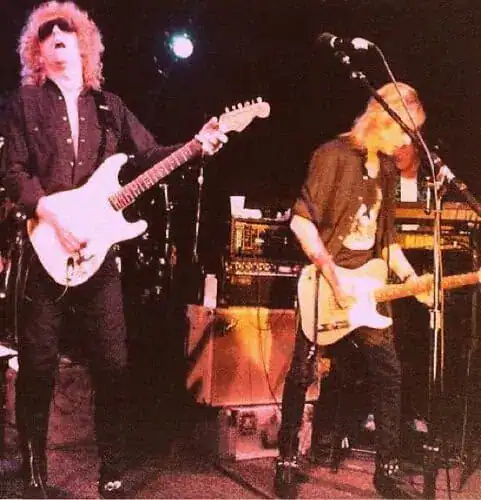
Ian Hunter and Mick Ronson in San Francisco, 5 October 1988.
Photo: mickeydb / Wikimedia Commons /
CC BY-SA 2.0.
Original image digitally retouched by JD554.
Following his departure from Mott the Hoople at the end of 1974, Ian Hunter embarked on a solo career that allowed him greater artistic freedom while continuing the intelligent songwriting and distinctive vocal style that had defined his work with the band. His self-titled debut album, Ian Hunter, was released in 1975 and received strong critical acclaim, although commercial success proved more modest.
One of the most important developments of Hunter’s solo career was the continuation of his creative partnership with guitarist Mick Ronson. Having briefly played together in the final line-up of Mott the Hoople, the two musicians now worked as equal collaborators, with Ronson contributing guitar, arrangements, production ideas and musical direction to many of Hunter’s finest recordings.
Hunter followed his debut with All American Alien Boy (1976), an ambitious album featuring a wide range of musical styles and notable guest musicians, including Jaco Pastorius. Although critically admired, the album again failed to achieve major commercial success.
Released later in 1977, Overnight Angels represented a more straightforward rock approach but proved disappointing both commercially and artistically in Hunter’s own opinion. Frustrated by the experience, he temporarily stepped away from recording.
Hunter returned triumphantly in 1979 with You’re Never Alone with a Schizophrenic, widely regarded as the finest solo album of his career. Produced by Mick Ronson, it featured contributions from members of Bruce Springsteen’s E Street Band and included acclaimed songs such as Just Another Night, Ships and Cleveland Rocks.
Hunter also enjoyed success with We Gotta Get Out Of Here, released in 1980 as one of the new studio recordings accompanying the live album Welcome to the Club. Featuring a duet with Ellen Foley, the song became Ian Hunter‘s best-known solo hit in the Netherlands, reaching the Dutch Top 40. It remains one of the defining recordings of his solo career.
Although Cleveland Rocks was already popular among Hunter’s fans, the song reached a much wider audience in the late 1990s when a version by The Presidents of the United States of America became the theme song for the American television sitcom The Drew Carey Show. The recording helped introduce Hunter’s songwriting to a new generation of listeners.
Throughout the following decades Hunter continued to release well-received albums while maintaining a reputation as one of Britain’s most respected singer-songwriters. His work consistently combined sharp lyrical observation, humour and emotional honesty, qualities that had first distinguished him during the Mott the Hoople years.
Mick Ronson – A Lifelong Musical Partnership
Ian Hunter and Mick Ronson performing live at Rockpalast in 1980.
Although Mick Ronson joined Mott the Hoople only during the band’s final months, his musical relationship with Ian Hunter truly flourished after Hunter launched his solo career in 1975. Having already established himself as David Bowie’s guitarist, musical arranger and one of the principal architects of the Ziggy Stardust era, Ronson brought exceptional versatility, imaginative arrangements and a distinctive guitar style that perfectly complemented Hunter’s songwriting.
Their first major collaboration came on Hunter’s self-titled debut album, where Ronson served not only as guitarist but also as co-producer and arranger. The chemistry between the two musicians was immediate. Hunter’s thoughtful, often autobiographical lyrics combined naturally with Ronson’s melodic playing, forming a creative partnership that would continue over the following two decades.
Ronson remained Hunter’s closest musical collaborator throughout much of the late 1970s and beyond. He played major roles on Ian Hunter, All American Alien Boy, You’re Never Alone with a Schizophrenic and later reunited with Hunter for YUI Orta in 1990. Together they developed a musical partnership that balanced powerful rock arrangements with thoughtful songwriting while allowing each musician’s individual strengths to remain clearly recognisable.
Away from the recording studio, Hunter and Ronson also became close personal friends. They toured extensively throughout Europe, North America and Japan, and audiences came to associate the pair with an unusually strong musical understanding that had first begun when Ronson joined Mott the Hoople during 1974.
“Mick was one of the finest musicians I’ve ever worked with. He could play almost anything, but he always played for the song.”
Their friendship was strengthened further by their shared connection with David Bowie. Although Ronson’s own professional partnership with Bowie came to an end during the mid-1970s, the respect between all three musicians endured. Hunter frequently acknowledged that Bowie’s belief in the band and Ronson’s extraordinary musicianship had each played decisive roles in shaping his own career.
In April 1992, Hunter and Ronson reunited on one of the world’s biggest concert stages when they both appeared at the Freddie Mercury Tribute Concert for AIDS Awareness at Wembley Stadium. Sharing the stage once again with David Bowie, they performed before a worldwide television audience in celebration of Freddie Mercury‘s life and legacy. For many fans, the concert represented a remarkable reunion of three musicians whose careers had become closely intertwined since the summer of 1972.
Only a year later, tragedy struck. Mick Ronson died on 29 April 1993 at the age of just forty-six after battling liver cancer. Hunter lost not only one of his greatest musical collaborators but also one of his closest friends. He continued to honour Ronson’s memory through concerts, recordings and interviews, ensuring that his contribution to rock music would never be forgotten.
More than any other guitarist, Mick Ronson helped define the sound of Ian Hunter‘s solo career. Their partnership produced many of Hunter’s finest recordings and remains one of the most admired artist-guitarist collaborations in British rock history, demonstrating how two musicians with very different talents could inspire one another over many years.
The Freddie Mercury Tribute Concert
On 20 April 1992, Ian Hunter reunited with David Bowie, Mick Ronson and the surviving members of Queen at Wembley Stadium for the Freddie Mercury Tribute Concert for AIDS Awareness. Broadcast to an estimated worldwide television audience of hundreds of millions, the concert celebrated Freddie Mercury‘s life while helping establish the Mercury Phoenix Trust, the charity created to continue the fight against HIV/AIDS.
For Hunter, the event represented far more than another guest appearance. Twenty years after All the Young Dudes had transformed Mott the Hoople’s career, he once again stood alongside Bowie and Ronson to perform the song that had forever linked their musical histories. Joining them on stage were Joe Elliott and Phil Collen of Def Leppard, whose backing vocals added further energy to one of the concert’s most memorable performances.
Immediately afterwards, Bowie and Ronson remained on stage for a powerful performance of Heroes, with Hunter joining the ensemble during the closing moments. The sequence became one of the defining highlights of the tribute concert and reunited three musicians whose careers had remained closely connected since the summer of 1972.
The Wembley appearance also carried a deeper emotional significance. It proved to be one of Mick Ronson‘s final major international concert appearances before his death from liver cancer on 29 April 1993 at the age of forty-six. Looking back, the Freddie Mercury Tribute Concert remains both a celebration of Freddie Mercury’s life and one of the final public reunions of Bowie, Hunter and Ronson.
For audiences around the world, the performance of All the Young Dudes served as a reminder of the extraordinary friendship that had begun when David Bowie refused to let Mott the Hoople disappear in 1972. Two decades later, the song continued to unite the musicians whose careers had become inseparably linked through one of rock music’s most celebrated collaborations.
Dandy – A Tribute to David Bowie
Ian Hunter performing Dandy, his heartfelt tribute to David Bowie.
The death of David Bowie on 10 January 2016 marked the loss of a friend whose generosity had transformed Ian Hunter‘s life more than four decades earlier. Rather than issuing only a written statement, Hunter chose to express his gratitude through music.
Later that year he released Dandy on the album Fingers Crossed, an affectionate and deeply personal tribute to Bowie. Rather than focusing on Bowie’s fame or public image, Hunter reflected on the man he had known personally—someone whose kindness, humour and willingness to help fellow musicians had remained unchanged throughout their friendship.
The lyrics are filled with warmth, admiration and gratitude, recalling both Bowie’s larger-than-life personality and the generosity that Hunter had experienced first-hand. Rather than portraying Bowie as an untouchable superstar, Dandy celebrates the friend who had refused to let Mott the Hoople disappear in 1972 and who continued to encourage Hunter throughout his career.
Musically, the song combines Hunter’s reflective songwriting with a deliberately understated arrangement that allows the lyrics to remain at the centre of the performance. It became one of the emotional highlights of Fingers Crossed and was widely praised by fans as one of the most heartfelt musical tributes released following Bowie’s death.
Ian Hunter on David Bowie
“He changed my life. Without David Bowie there would probably have been no Mott the Hoople after 1972, and certainly no career like the one I’ve been lucky enough to have.”
Although Hunter has always been careful to define himself by his own body of work rather than by his association with Bowie, he has never underestimated the importance of their friendship. Bowie did far more than write a hit single for Mott the Hoople. He recognised Hunter’s talent at a critical moment, encouraged him to trust his own songwriting and created the opportunity that allowed Hunter’s later career to flourish.
More than fifty years after All the Young Dudes, Dandy completed a story that had begun in 1972. It was not simply a tribute to one of rock music’s greatest artists, but a heartfelt thank-you from one songwriter to another whose generosity permanently changed the direction of his life.
Later Career
Rather than slowing down after decades in the music business, Ian Hunter entered one of the most creatively rewarding periods of his career during the twenty-first century. Free from commercial expectations, he concentrated entirely on writing the music he wanted to make while working with a loyal group of musicians that gradually became known as The Rant Band.
The group provided Hunter with a stable recording and touring line-up while allowing him complete artistic freedom. Critics frequently observed that his songwriting remained as thoughtful, humorous and honest as it had been during the early days of Mott the Hoople, demonstrating remarkable consistency across more than five decades.
The critically acclaimed album Rant (2001) marked the beginning of what many critics regard as a creative renaissance. Praised for its intelligent lyrics, contemporary production and sharp observations of modern life, the album confirmed that Hunter remained one of Britain’s finest rock songwriters rather than simply a respected figure from the classic rock era.
Hunter continued this remarkable resurgence with a succession of highly regarded releases, including Shrunken Heads (2007), Man Overboard (2009), When I’m President (2012) and Fingers Crossed (2016). Each album demonstrated his continuing ability to combine memorable melodies with lyrics that reflected both personal experience and wider social themes.
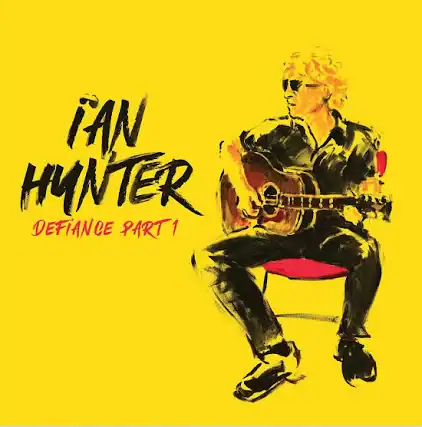
In 2023, at the age of eighty-four, Hunter surprised both fans and critics with Defiance Part 1. Recorded with an extraordinary collection of guest musicians, the album featured contributions from artists including Slash, Billy Gibbons, Jeff Beck, Todd Rundgren, Joe Elliott, Brian May, Ringo Starr, Mike Campbell, Taylor Hawkins and many others. Rather than serving as a retrospective project, it demonstrated that Hunter remained fully engaged as a songwriter and recording artist.
The project continued with Defiance Part 2: Fiction in 2024. Once again Hunter collaborated with an impressive range of musicians while maintaining complete artistic control over his work. Together, the two Defiance albums received widespread critical acclaim and confirmed that his creative ambition had not diminished with age.
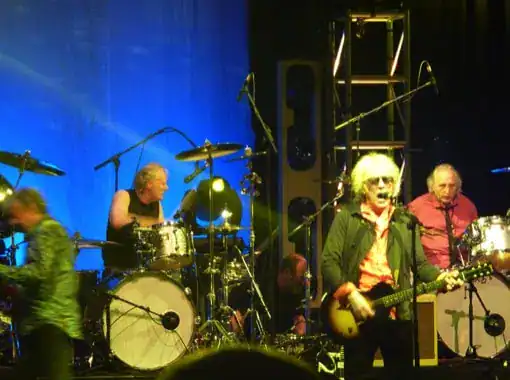
Alongside his recording career, Hunter has continued to perform selected concerts with The Rant Band, combining classics from Mott the Hoople with songs spanning his extensive solo catalogue. His performances remain renowned for their warmth, humour and honesty, qualities that have earned him an exceptionally loyal audience across several generations.
More than half a century after joining Mott the Hoople, Ian Hunter continues to be recognised not simply as a survivor of the classic rock era, but as a songwriter who has remained artistically relevant through constant evolution. His determination to keep writing, recording and performing on his own terms has secured his reputation as one of Britain’s most respected and enduring rock musicians.
Legacy
Over more than six decades, Ian Hunter has established himself as one of Britain’s most distinctive rock songwriters. While many artists of his generation became closely associated with a single era or musical movement, Hunter continued to evolve creatively long after the commercial peak of glam rock had passed. His career reflects a lifelong commitment to artistic independence rather than changing commercial fashions.
Hunter’s songwriting has consistently been characterised by intelligence, honesty and wit. Whether writing about fame, ageing, relationships or everyday life, he has approached his lyrics with the same observational style that first distinguished him during the Mott the Hoople years. That literary quality has earned admiration from fellow musicians, critics and audiences alike, many of whom regard him as one of rock’s finest lyricists.
Although All the Young Dudes remains the song most closely associated with his career, Hunter’s legacy extends far beyond a single hit. His work with Mott the Hoople helped define the glam rock era, while his solo recordings demonstrated a remarkable willingness to explore new musical directions without abandoning the qualities that made his songwriting unique.
Throughout his career, Hunter has earned the respect of an extraordinary range of musicians. Artists including David Bowie, Mick Ronson, Bruce Springsteen, Joe Elliott, Brian May, Todd Rundgren, Ringo Starr and Slash have either collaborated with him or publicly expressed their admiration for his music. The calibre of musicians associated with Hunter reflects the exceptional esteem in which he is held throughout the rock community.
His influence can also be heard in later generations of songwriters who value narrative lyrics, emotional honesty and literary storytelling alongside powerful rock music. Hunter demonstrated that intelligent songwriting and commercial rock could successfully exist together without compromising either artistic integrity or accessibility.
Perhaps the greatest measure of Ian Hunter‘s legacy is the remarkable consistency of his career. From the clubs of the 1960s to acclaimed albums such as the Defiance series, he has remained committed to writing, recording and performing on his own terms. More than fifty years after All the Young Dudes, he continues to be recognised as one of Britain’s most respected and enduring rock songwriters.
David Bowie and Ian Hunter
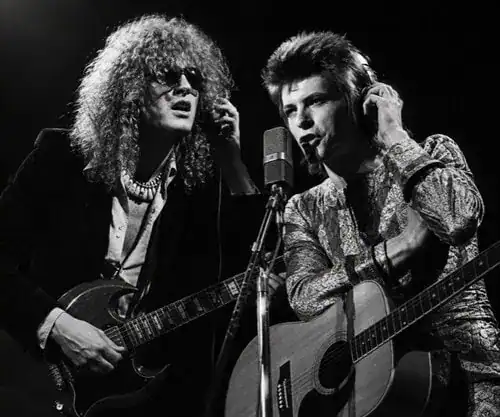
The relationship between Ian Hunter and David Bowie remains one of the most remarkable friendships in British rock history. Although their careers followed different paths, they shared a mutual respect that extended far beyond occasional musical collaborations. What began with Bowie’s determination to save Mott the Hoople in 1972 developed into a friendship that lasted for more than four decades.
Bowie admired Hunter as both a performer and songwriter, while also believing that Mott the Hoople deserved a far wider audience than its commercial success had so far reflected. Rather than attempting to reshape the band in his own image, Bowie encouraged Hunter to continue developing his own songwriting and helped create the opportunity for Mott the Hoople to establish its own identity.
Hunter never forgot Bowie’s generosity. Although All the Young Dudes became one of the defining songs of both men’s careers, Hunter consistently acknowledged that Bowie’s greatest gift had not been a hit single, but his belief in the band at the precise moment when its members were preparing to give up. Without that intervention, Mott the Hoople would almost certainly have ended in 1972, and Hunter’s subsequent solo career might never have happened.
Their friendship continued long after the glam rock era. The two musicians remained in contact throughout the following decades and reunited on several memorable occasions, most notably at the Freddie Mercury Tribute Concert in 1992, where they performed together once again before a worldwide audience. Their shared appearances reflected genuine affection and mutual respect rather than simple nostalgia.
Hunter also maintained a close friendship with Mick Ronson, creating a unique bond between three musicians whose careers became permanently intertwined. Together they produced some of the most memorable recordings associated with the glam rock era and remained connected through later performances, recordings and enduring personal friendships.
Following David Bowie’s death in January 2016, Hunter chose to remember his friend in the most personal way he knew: through music. His song Dandy, released later that year on the album Fingers Crossed, reflected not only Bowie’s extraordinary influence on popular music but also the kindness, humour and generosity that Hunter had experienced personally. Rather than celebrating a global superstar, the song paid tribute to the man behind the legend.
Looking back across more than fifty years, the relationship between Ian Hunter and David Bowie stands as an enduring example of artistic generosity, friendship and mutual respect. Bowie recognised that Hunter and Mott the Hoople deserved a much wider audience, while Hunter never allowed history to forget the importance of Bowie’s support. Together they created one of rock music’s most celebrated collaborations, built not only on great songs but also on genuine friendship.
Selected Discography
Studio Albums with Mott the Hoople
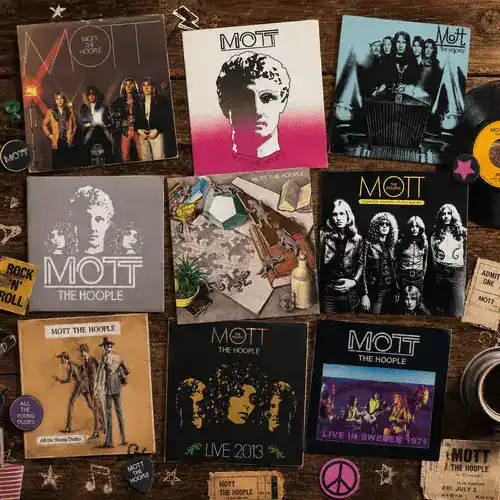
- Mott the Hoople (1969)
- Mad Shadows (1970)
- Wildlife (1971)
- Brain Capers (1971)
- All the Young Dudes (1972)
- Mott (1973)
- The Hoople (1974)
Selected Live Album with Mott the Hoople
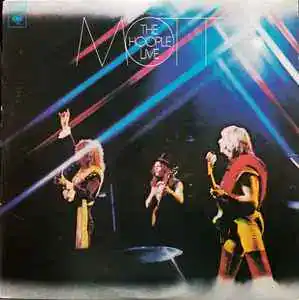
- Live (1974)
Ian Hunter Solo Studio Albums
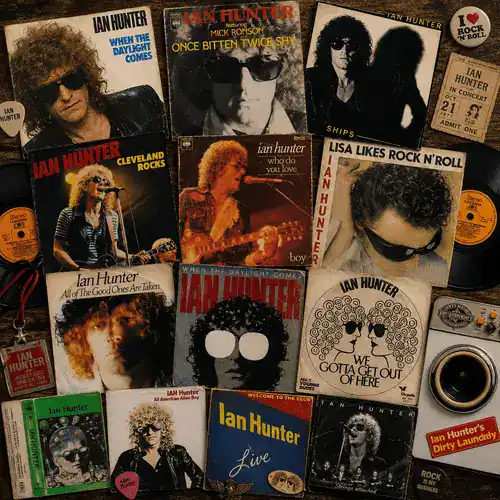
- Ian Hunter (1975)
- All American Alien Boy (1976)
- Overnight Angels (1977)
- You’re Never Alone with a Schizophrenic (1979)
- Short Back ‘n’ Sides (1981)
- All of the Good Ones Are Taken (1983)
- YUI Orta (1990)
- Dirty Laundry (1995)
- The Artful Dodger (1996)
- Rant (2001)
- Shrunken Heads (2007)
- Man Overboard (2009)
- When I’m President (2012)
- Fingers Crossed (2016)
- Defiance Part 1 (2023)
- Defiance Part 2: Fiction (2024)
Selected Singles with Mott the Hoople
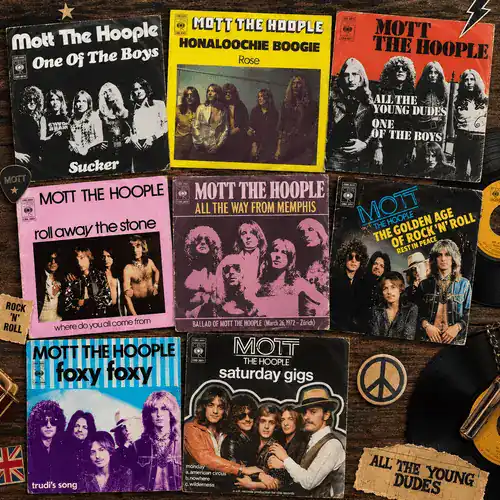
- All the Young Dudes (1972)
- Honaloochie Boogie (1973)
- All the Way from Memphis (1973)
- Roll Away the Stone (1973)
- The Golden Age of Rock ‘n’ Roll (1974)
- Foxy, Foxy (1974)
- Saturday Gigs (1974)
Selected Ian Hunter Solo Singles
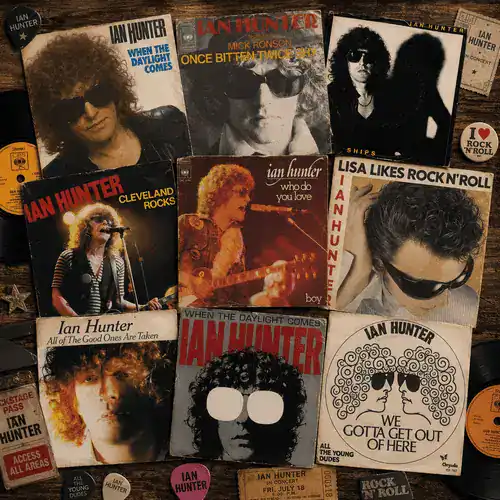
- Once Bitten, Twice Shy (1975)
- Who Do You Love (1975)
- All American Alien Boy (1976)
- You Nearly Did Me In (1976)
- England Rocks (1977)
- When the Daylight Comes (1979)
- Ships (1979)
- Cleveland Rocks (1979)
- Just Another Night (1979)
- We Gotta Get Out of Here (1980)
- Central Park n’ West (1981)
- Lisa Likes Rock ‘n’ Roll (1981)
- All of the Good Ones Are Taken (1983)
- American Music (1989)
- When the World Was Round (2007)
- Dandy (2016)
Official Website & Further Information
- Official website: https://www.ianhunter.com/
DavidBowieWorld.com is dedicated to documenting the careers of David Bowie’s collaborators through carefully researched historical information and, where available, first-hand contributions from the artists themselves. This page will continue to be updated as new verified information becomes available.
Article Origin
This article has been researched and written by DavidBowieWorld.com using contemporary interviews, official releases, historical publications, verified archival material and other reliable primary and secondary sources. Every effort has been made to ensure historical accuracy while presenting Ian Hunter‘s career within the wider context of David Bowie’s life and musical legacy.
Where possible, this page incorporates Ian Hunter‘s own recollections and published interviews to provide a first-hand perspective on the events described. The article will continue to be updated as new verified information becomes available.
