
The Making Of “Heroes” (1977)
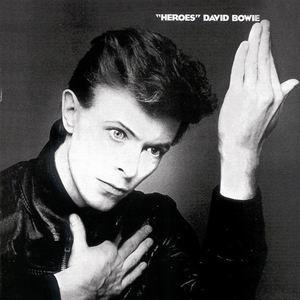
Image: David Bowie World collection / editorial use
Released on 14 October 1977, “Heroes” is one of the central works of David Bowie’s Berlin period. It followed Low, continued Bowie’s collaboration with Tony Visconti and Brian Eno, and became the only album of the so-called Berlin Trilogy to be recorded entirely in Berlin.
Recorded at Hansa Studio in West Berlin, close to the Berlin Wall, the album combined hard rock, electronic texture, ambient soundscapes, experimental studio methods and some of Bowie’s most powerful vocal performances.
- Album: “Heroes”
- Released: 14 October 1977
- Official recording sessions began: 11 July 1977
- Recorded: 11 July – 8 August 1977
- Main studio: Hansa Studio, West Berlin
- Mixing: Mountain Studios, Montreux, Switzerland
- Producers: David Bowie and Tony Visconti
- Key collaborator: Brian Eno
- Engineers: Tony Visconti, Colin Thurston and Eduard Meyer
- Label: RCA Records
- Previous studio album: Low
- Next studio album: Lodger
- Singles: “Heroes”, Beauty And The Beast
- Cover photographer: Masayoshi Sukita
- Visual influence: Erich Heckel and German Expressionism
Introduction
“Heroes” was made during one of the most productive periods of David Bowie’s career. In 1977 alone, Bowie released Low, helped Iggy Pop with The Idiot and Lust For Life, toured as Iggy’s keyboard player, recorded “Heroes”, promoted the album internationally and continued moving away from the personal chaos of his Los Angeles years.
The album is often grouped with Low and Lodger as part of the Berlin Trilogy. That phrase is useful, but it needs one important qualification: “Heroes” was the only one of the three albums recorded entirely in Berlin.
The record took the experimental ideas of Low and made them louder, harder and more dramatic. The first side contained songs with vocals, while the second side moved into darker instrumental territory before ending with The Secret Life Of Arabia.
The result was one of Bowie’s most intense albums: romantic but not sentimental, experimental but not cold, and deeply connected to the divided city in which it was made.
Making Of The Album
The making of “Heroes” began after Bowie had already established a new working rhythm in Europe. Low had shown that he no longer needed to follow conventional rock or soul formulas, while his work with Iggy Pop confirmed that Berlin could offer him a different kind of creative life.
Bowie was living in West Berlin, away from the extreme pressures of Los Angeles. He shared the city for part of this period with Iggy Pop and was able to walk, visit galleries, absorb German art and culture, and work with a degree of freedom he had not felt for several years.
The album’s musical direction was shaped by several forces: the disciplined rhythm section of Carlos Alomar, George Murray and Dennis Davis; the experimental textures of Brian Eno; Tony Visconti’s production and engineering; and Robert Fripp’s extraordinary guitar treatments.
Unlike many earlier Bowie albums, much of “Heroes” developed directly in the studio. Only Sons Of The Silent Age is generally identified as having been written before the sessions. The rest of the album grew from rhythm ideas, chord structures, improvisation, studio treatment and Bowie’s later lyric writing.
Berlin And The Divided City
Berlin was not just a background for “Heroes”. It was part of the album’s atmosphere.
Hansa Studio stood close to the Berlin Wall, and the presence of the divided city affected the people working there. The Wall, the guard towers, the heavy history of the building and the contrast between East and West all fed into the mood of the sessions.
Bowie’s Berlin was also a city of museums, bars, underground culture, cabaret echoes, political tension and post-war memory. Those contrasts can be heard throughout the album.
The music often feels like it is moving between pressure and release, darkness and hope, discipline and emotional risk. That tension is one of the reasons “Heroes” remains so powerful.
Running At The Speed Of Life
By the time Bowie entered Hansa Studio in July 1977, he had already completed a remarkable amount of work that year.
Low had been released in January. Bowie then toured with Iggy Pop during the spring, playing keyboards and backing vocals instead of standing at the front of the stage as the star.
After the tour, Bowie and Iggy travelled to Japan, where the photo session that produced the “Heroes” cover image took place. Bowie then returned to Europe and continued working at an intense pace.
This energy helped shape the album. “Heroes” sounds urgent because it was made by musicians who were working quickly, trusting instinct and using the studio as an instrument.
Recording Sessions
The official recording sessions for “Heroes” began on 11 July 1977 at Hansa Studio in West Berlin and continued until 8 August 1977.
The album was recorded at Hansa Tonstudio 2, often remembered as Hansa by the Wall because of its proximity to the Berlin Wall. The studio’s large room, historical atmosphere and physical location helped give the album its distinctive sound and mood.
Bowie and Tony Visconti co-produced the album. Brian Eno was not the producer, but his role was crucial as a collaborator, musician and generator of experimental ideas.
After the Berlin recording sessions, the album was mixed at Mountain Studios in Montreux, Switzerland.
Hansa Studio By The Wall

Hansa Studio gave “Heroes” a unique physical and emotional setting.
The large recording room allowed Bowie, Visconti and the musicians to create recordings that felt spacious but tense. The studio was not a neutral environment. Its history, its architecture and its closeness to the Berlin Wall became part of the record’s identity.
The atmosphere was very different from the French Château d’Hérouville sessions that had produced much of Low. Here Bowie was recording entirely in Berlin, the city that had become central to his recovery and artistic reinvention.
The result was a record that sounds both local and universal: rooted in Berlin, yet expansive enough to speak about fear, love, division, survival and hope.
Tony Visconti And Brian Eno
Tony Visconti’s role on “Heroes” was essential. He co-produced the album with Bowie, engineered important parts of the sessions and helped create some of the record’s most famous sounds.
Visconti’s production approach allowed the music to remain spontaneous without becoming unfocused. The band could work quickly, while the studio treatments gave the recordings depth and character.
Brian Eno helped Bowie move away from conventional songwriting and arrangement. His use of synthesizers, treatments and conceptual working methods encouraged unexpected musical decisions.
Together, Bowie, Visconti and Eno created a working environment where accidents, experiments and first instincts could become finished recordings.
Key Musicians
The musicians on “Heroes” combined Bowie’s strongest mid-1970s rhythm section with experimental textures and one of Robert Fripp’s most famous guitar performances.
- David Bowie: vocals, keyboards, guitar, saxophone and koto
- Carlos Alomar: rhythm guitar
- Robert Fripp: lead guitar
- George Murray: bass guitar
- Dennis Davis: drums and percussion
- Brian Eno: synthesizers, keyboards and guitar treatments
- Tony Visconti: production, engineering, percussion and backing vocals
- Antonia Maass: backing vocals
- Peter Burgon: backing vocals
- Colin Thurston: engineering
- Eduard Meyer: Hansa Studio engineering support
Carlos Alomar, George Murray And Dennis Davis
Carlos Alomar, George Murray and Dennis Davis formed one of Bowie’s most important rhythm foundations.
Alomar’s guitar work gave the tracks structure and movement. Murray’s bass was powerful, disciplined and melodic, while Davis’s drumming brought force and flexibility.
Together they helped make “Heroes” harder and more physical than Low. Even the most experimental parts of the album are grounded in a band that could play with extraordinary precision.
Robert Fripp, Filters And Feedback
Robert Fripp was brought into the sessions after the initial backing tracks had been developed.
His guitar work became one of the album’s defining sounds. On the title track, Fripp created sustained, soaring lines that were treated through Brian Eno’s synthesizer equipment and shaped in the mix by Tony Visconti.
The result was not a conventional guitar solo. It was closer to a voice, a signal or a long emotional cry running through the music.
Fripp’s contribution helped transform “Heroes” from a strong album track into one of Bowie’s most recognisable recordings.
Lyrics And Vocals
Bowie often wrote lyrics late in the recording process, after the backing tracks had been created. “Heroes” followed that method.
The musicians could record powerful tracks without always knowing what the final words or melodies would be. Bowie then used the completed musical atmosphere as the trigger for his lyric writing.
This approach gave the album a special tension. The music often seems to exist first as mood, pressure and movement. The words arrive later, almost as if Bowie is discovering what the tracks mean while singing them.
On the title track, Visconti’s famous multi-microphone recording method helped capture Bowie’s vocal performance as it grew in intensity. The sound of the room itself became part of the recording.
The Making Of “Heroes“
Although the album contains ten tracks, the emotional centre of the record is the title song “Heroes“.
The basic backing track was created first by Bowie, Brian Eno, Carlos Alomar, George Murray and Dennis Davis. Robert Fripp later added his soaring, sustained guitar parts, while Tony Visconti developed his famous three-microphone recording technique to capture Bowie’s increasingly powerful vocal performance.
The lyrics were completed only after most of the music had already been recorded. Inspired in part by the sight of Tony Visconti and Antonia Maass embracing near the Berlin Wall, Bowie transformed a private moment into one of the most enduring songs of his career.
Although the single achieved only moderate chart success in 1977, “Heroes“ gradually became one of the defining recordings of David Bowie’s career and one of the most celebrated songs in rock history.

"Heroes" Bing Crosby Show
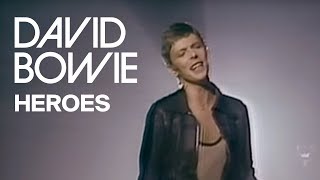
"Heroes" (Official Video)

"Heroes" (Marc Bolan Show

"Heroes" (1977) • TopPop
-
"Heroes" Bing Crosby Show
From Bing Crosby Christmas special, recorded in 1977. -
"Heroes" (Official Video)
The official music video for David Bowie - "Heroes" from Bowie's 'Heroes' album released in 1977, which featured the singles 'Heroes' / 'V-2 Schneider' and 'Beauty and the Beast' / 'Sense of Doubt' -
"Heroes" (Marc Bolan Show
David Bowie performs "Heroes" at Marc Bolan Show in 1977
Track Listing
Important Songs
The album contains ten tracks, and each one plays a clear role in the structure of “Heroes”.
The first side contains songs, while the second side moves into instrumental and atmospheric territory before returning to vocal music with The Secret Life Of Arabia.
Important Song: Beauty And The Beast
Beauty And The Beast opens the album with a harder and more aggressive sound than many listeners expected after Low.
The track is driven by Dennis Davis’s powerful drumming, George Murray’s bass and Carlos Alomar’s guitar foundation, with Robert Fripp’s treated guitar adding a fierce edge.
Lyrically, the song suggests inner conflict, instinct, danger and self-division. It does not explain itself in a straightforward way, but it immediately establishes the album’s mood of pressure and transformation.
As the album opener, Beauty And The Beast announces that “Heroes” will be more direct, louder and more forceful than Low, while still remaining experimental.
Important Song: Joe The Lion
Joe The Lion is one of the album’s most angular and unstable rock songs.
The title has often been connected with performance art and the figure of the artist as a physical risk-taker. The lyrics are fragmented, vivid and difficult to reduce to one simple meaning.
Musically, the track combines a hard band performance with distorted textures and sudden changes of energy. Bowie’s vocal delivery is tense, sharp and dramatic.
The song shows how Bowie could use rock music without returning to conventional rock structure. It is aggressive, but it is also strange and deliberately unsettled.
Important Song: “Heroes”
“Heroes” is the emotional centre of the album and one of the defining recordings of Bowie’s career.
The track was built from a powerful band performance, Brian Eno’s textures, Robert Fripp’s sustained guitar lines and Tony Visconti’s innovative vocal recording technique.
The lyric was partly inspired by the image of two lovers near the Berlin Wall. Bowie later confirmed that the couple he had seen were Tony Visconti and German singer Antonia Maass. For many years he kept that detail private because Visconti was married at the time.
The quotation marks around the title are important. The song is not a simple anthem of victory. It is about a moment of courage, love or defiance that may last only briefly, but still matters.
Although the single was only a moderate hit in 1977, its reputation grew steadily. Over time, “Heroes” became one of Bowie’s most loved and most widely recognised songs.
Important Song: Sons Of The Silent Age
Sons Of The Silent Age is one of the album’s more structured songs and is usually identified as the one track written before the sessions began.
Its atmosphere is mysterious and theatrical, with a more developed melodic shape than some of the tracks created directly in the studio.
The song’s imagery suggests isolation, observation and strange modern identities. It fits naturally within the album’s larger themes of distance and alienation.
Because it sits between “Heroes” and Blackout, it also helps balance the first side of the record.
Important Song: Blackout
Blackout is one of the most intense songs on the album.
The track combines frantic vocal delivery, hard rhythm and a sense of psychological pressure. Its title suggests collapse, loss of control and disorientation.
Bowie’s performance is urgent and unsettled, while the band plays with great force. The song is not polished in a comfortable way; its power lies in its nervous energy.
As the closing track on the first side, Blackout pushes the album’s vocal material to a point of crisis before the second side moves into instrumental territory.
Important Song: V-2 Schneider
V-2 Schneider opens the second side and is one of the clearest examples of Bowie’s admiration for German electronic music.
The title is a tribute to Florian Schneider of Kraftwerk, while the reference to the V-2 rocket adds a darker historical layer.
The track is mostly instrumental and built around rhythm, saxophone and mechanical movement. It connects the album to the German musical environment Bowie was absorbing in Berlin.
Rather than imitating Kraftwerk directly, Bowie transforms that influence into something rougher, stranger and more personal.
Important Song: Sense Of Doubt
Sense Of Doubt is one of the album’s darkest instrumental pieces.
Its heavy descending piano figure creates an atmosphere of uncertainty, threat and unresolved tension.
The track shows how Bowie and Eno could create drama without conventional song form. It feels like a landscape or a psychological state rather than a pop composition.
Placed on the second side, Sense Of Doubt deepens the album’s darker atmosphere and prepares the listener for the more ambient passages that follow.
Important Song: Moss Garden
Moss Garden brings a very different atmosphere to the album.
Bowie’s use of koto gives the piece a Japanese influence, while Brian Eno’s textures create an environment of quiet space and distant movement.
The track reflects Bowie’s broader cultural interests during 1977, including his visit to Japan earlier that year.
After the tension of Sense Of Doubt, Moss Garden offers stillness, but not simple calm. It remains mysterious and carefully controlled.
Important Song: Neuköln
Neuköln is one of the album’s most haunting instrumentals.
The title refers to the Berlin district of Neukölln, and the music carries a sense of displacement, melancholy and urban isolation.
Bowie’s saxophone gives the piece a human voice inside the electronic and atmospheric setting. The performance is raw, emotional and uneasy.
The track is one of the clearest examples of how Berlin’s geography and emotional atmosphere entered the album’s music.
Important Song: The Secret Life Of Arabia
The Secret Life Of Arabia closes the album by breaking away from the purely instrumental mood of the previous tracks.
The song combines rhythm, vocal performance and exotic atmosphere, pointing toward Bowie’s interest in movement, travel and cultural imagination.
Its placement at the end of the album is important. Instead of closing in darkness, “Heroes” ends with a strange return to song form and a sense of forward motion.
The track also shows that Bowie was already moving beyond the exact structure of Low, even while using some of its basic side-one/side-two ideas.
Track Listing
The final album sequence combines powerful vocal tracks, Berlin-inspired instrumentals and experimental studio textures.

Image: David Bowie World collection / editorial use
- Beauty And The Beast
- Joe The Lion
- “Heroes”
- Sons Of The Silent Age
- Blackout
- V-2 Schneider
- Sense Of Doubt
- Moss Garden
- Neuköln
- The Secret Life Of Arabia
Together these ten tracks created one of Bowie’s strongest and most atmospheric albums, balancing rock energy with instrumental experimentation.
Singles From The Album
“Heroes”
“Heroes” was released as a single on 23 September 1977, before the album appeared.
The single was backed with V-2 Schneider and was promoted through television appearances, interviews and promotional films. It reached the UK Top 30 but was not a major hit at the time.
Its reputation grew gradually after release. Today it is one of Bowie’s defining songs, but its original chart performance was modest compared with its later cultural importance.
German and French versions, “Helden” and “Héros”, were also recorded, giving the song a special place in Bowie’s international catalogue.
Beauty And The Beast
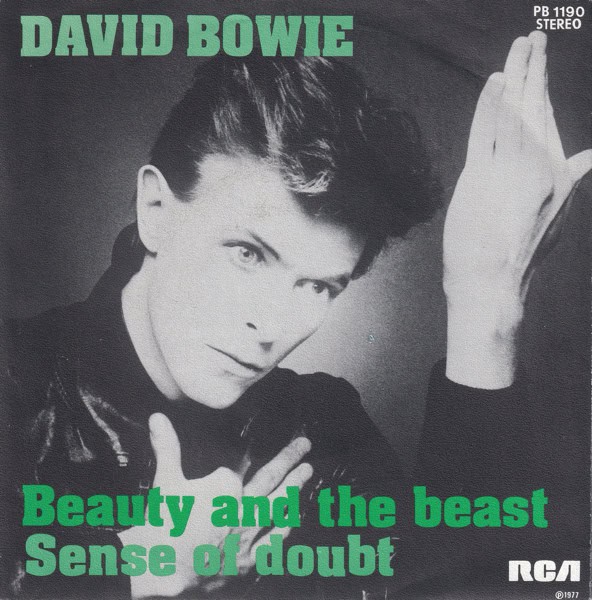
Beauty And The Beast was released as the second single from “Heroes” on 6 January 1978.
Backed with the instrumental Sense Of Doubt, the single highlighted the album’s darker, more abrasive opening track rather than its more accessible moments.
Although it reached only No. 39 on the UK Singles Chart and achieved modest international success, it demonstrated Bowie’s determination to promote the album on its own artistic terms rather than chasing commercial expectations.
The single later became recognised as an important document of Bowie’s Berlin period, capturing the tension, energy and experimental spirit that defined the “Heroes” sessions.
No Later Single Releases Needed
“Heroes” does not require a separate later single releases section in the same way as some earlier Bowie albums. The historically important single activity belongs to the original 1977–1978 album campaign, including the title track, its German and French versions, and Beauty And The Beast.
International Language Versions
To promote the album in continental Europe, Bowie also recorded two foreign-language versions of “Heroes“.
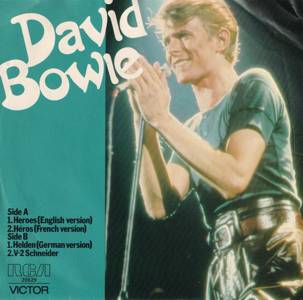
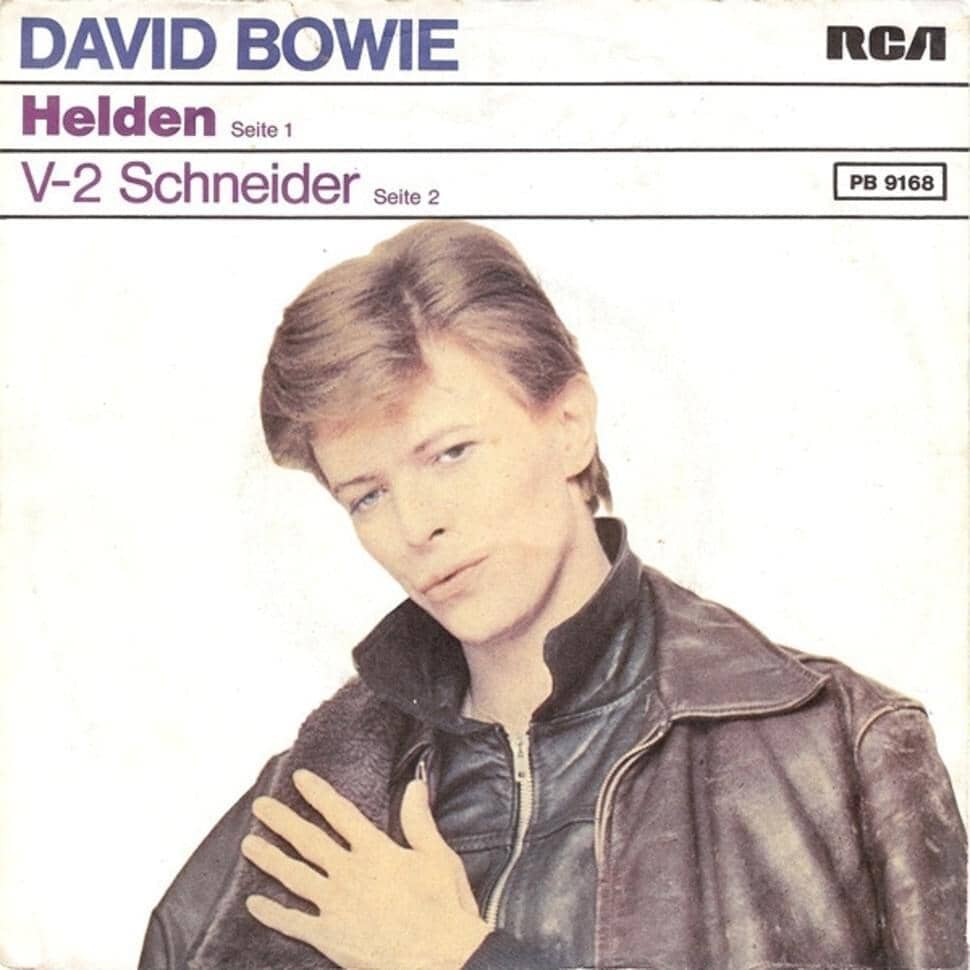
- “Helden” – German-language version, released in Germany.
- “Héros” – French-language version, released in France and other selected territories.
Both versions were recorded at Mountain Studios, Montreux, in August 1977 after completion of the album, with Antonia Maass coaching the German pronunciation and Coco Schwab assisting with the French lyrics.
Television And Promotion
Bowie supported “Heroes” with one of his strongest promotional campaigns of the later 1970s.
He appeared on television in several countries and performed or mimed the title track for major broadcasts. These appearances helped establish the visual identity of the album even though the single was not an immediate worldwide hit.
In the Netherlands, Bowie appeared on TopPop in October 1977, where he performed “Heroes” over a backing track and was presented with gold discs connected to the success of Low and the “Heroes” single.
In Britain, he also performed “Heroes” on Top Of The Pops, using a newly recorded backing track arranged by Tony Visconti at Good Earth Studios.
Making Of The Album Covers / Cover Story
The cover of “Heroes“ is one of David Bowie’s most recognisable images.
The photograph was taken by Japanese photographer Masayoshi Sukita during Bowie’s visit to Japan in April 1977, several months before the album was recorded.
Image: David Bowie World collection / editorial use
The sleeve’s dramatic hand gesture was not random. It was closely connected to Bowie’s interest in German Expressionist art.
The most important visual reference was Roquairol, a painting by German Expressionist artist Erich Heckel. Bowie had seen Heckel’s work in Berlin and was strongly affected by its angular, theatrical emotional language.
Sukita’s photograph transformed that influence into a modern rock image. Bowie’s face, hands and posture suggest performance, distance, fragility and control.
The cover perfectly matches the album: stark, dramatic, European and emotionally charged.
Want to discover the full story behind the iconic “Heroes“ album cover? Explore the complete history of the photo session with Masayoshi Sukita, the influence of German Expressionism, Erich Heckel’s artwork, and the creation of one of David Bowie’s most celebrated album sleeves.
Erich Heckel And German Expressionism
German Expressionism was central to the visual world around “Heroes”.
Bowie was especially interested in Erich Heckel and the art of Die Brücke. These works often used angular forms, intense emotion and distorted physical gestures to express psychological states.
The same artistic influence can also be seen around Iggy Pop’s The Idiot, another project closely connected with Bowie’s Berlin period.
By connecting rock photography with Expressionist painting, Bowie gave the “Heroes” cover a historical depth that went beyond ordinary album design.
Back Cover / Cover Versions
The original album packaging continued the stark visual world of the front sleeve.
The typography, monochrome presentation and restrained design helped keep the focus on Bowie’s image and the album’s title.
The cover later gained renewed attention when designer Jonathan Barnbrook adapted the “Heroes” sleeve image for Bowie’s 2013 album The Next Day. That later reuse confirmed how iconic the original image had become.
Release And Reception
“Heroes” was released by RCA Records on 14 October 1977.
The album performed strongly in several countries. It reached number three in the United Kingdom and the Netherlands, and also charted well in parts of Europe and Australia.
In the United States, however, it was less commercially successful than some of Bowie’s earlier mid-1970s albums.
Critical response recognised the album’s ambition, though its mixture of rock songs, ambient instrumentals and experimental production challenged ordinary expectations of a David Bowie album.
The “There’s Old Wave, There’s New Wave, And There’s David Bowie” Campaign
RCA promoted the album with the famous slogan: “There’s Old Wave, there’s New Wave, and there’s David Bowie.”
The slogan was effective because it placed Bowie outside the musical categories of the moment. In 1977, punk, new wave and disco were shaping popular music, but Bowie was following a different path.
Rather than competing directly with a trend, “Heroes” presented Bowie as an artist operating in his own space.
Reissues, Remasters And Later Releases
“Heroes” has been reissued many times, reflecting its central importance in Bowie’s catalogue.
It first appeared on compact disc through RCA in the 1980s. A 1991 Rykodisc/EMI edition added bonus material, including Abdulmajid and a remix of Joe The Lion.
A 1999 EMI/Virgin remaster appeared as part of the David Bowie Series.
In 2017, “Heroes” was included in the box set A New Career In A New Town (1977–1982), and later appeared again as a standalone release.
Later Special Releases
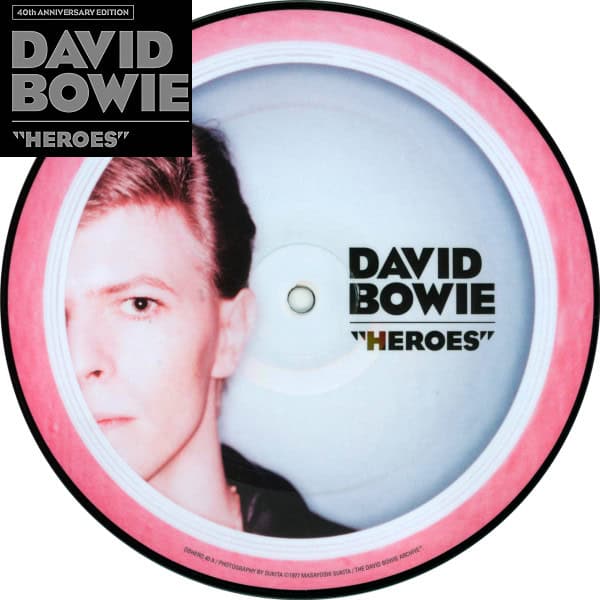
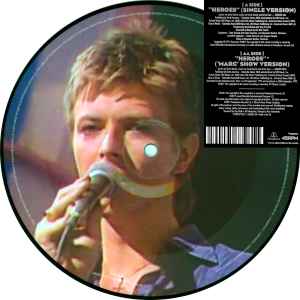
The legacy of “Heroes“ continued through later collector releases and archival live recordings.
In 2017, to mark the 40th anniversary of the original single, Parlophone issued a limited edition 7-inch picture disc of “Heroes“. The A-side featured the 2017 remaster of the single version, while the AA-side included a previously unreleased live version recorded for Marc Bolan‘s television show Marc on 7 September 1977 and broadcast on 20 September 1977.
The album’s B-side track V-2 Schneider also gained a later live afterlife. Bowie performed the song at Paradiso in Amsterdam on 10 June 1997, and that recording later appeared officially on Liveandwell.com (2020 Remaster).
Legacy
Today “Heroes” is regarded as one of David Bowie’s essential albums.
Its title track has become one of his most famous songs, but the album’s importance goes far beyond that one recording. It shows Bowie working at the edge of rock, electronics, ambient music, European art and modern studio production.
The album also confirmed that the experiments of Low were not a one-off. Bowie had entered a new creative phase and was prepared to keep moving forward.
The sound of “Heroes” influenced later generations of musicians who wanted rock music to be more atmospheric, more cinematic and more open to experimental ideas.
The Berlin Wall And The Song’s Afterlife
The title track gained even greater emotional power after Bowie performed it near the Berlin Wall in 1987.
That later performance connected the song directly with the divided city in a public and political way. People on the other side of the Wall could hear the concert, turning the song into something larger than its original release.
After the fall of the Berlin Wall in 1989, “Heroes” came to be heard by many listeners as one of the great songs of hope, division and human defiance.
That later history should not obscure the album’s original meaning, but it helps explain why the song and the record have continued to grow in stature.
Why “Heroes” Still Matters
“Heroes” still matters because it captures Bowie at a moment when personal recovery, European culture, studio experiment and political atmosphere all came together.
The album is not easy in a conventional sense, but it is deeply powerful. It contains fear, romance, humour, pressure, beauty and a hard-won sense of possibility.
It is also the clearest Berlin statement of Bowie’s career: recorded in the city, shaped by the Wall, visually linked to German Expressionism and musically connected to the European future he was helping to invent.
Article Origin
This article was created using documented information relating to the writing, recording, production, release, artwork and later history of David Bowie’s “Heroes”.
It incorporates historical album-session information, documented musician and producer recollections, RCA release history, chart information, material connected with Hansa Studio and material preserved in the David Bowie World archive.
The cover story section also draws on the David Bowie World article “Heroes” (1977) – The Story Behind The Album Cover, including the connection with Masayoshi Sukita, Erich Heckel and German Expressionism.
