
Kabuki – Japanese Theatre Influence on David Bowie
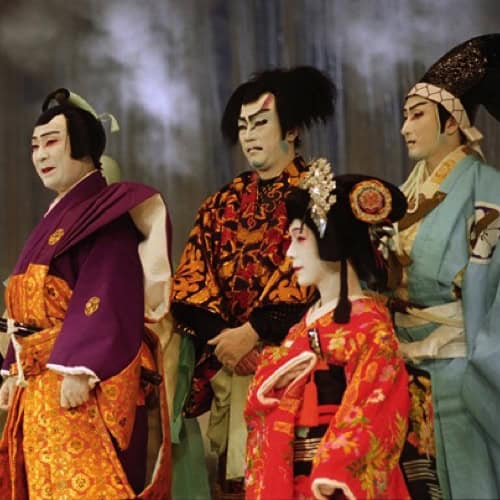
Kabuki theatre performers. Source: Wikimedia Commons .
Kabuki is one of Japan’s major classical theatre traditions. Developing from the early seventeenth century, it combines acting, dance, music, elaborate costume, highly stylised movement and distinctive forms of stage presentation. Elements of Japanese theatre and design became part of the visual world surrounding David Bowie, particularly during the early 1970s.
The clearest documented Kabuki connection came through Japanese fashion designer Kansai Yamamoto. His stage clothing for Bowie drew on Japanese theatrical ideas, including the Kabuki costume-change technique known as hikinuki.
Bowie’s interest was broader than Kabuki alone. His earlier mime training with Lindsay Kemp, together with fashion, photography, makeup, film and other theatrical traditions, all contributed to the visual language of the Ziggy Stardust and Aladdin Sane period.
- Name: Kabuki
- Country of origin: Japan
- Origins: Early seventeenth century
- Art form: Classical Japanese theatre combining acting, dance and music
- Visual characteristics: Stylised performance, elaborate costume, theatrical makeup and distinctive stagecraft
- Bowie connection: A documented Japanese theatrical influence within Bowie’s early-1970s visual development
- Key Bowie period: Ziggy Stardust and Aladdin Sane, particularly 1972–1973
- Important creative connection: Kansai Yamamoto
- Documented Kabuki link: Yamamoto connected clothing worn by Bowie with hikinuki, a Kabuki method of rapid costume transformation
- Related evidence: Kabuki-inspired makeup photographed by Masayoshi Sukita and Bowie’s documented interest in Japanese theatrical masks
Kabuki – A Theatre of Stylisation
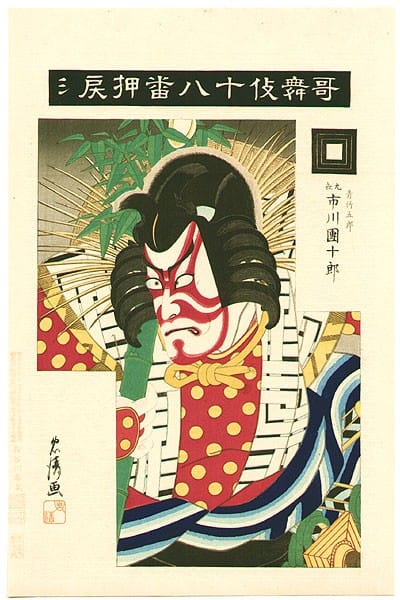
Source: Wikimedia Commons
Kabuki emerged in Japan at the beginning of the seventeenth century and developed into one of the country’s major theatrical traditions. Across more than four centuries it established distinctive conventions of acting, dance, music, costume, makeup and stagecraft.
Unlike forms of theatre primarily based on naturalistic behaviour, Kabuki openly embraces stylisation. Movement may be carefully controlled or exaggerated, while costume and makeup can transform the performer into a strongly defined theatrical figure.
Costume is central to this visual language. Clothing can change the apparent proportions of a performer and contribute directly to the dramatic identity of a role. Colour, pattern, fabric and silhouette are therefore part of the theatrical presentation rather than simple decoration.
Makeup can be equally important. One of Kabuki’s best-known makeup traditions is kumadori, particularly associated with certain roles in the aragoto acting style. Strong lines and colours emphasise facial features and help communicate character from a distance.
Not every Kabuki performer uses kumadori, and not every stylised Bowie image should automatically be identified as Kabuki-inspired. The historical connection is strongest where surviving evidence establishes a specific link.
David Bowie Before the Japanese Connection
Bowie’s interest in theatrical performance began before Japanese design became prominent in his stage presentation. During the late 1960s he studied mime with Lindsay Kemp, whose theatrical work combined movement, costume, makeup, music and character.
Bowie appeared with Kemp in Pierrot in Turquoise, gaining practical experience of performance in which physical movement and visual presentation were integral to the work.
Mime demonstrated how gesture, posture, stillness and movement could communicate alongside music. It also reinforced the idea that costume and facial appearance could help create a distinct theatrical identity.
Kabuki therefore did not create Bowie’s theatrical approach. Japanese performance traditions entered an artistic vocabulary that Bowie had already begun developing through mime, music, fashion and visual art.
Ziggy Stardust and the Construction of a Stage Identity
During 1972, Bowie transformed his public presentation through the emergence of Ziggy Stardust. The character became associated not only with the music of The Rise and Fall of Ziggy Stardust and the Spiders from Mars, but also with Bowie’s clothing, hair, makeup, photography and physical performance.
Ziggy’s visual appearance continued to evolve during the touring period. New costumes and makeup designs appeared as Bowie worked with different designers, photographers and creative figures.
Japanese fashion became particularly important through Bowie’s association with Kansai Yamamoto. Yamamoto’s designs offered unusual silhouettes, vivid colours and theatrical possibilities that fitted Bowie’s developing stage image.
Kansai Yamamoto – The Direct Kabuki Connection
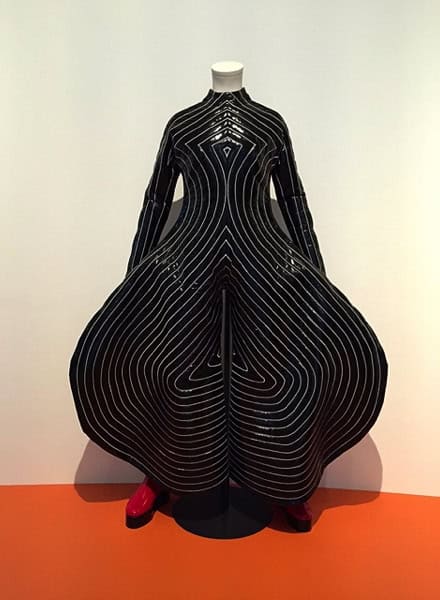
Source: Wikimedia Commons
Kansai Yamamoto became one of the most important designers associated with Bowie’s Ziggy Stardust and Aladdin Sane period. His contemporary fashion incorporated references to Japanese visual culture and theatrical tradition without simply reproducing traditional Japanese costume.
Yamamoto presented his first London collection in 1971. Bowie subsequently began wearing his designs as his own stage clothing became increasingly theatrical.
Some of Yamamoto’s garments reached Bowie through stylist Yasuko Hayashi. Yamamoto later saw Bowie wearing his designs during a performance in New York.
The designer was struck by Bowie’s use of clothing that had originally been created for women. Bowie treated the garments as part of his stage identity rather than accepting conventional distinctions between masculine and feminine fashion.
More importantly for the history of Kabuki, Yamamoto directly identified a theatrical technique behind some of the clothing Bowie wore: hikinuki.
Hikinuki – Transformation Through Costume
Hikinuki costume transformation: On the Hanamichi Day 115
In Kabuki, hikinuki is a technique that allows a performer’s costume to be changed rapidly during the action. Specially prepared garments can reveal another layer or appearance without requiring the performer to leave the stage for a conventional costume change.
The transformation itself becomes part of the theatrical spectacle.
Yamamoto explicitly connected this Kabuki technique with the clothing worn by Bowie, providing one of the strongest direct pieces of evidence for Kabuki influence on Bowie’s early-1970s stage presentation.
Kansai Yamamoto on his David Bowie costumes
“The clothes were influenced by hikinuki, the method of changing costumes quickly in kabuki.”
The relationship was therefore not one of Bowie simply copying Kabuki. A Japanese theatrical technique was reinterpreted by a contemporary Japanese designer and then used by Bowie in the very different setting of an international rock concert.
The Yamamoto Costumes on Stage
David Bowie – 1984 / Dodo – The 1980 Floor Show, 1973
Yamamoto’s designs became some of the most recognisable costumes of Bowie’s early career. Their proportions, shapes and patterns could alter Bowie’s appearance dramatically under stage lighting.
Certain garments changed visually when Bowie moved, turned or extended his arms. The relationship between the body and the clothing was therefore part of their impact.
This helped distinguish the costumes from conventional rock clothing. They were designed not merely to be worn but to function as part of performance.
The designs also suited Bowie’s already established willingness to challenge gender expectations. This aspect of their collaboration belongs to the broader Bowie–Yamamoto story and should not itself be described as a Kabuki tradition.
David Bowie in Japan – April 1973
Bowie travelled to Japan as a performer in April 1973 during the continuing Ziggy Stardust tour. By that point his use of Yamamoto’s clothing was already established.
The visit therefore did not mark Bowie’s discovery of Japanese design. Instead, it brought him directly into the country whose contemporary fashion and theatrical culture had already entered his visual world.
During the Japanese dates, Bowie continued expanding the range of costumes associated with the Ziggy Stardust and Aladdin Sane stage presentation.
His relationship with Japan would continue long beyond this tour through photographers, designers and later visits to the country.
Masayoshi Sukita and Kabuki-Inspired Makeup
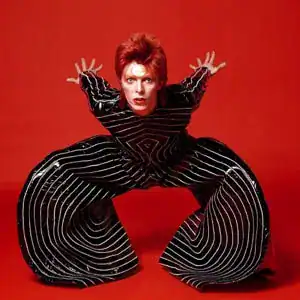
Photographer Masayoshi Sukita first photographed Bowie in 1972 and went on to create an extensive body of Bowie imagery over several decades.
A Sukita photographic session in New York in February 1973 is especially relevant to this page. Bowie appeared wearing a Kansai Yamamoto costume together with makeup subsequently identified by Bowie’s official website as Kabuki-inspired.
This provides direct support for describing that particular visual presentation as connected with Kabuki.
It does not mean that every geometric or brightly coloured makeup design Bowie wore during 1972–1973 came from Kabuki. Bowie’s makeup was continually changing and drew on several different artistic sources.
Pierre LaRoche and Japanese Theatrical Masks
Makeup artist Pierre LaRoche played an important role in Bowie’s changing visual appearance during the early 1970s.
Evidence from the David Bowie Archive shows that Bowie’s engagement with Japanese theatre extended beyond fashion. In 1973 he gave LaRoche a book concerning Japanese theatrical masks.
Research by the Victoria and Albert Museum connects this material with Bowie’s interest in the visual traditions of both Kabuki and Noh and with LaRoche’s subsequent makeup work.
This evidence is particularly valuable because it shows Bowie actively looking at Japanese theatrical imagery rather than merely encountering Japanese references indirectly through contemporary fashion.
Kabuki and Noh – Two Different Traditions
Kabuki and Noh are separate Japanese theatrical traditions and should not be treated as interchangeable.
Noh developed centuries before Kabuki and possesses its own highly controlled performance conventions, musical structures and use of carved masks for particular roles.
Kabuki developed later and established different traditions of acting, dance, music, costume, makeup and stagecraft.
Bowie’s interest touched on imagery connected with both. For that reason, archival material concerning Japanese theatrical masks cannot automatically be described as exclusively Kabuki.
Aladdin Sane and the Changing Bowie Face
The release of Aladdin Sane in April 1973 coincided with another stage in Bowie’s visual development. Photography, makeup and costume became increasingly central to the way his music was presented.
The album’s famous cover photograph was created by Brian Duffy, with makeup by Pierre LaRoche. Bowie’s face was transformed by the red-and-blue lightning design that became one of the most recognisable images of his career.
There is no reason to label the lightning-flash design itself as Kabuki without direct evidence. Its relevance here lies in the broader development of Bowie’s use of the face as a deliberately designed element of performance and photography.
At the same time, Bowie was demonstrably wearing Kabuki-inspired makeup in other documented images and appearing in Yamamoto’s Japanese stage designs.
Pin Ups and the Mask-Like Face
The visual presentation surrounding Pin Ups later in 1973 provides another connection with Bowie’s interest in the transformed face.
Bowie and Twiggy appeared on the album cover with heavily painted faces, creating a deliberately artificial and mask-like effect.
Bowie’s documented interest in Japanese theatrical masks and the material he gave Pierre LaRoche provide important historical context for this visual development.
The cover should not, however, be described simply as Kabuki. The surviving evidence also concerns Noh, and Bowie’s visual language continued to combine multiple sources.
Movement, Gesture and Historical Caution
Kabuki performers use carefully controlled movement, gesture and pose, and moments of stillness can carry strong dramatic importance.
Similarities can certainly be observed between such theatrical practices and aspects of Bowie’s stage behaviour. However, visual resemblance alone does not establish direct influence.
Bowie’s training with Lindsay Kemp already provides a documented source for his interest in stylised physical performance.
It is therefore safer to connect Kabuki directly with Bowie where historical evidence survives rather than assigning particular gestures or poses to Japanese theatre without documentation.
The Final Ziggy Stardust Concert
On 3 July 1973, Bowie performed the final concert of the Ziggy Stardust tour at the Hammersmith Odeon in London.
Near the end of the concert, Bowie announced that it would be the last show the group would ever do, surprising the audience and members of the band.
The retirement of Ziggy demonstrated Bowie’s willingness to abandon a highly successful stage identity rather than allowing it to become permanent.
That decision was not a Kabuki practice, but Yamamoto’s costumes and other Japanese visual influences had contributed significantly to the theatrical appearance of Ziggy’s final period.
Japan Beyond Ziggy Stardust
Bowie’s interest in Japan did not end with Ziggy Stardust. He continued to visit the country and maintained important relationships with Japanese artists and photographers.
Masayoshi Sukita’s collaboration with Bowie became especially enduring and continued through very different stages of Bowie’s career.
These later connections should not automatically be described as Kabuki influences. Bowie’s engagement with Japanese culture was much broader than a single theatrical tradition.
Kansai Yamamoto’s Lasting Importance
Yamamoto continued to develop an international career after his early work with Bowie, while their stage costumes became some of the most widely recognised designs associated with both men.
Bowie later acknowledged Yamamoto’s importance and the contribution his designs had made to fashion and to the visual culture of the early 1970s.
David Bowie on Kansai Yamamoto
“Kansai’s brave ideas brought Japanese clothes design to the forefront of fashion.”
— David Bowie, 2008
The complete story of Yamamoto’s career and his personal collaboration with Bowie belongs to the separate DavidBowieWorld page devoted to Kansai Yamamoto. On this page, his importance lies specifically in establishing the strongest documented connection between Kabuki stagecraft and Bowie’s performance image.
Preserving the Bowie–Yamamoto Costumes
The survival of Bowie’s early-1970s Yamamoto costumes allows their construction to be examined away from the original concerts.
Their materials, shapes, fastenings and proportions demonstrate that they were carefully designed objects rather than improvised stage clothing.
At the same time, museum display can only reproduce part of their original effect. The garments were created to interact with Bowie’s body, movement and stage lighting.
They therefore survive both as fashion objects and as documents of performance history.
David Bowie Is and the Archive
The Victoria and Albert Museum’s David Bowie Is exhibition opened in London in 2013 before travelling internationally.
Drawing extensively on material from the David Bowie Archive, the exhibition brought together costumes, photographs, handwritten material, artwork and objects connected with Bowie’s creative process.
The exhibition demonstrated how central visual design had been throughout Bowie’s career and allowed Japanese costumes and theatrical references to be considered alongside his many other artistic influences.
A Cross-Cultural Creative Exchange
The relationship between Bowie, Yamamoto and Kabuki cannot be reduced to a simple story of a Western performer borrowing traditional Japanese imagery.
Yamamoto was a contemporary Japanese designer creating new fashion for an international audience. He incorporated Japanese cultural references into designs that were themselves modern rather than traditional Kabuki costumes.
Bowie then used those garments within another contemporary form: the international rock concert.
The result was a cross-cultural creative exchange in which theatrical ideas were repeatedly reinterpreted rather than copied unchanged.
What Kabuki Contributed to Bowie’s Visual World
The documented Kabuki contribution to Bowie’s work is specific but important.
Kansai Yamamoto connected his Bowie clothing directly with hikinuki. Bowie appeared in documented Kabuki-inspired makeup. He also studied Japanese theatrical masks and shared relevant material with Pierre LaRoche.
These facts are enough to establish Kabuki as a genuine strand within Bowie’s visual development without claiming that Ziggy Stardust or Bowie’s complete stage style originated in Kabuki.
Its importance lies particularly in the areas of costume, visible transformation, makeup and theatrical presentation.
Legacy
More than half a century later, the Japanese dimension of Bowie’s early-1970s visual identity remains immediately recognisable.
Yamamoto’s costumes, Sukita’s photographs and Bowie’s experiments with theatrical makeup have become enduring parts of the historical record of the Ziggy Stardust and Aladdin Sane period.
Kabuki occupies an important but carefully defined place within that history. It was one documented influence among many, entering Bowie’s work through contemporary Japanese fashion, theatrical imagery and the creative people around him.
Its significance lies not in providing a complete explanation for Bowie’s theatricality, but in showing how readily Bowie could encounter an artistic tradition, understand its possibilities and incorporate selected ideas into a wider creative language of his own.
Kabuki in Bowie’s Wider Creative Universe
Kabuki was not a collaborator and should not be described as one. Within Bowie’s wider creative history it belongs instead among the artistic influences that became visible through his relationships with designers, photographers and makeup artists.
Kansai Yamamoto provides the strongest direct link through costume design and hikinuki. Masayoshi Sukita documented Bowie wearing Japanese designs and Kabuki-inspired makeup, while Pierre LaRoche worked with Bowie during a period in which Japanese theatrical masks were actively being studied.
Together, these connections show how Japanese theatre entered Bowie’s creative world without reducing his work to an imitation of Kabuki itself.
Official Website & Further Information
Kabuki remains an active Japanese theatrical tradition, with its historic repertoire, performance conventions, costumes, makeup and stage techniques continuing to be preserved and performed.
For the complete history of the Japanese designer whose work provides the strongest documented connection between Kabuki stagecraft and David Bowie’s early-1970s stage presentation, see: Kansai Yamamoto – Fashion Designer and David Bowie Collaborator .
Article Origin
This article has been researched and written for DavidBowieWorld.com as part of the site’s ongoing project documenting the musicians, artists, producers, designers, performers, artistic influences and creative figures who helped shape David Bowie’s extraordinary career.
Particular care has been taken to distinguish documented Kabuki connections from later interpretation. Visual similarity alone has not been treated as evidence of direct influence, and Kabuki and Noh have been identified separately where the surviving historical evidence requires that distinction.
© DavidBowieWorld.com — David Bowie Collaborations & Creative Circle Archive.
