
Live Aid – David Bowie at Wembley Stadium in 1985
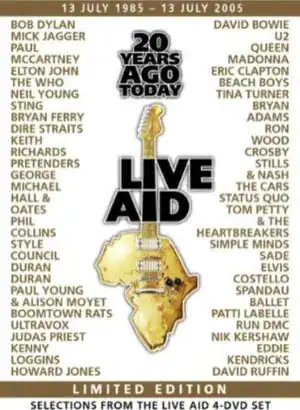
On 13 July 1985, David Bowie performed at Live Aid at Wembley Stadium in London, part of the international benefit event organised to raise money for famine relief in Ethiopia.
Bowie performed a compact four-song set: TVC 15, Rebel Rebel, Modern Love and “Heroes”. His appearance also became connected with one of Live Aid’s most powerful non-musical moments when, immediately after his set, devastating film of the Ethiopian famine was shown to the television audience.
Live Aid was not a conventional Bowie collaboration. Instead, it placed him within an extraordinary international gathering of musicians who temporarily shared the same humanitarian purpose and global broadcast.
- Event: Live Aid
- Date: 13 July 1985
- Bowie venue: Wembley Stadium, London
- Purpose: Benefit concert for famine relief in Ethiopia
- Bowie set: TVC 15, Rebel Rebel, Modern Love, “Heroes”
- Guitar: Kevin Armstrong
- Bass: Matthew Seligman
- Drums: Neil Conti
- Keyboards: Thomas Dolby
- Saxophone: Clare Hirst
- Percussion: Pedro Ortiz
- Backing vocals: Tessa Niles and Helena Springs
Live Aid
Live Aid was staged on 13 July 1985, with its principal concerts taking place at Wembley Stadium in London and John F. Kennedy Stadium in Philadelphia.
The event developed from the humanitarian campaign associated with Band Aid and brought together many of the best-known performers in contemporary popular music. Through television and satellite broadcasting, performances from the principal venues reached audiences around the world.
For Bowie, Wembley provided a very different setting from a conventional tour concert. He was one artist within a tightly scheduled event in which individual performances had to serve the larger purpose of Live Aid.
Bowie in 1985
Bowie arrived at Live Aid as one of the most internationally recognisable performers of his generation.
The enormous commercial success of Let’s Dance in 1983 and the accompanying Serious Moonlight Tour had introduced him to an even larger worldwide audience. By 1985, however, Bowie was not undertaking a regular concert tour.
His Wembley appearance therefore required musicians to be brought together specifically for Live Aid rather than simply using an established touring band already travelling with him.
The Live Aid Band
Bowie appeared at Wembley with a specially assembled group of musicians. Guitarist Kevin Armstrong, bassist Matthew Seligman and drummer Neil Conti formed the core rhythm section.
Thomas Dolby played keyboards, Clare Hirst played saxophone and Pedro Ortiz provided percussion. Tessa Niles and Helena Springs supplied backing vocals.
The temporary nature of the group makes the performance unusual within Bowie’s live history. This was not a long-established touring band carrying a familiar production from city to city. The musicians had been assembled for a short, internationally televised appearance in which preparation time was limited and the schedule was tightly controlled.
Dancing in the Street

Premiere at Live-Aid
-
Premiere at Live-Aid
Dancing in the Street Premiere at Live Aid
Bowie’s connection with Live Aid also involved Mick Jagger.
Bowie and Jagger recorded a version of the Motown song Dancing in the Street as part of the fundraising effort associated with Live Aid. An original plan to perform together across the Atlantic — Bowie in London and Jagger in Philadelphia — proved impractical because of the satellite delay.
Instead, Bowie and Jagger recorded the song together and filmed a promotional video. The video was shown during Live Aid shortly before Bowie took the stage at Wembley.
The recording was subsequently released as a charity single, with proceeds benefiting famine relief. It became a major international hit and reached number one in the United Kingdom.
David Bowie Takes the Wembley Stage
Bowie’s own Live Aid performance consisted of four songs drawn from different periods of his career.
He opened with TVC 15, originally released on Station to Station in 1976, followed by Rebel Rebel from 1974.
Bowie then moved to the more recent Modern Love from Let’s Dance before closing the musical portion of his appearance with “Heroes”.
Live Aid Setlist
- TVC 15
- Rebel Rebel
- Modern Love
- “Heroes”

Video: TVC 15

Video: Rebel Rebel

Video: Modern Love

Video: Heroes
-
Video: TVC 15
-
Video: Rebel Rebel
-
Video: Modern Love
-
Video: Heroes
“Heroes” at Wembley
“Heroes” provided the conclusion to Bowie’s four-song performance. Originally released in 1977, the song acquired a different scale when performed before the enormous Wembley audience and an international television audience.
Bowie introduced the musicians who had accompanied him and dedicated “Heroes” to his son, to children generally and to the children whose suffering had brought the musicians together at Live Aid.
The performance has subsequently become one of the most frequently remembered parts of Bowie’s appearance. It is important, however, to preserve the correct sequence of events: the Ethiopian famine film was screened after Bowie completed “Heroes”, not before it.
The Ethiopian Famine Film
One of the most important parts of Bowie’s involvement occurred immediately after his musical performance.
Before Live Aid, Bowie and promoter Harvey Goldsmith watched a CBC news report showing the human consequences of the Ethiopian famine. The footage was accompanied by Drive by The Cars.
Goldsmith later recalled Bowie’s immediate reaction to the film.
Harvey Goldsmith recalls David Bowie
“You’ve got to put that in the show; it’s the most dramatic thing I’ve ever seen.”
— David Bowie, recalled by Live Aid promoter Harvey Goldsmith
Bowie wanted the film included in the broadcast and agreed to reduce his own performance so that sufficient time would be available.
The Song Bowie Gave Up
Bowie had planned to include Five Years in his Live Aid set, but dropped the song so that the Ethiopian famine film could be shown during the time allocated to his appearance.
The decision meant that his Live Aid contribution was not simply about extending his own stage time. Instead, part of the time available to one of the event’s biggest performers was deliberately transferred back to the humanitarian purpose of the concert.
As Bowie’s band left the stage, he reminded the Wembley audience why Live Aid was taking place.
“Let us not forget why we are here. People are still starving.”
— David Bowie, Wembley Stadium, 13 July 1985
The Famine Film on the Wembley Screens
The CBC film followed Bowie’s set. The transition was deliberately stark: the spectacle of Wembley Stadium gave way to images showing the human consequences of famine in Ethiopia.
The report, accompanied by The Cars’ Drive, brought the purpose of Live Aid directly back into the television broadcast.
Harvey Goldsmith later described the footage as one of the most evocative elements of the entire event. Its placement immediately after Bowie’s performance became an important part of how his Live Aid appearance was remembered.
Backstage at Live Aid

Backstage Interview
-
Backstage Interview
Backstage Interview (Live Aid 1985)
Live Aid also provides a rare filmed glimpse of Bowie away from the Wembley stage. Backstage interviews recorded during the event capture him discussing the extraordinary scale of the day and the purpose behind it.
The footage shows a relaxed Bowie surrounded by the activity of the event rather than the carefully controlled setting of a conventional promotional interview.
His comments also return attention to the fundraising purpose of Live Aid. Bowie emphasised that the people donating money deserved recognition alongside the artists appearing on stage.
The Wembley Finale
Bowie’s participation in Live Aid did not end when his own performance finished.
Later in the evening he returned alongside other performers as the London concert moved towards its collective finale.
Bowie was among the artists participating in Do They Know It’s Christmas?, bringing together many musicians who had appeared individually during the day.
It was a fitting conclusion to the collective nature of Live Aid: individual stars who had performed their own material were finally brought together on the same Wembley stage.
Live Aid in Bowie’s Performance History
Live Aid occupies an unusual place in Bowie’s concert history. It was neither part of a David Bowie tour nor the launch of a new stage character, album or conventional promotional campaign.
Instead, Bowie adapted to the requirements of a unique event: a short set, a specially assembled band, an enormous stadium audience and an international broadcast whose primary purpose extended beyond entertainment.
His four-song performance demonstrates Bowie’s ability to move through material from different periods of his career without constructing the elaborate theatrical framework associated with some of his previous tours.
Equally important was his support for screening the famine film. By giving up part of his available performance time, Bowie helped return the humanitarian reason for Live Aid to the centre of the broadcast.
Legacy
Live Aid remains one of the most widely remembered music events of the 1980s, and Bowie’s Wembley appearance forms an important part of that history.
His contribution involved more than the performance of four songs. It included the specially assembled Live Aid band, the connection with Mick Jagger and Dancing in the Street, his decision to sacrifice Five Years so that the famine film could be shown, and his return for the collective Wembley finale.
“Heroes” remains the musical image most closely associated with Bowie at Live Aid, but the events immediately after it provide an equally important part of the historical record.
Official Website & Further Information
Further information about David Bowie’s Live Aid appearance can be found through the official David Bowie archive and the official Live Aid archive.
David Bowie – Official Website
Live Aid – Official Video Archive
Article Origin
This DavidBowieWorld archive article was researched and rewritten using documented material relating to David Bowie’s appearance at Live Aid on 13 July 1985.
Particular attention has been given to the correct sequence of Bowie’s four-song performance and the Ethiopian famine film that followed it, the musicians who accompanied Bowie at Wembley, the planned fifth song Five Years, and Bowie’s participation in the wider Live Aid event.
© DavidBowieWorld.com — David Bowie Collaborations & Creative Circle Archive.
