
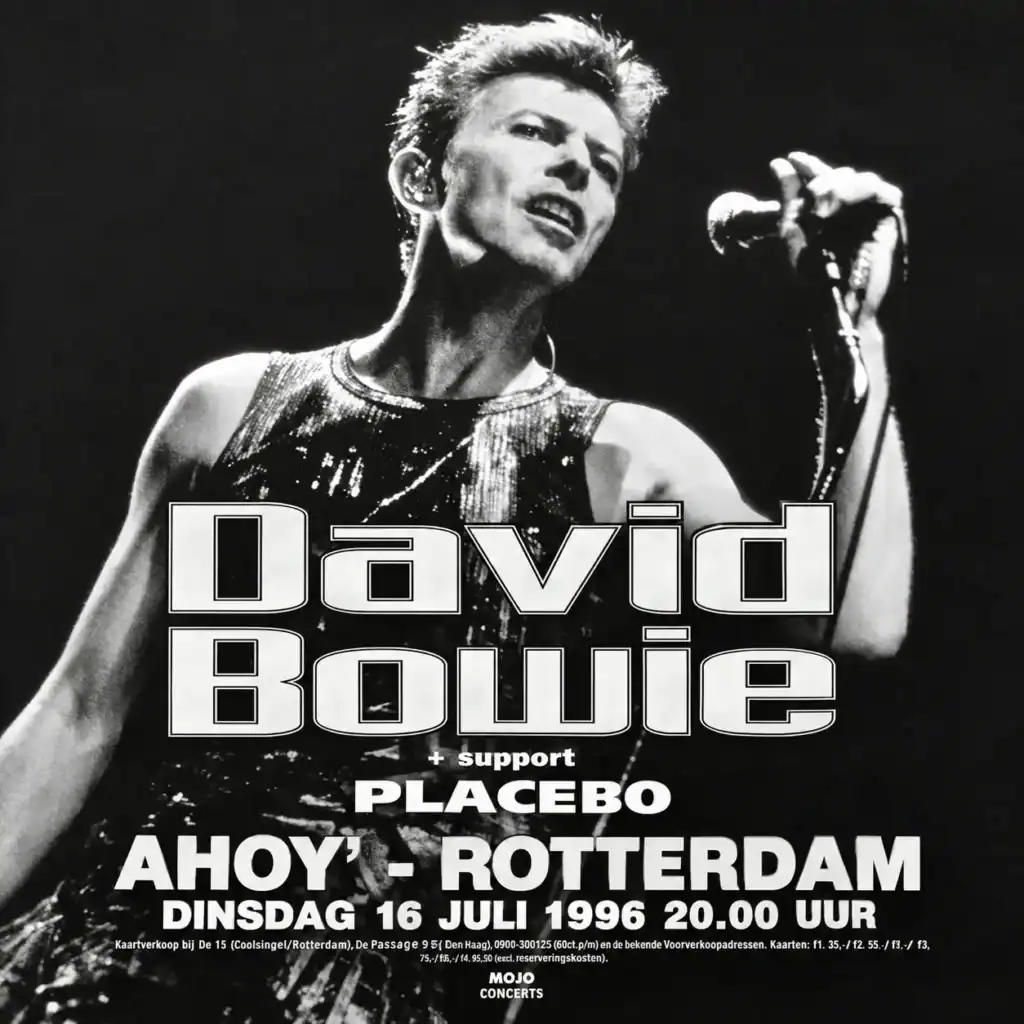
David Bowie 1996-07-16 Rotterdam ,Sportpaleis Ahoy - SQ 8,5.
Label: No label
Audio Source: Audience
Lineage: Master Cassettes > Sony WM-D6 > Sony PCM-M10
Taping Gear: Sony WM-D3 with supplied microphone > Master Cassettes
Taper: ManOfStealth
Recording Location: Unknown
Total running time: 1:49:06
Sound Quality: Very good. Equals record or radio apart from slight noise and some dullness.
Attendance: Approximately 9,000 (reported)
Artwork: None
Note: "Look Back In Anger" and "Breaking Glass" contain internal cuts. The recording also includes the encore break and closing audience noise.
David Bowie 1996-07-16 Rotterdam, Sportpaleis Ahoy – Outside Summer Festivals Tour
David Bowie – Rotterdam, Sportpaleis Ahoy, 16 July 1996 is an unofficial audience recording documenting Bowie's Dutch concert during the Outside Summer Festivals Tour. Recorded at Rotterdam's Sportpaleis Ahoy, the performance captures Bowie and his five-piece band combining the dark, experimental music of 1. Outside with radically reworked selections from his earlier catalogue.
Running for 1 hour, 49 minutes and 6 seconds, this recording preserves a substantial performance from an important transitional year. The concert includes material from 1. Outside, songs associated with Tin Machine, classic Bowie compositions and early performances of material connected with the forthcoming Earthling album. The master-cassette lineage and the identification of the original taper make this a particularly interesting document for collectors of Bowie's 1996 live recordings.
Sound Quality Rating
Mastering: Dennis Orr
Recorded: 16 July 1996
Venue: Sportpaleis Ahoy, Rotterdam, Netherlands
Tour: Outside Summer Festivals Tour
Tracklisting
01. The Motel
02. Baby Universal '97
03. Look Back In Anger (Cut Inside)
04. We Prick You
05. Scary Monsters (And Super Creeps)
06. The Hearts Filthy Lesson
07. Outside
08. Aladdin Sane
09. The Voyeur Of Utter Destruction (As Beauty)
10. The Man Who Sold The World
11. Hallo Spaceboy
12. Breaking Glass (Cut Inside)
13. Telling Lies
14. Jump They Say
15. Under Pressure
16. "Heroes"
17. Moonage Daydream
18. Encore Break
Encore
19. A Small Plot Of Land
20. Strangers When We Meet
21. Lust For Life
22. White Light/White Heat
23. All The Young Dudes
24. Crowd
Rotterdam – 16 July 1996
On Tuesday, 16 July 1996, David Bowie returned to Rotterdam for a performance at Sportpaleis Ahoy, one of the Netherlands' established indoor concert venues. The appearance formed part of the European summer leg of his 1996 touring activities, following the conclusion of the main Outside Tour earlier that year.
The concert took place during a period when Bowie was deliberately moving away from the expectation that his live shows should function primarily as celebrations of his greatest hits. His musical direction was increasingly experimental, drawing on industrial rock, electronic rhythms, avant-garde arrangements and the darker narrative atmosphere of 1. Outside.
Rather than assembling a large theatrical production, Bowie appeared with a compact five-piece group. The musicians were capable of moving quickly between atmospheric ballads, aggressive guitar-driven performances and unusual interpretations of songs that had already been familiar to audiences for decades.
Rotterdam was positioned between Bowie's appearance in St. Pölten, Austria, on 14 July and the Phoenix Festival in England on 18 July. The Dutch concert was therefore part of a particularly active period in a tour that moved rapidly between European cities and festival appearances.
The Outside Summer Festivals Tour
The Outside Summer Festivals Tour followed the main Outside Tour of 1995–1996, which had supported Bowie's album 1. Outside. The earlier tour had featured a larger group of musicians, including Carlos Alomar, Peter Schwartz and George Simms, alongside the players who would continue into the summer.
For the 1996 summer performances, Bowie reduced the touring group to five musicians: himself, guitarist Reeves Gabrels, bassist and vocalist Gail Ann Dorsey, drummer Zachary Alford and keyboardist Mike Garson.
The smaller line-up changed the character of the concerts. The music became more direct in places, while the musicians retained considerable freedom to reshape arrangements and move between different styles. Gabrels supplied abrasive guitar textures, Garson introduced unpredictable piano passages, and the rhythm section provided the power needed to connect the newer material with Bowie's earlier songs.
The tour opened at the Nippon Budokan in Tokyo on 4 June 1996 before continuing through Japan, Russia and the European summer concert circuit. The Rotterdam appearance came during the latter part of the European itinerary.
From 1. Outside Towards Earthling
By July 1996, Bowie was already moving beyond the musical world established on 1. Outside. Released in September 1995, the album had been developed with Brian Eno and presented a fragmented narrative involving the fictional detective Nathan Adler and a series of disturbing characters.
Its music combined industrial influences, experimental studio techniques, complex rhythms and atmospheric passages. Songs such as The Hearts Filthy Lesson, Hallo Spaceboy and The Voyeur Of Utter Destruction (As Beauty) translated particularly well into the aggressive live sound of the 1996 band.
At the same time, Bowie was exploring the electronic dance rhythms that would become prominent on Earthling, released in February 1997. The appearance of Telling Lies in the Rotterdam setlist is especially significant because the song belonged to this emerging phase of his work.
The concert therefore captures Bowie between two closely connected but musically distinct projects. The dark atmosphere of 1. Outside remained central, while the first signs of his next transformation were already audible.
The Opening Sequence – The Motel and Baby Universal
The Rotterdam concert opened with The Motel, one of the most atmospheric compositions from 1. Outside. Its restrained opening and gradual development created an unusual beginning for a rock concert, placing emphasis on tension and musical atmosphere rather than an immediate display of volume.
The song's changing dynamics gave the musicians an opportunity to establish the darker character of the performance. Mike Garson's keyboard work and Reeves Gabrels' guitar textures were especially well suited to the composition's unsettled mood.
Bowie followed with Baby Universal, originally recorded by Tin Machine for their 1991 album Tin Machine II. Its presence in the setlist demonstrated that Bowie continued to regard the Tin Machine repertoire as part of his ongoing musical development rather than a separate chapter that had been permanently closed.
The version identified on this recording as Baby Universal '97 reflects the song's later live arrangement. The performance also provides an energetic contrast to the more atmospheric opening number.
Look Back In Anger – Revisiting Lodger
Look Back In Anger, originally released on Lodger in 1979, was one of several older Bowie songs reintroduced during the Outside period. The composition's driving rhythm and forceful vocal lines made it particularly suitable for the five-piece touring group.
The Rotterdam recording contains an internal cut during this performance. Although the interruption affects the continuity of the surviving audience tape, the track remains an important part of the concert's documented sequence.
Its inclusion also illustrates Bowie's approach to his earlier catalogue in 1996. Rather than reproducing the original studio arrangements, he selected songs that could be integrated into the contemporary sound of the band.
We Prick You and the Industrial Sound of Outside
We Prick You was one of the most rhythmically aggressive songs on 1. Outside. Its mechanical pulse, repeated vocal phrases and electronic influences made it a natural choice for a concert built around the harder side of Bowie's mid-1990s music.
In a live setting, the song allowed the group to emphasise the relationship between electronic-style rhythms and the physical energy of a rock band. Zachary Alford's drumming and Gail Ann Dorsey's bass playing supplied a powerful foundation beneath the guitars and keyboards.
The performance helped establish the modern, confrontational character of the Rotterdam concert, particularly when heard alongside the older songs that followed.
Scary Monsters and The Hearts Filthy Lesson
The pairing of Scary Monsters (And Super Creeps) and The Hearts Filthy Lesson connected two periods of Bowie's career separated by fifteen years.
Scary Monsters, released in 1980, had already demonstrated Bowie's interest in combining unconventional guitar sounds with a strong rock arrangement. The song was therefore well suited to Reeves Gabrels' distinctive playing style.
The Hearts Filthy Lesson, released in 1995, represented the darker experimental direction of 1. Outside. Its distorted textures, fragmented lyrics and unsettling atmosphere were central to the album's identity.
Hearing the two compositions in succession demonstrates the connections between Bowie's earlier experiments and his mid-1990s work. Although the production methods and musical influences had changed, his interest in unusual sounds and challenging arrangements remained consistent.
Outside and the Nathan Adler Narrative
The title track Outside brought the concert directly into the conceptual world of Bowie's 1995 album. The song forms part of the wider musical setting surrounding the fictional Nathan Adler investigation, although its live performance does not require the audience to follow the album's complete narrative.
The composition's atmosphere and arrangement made it an effective addition to the 1996 setlist. Its inclusion also reinforced the fact that Bowie was still actively promoting the musical ideas of 1. Outside, even as new material was beginning to emerge.
Aladdin Sane – Mike Garson's Piano
Aladdin Sane was originally released in 1973 and became one of the most distinctive recordings associated with Mike Garson's early work with Bowie.
Garson's extraordinary piano solo on the original studio recording helped establish the song's identity, bringing elements of free jazz and avant-garde improvisation into Bowie's rock music.
His return to Bowie's touring band in the 1990s made performances of Aladdin Sane particularly interesting. The song allowed Garson to revisit material from their first period of collaboration while continuing to explore new approaches to its arrangement.
Within the Rotterdam setlist, Aladdin Sane provided a direct connection between Bowie's early-1970s experimental work and the more abrasive musical language of the Outside period.
The Voyeur Of Utter Destruction (As Beauty)
The Voyeur Of Utter Destruction (As Beauty) was one of the most intense compositions from 1. Outside. Its combination of distorted guitars, shifting musical textures and disturbing imagery made it an important part of Bowie's mid-1990s live repertoire.
The song's structure gave the band considerable scope to emphasise its contrasts between rhythmic passages and more chaotic instrumental sections.
In the Rotterdam performance, its position between Aladdin Sane and The Man Who Sold The World placed it within a sequence that moved rapidly across different periods of Bowie's career.
The Man Who Sold The World – A New Interpretation
Originally released in 1970, The Man Who Sold The World had acquired renewed attention during the 1990s, partly through Nirvana's performance on MTV Unplugged.
Bowie's own live interpretations during this period were not simply attempts to recreate the familiar original recording. The song was adapted to suit the musicians and the musical atmosphere of his contemporary concerts.
Its inclusion in Rotterdam demonstrated how an older composition could remain relevant within a setlist dominated by material from 1. Outside.
Hallo Spaceboy – From Outside to the Dance Floor
Hallo Spaceboy was one of the most prominent songs associated with Bowie's return to a harder, more industrial sound during the mid-1990s.
Originally included on 1. Outside, the composition gained additional attention when the Pet Shop Boys collaborated with Bowie on a revised version released as a single in 1996.
The song combined forceful rhythms with an electronic musical vocabulary that reflected Bowie's growing interest in contemporary dance music.
Its presence in the Rotterdam setlist placed one of his most recent singles alongside material from several earlier decades, demonstrating the breadth of the repertoire he was willing to perform.
Breaking Glass – A Return to Low
Breaking Glass originally appeared on Low in 1977, an album recorded during Bowie's period of collaboration with Brian Eno and Tony Visconti.
The song's compact structure and rhythmic character made it well suited to the 1996 touring band. Its inclusion also connected the electronic experimentation of the Berlin period with Bowie's renewed interest in contemporary electronic music.
The Rotterdam audience recording contains an internal cut during Breaking Glass. This interruption is a limitation of the surviving source rather than evidence that the song itself was performed in an incomplete arrangement.
Telling Lies – A Glimpse of Earthling
One of the most historically interesting selections from the Rotterdam concert is Telling Lies.
The song belonged to the new material Bowie was developing during 1996 and would later appear on Earthling in 1997. Its electronic rhythms and contemporary production influences marked another change in his musical direction.
The recording of Telling Lies at Rotterdam is therefore particularly valuable because it documents the song during the period before the release of its parent album.
For collectors interested in the transition between 1. Outside and Earthling, this performance provides an important connection between the two projects.
Jump They Say and Under Pressure
Jump They Say, originally released on Black Tie White Noise in 1993, brought another aspect of Bowie's early-1990s music into the concert. The song's strong rhythmic structure allowed it to sit comfortably alongside the newer material.
The performance of Under Pressure was particularly significant because Gail Ann Dorsey had become an essential part of Bowie's live interpretation of the song.
Originally recorded by Bowie and Queen in 1981, Under Pressure required two contrasting vocal parts. During the 1996 concerts, Dorsey performed the vocal role associated with Freddie Mercury, creating one of the most recognisable musical partnerships within Bowie's touring band.
Her ability to combine bass playing with powerful lead vocals made the song a natural highlight of the group's repertoire.
"Heroes" and Moonage Daydream
The main set concluded with two compositions from very different periods of Bowie's career.
"Heroes", originally released in 1977, had become one of his most enduring live songs. Its gradual musical development and emotional vocal delivery provided a powerful contrast to the darker, more fragmented material from 1. Outside.
Moonage Daydream, from The Rise and Fall of Ziggy Stardust and the Spiders from Mars, brought the performance back to the glam-rock period of 1972.
The song's dramatic structure and prominent guitar passages gave Reeves Gabrels an opportunity to reinterpret material originally associated with Mick Ronson.
Together, these performances demonstrated how Bowie's classic repertoire could be integrated into a concert that otherwise emphasised his most recent musical direction.
The Encore – A Small Plot Of Land
After the encore break, Bowie returned with A Small Plot Of Land, one of the most unusual compositions from 1. Outside.
The song's complex structure and atmospheric arrangement made it an unconventional choice for an encore. Rather than beginning the final section with a familiar hit, Bowie continued to challenge the audience with one of the more experimental pieces in his contemporary repertoire.
The performance also highlighted the abilities of the musicians, particularly Mike Garson, whose piano work was well suited to the composition's shifting atmosphere.
Strangers When We Meet
Strangers When We Meet occupied an interesting position in Bowie's catalogue because it had appeared in different forms during the 1990s.
The song was originally released on The Buddha Of Suburbia in 1993 before being re-recorded for 1. Outside in 1995.
Its inclusion in the Rotterdam encore provided a more melodic contrast to the darker material that preceded it.
The song's continued presence in the live repertoire demonstrated Bowie's attachment to a composition that had already undergone substantial changes between its original recording and its later studio version.
Lust For Life – The Iggy Pop Connection
Lust For Life was originally recorded by Iggy Pop for his 1977 album of the same name. Bowie co-wrote the composition and played an important role in the album's creation during their period of collaboration in Europe.
Its appearance in the Rotterdam encore recalled one of the most productive musical partnerships of Bowie's career.
The song's driving rhythm and direct rock arrangement also provided an energetic contrast to the experimental compositions that dominated much of the concert.
White Light/White Heat – The Velvet Underground Influence
White Light/White Heat was originally released by The Velvet Underground in 1968. The group had been a major influence on Bowie's musical development, particularly during the period before his international breakthrough.
Bowie had performed the song during earlier stages of his career, including the Ziggy Stardust era.
Its return to the 1996 setlist connected the abrasive guitar sound of the Outside band with one of the musical influences that had helped shape Bowie's approach to rock music.
The performance also suited Reeves Gabrels' unconventional guitar style, allowing the band to explore the song's raw and aggressive character.
All The Young Dudes – The Final Song
The concert concluded with All The Young Dudes, the composition Bowie wrote for Mott The Hoople in 1972.
The song became one of the defining recordings of the glam-rock era and remained closely associated with Bowie's songwriting, even though Mott The Hoople's version was the original hit.
Its appearance as the final performed song at Rotterdam provided a direct connection to the early 1970s, bringing the evening to a close with one of Bowie's most celebrated compositions.
The audience recording continues briefly after the song, preserving crowd noise as the final indexed track.
The 1996 Touring Band
The Rotterdam performance featured the five-piece line-up of Bowie's Outside Summer Festivals Tour. Compared with the larger band used during the main Outside Tour, this configuration placed greater emphasis on the individual contributions of the remaining musicians.
David Bowie – Lead vocals
Reeves Gabrels – Guitar, backing vocals
Gail Ann Dorsey – Bass guitar, vocals
Zachary Alford – Drums
Mike Garson – Keyboards, backing vocals
Reeves Gabrels had been associated with Bowie since the Tin Machine period and brought a distinctive experimental approach to guitar playing. His use of unconventional sounds and textures was particularly important to the live arrangements of the Outside material.
Gail Ann Dorsey combined bass playing with an exceptional vocal range, allowing her to take a prominent role in songs such as Under Pressure.
Zachary Alford supplied the rhythmic foundation, adapting to material that ranged from straightforward rock arrangements to compositions influenced by electronic and industrial music.
Mike Garson, whose association with Bowie began in 1972, brought his distinctive piano and keyboard style to both the older repertoire and the newer experimental compositions.
The Audience Recording – ManOfStealth
This particular recording is credited to the taper ManOfStealth, using a Sony WM-D3 portable cassette recorder with its supplied microphone.
The stated recording lineage begins with the original master cassettes, followed by a Sony WM-D6 and a Sony PCM-M10. The recording is credited as having been mastered by Dennis Orr.
The exact position of the taper inside Sportpaleis Ahoy has not been documented in the information accompanying this version.
The recording is described as very good for an audience source, although slight noise and some dullness remain audible. These characteristics are consistent with the limitations that can affect recordings made in large indoor venues.
Two tracks contain documented interruptions: Look Back In Anger and Breaking Glass. Both cuts are identified in the tracklisting so that collectors can distinguish limitations of the surviving tape from the actual concert performance.
Despite these imperfections, the recording preserves the complete listed sequence, including the encore break and closing audience noise, with a stated running time of 1:49:06.
Sportpaleis Ahoy – A Dutch Concert Venue
Sportpaleis Ahoy in Rotterdam was one of the Netherlands' major indoor venues for international concerts. Its large arena configuration made it suitable for productions ranging from conventional rock concerts to elaborate theatrical performances.
Bowie had performed in Rotterdam during earlier stages of his career, and the 1996 appearance formed part of his long association with Dutch audiences.
Unlike the spectacular staging associated with some of his 1980s tours, the Outside Summer Festivals Tour relied primarily on the musicians and their arrangements.
The Rotterdam performance therefore represented a different kind of Bowie concert: less dependent on theatrical scenery and more focused on the musical interaction of a small, highly adaptable band.
Video – David Bowie in 1996
The following video accompanies this archive entry as additional material relating to David Bowie's 1996 live performances. It should not be treated as confirmation that the footage documents this exact Rotterdam concert unless its original source establishes that connection.
About David Bowie – Rotterdam, 16 July 1996
The audience recording of David Bowie's concert at Sportpaleis Ahoy on 16 July 1996 documents an important moment in the evolution of his live performances.
The concert combined the experimental music of 1. Outside with earlier compositions drawn from Aladdin Sane, Low, Lodger, Scary Monsters and other periods of his career. It also included Telling Lies, providing a glimpse of the musical direction that would soon emerge on Earthling.
The five-piece touring band was central to the performance. Reeves Gabrels, Gail Ann Dorsey, Zachary Alford and Mike Garson helped Bowie reinterpret familiar songs while maintaining the aggressive, experimental character of his contemporary material.
For collectors, the recording's significance extends beyond its setlist. The identified taper, stated master-cassette lineage and mastering credit provide useful information about the source, while the documented cuts in two songs make its limitations clear.
With a running time of 1:49:06, this Rotterdam recording preserves a substantial concert from a year in which Bowie was once again transforming his musical identity. It offers an opportunity to hear the Outside Summer Festivals Tour at a Dutch indoor venue, shortly before the release of the music that would define the next phase of his career.
