
Louise Lecavalier & David Bowie
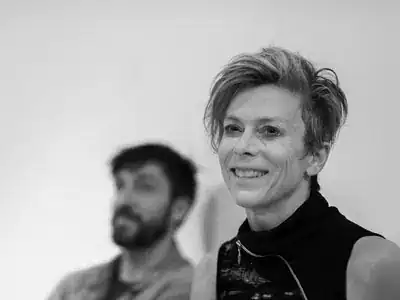
Louise Lecavalier after the premiere of So Blue, Düsseldorf, 8 December 2012. Photo: Maximilian Schönherr / Wikimedia Commons / CC BY-SA 3.0..
Louise Lecavalier is a Canadian dancer and choreographer whose extraordinary physical style made her one of the defining performers of La La La Human Steps.
During the 1980s she became internationally recognised for performances that combined extreme speed, strength, precision and risk. Working with choreographer Édouard Lock, Lecavalier helped establish a movement language that challenged conventional distinctions between contemporary dance, ballet and performance art.
Her work entered David Bowie’s creative world in 1988, when Bowie collaborated with La La La Human Steps on a radical reconstruction of Look Back in Anger.
The relationship did not end with that performance. Lecavalier and the visual language developed by La La La Human Steps would remain connected with Bowie into the Sound+Vision period and Fame ’90.
- Name: Louise Lecavalier
- Born: 3 October 1958, Laval, Quebec, Canada
- Profession: Dancer and choreographer
- Company: La La La Human Steps
- Choreographer: Édouard Lock
- Bowie collaboration began: 1988
- Key Bowie performance: Look Back in Anger
- London appearance: Dominion Theatre, 1 July 1988
- Later Bowie connection: Fame ’90 and Sound+Vision
Louise Lecavalier
Louise Lecavalier emerged from Montreal’s contemporary dance scene and became one of the most distinctive dancers of her generation.
She joined La La La Human Steps in the early 1980s and became closely identified with the work of the company’s founder and choreographer, Édouard Lock.
Lecavalier’s performances were remarkable for their physical intensity. Speed, sudden changes of direction, demanding lifts, rapid turns and an almost confrontational use of the body became central characteristics of her work.
Her importance went beyond technical virtuosity. Lecavalier challenged traditional expectations of how female dancers should move and how strength, aggression and vulnerability could coexist within contemporary dance.
La La La Human Steps and Édouard Lock
La La La Human Steps was founded in Montreal by Édouard Lock and developed an international reputation for choreography that was fast, athletic and visually uncompromising.
Lecavalier became the company’s most recognisable performer during its breakthrough years. Her physical abilities allowed Lock to develop movement that appeared to push dancers beyond conventional limits.
The company combined elements associated with contemporary dance, ballet, punk energy and performance art without settling comfortably inside any single tradition.
David Bowie on La La La Human Steps
“It’s where punk and ballet clash with each other.”
David Bowie Discovers a New Movement Language
By the late 1980s, Bowie had already spent decades exploring the relationship between music, theatre, mime, movement and visual presentation.
La La La Human Steps offered something different from conventional rock choreography. Lecavalier was not simply a dancer accompanying a singer. Her movement could operate as an independent creative force alongside the music.
Bowie’s interest therefore developed around the artistic identity that Lecavalier, Lock and the company had already established for themselves.
Their collaboration became one of the clearest examples of Bowie entering another artist’s creative language rather than simply employing dancers to illustrate his songs.
Intruders at the Palace
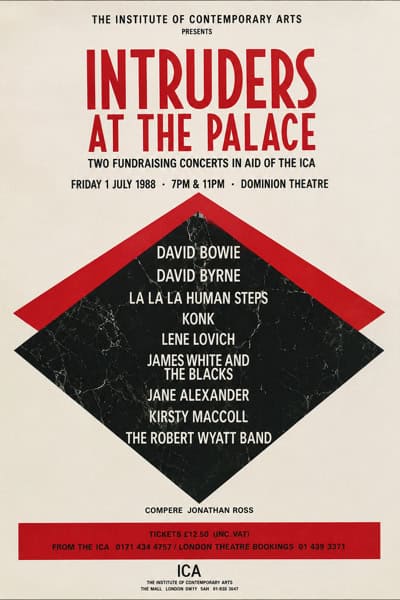
Intruders at the Palace – ICA benefit, Dominion Theatre, London, 1 July 1988.
On 1 July 1988, Lecavalier and La La La Human Steps appeared with David Bowie at London’s Dominion Theatre during Intruders at the Palace, an off-site musical benefit for the Institute of Contemporary Arts.
The programme also featured The Woodentops, Microdisney and the Kronos Quartet.
Bowie’s appearance was not a conventional tour concert. The collaboration with La La La Human Steps was conceived as a concentrated performance bringing live music and Lock’s choreography together.
Lecavalier occupied a central position within that collaboration, placing contemporary dance on equal creative terms with Bowie’s music.
Look Back in Anger Reconstructed
David Bowie with La La La Human Steps – Look Back in Anger, Dominion Theatre, London, 1 July 1988.
The musical foundation of the collaboration was Look Back in Anger, written by Bowie and Brian Eno and originally released on Lodger in 1979.
For the 1988 performance, Bowie did not simply revive the original studio arrangement. The song was reconstructed into a substantially longer and harder-edged piece capable of matching the physical intensity of La La La Human Steps.
Lecavalier’s movement was therefore not an addition placed on top of an existing Bowie performance. Music and choreography were reworked as parts of the same piece.
The new musical arrangement also became an important early collaboration between Bowie and guitarist Reeves Gabrels.
David Bowie on the new arrangement
“I like the hard-edged wall of guitar sound that we put into it.”
— David Bowie, filmed interview, 1988
Dance as an Equal Creative Force
The significance of the collaboration lies partly in the relationship between Lecavalier’s movement and Bowie’s performance.
Bowie had worked with dancers before, most visibly during the Glass Spider Tour, but La La La Human Steps came from an independent contemporary-dance tradition with its own artistic identity.
Lecavalier’s physical vocabulary could be violent, precise, athletic and unexpectedly delicate. That contrast corresponded naturally with the harder musical environment created for the new Look Back in Anger.
Rather than using dance as decoration, the performance allowed movement to become part of the narrative and emotional structure of the music.
The 1988 Studio Version
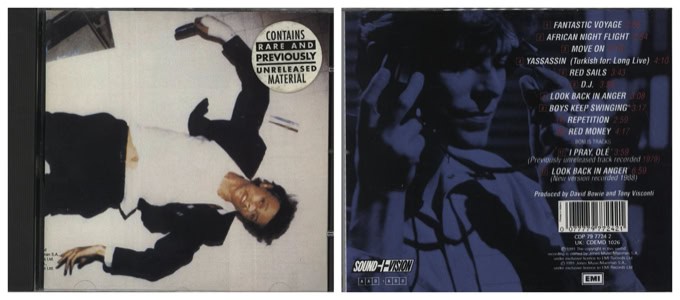
David Bowie – Lodger, 1991 Rykodisc/EMI CD reissue featuring Look Back in Anger (New Version Recorded 1988) as a bonus track.
The reconstruction created for the collaboration also resulted in a new studio recording of Look Back in Anger in 1988.
The recording preserved the harder musical approach associated with the performance and extended the song well beyond the length of its original Lodger version.
It was eventually issued as a bonus track on the 1991 Rykodisc/EMI reissue of Lodger.
Although Lecavalier’s contribution was naturally visual rather than part of the audio recording itself, the version exists because of the wider 1988 collaboration for which the song had been reconstructed.
Wrap Around the World
Lecavalier’s connection with Bowie did not end at the Dominion Theatre.
Later in 1988, Bowie and La La La Human Steps participated in Nam June Paik’s Wrap Around the World, an ambitious international television project connected through satellite technology.
Paik’s project deliberately brought together popular culture, experimental performance, television and video art on an international scale.
The appearance gave Bowie and La La La Human Steps another context in which music and movement could operate as part of a larger multimedia work.
For Lecavalier, it placed the physical language she had developed with Édouard Lock inside an enormous international media experiment.
Video – David Bowie with La La La Human Steps
David Bowie Wired Interview July 1988
David Bowie With La La La Human Steps London 01 July 1988
Fame ’90
David Bowie – Fame ’90, featuring Louise Lecavalier.
The Bowie connection continued as he revisited Fame at the beginning of the 1990s.
Lecavalier appeared in the visual world surrounding Fame ’90, extending the collaboration beyond the original 1988 performance.
Her presence made sense within Bowie’s changing approach to his own past. Rather than merely recreating an older image, Bowie was placing familiar material inside new visual and performance contexts.
The Sound+Vision Connection
David Bowie – Sound+Vision Tour, 1990, with Louise Lecavalier.
The relationship between Bowie and the La La La Human Steps circle continued into the Sound+Vision Tour in 1990.
Édouard Lock became involved in the tour’s visual presentation, while filmed material featuring Louise Lecavalier was incorporated into Bowie’s stage world.
Lecavalier’s involvement went beyond the projected material. She also appeared as a guest performer during selected stops on the Sound+Vision Tour, bringing the physical language of La La La Human Steps directly onto Bowie’s stage.
This extended the principle first explored in 1988: movement was not simply decoration around Bowie’s music, but an independent element of the performance.
The connection therefore developed from a single live collaboration into a broader influence on Bowie’s visual presentation at the beginning of the 1990s.
Beyond David Bowie
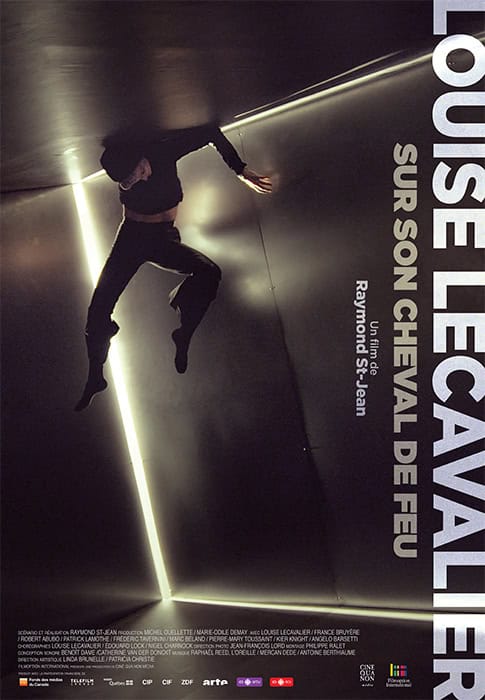
Bowie represents only one chapter in Louise Lecavalier’s much larger career.
Her international reputation had been created through dance, and she continued developing as an artist long after the Bowie collaborations.
After her years with La La La Human Steps, Lecavalier worked with other choreographers and performers before increasingly developing work under her own artistic direction.
Her career demonstrated that the extraordinary physical language associated with her early performances was not simply a product of one company or one period. She continued exploring movement, endurance, risk and individuality as an independent artist.
Fou Glorieux
Lecavalier eventually established Fou Glorieux, providing a framework for her own creative projects and collaborations.
This phase allowed her to move beyond her historical identification with La La La Human Steps and develop work from her own perspective.
Her transition from celebrated interpreter to choreographer reinforced the independence that had always been visible in her performances.
Legacy
Louise Lecavalier occupies a distinctive position in contemporary dance. Her work helped redefine expectations of physicality, speed and strength on stage and made her an internationally recognisable performer.
Her collaboration with David Bowie is significant precisely because Bowie encountered an artist who already possessed an unmistakable creative identity of her own.
From the Dominion Theatre performance of Look Back in Anger through Wrap Around the World, Fame ’90 and the Sound+Vision period, their paths crossed at a moment when Bowie was again searching for new relationships between sound, movement and image.
Within Bowie’s creative circle, Lecavalier should therefore be remembered not simply as a dancer who appeared beside him, but as an independent artist whose movement language became part of his evolving visual world.
Official Website & Further Information
Further information about Louise Lecavalier and her work can be found through her official website and Fou Glorieux.
Louise Lecavalier – Official Website
Further archival information about Bowie’s 1988 ICA collaboration can also be found through the Institute of Contemporary Arts.
Institute of Contemporary Arts – Official Website
David Bowie – Official Website
Article Origin
This DavidBowieWorld archive article documents the creative relationship between Louise Lecavalier and David Bowie, with particular attention to Lecavalier’s work with La La La Human Steps and Édouard Lock.
The article follows the collaboration from the 1988 Intruders at the Palace performance and the reconstruction of Look Back in Anger through its later connections with Wrap Around the World, Fame ’90 and Bowie’s Sound+Vision period.
Louise Lecavalier’s independent career is included to place the Bowie collaboration within the wider artistic life of one of contemporary dance’s most distinctive performers.
© DavidBowieWorld.com — David Bowie Collaborations & Creative Circle Archive.
