
Robert Smith & David Bowie | The Cure Frontman and 1997 Live Collaborator
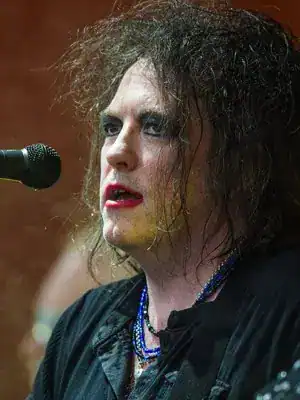
Photo: Kymi / Wikimedia Commons / CC BY-SA 3.0 (editorial use)
Robert Smith is the singer, songwriter, guitarist and defining presence of The Cure, one of the most influential bands to emerge from the late-1970s British post-punk scene. His direct connection with David Bowie was brief but historically clear: Smith appeared as one of Bowie’s guest performers at the David Bowie and Friends: A Very Special Birthday Concert at Madison Square Garden in New York on 9 January 1997.
Smith was not a long-term Bowie sideman, studio musician or songwriting partner. His place in Bowie’s wider collaborative universe rests mainly on that 1997 live appearance, together with a documented mid-1990s radio conversation and Smith’s open admiration for Bowie as an artist who helped make theatricality, alienation and emotional intensity part of modern pop language.
- Name: Robert James Smith
- Born: 21 April 1959, Blackpool, Lancashire, England
- Role: Singer, songwriter, guitarist and bandleader
- Band: The Cure
- Bowie connection: Guest performer at Bowie’s 50th Birthday Concert, Madison Square Garden, 9 January 1997
- Known Bowie performances: The Last Thing You Should Do and Quicksand
From post-punk outsider to alternative icon
Robert Smith became the central creative figure of The Cure after the band emerged from the British post-punk scene in the late 1970s. Across the following decades, his songwriting moved between spare, anxious minimalism, dark romantic atmosphere, abrasive guitar music and melodic pop. That range helped The Cure become one of the defining alternative bands of the 1980s and beyond.
Smith’s public image became inseparable from the music: backcombed hair, smeared lipstick, black clothing and an expressive stage presence that made vulnerability feel theatrical without turning it into parody. Like Bowie, he understood that appearance could be part of the emotional architecture of a performance.
Bowie as an artistic reference point
Smith’s relationship to Bowie was not built on years of shared studio work. It was closer to a line of influence and recognition. Bowie had shown earlier generations of musicians that pop could include role-playing, alienation, sexuality, science-fiction imagery, emotional distance and confession without being confined to one fixed identity.
For an artist such as Smith, whose own work often placed private feeling inside stylised sound and image, Bowie’s example mattered. The connection between them should therefore be described carefully: Bowie was an important cultural and artistic reference point, while the documented collaboration itself was limited and specific.
The 1995 Bowie and Robert Smith radio conversation
One important prelude to their live appearance was a mid-1990s radio conversation in which Bowie and Smith interviewed each other. Surviving references describe it as an XFM conversation from late 1995, centred on life, music, albums and the experience of being British artists with very particular public identities.
Because the complete recording and full transcript are not widely available, this should not be overused as a source for detailed claims. What can safely be said is that Bowie and Smith were in direct public conversation before the 1997 concert, and that the exchange reflects mutual curiosity rather than a conventional musician-and-sideman relationship.
Madison Square Garden, 9 January 1997
Robert Smith’s clearest Bowie collaboration took place at David Bowie and Friends: A Very Special Birthday Concert, held at Madison Square Garden in New York on 9 January 1997 to mark Bowie’s 50th birthday. The concert brought Bowie together with a range of guest artists, including Lou Reed, Sonic Youth, Foo Fighters, Frank Black, Billy Corgan and Robert Smith.
Smith joined Bowie for two songs: The Last Thing You Should Do, from Bowie’s then-current Earthling period, and Quicksand, originally released on Hunky Dory in 1971. This is the historically documented live collaboration between Bowie and Smith. Claims that Smith joined Bowie on stage in 1979 for Heroes should not be used, because they are not supported by the known record.
The Last Thing You Should Do and Quicksand
The choice of songs gave the collaboration an unusual shape. The Last Thing You Should Do placed Smith inside Bowie’s 1990s drum-and-bass-influenced, industrial-leaning Earthling world. Quicksand, by contrast, reached back to the philosophical and occult-tinged introspection of early-1970s Bowie.
That contrast made the pairing more interesting than a simple guest appearance. Smith was not there merely to sing a Cure-style version of a Bowie classic. He moved between two very different Bowie eras, one contemporary and one historical, which gave the performance a small but meaningful place in Bowie’s live history.
Video
David Bowie with Robert Smith – The Last Thing You Should Do / Quicksand
This live performance from Bowie’s 50th Birthday Concert is the essential documented Bowie–Robert Smith collaboration. It shows Smith as a guest within Bowie’s own live setting rather than as a long-term member of Bowie’s band.
The pairing is especially interesting because it connects Bowie’s 1970s songwriting legacy with his 1990s experimental period. Smith’s presence underlines how deeply Bowie’s work had reached into later alternative and post-punk music.
Shared themes, different worlds
Bowie and Smith should not be treated as identical artists. Bowie’s career moved through glam rock, soul, electronic experimentation, art rock, pop, industrial textures and late-career abstraction. Smith’s identity remained more closely tied to The Cure and to the emotional language of post-punk, gothic rock and alternative pop.
Even so, there are real points of contact. Both artists used stylised performance to make alienation visible. Both made vulnerability theatrical. Both understood that image could intensify rather than replace emotional meaning. These similarities explain why the 1997 pairing feels artistically logical, even though their direct collaboration was brief.
Reeves Gabrels and an indirect connection
The 1997 birthday concert also placed Robert Smith in the same wider Bowie orbit as guitarist Reeves Gabrels, who was central to Bowie’s 1990s work and served as musical director for the concert. Smith and Gabrels later worked together outside Bowie’s own career, and Gabrels eventually became a member of The Cure in the 2010s.
This does not make Bowie responsible for The Cure’s later line-up, but it does show how Bowie’s collaborative world often created intersections between musicians who would later develop their own separate relationships.
Mutual respect without exaggeration
Robert Smith’s admiration for Bowie is well documented in interviews and commentary, but it is important not to turn that admiration into a larger collaboration than the evidence supports. Smith was not a Bowie studio collaborator, producer or regular touring partner.
His Bowie connection is best understood as three related things: influence, conversation and one significant live appearance. That is enough to justify his place in Bowie’s extended universe, provided the page remains honest about the limited scale of the direct collaboration.
Legacy within Bowie’s universe
Robert Smith represents one of the many later artists who absorbed Bowie’s lesson that pop music could be emotionally intense, visually constructed and artistically restless at the same time. The Cure did not sound like Bowie, but Smith’s career belongs to a wider post-Bowie landscape in which theatrical identity and emotional exposure became central tools for alternative musicians.
Within this collection, Smith’s place is therefore specific rather than broad. He was a guest at one of Bowie’s most symbolic late-1990s live events, a public admirer, and an artist whose own work shows how Bowie’s influence travelled beyond genre into attitude, image and emotional possibility.
