
David Bowie, Klaus Nomi & Joey Arias – Saturday Night Live (1979)
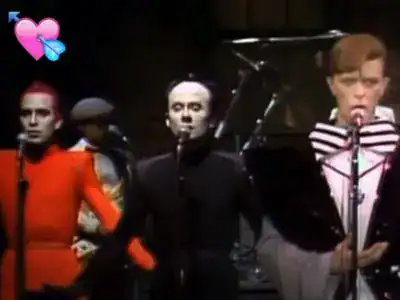
On 15 December 1979, David Bowie delivered one of the most visually daring television appearances of his career when he performed on Saturday Night Live. Joined by avant-garde performers Klaus Nomi and Joey Arias, Bowie transformed a national television broadcast into an extraordinary fusion of music, theatre, fashion and performance art.
The appearance came during one of the most experimental periods of Bowie’s career. He was spending increasing amounts of time in New York, where he immersed himself in the city’s thriving underground arts community. Rather than seeking inspiration from mainstream popular culture, Bowie surrounded himself with artists, musicians, designers and performers whose work challenged conventional ideas of music and theatre.
For American television audiences the broadcast was unlike anything they had previously encountered. Bowie appeared wearing elaborate theatrical costumes, accompanied by Klaus Nomi and Joey Arias in matching tuxedos inspired by Bauhaus design, German Expressionism and European cabaret. The performances rejected the traditional presentation of a rock band, replacing it with carefully choreographed visual theatre in which movement, costume and symbolism became inseparable from the music itself.
Although the collaboration lasted for only three songs, it has remained one of the most celebrated moments in Bowie’s television career. It also introduced millions of viewers to two remarkable performers whose influence on New York’s underground scene had already earned them enormous respect among fellow artists.
- Date: 15 December 1979
- Main artists: David Bowie, Klaus Nomi and Joey Arias
- Programme: Saturday Night Live (NBC)
- Studio: NBC Studio 8H, Rockefeller Center, New York City
- Performances: The Man Who Sold the World, TVC 15 and Boys Keep Swinging
- Creative influences: Performance art, German Expressionism, Bauhaus, Kabuki theatre and Weimar cabaret
New York’s Underground Scene
By the late 1970s New York had become one of the world’s most adventurous artistic centres. Downtown clubs such as the Mudd Club and Club 57 encouraged musicians, actors, designers, filmmakers and performance artists to experiment without commercial restrictions. Punk, New Wave, drag performance, contemporary art and experimental theatre frequently overlapped, creating an environment where originality was valued above commercial success.
David Bowie found the atmosphere deeply inspiring. Throughout his career he had consistently searched for artists who challenged accepted conventions, and New York offered an almost limitless source of creative ideas. Instead of simply observing the underground scene, Bowie actively participated in it, attending performances and meeting many of the performers who were redefining the city’s cultural landscape.
Among the artists attracting growing attention were Klaus Nomi and Joey Arias. Although very different as performers, both embraced theatrical presentation, visual experimentation and artistic freedom. Their performances blurred the boundaries between music, fashion and performance art, making them ideal collaborators for Bowie’s increasingly theatrical vision.
Klaus Nomi – The Alien Voice of New Wave
Born Klaus Sperber in Bavaria in 1944, Klaus Nomi developed a lifelong fascination with opera before relocating to New York during the early 1970s. Rather than pursuing a conventional operatic career, he combined his remarkable countertenor voice with electronic music, science-fiction imagery and striking geometric costume design, creating one of the most distinctive stage identities of the New Wave era.
Working within New York’s underground performance scene, Nomi quickly gained a reputation for performances that were unlike anything audiences had previously experienced. His futuristic appearance contrasted dramatically with his classically trained voice, allowing him to move effortlessly between eighteenth-century opera and contemporary synthesizer-driven music. Fellow artists immediately recognised both his originality and his extraordinary technical ability.
It was this combination of visual innovation and musical excellence that attracted David Bowie. Rather than viewing Nomi simply as a backing performer, Bowie recognised him as an artist whose individuality deserved to be presented to a much wider audience.
Joey Arias – Cabaret, Performance and Identity
Unlike Klaus Nomi, whose reputation centred on his extraordinary operatic voice, Joey Arias established himself through performance, character and stage presence. Raised in the Philippines before returning to the United States, Arias became part of New York’s rapidly expanding downtown arts community during the 1970s, where music, fashion, theatre and drag performance increasingly overlapped.
Working in clubs such as the Mudd Club and Club 57, Arias developed a style that refused to follow traditional theatrical conventions. His performances combined humour, improvisation, glamour and emotional vulnerability, while constantly challenging audiences’ expectations of gender, identity and entertainment. Rather than presenting a fixed stage character, Arias continuously reinvented himself, making every performance feel unique.
Within New York’s underground scene Arias and Klaus Nomi became frequent collaborators. Although their artistic approaches differed considerably, they shared a fascination with visual presentation and experimental performance. Together they created stage productions that mixed music, costume, movement and theatrical storytelling, earning them growing recognition among fellow artists throughout downtown Manhattan.
By the time David Bowie encountered their work, both performers had already established strong reputations within New York’s avant-garde community. Bowie’s invitation to appear on Saturday Night Live did not create their careers, but it introduced their distinctive artistic vision to a national television audience far beyond the city’s underground clubs.
Preparing for Saturday Night Live

David Bowie’s appearance on Saturday Night Live was never intended to be a conventional promotional performance. Instead of presenting himself as a traditional rock star backed by anonymous musicians, Bowie developed a carefully staged theatrical production in which costume, movement and visual composition became as important as the music itself.
The three performances required extensive preparation. Costume changes had to be completed within moments, stage positions were carefully rehearsed and every camera movement had to accommodate the unusual costumes and visual concepts. Unlike a concert audience, television viewers would experience the production entirely through the cameras, making framing and timing essential elements of the performance.
The costumes themselves reflected several of Bowie’s long-standing artistic interests. Elements of German Expressionism, Bauhaus design, mime, avant-garde theatre and Japanese performance traditions were brought together to create imagery unlike anything previously seen on American network television. Rather than attempting realism, the production embraced symbolism, abstraction and theatrical illusion.
Klaus Nomi and Joey Arias were central to this concept. Their visual identities had already become familiar within New York’s underground community, and Bowie deliberately incorporated those identities into the production rather than asking them to blend into the background. The result was a collaboration between three established performers, each contributing a distinctive artistic voice to the overall presentation.
The Saturday Night Live Broadcast
On the evening of 15 December 1979, millions of American viewers watched a sequence of performances unlike anything previously broadcast on Saturday Night Live. Rather than adapting his ideas to fit the expectations of mainstream television, Bowie brought elements of New York’s experimental performance culture directly into viewers’ homes, assisted throughout by Klaus Nomi and Joey Arias.
The Saturday Night Live Performances
David Bowie appeared as the musical guest on Saturday Night Live on 15 December 1979. The programme was broadcast live from NBC’s Studio 8H in New York and was hosted by actor Martin Sheen. Bowie performed three songs: The Man Who Sold the World, TVC 15 and Boys Keep Swinging.
Klaus Nomi and Joey Arias appeared throughout Bowie’s musical performances as backing vocalists and theatrical collaborators. Each song was presented with a different costume and staging concept. Rather than reproducing the visual style of Bowie’s current album, Lodger, the three performances were developed as separate pieces of television theatre.
Joey Arias on Working with David Bowie
“Bowie was amazing — cool, no-bullshit, super engaging, interested to know who we were.”
The Man Who Sold the World
Bowie opened his musical appearance with The Man Who Sold the World. For this performance he wore a large, rigid black-and-white costume based on an oversized man’s evening suit. The construction restricted his movement so completely that Klaus Nomi and Joey Arias had to carry him into position in front of the microphone.
Once Bowie had been placed on the stage, Nomi and Arias stood on either side of him and provided backing vocals. The three performers formed a carefully arranged visual composition: Bowie remained almost motionless inside the geometric costume, while Nomi and Arias supported both the musical arrangement and the theatrical presentation.
The costume has frequently been associated with the exaggerated geometric silhouette of Dada poet and performer Tristan Tzara. Its rigid construction also anticipated the triangular tuxedo that later became closely associated with Klaus Nomi‘s own stage image.
The performance did not depend upon conventional rock-stage movement. Bowie’s immobility became the central visual idea, turning him into a sculptural figure while Nomi and Arias acted as both backing singers and handlers. The official David Bowie archive later described how they lifted and positioned Bowie because the costume rendered him unable to move freely.
TVC 15
For TVC 15, Bowie changed into a dark skirt, jacket and high-heeled shoes. The staging referred directly to the song’s surreal story of a woman being consumed by a television set, but translated that idea into an absurd piece of theatrical imagery.
Klaus Nomi and Joey Arias accompanied Bowie while moving a large pink toy poodle around the stage. A small television monitor had been built into the animal’s mouth. The screen displayed images during the performance, making the pooch both a comic stage prop and a literal representation of the television imagery within the song.
The visual concept differed completely from the rigid presentation used for The Man Who Sold the World. Bowie could move freely around the stage, while Nomi and Arias controlled the pink poodle and supplied backing vocals. The unusual combination of formal clothing, high heels and the television animal gave the performance a deliberately artificial and humorous character.
Joey Arias on Bowie’s Costume Ideas
“He told us he had three ideas for costumes: one was going to be this Bauhaus outfit; the next was going to be a Chinese airline stewardess with a pink poodle; and the third one was going to be puppets.”
Boys Keep Swinging
The final song was Boys Keep Swinging, released earlier in 1979 on Lodger. Bowie appeared inside a life-sized marionette construction that created the illusion of a puppet body moving around him.
The costume used a separately constructed body while Bowie’s own face remained visible above it. As he performed, the artificial limbs moved with exaggerated, uncontrolled gestures. The result deliberately resembled a dancer being manipulated by invisible strings.
Klaus Nomi and Joey Arias again provided backing vocals and participated in the visual staging. The marionette concept gave the song a different character from the promotional film Bowie had made earlier in 1979, in which he appeared as three female backing singers during the closing sequence.
During the live broadcast, NBC muted parts of two lines from the song: “life’s a pop of the cherry” and “other boys check you out.” The censorship affected the transmitted vocal but did not interrupt the performance itself.

Keep Swinging - SNL 1979 (Reversed)

Man Who Sold the World - SNL 1979

TVC 15 - SNL 1979 (Excerpt)
-
Keep Swinging - SNL 1979 (Reversed)
-
Man Who Sold the World - SNL 1979
The 2 great legends team up on SNL in 1979, with some help from Joey Arias, and perform Bowie's Man Who Sold The World. Simply sublime and otherworldly -
TVC 15 - SNL 1979 (Excerpt)
David Bowie performing TVC 15 with Klaus Nomi & Joey Arias during Saturday Night Live season 5 episode 7 aired on December 15, 1979.
The Collaboration After Saturday Night Live
The appearance brought Klaus Nomi and Joey Arias before a national American television audience, but it did not lead to an extended performing partnership with Bowie. Their documented collaboration with him centred on the preparation and broadcast of the three Saturday Night Live performances.
Nomi subsequently incorporated a sharply structured black-and-white tuxedo into his own stage identity. Although it developed into a design associated specifically with Nomi, the visual connection with the costume Bowie had worn during The Man Who Sold the World was unmistakable.
Nomi later signed with RCA and released the albums Klaus Nomi in 1981 and Simple Man in 1982. His recordings combined operatic repertoire, original compositions and radically rearranged popular songs. He died in New York on 6 August 1983 from complications associated with AIDS.
Joey Arias continued working in cabaret, drag performance, theatre and live entertainment. His career developed independently of Bowie, while his appearance on Saturday Night Live remained one of the best-known surviving records of his early work with Klaus Nomi.
Historical Importance
The importance of Bowie’s 1979 appearance lies first in what can be seen and documented: three established songs were completely restaged for live television through costume, choreography, backing vocals and theatrical objects. Each performance had its own visual identity, while Klaus Nomi and Joey Arias were visible participants rather than anonymous backing singers.
The broadcast also preserved an encounter between Bowie’s international career and New York’s downtown performance community. Nomi and Arias had developed their artistic identities before working with Bowie. Their appearance on national television exposed a much larger audience to performers and visual ideas that were more commonly encountered in New York clubs and experimental performance spaces.
The collaboration was brief, but the surviving footage has remained an important document in the histories of all three performers. It records Bowie, Nomi and Arias working together at a specific moment on 15 December 1979, using mainstream television to present three performances built around music, costume and theatrical staging.
Joey Arias on Saturday Night Live
“We didn’t have to do anything but be ourselves that night.”
Official Website & Further Information
DavidBowieWorld.com is dedicated to documenting the careers of David Bowie’s collaborators through carefully researched historical information and, where available, first-hand contributions from the artists themselves. This page will continue to be updated as new verified information becomes available.
Article Origin
This article has been researched and written by DavidBowieWorld.com using contemporary publications, television archives, documented interviews and historically verified sources relating to David Bowie’s Saturday Night Live appearance of 15 December 1979 and the careers of Klaus Nomi and Joey Arias.
Every effort has been made to ensure historical accuracy. As additional primary documentation, interviews or archival material becomes available, this page will be updated accordingly.
