

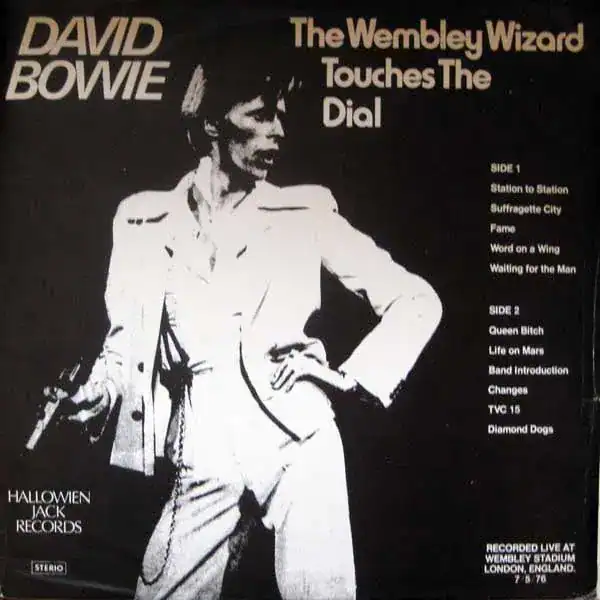
David Bowie 1976-05-07 London ,Wembley Empire Pool - The Wembley Wizard Touches The Dial - SQ 7,5.
Label: Hallowien Jack Records – CC1 (Limited edition 236 of 250 copies)
Audio Source: Audience
Lineage: Vinyl, LP, Limited Edition, Numbered (236/250), Unofficial Release
Total running time: Approximately 57 minutes
Sound Quality: Noticeable noise and some dullness, but still listenable.
Attendance: Approximately 8,000 (reported)
Artwork: Tommy
Note: The sleeve incorrectly identifies Wembley Stadium as the concert venue. The actual performance took place at Wembley Empire Pool. "Stay" appears on the recording but is omitted from the printed sleeve tracklisting.
David Bowie 1976-05-07 London, Wembley Empire Pool – The Wembley Wizard Touches The Dial
Sound Quality Rating
David Bowie – The Wembley Wizard Touches The Dial is an unofficial vinyl release featuring an audience recording from Bowie's concert at Wembley Empire Pool in London on 7 May 1976, during the European leg of his Isolar Tour.
The album captures Bowie during the Station to Station period, when the Thin White Duke persona, dramatic lighting and a tightly rehearsed touring band defined his live performances. Beyond the music, the recording has an extraordinary history involving the Japanese bootleg Don't Touch That Dial and the British record-industry investigation known as Operation Moonbeam.
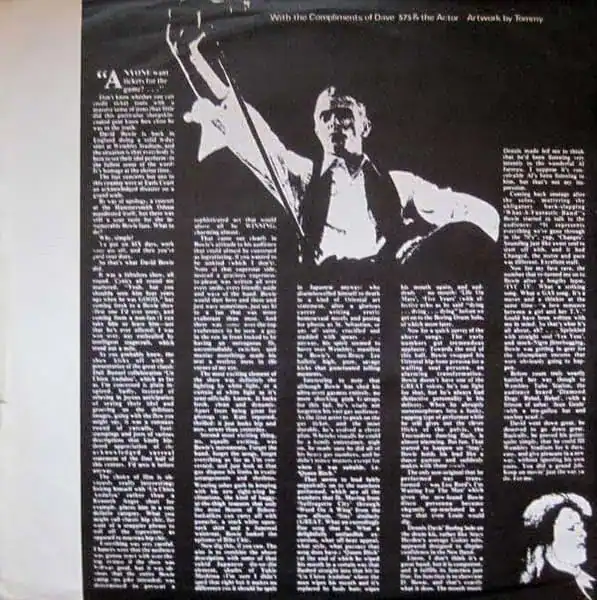

Tracklisting
Side A
A1. Station To Station
A2. Suffragette City
A3. Fame
A4. Word On A Wing
A5. Stay
A6. Waiting For The Man
Side B
B1. Queen Bitch
B2. Life On Mars
B3. Band Introduction
B4. Changes
B5. TVC 15
B6. Diamond Dogs
Wembley Empire Pool – 7 May 1976
On 7 May 1976, David Bowie performed at Wembley Empire Pool in London during the European leg of his Isolar Tour. The indoor venue, later renamed Wembley Arena, stood beside Wembley Stadium but was a separate concert location.
The performance came during an important period in Bowie's career. His album Station to Station had been released in January, introducing a musical direction that combined rock, soul, funk and experimental arrangements. The Wembley concerts gave British audiences an opportunity to experience this new material in a live setting.
Rather than relying on the elaborate theatrical scenery of the earlier Diamond Dogs Tour, the 1976 production used stark lighting, a largely uncluttered stage and the musical precision of Bowie's touring band. The result was a concert presentation very different from the colourful Ziggy Stardust performances of only a few years earlier.
The Isolar Tour and the Thin White Duke
The Isolar Tour began in North America in February 1976 before continuing through Europe. Its repertoire combined material from Station to Station with selections from Bowie's earlier albums, allowing familiar compositions to be heard through the musical approach of his new touring group.
The extended opening arrangement of Station to Station established the atmosphere of the concert. Its gradual introduction developed into a powerful ensemble performance, with the musicians moving between tightly controlled rhythms and more forceful rock passages.
Bowie's Thin White Duke persona was central to the visual character of the tour. His formal clothing, restrained movements and theatrical lighting created a striking contrast with the flamboyant costumes and staging of the Ziggy Stardust era.
The Wembley Audience Recording
The Wembley Wizard Touches The Dial was produced from an audience recording rather than an official multitrack concert recording. Consequently, the sound contains audible noise, limited clarity and the acoustic characteristics of a large indoor venue.
Despite these limitations, the recording preserves a valuable document of Bowie's live performances during May 1976. The album includes material from Station to Station alongside earlier songs such as Queen Bitch, Life on Mars? and Diamond Dogs.
The LP does not reproduce the complete concert. Additional songs performed during the evening are absent from the record, making this release a selection from the Wembley performance rather than a complete document of the show.
The Band Introduction and George Murray
One of the most interesting moments on the album is the introduction of Bowie's touring musicians. The group featured guitarists Carlos Alomar and Stacy Heydon, bassist George Murray, drummer Dennis Davis and keyboard player Tony Kaye.
During the introduction, Bowie refers to George Murray as "the one who has a beautiful girlfriend". The remark provides a brief moment of humour within the otherwise carefully controlled stage presentation.
A story circulated among collectors connects the comment with an earlier encounter in Zürich. According to that account, a woman had shown particular interest in Murray rather than Bowie. The precise circumstances of the anecdote remain unverified, but the spoken introduction adds a personal detail to the recording.
Don't Touch That Dial – The Japanese Bootleg
The history of the Wembley recording is closely associated with an earlier unofficial LP, Don't Touch That Dial, attributed to the Japanese Marc label and issued in the second half of 1976.
Collector accounts describe an original pressing of approximately 2,000 copies. The record subsequently became known among collectors interested in Bowie's 1976 tour and the international market for unofficial concert recordings.
A small number of Japanese copies reportedly reached European distributors. The recording later became the basis of a British pressing whose history would attract attention far beyond the usual community of Bowie collectors.
Operation Moonbeam – The Bootleg Investigation
One of the most remarkable aspects of The Wembley Wizard Touches The Dial is its connection with Operation Moonbeam, an investigation conducted by the British Phonographic Industry into the distribution of unauthorised recordings.
Accounts of the operation describe BPI investigator Bill Hood becoming involved with individuals connected to the British bootleg market. Rather than simply tracing existing records through the distribution network, the investigation reportedly involved the pressing of approximately 2,500 copies of a Bowie concert bootleg.
The resulting record circulated under the Wembley Wizard title. The investigation was intended to identify those involved in manufacturing and distributing unauthorised recordings, but it also created an unusual situation in which the record industry itself became involved in producing records for the market it was investigating.
Contemporary reporting confirms that the Wembley Wizard LP was connected with the BPI's enforcement action in 1979. Later collector accounts provide additional details about the operation, although some of the reported production figures and outcomes remain difficult to establish independently.
The British Bootleg Market and the 1979 Raids
Operation Moonbeam took place during a period when unofficial live albums circulated through independent record shops, specialist dealers and collectors' networks. Such releases often documented concerts that were otherwise unavailable through official record companies.
In 1979, the BPI pursued legal action against individuals and businesses involved in the distribution of unauthorised recordings. The investigation included raids and court proceedings, with the Wembley Wizard LP appearing in contemporary accounts of the operation.
The involvement of Rough Trade Records was particularly notable because the company was becoming an important part of Britain's independent music industry. The case illustrates the tensions between record-company copyright enforcement and the alternative distribution networks through which unofficial recordings circulated.
For Bowie collectors, the most unusual consequence was that the Wembley recording became associated not only with a concert from the Isolar Tour but also with a much wider episode in British record-industry history.
The Hallowien Jack Records Edition
The copy featured here was issued by Hallowien Jack Records under catalogue number CC1. It belongs to a numbered limited edition of 250 copies, with this example identified as 236/250.
The sleeve artwork is credited to Tommy. One noticeable error is the identification of the concert venue as Wembley Stadium rather than Wembley Empire Pool. The two locations should not be confused.
Another detail is the omission of Stay from the printed tracklisting, even though the performance appears on the vinyl. Such differences between the sleeve and the actual recording are of particular interest when documenting unofficial editions.
The Hallowien Jack edition belongs to the later history of the recording and should be distinguished from the original Japanese pressing and the British copies associated with Operation Moonbeam.
The 1976 Touring Band
David Bowie – Lead vocals, saxophone
Carlos Alomar – Rhythm guitar, musical director, backing vocals
Stacy Heydon – Lead guitar, backing vocals
George Murray – Bass guitar, backing vocals
Dennis Davis – Drums, percussion
Tony Kaye – Keyboards
The musicians gave the 1976 concerts their distinctive combination of rock intensity, funk rhythms and tightly structured arrangements. The musical partnership of Alomar, Murray and Davis was particularly important to Bowie's sound during this period.
Their performances allowed Bowie to move between very different parts of his catalogue without losing the musical identity of the tour. Older compositions acquired a harder rhythmic character, while the newer material retained the complexity of the Station to Station arrangements.
The Tour Crew
Band Technicians and Personnel
Vern Moose Constan
Rob Joyce
Lighting Technicians and Personnel
Lonnie McKenzie
Leroy Kerr
Lester Burton
Buddy Prewitt
Larry Sizemore
Sound Technicians and Personnel
Buford Jones
Scott Wadsworth
The technical crew supported a production in which lighting and sound were essential to the atmosphere of the performance. The apparently simple stage presentation depended on careful coordination between the musicians and the people responsible for the concert's technical operation.
Complete Wembley Concert Setlist
The original concert included more material than the selections preserved on this LP. The following setlist provides a broader overview of Bowie's performance at Wembley Empire Pool on 7 May 1976.
A Remarkable Piece of Bowie Bootleg History
The Wembley Wizard Touches The Dial occupies an unusual position in the history of David Bowie concert recordings. It preserves part of a London performance from one of his most distinctive tours while carrying a separate story involving unofficial record production and the record industry's response to bootlegging.
The Wembley performance documents Bowie at a crucial point between the American soul influences of Young Americans and the experimental musical direction that would emerge on Low and "Heroes". The Isolar Tour brought these changing musical interests together on stage through a band capable of moving between rock, funk and more atmospheric arrangements.
The recording's release history adds another dimension. From the Japanese Don't Touch That Dial pressing to the British Wembley Wizard editions and the later numbered Hallowien Jack release, the album passed through several distinct chapters of unofficial vinyl collecting.
For collectors, copy 236/250 represents more than a surviving audience recording. It connects Bowie's 7 May 1976 Wembley concert with one of the most unusual episodes in the history of British bootleg records, making The Wembley Wizard Touches The Dial a particularly fascinating addition to a David Bowie vinyl collection.
