Charlie Sexton & David Bowie | Glass Spider Tour Guest Guitarist
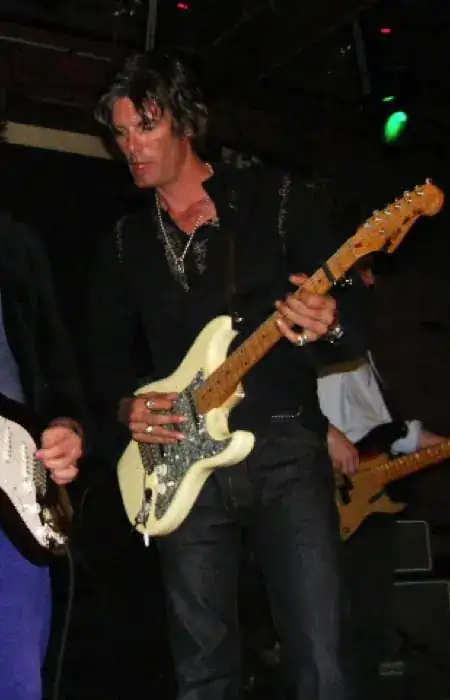
Photo: Ron Baker / Wikimedia Commons / CC BY-SA 3.0 (editorial use)
Charlie Sexton is an American guitarist, singer, songwriter and producer whose connection with David Bowie belongs mainly to the Glass Spider Tour era of 1987. He was not a permanent member of Bowie’s tour band, but he appeared as a special guest guitarist and vocalist during encore performances at selected shows.
His most visible Bowie moment is his appearance on White Light/White Heat, performed with Bowie during the Glass Spider period. The performance linked Bowie with a young American guitarist who had already become known through his 1985 hit Beat’s So Lonely.
- Name: Charlie Sexton
- Full name: Charles Wayne Sexton
- Born: 11 August 1968, San Antonio, Texas, United States
- Role with Bowie: Special guest guitarist and vocalist during the Glass Spider Tour era
- Bowie connection: Guest appearances during selected 1987 encore performances
- Known for: Beat’s So Lonely, Arc Angels, solo work, production work and later work with Bob Dylan
Early life and musical background
Charlie Sexton was born Charles Wayne Sexton in San Antonio, Texas, in 1968. He grew up in the Austin music environment, where blues, rock, roots music and live performance culture shaped his development from a very young age.
Sexton was widely recognised as a gifted young guitarist before he became known to a national pop audience. His early musical life placed him close to the Austin club scene and to musicians connected with Texas blues and rock traditions.
Breakthrough before Bowie
Before his Bowie connection, Sexton had already become a visible young star. His 1985 album Pictures for Pleasure produced the hit single Beat’s So Lonely, making him one of the most recognisable young American rock musicians of the mid-1980s.
This early success is important context for his Bowie appearances. Sexton was not an anonymous guest player: he arrived with his own reputation, image and musical identity, combining guitar skill with a pop and rock presence that fitted the high-profile atmosphere of the 1987 Glass Spider era.
The Glass Spider Tour context
David Bowie’s Glass Spider Tour was launched in 1987 in support of the album Never Let Me Down. It was one of Bowie’s most elaborate stage productions, built around a large theatrical set, dancers, spoken sections, choreography and a highly visual concert structure.
The regular Glass Spider touring band included Bowie with musicians such as Peter Frampton, Carlos Alomar, Carmine Rojas, Alan Childs, Erdal Kızılçay and Richard Cottle. Charlie Sexton should not be listed as a regular band member. His role was more specific: he was associated with the tour as a guest performer, especially during encore material at selected shows.
Guest appearances with Bowie
Sexton’s Bowie connection is best understood as a special guest collaboration rather than a full touring-band position. During the 1987 tour period, he appeared with Bowie on stage for encore performances, adding guitar and vocals to material outside the main dramatic structure of the show.
This distinction matters historically. Bowie’s core Glass Spider band had a fixed musical function within a highly choreographed production. Sexton’s appearances were different: they brought an extra guest energy to specific performances rather than forming part of the entire tour arrangement.
White Light/White Heat
The most important documented Bowie/Sexton performance is White Light/White Heat, the Lou Reed song originally recorded by The Velvet Underground. Bowie had long-standing connections with Reed and The Velvet Underground’s influence, so the choice of song carried historical weight beyond being a simple rock encore.
With Sexton joining on guitar and vocals, the performance became a meeting point between Bowie’s art-rock history and Sexton’s young American rock presence. It also gave the Glass Spider show a rawer, more spontaneous edge at the end of a production otherwise known for its scale and theatrical design.
I Wanna Be Your Dog
Sexton has also been associated with Bowie performances of I Wanna Be Your Dog, the Stooges song written by Iggy Pop, Ron Asheton, Scott Asheton and Dave Alexander. Like White Light/White Heat, this was material with deep roots in Bowie’s musical universe.
Bowie’s connection with Iggy Pop and with New York and Detroit underground rock had been central to parts of his 1970s story. Bringing Sexton into these songs during the Glass Spider period created a bridge between Bowie’s older influences and the younger rock musicians who followed him.
Why Sexton’s role is often misunderstood
Charlie Sexton is sometimes casually described as being part of the Glass Spider band, but that wording is too broad. The historically safer description is that he was a guest performer and, in some contexts, an opening act during the tour period.
This page therefore avoids presenting him as a regular member of Bowie’s official touring band. His importance lies not in a long-term Bowie partnership, but in a specific and memorable 1987 live collaboration that became visible through filmed and circulated performances.
Video
David Bowie – White Light/White Heat With Charlie Sexton (Live Glass Spider Tour ’87)
This performance is the key visual document of the Bowie/Sexton connection. It shows Sexton not as a background musician, but as a guest guitarist and vocalist sharing the stage with Bowie during the Glass Spider period.
The choice of White Light/White Heat also matters. The song connects Bowie to the New York underground rock tradition and to Lou Reed, while Sexton’s presence gives the performance a young, guitar-driven 1980s energy.
After the Bowie connection
After the 1980s, Charlie Sexton continued to build a substantial career as a guitarist, singer, songwriter and producer. In the early 1990s, he co-founded the Arc Angels with Doyle Bramhall II, Chris Layton and Tommy Shannon, connecting him further to the Austin and Texas blues-rock tradition.
Sexton later became widely known for his long association with Bob Dylan’s touring band. He also developed a respected career as a producer and collaborator, working across rock, blues, Americana and roots music.
Place within Bowie’s universe
Within David Bowie’s wider creative universe, Charlie Sexton represents a short but memorable live connection. He was not one of Bowie’s long-term collaborators like Carlos Alomar, Mike Garson or Gail Ann Dorsey, and he was not a core member of the Glass Spider band.
His importance is more specific: he joined Bowie during one of the most visually ambitious tours of Bowie’s career and appeared in performances that connected Bowie’s 1987 stage world with older underground rock material. For that reason, Sexton deserves a place in the Bowie collaborations story, but with the correct historical framing: special guest, not permanent band member.
