
The Secret Bowie Wedding – Bromley 1970
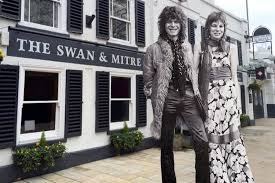
Photo: David Bowie World archive / editorial use
Christopher Maddock was a young junior reporter working for the Bromley and Kentish Times when he unexpectedly received a phone call that would place him at one of the most fascinating moments in early Bowie history: the wedding of David Bowie and Mary Angela Barnett at Bromley Register Office in March 1970.
What began as a local newspaper assignment slowly evolved into a remarkable eyewitness memory covering Bowie’s uncertain pre-Ziggy years, the Beckenham scene, the rise of the Spiders from Mars and even an unexpected encounter with rare wedding photographs years later in Australia.
- Main event: Bowie and Angie’s wedding
- Location: Bromley Register Office, London
- Period covered: 1970–1973
- Story type: Eyewitness / journalist memory
- Submitted by: Christopher Maddock
A phone call from David Bowie’s mother
On 19 March 1970, Christopher Maddock was a 19-year-old junior reporter working at the Bromley and Kentish Times newspaper office in south-east London. It began as an ordinary day until he answered the phone and heard a woman’s voice tell him that David Bowie was getting married that morning, at 11 o’clock, at Bromley Register Office.
When he asked who was calling, the woman replied that she was David’s mother. She added that Bowie should not be told she had passed on the information, because he did not want his fans to know. There was something faintly amusing about that, Maddock recalls, because in early 1970 Bowie was not yet the superstar he would soon become. To the local paper he was a minor celebrity from nearby Beckenham: a young artist who had scored one major hit with “Space Oddity” in 1969, but who was still very much trying to find his direction.
Bowie before the breakthrough
At that point Bowie’s public profile was fragile. The great explosion of the Swinging Sixties had happened around him, but he had moved through a string of groups without lasting commercial success: The Konrads, The King Bees, The Manish Boys, The Lower Third, The Buzz and The Riot Squad among them. “Space Oddity” had changed things, but not enough to make his future certain.
His follow-up single “The Prettiest Star” was newly released and struggling, and the album The World of David Bowie was not setting the charts alight either. The year 1970 would become a difficult transitional period. Bowie was uncertain about his musical direction, trying to assemble a more stable band, questioning his relationship with manager Ken Pitt, experimenting with mime and performance ideas, and considering whether to step back from the Beckenham Arts Lab, which had been taking place on Sundays at the Three Tuns pub near his home.
Waiting outside Bromley Register Office
After receiving the call from Mrs Jones, Maddock quickly gathered a Kentish Times photographer and went to the register office. He also contacted the Ferrari Press Agency in Sidcup, which supplied stories and photographs to the national newspapers in Fleet Street. If agency owner Geoff Garvey managed to sell the story, Maddock would receive a cut.
Garvey evidently thought the wedding had enough news value, despite Bowie’s still modest fame, and sent his own reporter and photographer as well. So when Bowie arrived with his bride-to-be Mary Angela Barnett, his mother Margaret “Peggy” Jones and a small group of friends, four members of the press were already waiting outside with notebooks and cameras ready.
Bowie, Angie and Peggy Jones
Bowie was surprised by the presence of the press, but according to Maddock he remained polite. He introduced Angie, describing her as an American model. The couple were dressed vividly and unmistakably: Bowie with rat-tail hair and an Afghan coat, Angie beside him, and Peggy Jones looking smart and formal, almost regal, in a matching jacket, skirt and hat, with a clutch bag in hand.
For a few minutes the couple and Bowie’s mother obliged the two photographers. Peggy stood between the bride and groom as the pictures were taken. Then Bowie led the party inside, leaving the reporters on the pavement. Around 20 minutes later the newlyweds came back out, and the press group was still there.
The Swan and Mitre
The wedding party crossed the road to the Swan and Mitre pub for celebratory drinks. The reporters followed, but Maddock remembers that Bowie’s expression made it clear he had now had enough of the uninvited attention. The message was understood, and the journalists withdrew.
The story, with a photograph, was sold that same day to one of the London afternoon newspapers. The Bromley and Kentish Times, a weekly paper focused on local news, placed the wedding on its front page. The published image was cropped to show the upper half of Bowie, Angie and Peggy Jones. As far as Maddock could tell, none of Bowie’s own party had brought a camera outside, so without the unexpected press presence, the public record of the moment might have been much thinner.
A glare in Bromley Library Gardens
Not long afterwards, though Maddock cannot now recall the exact date, Bowie played for free in Bromley Library Gardens with a band billed as Harry the Butcher. Maddock believes this may have been The Hype performing under a pseudonym. When Bowie noticed him in the audience, he gave him a pointed look — apparently remembering the young reporter who had helped publicise the supposedly secret wedding.
The first signs of Ziggy
Maddock’s Bowie story did not end there. A friend named Ken, who was involved with the Beckenham Arts Lab, later told him that Bowie was “making a comeback” in Eltham and asked if he wanted to go. The show was at Avery Hill College on 25 February 1972. What Maddock saw there was something completely different: the early Spiders from Mars in motion, with the costumes, haircuts, theatre, provocation and electricity that would soon reshape Bowie’s career.
The performance took place in a college hall before a reasonably sized standing crowd, but it felt powerful enough that Maddock went to see Bowie again only a week or so later at Imperial College in London. The venue was bigger, the crowd was bigger, and something was clearly building. By June 1972, with the release of The Rise and Fall of Ziggy Stardust and the Spiders from Mars, Bowie’s ascent became unstoppable.
The Rainbow and the moment Bowie arrived
Maddock later saw Bowie at the Rainbow Theatre in Finsbury Park, London, on either 19 or 20 August 1972, with Roxy Music as support. By then, in his words, that was it: Bowie, as Ziggy Stardust, had reached the big time. The uncertainty of 1970 had turned into one of the most dramatic artistic breakthroughs in British rock history.
An unexpected discovery in Australia
Years later, between 1980 and 1984, Maddock was working as a journalist in Sydney, Australia. He often walked from home to the office past the Grace Bros. store on Broadway and would sometimes stop to browse the book section. One day he picked up a copy of a David Bowie Black Book and began leafing through it.
To his astonishment, he found a page containing four photographs from Bowie’s wedding. Two were the familiar cropped images of Bowie, Angie and Peggy Jones. The other two were full-length shots — and there, in the background, was Maddock himself, notebook in hand. It was, he remembers, quite a shock to unexpectedly find himself in a Bowie book years after the event.
The white-label Ziggy pressing
There was one more personal connection. Maddock had loved Hunky Dory so much that he kept asking a friend at RCA when a new Bowie album would arrive. Eventually the friend sent him an unmarked white-label test pressing. It turned out to be The Rise and Fall of Ziggy Stardust and the Spiders from Mars, and Maddock immediately recognised how tremendous it was.
In 1973, while saving money to travel the hippie trail, he sold that test pressing, along with other albums, to a record shop in Bromley for two pounds. It was an ordinary practical decision at the time, but in hindsight it became another remarkable footnote in a story already full of Bowie history.
Editor’s note
This eyewitness account was submitted to David Bowie World through the Concert Memories section, but its scope is wider than a concert recollection. It documents a rare local-journalist memory of Bowie’s Bromley wedding, the Beckenham/Bromley period, and the early rise of Ziggy Stardust. For that reason it has been placed in Biography → Events & Stories → Eyewitness Stories.
Some published sources date the Bowie/Barnett wedding to 20 March 1970, while this submitted first-hand account gives 19 March 1970. The date has therefore been preserved as supplied by the contributor, with this note added for historical transparency.
Submitted by
Christopher Maddock
