
The Making Of Diamond Dogs (1974)
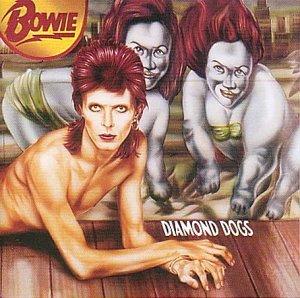
Image: David Bowie World collection / editorial use
Released on 24 May 1974, Diamond Dogs marked one of the most dramatic turning points in David Bowie’s career. The album arrived after the end of Ziggy Stardust, after the departure of the Spiders from Mars as his regular recording band, and after Bowie’s failed attempt to create a musical adaptation of George Orwell’s Nineteen Eighty-Four.
Instead of abandoning the idea, Bowie transformed it into his own dystopian world: Hunger City, a ruined landscape of tower blocks, violent street gangs, mutation, paranoia and theatrical decay. The result was a dark, unstable and ambitious album that stood between glam rock, theatrical science fiction, soul, proto-punk and the next phase of Bowie’s work.
- Album: Diamond Dogs
- Released: 24 May 1974
- Recorded: December 1973 – February 1974
- Main studios: Olympic Studios, London; Trident Studios, London; Studio L Ludolf, near Hilversum, Netherlands
- Producer: David Bowie
- Engineer: Keith Harwood
- Mixing: David Bowie, Keith Harwood and Tony Visconti
- Label: RCA Records
- Previous studio album: Pin Ups
- Next studio album: Young Americans
- Major single: Rebel Rebel
- Cover artist: Guy Peellaert
- Cover photography: Terry O’Neill
Introduction
Diamond Dogs was created at a moment when David Bowie was deliberately dismantling the world that had made him famous. Ziggy Stardust had turned him into a major star, but by 1973 the character had become creatively limiting. Bowie ended the Ziggy era at Hammersmith Odeon on 3 July 1973 and soon began moving toward darker, stranger and more fragmented territory.
The album that followed was not a simple continuation of Ziggy Stardust. It was rougher, more anxious and more urban. Its world was not the romantic science-fiction rock theatre of Ziggy Stardust, nor the Americanised glamour of Aladdin Sane. Diamond Dogs imagined a ruined future city filled with scavengers, broken social systems and half-human figures.
The record was also unusual because Bowie produced it himself and played much of the guitar, saxophone and keyboard work. Without Mick Ronson as his main guitarist and without Ken Scott as producer, Bowie carried far more of the album’s musical weight than he had on his previous records.
That pressure can be heard throughout the album. Diamond Dogs is not a polished band record in the same sense as Ziggy Stardust or Aladdin Sane. Its power lies partly in its tension, its rough edges and its sense of a creator building a collapsing world almost by force of will.
Making Of The Album
The origins of Diamond Dogs lie in several overlapping projects Bowie was considering during 1973. After completing Pin Ups, he was thinking about theatrical productions, television concepts and a new kind of rock musical. One idea involved expanding the Ziggy Stardust story for the stage. Another, more important idea, involved George Orwell’s novel Nineteen Eighty-Four.
Bowie wanted to create a musical adaptation of Orwell’s book, but the rights were not granted by Orwell’s estate. This refusal forced him to change direction while some of the material was already being developed. Rather than abandon the songs, he reshaped the project into a looser dystopian concept of his own.
The Orwell influence remained visible, especially in songs such as We Are The Dead, 1984 and Big Brother. However, the finished album was no longer a direct adaptation of the novel. Bowie created a new setting, Hunger City, and introduced figures such as Halloween Jack and the Diamond Dogs themselves.
This change gave Bowie more freedom. Instead of following Orwell’s plot, he could combine elements from literature, film, street culture, science fiction, theatre and his own anxieties about fame and control.
From Nineteen Eighty-Four To Hunger City
The failed Orwell project was one of the decisive events behind the album. Bowie had already written or developed material connected to Nineteen Eighty-Four, but once the rights were refused he had to rebuild the concept quickly.
The new world of Diamond Dogs was still authoritarian, apocalyptic and full of surveillance-like dread, but it was now filtered through Bowie’s own imagination. Hunger City was not Orwell’s London. It was a ruined, theatrical landscape populated by scavengers, violent gangs and strange survivors.
The opening narration, Future Legend, establishes this world immediately. It describes a grotesque city of tribes, rooftops, decay and mutation before ending with the famous announcement that the listener is not entering ordinary rock and roll.
This introduction is essential because it frames the album as theatre. The listener is not simply hearing a set of songs; they are being invited into an invented environment.
Halloween Jack
The central figure introduced in Diamond Dogs is Halloween Jack, a character who lives on top of Manhattan Chase in Hunger City.
Unlike Ziggy Stardust, Halloween Jack is not developed into a full dramatic persona across the entire album. He appears most clearly in the title track and functions more as a guide into the world than as a complete character with a beginning, middle and end.
That difference is important. Ziggy Stardust had suggested a rise-and-fall story around a doomed rock star. Diamond Dogs is more fragmented. It offers scenes, images and voices rather than a single linear narrative.
This fractured structure suited Bowie’s changing interests. He was becoming increasingly drawn to collage, cut-up writing and broken narratives. The album feels like a series of damaged transmissions from a future city rather than a conventional rock opera.
The Influence Of William S. Burroughs
Another major influence on Diamond Dogs was the writing of William S. Burroughs.
Bowie was fascinated by Burroughs’ cut-up technique, in which text could be cut apart and rearranged to create unexpected connections. This method suited Bowie’s interest in fractured identity, unstable meaning and non-linear storytelling.
The lyrics on Diamond Dogs often feel like collages. Images appear suddenly, disappear and return in altered form. Streets, bodies, political power, sexuality, performance and violence are fused together into a language that feels unstable but vivid.
This approach is especially important in the Sweet Thing sequence. The songs do not explain themselves in a straightforward way, but they create a strong emotional and visual atmosphere. The listener senses corruption, desire, danger and surrender even when the narrative remains deliberately unclear.
Other Influences: A Clockwork Orange, Freaks And Metropolis
The world of Diamond Dogs also drew on cinema and popular culture.
The violent youth-gang imagery has often been connected with A Clockwork Orange, while the title track contains echoes of Tod Browning’s 1932 film Freaks. Bowie’s interest in outsiders, mutations and carnival-like figures gave the album a grotesque theatrical quality.
Fritz Lang’s Metropolis also fits naturally beside the album’s imagery of tower blocks, machinery, social division and futuristic urban decay. Whether through direct influence or shared atmosphere, the film’s monumental cityscapes belong to the same visual universe that Bowie was exploring.
These influences did not produce a single clear storyline. Instead, Bowie absorbed them into a world of his own. Diamond Dogs is best understood as a dystopian collage: part Orwell, part Burroughs, part urban nightmare, part glam-rock theatre and part warning about the power of performance.
The End Of The Spiders From Mars
One of the most important differences between Diamond Dogs and Bowie’s earlier 1970s albums was the absence of the Spiders from Mars as his main recording band.
Mick Ronson, Trevor Bolder and Mick Woodmansey had been central to the sound of Ziggy Stardust and Aladdin Sane. By the time Diamond Dogs was made, that working structure had changed. Bowie no longer had Ronson’s guitar and arranging presence at the centre of the record.
This forced Bowie into a new role. He did not simply write and sing the songs; he also took on much of the instrumental responsibility, especially on guitar. The result was a record with a rougher and more personal instrumental character.
The absence of Ronson is one reason Diamond Dogs sounds so different from the Ziggy-era records. The guitar work is less polished and less heroic, but it has a dirty, nervous quality that fits the album’s setting.
David Bowie As Producer
Diamond Dogs was produced by David Bowie himself.
This was a major shift. Ken Scott had been central to Bowie’s previous run of albums, including Hunky Dory, Ziggy Stardust, Aladdin Sane and Pin Ups. For Diamond Dogs, Bowie moved forward without Scott as the album’s producer.
Producing the album gave Bowie creative control, but it also increased the pressure on him. He was building a new musical world while also managing the sound, arrangements and direction of the sessions.
That pressure is part of the album’s identity. Diamond Dogs often sounds like a record made under strain. Its roughness is not a weakness when understood in context; it reflects the unstable world Bowie was trying to create.
Recording Sessions
The recording of Diamond Dogs took place mainly between late 1973 and February 1974.
The sessions were centred on Olympic Studios in London, with additional work connected to Trident Studios and final work in the Netherlands at Studio L Ludolf, near Hilversum.
Trident remained important because Bowie recorded early work connected to the album there, including material around Rebel Rebel. The song became one of his final major recordings associated with Trident, the studio that had played such a large role in his rise.
Olympic Studios became the main creative base for the album. There Bowie worked with engineer Keith Harwood, whose background with major rock acts gave the sessions a different atmosphere from the earlier Ken Scott period.
The final stages involved Tony Visconti, who returned to Bowie’s working circle and helped mix the album. Visconti’s involvement would become increasingly important during Bowie’s mid- and late-1970s work.
Olympic Studios

Olympic Studios in Barnes was one of the most important London studios of the period. By the time Bowie arrived there for Diamond Dogs, it already had a strong reputation for rock recording.
The atmosphere at Olympic suited the harder, dirtier edge Bowie wanted. The album needed to feel less polished than Hunky Dory and less cleanly theatrical than Ziggy Stardust. Olympic gave Bowie a place where he could build a heavier and more unstable sound.
The sessions were not built around a settled band in the way Bowie’s earlier albums had been. Instead, Bowie used a mixture of his own playing and selected musicians, adding parts as needed.
This working method helped make Diamond Dogs feel constructed rather than simply performed. Even the tracks that sound like a band are often shaped by Bowie’s overdubs, edits, saxophones, guitars and keyboards.
Keith Harwood
Engineer Keith Harwood played an important technical role in the recording of Diamond Dogs.
Harwood had worked with major rock artists and brought a different studio personality from Ken Scott. His presence contributed to the rawer and more aggressive sound of the album.
The album’s production is not smooth in the conventional sense. The drums, guitars, vocals and effects often feel compressed into a tense, unstable space. That sound works because the album is about collapse, pressure and decay.
Instead of presenting a clean fantasy world, Harwood and Bowie captured something harsher: a record that seems to come from inside Hunger City itself.
Tony Visconti Returns
Tony Visconti had worked with Bowie earlier in his career, most notably on Space Oddity and The Man Who Sold The World. After several years apart, he returned during the Diamond Dogs period.
Visconti’s role on the album was especially important during the mixing stage. He helped shape the final sound and used studio technology creatively, including delay effects that added to the album’s futuristic and unsettling atmosphere.
His return also marked the beginning of a renewed working relationship that would become crucial later in the decade.
Although Diamond Dogs was produced by Bowie, Visconti’s mixing contribution helped give the finished album its distinctive character. The record sounds theatrical, dirty, metallic and unstable, but also carefully shaped.
Hilversum And The Final Work
In February 1974 Bowie travelled to the Netherlands for promotional appearances connected with Rebel Rebel and his RCA profile.
During this period he appeared on Dutch television performing Rebel Rebel with his famous eyepatch look, caused by an eye infection. The image became one of the most recognisable visual moments of the early Diamond Dogs period.
Final work on the album was completed near Hilversum at Studio L Ludolf, later known as Bullet Sound Studios. This Dutch connection gives Diamond Dogs a special place in Bowie’s European recording history.
By the time the album was finished, Bowie had created one of the most unusual records in his catalogue: a self-produced dystopian rock album built during a period of artistic transition, personal pressure and extreme ambition.
Key Musicians
The personnel on Diamond Dogs reflected Bowie’s changing working methods. Instead of relying on a fixed band, he used a smaller group of musicians and performed many parts himself.
- David Bowie: vocals, guitar, saxophone, keyboards, synthesizer and production
- Mike Garson: piano and keyboards
- Herbie Flowers: bass guitar
- Tony Newman: drums
- Aynsley Dunbar: drums
- Alan Parker: electric guitar, including important work on 1984
- Tony Visconti: mixing and string arrangements
- Keith Harwood: engineering and mixing
- Geoffrey MacCormack (Warren Peace): co-writer of Rock ’n’ Roll With Me
David Bowie On Guitar
One of the most striking features of Diamond Dogs is Bowie’s own guitar playing.
After years of working closely with Mick Ronson, Bowie now had to define the guitar sound himself. He was not trying to replace Ronson with another heroic lead guitarist. Instead, he created a rougher, dirtier and more jagged sound that suited the album’s dystopian setting.
The guitar parts on Diamond Dogs often feel scratchy, aggressive and unstable. They do not always have the smooth authority of Ronson’s playing, but they add a sense of danger and decay.
This is one reason the album remains unique in Bowie’s catalogue. It sounds like Bowie constructing a world with the tools available to him, rather than relying on an established band identity.
Mike Garson
Pianist and keyboard player Mike Garson remained one of Bowie’s most important musical collaborators during this period.
Garson had already made a major impact on Aladdin Sane, where his avant-garde piano playing helped define the album’s sound. On Diamond Dogs, his role was different but still important.
His keyboard work added theatrical colour, tension and musical sophistication. In a record filled with dystopian imagery and rough guitar textures, Garson’s playing helped widen the emotional and dramatic range.
Herbie Flowers
Herbie Flowers provided bass guitar on the album.
Flowers was an experienced session musician whose work had already connected indirectly with Bowie’s world through Lou Reed’s Walk On The Wild Side, a recording produced by Bowie and Mick Ronson.
His bass playing helped stabilise tracks that might otherwise have become too fragmented. On an album full of theatrical voices, cut-up lyrics and unstable guitar textures, the bass gives the songs weight and movement.
Tony Newman And Aynsley Dunbar
Drummers Tony Newman and Aynsley Dunbar both contributed to the album.
The drumming on Diamond Dogs is direct, forceful and often deliberately heavy. It gives the record a physical foundation beneath the theatrical and literary ideas.
The rhythm section was essential because Bowie’s concept could easily have become too abstract. The drums and bass keep the album grounded in rock, even when the lyrics and arrangements move into stranger territory.
Alan Parker
Session guitarist Alan Parker made important guitar contributions to the album.
His playing is especially associated with 1984, where the wah-wah guitar texture points toward the soul and funk influences that would become more prominent on Young Americans.
Parker also contributed guitar parts during the recording sessions for Diamond Dogs. Although David Bowie wrote the song and created the famous riff of Rebel Rebel, Parker helped shape the overall sound of the album through his session work.
Important Songs
The songs on Diamond Dogs do not all function in the same way. Some are remnants of the failed Orwell project, some belong to the Hunger City world, and some point forward to Bowie’s next musical direction.
Together they create an album that is deliberately uneven in mood: part rock anthem, part dystopian theatre, part soul experiment and part nightmare cabaret.
Important Song: Future Legend
Future Legend opens the album like the beginning of a stage production or a science-fiction film.
Instead of starting with a conventional song, Bowie introduces the listener to Hunger City through spoken narration, sound effects and grotesque imagery. The track describes a broken world of tribes, ruined buildings and mutated life.
Its purpose is not to stand alone as a pop song. It creates the setting for everything that follows.
The transition into Diamond Dogs is deliberately theatrical. Bowie invites the listener into a world where rock music, social collapse and violent fantasy are inseparable.
Important Song: Diamond Dogs
The title track introduces Halloween Jack and the Diamond Dogs themselves.
Musically, the song still carries traces of glam rock and Rolling Stones-style swagger, but its imagery is much darker than Bowie’s earlier glam material.
The Diamond Dogs are not glamorous heroes. They are scavengers, outsiders and survivors. They belong to a world where civilisation has broken down and style has become part of violence.
Although it did not equal the commercial success of Rebel Rebel, the title track remains one of the defining recordings of the album and one of Bowie’s most vivid pieces of dystopian storytelling.
Important Song: Sweet Thing
Sweet Thing begins one of the most important sequences on the album.
The song is dark, sensual and theatrical. Bowie’s vocal performance is unusually dramatic, moving through low, intimate phrases and soaring moments of intensity.
The lyrics suggest desire, corruption and escape, but they do not form a simple narrative. Instead, they create a world of shadowy encounters and emotional danger.
The track shows how far Bowie had moved from straightforward glam rock. Sweet Thing is closer to urban theatre than conventional pop.
Important Song: Candidate
Candidate continues the suite begun by Sweet Thing.
The title suggests politics, performance and manipulation. The song’s atmosphere is uneasy, as if private desire and public power have become mixed together.
The lyrics include some of the album’s most striking cut-up imagery. Rather than explaining the world of Hunger City directly, Bowie lets fragments collide.
The result is one of the album’s most unsettling moments. It feels both personal and political, intimate and corrupt.
Important Song: Sweet Thing (Reprise)
Sweet Thing (Reprise) completes the album’s central suite and drives it toward Rebel Rebel.
The reprise intensifies the emotional pressure of the earlier songs. Bowie’s vocal becomes more urgent, while the music builds toward a release that feels almost violent.
This sequence is one of the strongest arguments for Diamond Dogs as a major Bowie album. It is ambitious, theatrical and unlike anything else in his catalogue at the time.
The suite also shows how Bowie could use the album format as drama, not just as a collection of tracks.
Important Song: Rebel Rebel
Rebel Rebel became the album’s most famous song and the clearest bridge between Bowie’s glam-rock past and his next period of change.
Recorded before the album’s release and issued as a single in February 1974, the song gave Bowie another major UK hit. Its central guitar riff became one of the most recognisable in his catalogue.
Lyrically, Rebel Rebel returned to themes of gender ambiguity, youth rebellion and outsider identity. The famous opening line immediately connected the song with the same cultural territory that had made Ziggy Stardust so powerful.
Collectors should note that the UK and US single releases were not identical. The American release featured a different mix and edit, reflecting Bowie’s growing interest in the sound of American radio and anticipating the musical direction he would soon explore on Young Americans.
Although often regarded as the last great anthem of Bowie’s glam-rock era, Rebel Rebel also marked the beginning of a new phase in his career.
Important Song: Rock ’n’ Roll With Me
Co-written by David Bowie and Geoffrey MacCormack (Warren Peace), Rock ’n’ Roll With Me is one of the album’s most emotional and accessible songs.
Unlike the darker dystopian material surrounding it, the song offers warmth, optimism and a sense of connection between performer and audience. Beneath its apparent simplicity, however, the lyrics continue the album’s recurring themes of leadership, devotion and the complex relationship between rock stars and their followers.
Musically, the song is equally significant. Its broad melodic structure, gospel-influenced backing vocals and soulful atmosphere reveal Bowie moving beyond glam rock. While still firmly part of Diamond Dogs, it already points toward the richer vocal arrangements and American soul influences that would dominate Young Americans.
For that reason, Rock ’n’ Roll With Me is often regarded as one of the album’s most important transitional recordings, linking the theatrical world of Hunger City with Bowie’s forthcoming transformation into his so-called “plastic soul” period.
Important Song: We Are The Dead
We Are The Dead is one of the tracks most closely connected to the original Nineteen Eighty-Four idea.
Its title comes directly from Orwell’s novel, and its atmosphere is one of fatalism, paranoia and doomed intimacy.
The song is quieter and more controlled than much of the album, but its emotional weight is considerable. Bowie sings as if the characters already know that escape is impossible.
Within the album, We Are The Dead forms a bridge between the Hunger City material and the more explicitly Orwellian second side.
Important Song: 1984
1984 is the clearest surviving link to David Bowie’s abandoned plan to adapt George Orwell’s Nineteen Eighty-Four as a stage musical.
An earlier version had already appeared as part of the 1984/Dodo medley performed during The 1980 Floor Show. For Diamond Dogs, Bowie completely reworked the song into one of the album’s most sophisticated recordings.
The arrangement represented a major stylistic shift. Alan Parker’s distinctive wah-wah guitar, Tony Visconti’s dramatic string arrangement and the tightly constructed rhythm section moved the music away from glam rock toward American funk and soul.
Looking back, 1984 can be heard as the musical bridge between Diamond Dogs and Young Americans. Although its lyrics remained rooted in Orwell’s dystopian vision, its groove, orchestration and rhythmic feel anticipated the “plastic soul” direction Bowie would fully embrace the following year.
The song was released as a single only in selected territories, including the United States and Japan. It was not issued as a commercial single in the United Kingdom.
For many listeners, 1984 is therefore not only one of the strongest tracks on Diamond Dogs, but also one of the earliest recordings to reveal the next stage of Bowie’s musical evolution.
Important Song: Big Brother
Big Brother is another direct reminder of the album’s Orwellian origins.
The song turns the authoritarian figure of Big Brother into something that is both political and theatrical. Bowie presents the desire for control and the desire to be controlled as part of the same frightening system.
The arrangement has a grand, almost stage-musical quality. It suggests that the abandoned theatrical project still survived inside the album’s structure.
The song also reflects one of Bowie’s recurring concerns during the 1970s: the dangerous relationship between charismatic figures and the audiences who follow them.
Important Song: Chant Of The Ever Circling Skeletal Family
Chant Of The Ever Circling Skeletal Family closes the album in strange and unsettling fashion.
Rather than offering a clear resolution, the track traps the listener in repetition. The music feels circular, mechanical and unresolved.
This ending suits Diamond Dogs. The album does not close with salvation or escape. It ends inside the machinery of its own nightmare.
The track may be brief, but it leaves the album with a sense of collapse rather than conclusion.
Track Listing
The final sequence of Diamond Dogs combines dystopian narration, glam-rock power, theatrical balladry, Orwellian fragments and early signs of Bowie’s coming soul direction.

- Future Legend
- Diamond Dogs
- Sweet Thing
- Candidate
- Sweet Thing (Reprise)
- Rebel Rebel
- Rock ’n’ Roll With Me
- We Are The Dead
- 1984
- Big Brother
- Chant Of The Ever Circling Skeletal Family
Together these eleven tracks created one of Bowie’s darkest and most unusual albums: part concept record, part theatrical collage and part final statement from his glam-rock period.
Singles From The Album
Rebel Rebel
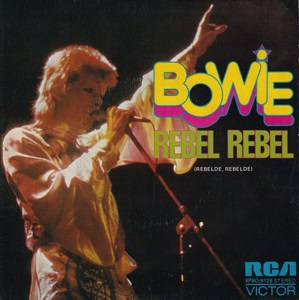
Released in February 1974, Rebel Rebel became the definitive single from the Diamond Dogs era and one of David Bowie’s signature recordings.
The original UK single reached the Top 10 and introduced audiences to the new Diamond Dogs period several months before the album appeared. Built around one of Bowie’s most recognisable guitar riffs, the song combined glam rock swagger with themes of gender ambiguity and youthful rebellion.
Collectors should note that the UK and US releases were not identical. The American single was remixed with a heavier rhythm section and a different edit, reflecting Bowie’s growing interest in the sound of American radio and foreshadowing the direction he would soon explore on Young Americans.
Today both versions remain official releases and are collected as important examples of Bowie’s changing musical style during 1974.
Diamond Dogs
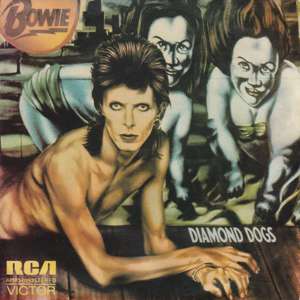
Diamond Dogs was released as the album’s second single and introduced listeners directly to Hunger City, Halloween Jack and the violent street-gang imagery at the centre of the record.
The song was less commercially successful than Rebel Rebel, but it remains one of the defining recordings from the album and one of Bowie’s strongest examples of dystopian storytelling.
Its swaggering rock sound, theatrical vocal performance and grotesque imagery made it the clearest musical entrance into the world Bowie had created.
1984
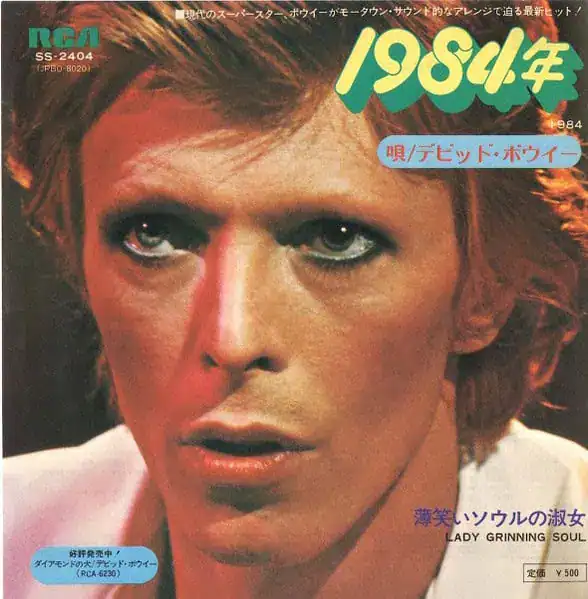
Unlike Rebel Rebel, 1984 was not released as a commercial single in the United Kingdom.
Instead, RCA issued the song only in selected territories, including the United States and Japan, where its increasingly soulful arrangement was considered suitable for radio.
Its combination of wah-wah guitar, dramatic string arrangements and funk-influenced rhythm made it one of the clearest previews of Bowie’s forthcoming soul direction. Although it never became a major international hit, 1984 remains one of the key recordings linking Diamond Dogs with Young Americans.
No Later Single Releases Needed
Unlike some earlier Bowie albums, Diamond Dogs does not require a separate “Later Single Releases” section. The historically significant single activity belongs to the original 1974 campaign and the territory-specific releases issued during that period.
The 1980 Floor Show Connection
Before Diamond Dogs was completed, Bowie had already begun presenting some of its ideas through The 1980 Floor Show.
Recorded at London’s Marquee Club in October 1973 for American television, the programme marked one of Bowie’s final performances using the Ziggy-era visual style while introducing new Orwell-inspired material through the 1984/Dodo medley.
Because the rights to Nineteen Eighty-Four were later refused, The 1980 Floor Show became one of the few surviving documents showing the original direction Bowie had intended before transforming the material into Diamond Dogs.
The production also illustrates how closely Bowie was combining music, theatre, television and visual presentation during this period.

Video: Got You, Babe

Video: Salute to David Bowie

Video: The Midnight Special Episode
-
Video: Got You, Babe
I Got You, Babe - David Bowie & Marianne Faithfull | live November 16, 1973 on The Midnight Special. -
Video: Salute to David Bowie
Salute to David Bowie | live November 16, 1973 on The Midnight Special. -
Video: The Midnight Special Episode
Hosted by David Bowie from London England with his 1980 Floor Show and special guest appearance by Carmen, Dooshenka, Marianne Faithfull and The Troggs
The Astronettes And The Move Toward Soul
During the same period Bowie was also working with the Astronettes, the vocal trio centred around Ava Cherry, Geoffrey MacCormack and Jason Guess.
Although these recordings were not part of the released Diamond Dogs album, they demonstrate that Bowie was already exploring American soul, vocal harmony and rhythm-and-blues influences before beginning work on Young Americans.
Some musical ideas developed during these sessions would later influence Bowie’s own recordings. They show that Diamond Dogs emerged during a period of overlapping creative experiments rather than as an isolated project.
While Bowie was constructing Hunger City and expanding his Orwellian vision, he was simultaneously moving toward a completely different musical future.
The Diamond Dogs Tour
The theatrical ambitions of Diamond Dogs continued on stage. Bowie designed the Diamond Dogs Tour as one of the most ambitious rock productions of the 1970s.
Inspired by Hunger City, the production featured towering scenery, bridges, catwalks, moving platforms and elaborate stage machinery that transformed arenas into a dystopian landscape. Rather than presenting a conventional rock concert, Bowie wanted audiences to experience the world of the album as a piece of futuristic theatre.
The scale of the production made the tour technically complex and extremely expensive. Many venues struggled to accommodate the enormous stage set, and transporting the production across North America proved increasingly difficult. As the tour progressed, parts of the scenery were gradually removed, allowing the performances to become more musically focused.
During the second half of the tour, Bowie’s growing fascination with American soul music became increasingly apparent. New arrangements and additional soul material gradually transformed the production into what later became known as the Soul Tour, providing a direct bridge between Diamond Dogs and Young Americans.
From Glam Rock To Plastic Soul
Diamond Dogs is often described as Bowie’s final major glam-rock album, but that description tells only part of the story.
The album certainly contains glam-rock elements, particularly in Rebel Rebel and the title track. At the same time, other songs move toward darker theatrical forms, soul-influenced arrangements and increasingly sophisticated rhythmic ideas.
The record therefore functions as a bridge. Behind it stood the worlds of Ziggy Stardust and Aladdin Sane; ahead lay Philadelphia soul, American rhythm and blues, and the radically different musical approach of Young Americans.
Bowie was not repeating himself. He was deliberately leaving one artistic identity behind while creating another.
Making Of The Album Covers / Cover Story
The cover of Diamond Dogs is one of the most controversial and visually disturbing sleeves in David Bowie’s catalogue.
By 1974 Bowie was moving away from the glamorous image of Ziggy Stardust. The world of Diamond Dogs was darker, dirtier and more violent, and the sleeve was designed to introduce that atmosphere before the music even began.

Image: David Bowie World collection / editorial use
The artwork was created by Belgian artist Guy Peellaert, whose highly stylised, surreal visual language suited Bowie’s dystopian vision perfectly. Rather than portraying Bowie as a glamorous rock star, Peellaert transformed him into a disturbing half-man, half-dog hybrid that embodied the album’s themes of mutation, decay and survival.
The image immediately established that Bowie had left the colourful fantasy world of Ziggy Stardust behind. The new character belonged to Hunger City, a place where beauty and danger existed side by side.
Want to discover the full story behind the controversial Diamond Dogs cover? Explore Guy Peellaert‘s artwork, Terry O’Neill’s photographs and the original uncensored sleeve.
Guy Peellaert And The Diamond Dogs Image
Belgian painter and illustrator Guy Peellaert had become internationally known for his striking portrayals of popular culture figures. Bowie admired his work and reportedly approached him soon after learning that Mick Jagger was also interested in working with the artist.
Bowie conceived the central idea of presenting himself as a hybrid creature, while Peellaert translated that concept into one of the most memorable painted album covers in rock history.
The front sleeve depicts Bowie with a human upper body and the lower body of a dog. Rather than presenting a glamorous performer, the image suggests transformation, mutation and the collapse of civilisation, perfectly matching the atmosphere of Hunger City.
The circus-like background, theatrical atmosphere and grotesque figures reinforce the album’s themes of outsiders, urban decay and distorted humanity.
Terry O’Neill And The Photo Session
Before Guy Peellaert created the finished painting, photographer Terry O’Neill photographed Bowie during the Diamond Dogs period, including a famous session featuring a large dog.
These photographs helped establish the visual mood of the project and provided important reference material during the development of the finished artwork.
O’Neill later recalled Bowie arriving with a remarkably clear vision of the atmosphere he wanted to create. The combination of elegance, theatricality and barely controlled danger became one of the defining visual signatures of the entire Diamond Dogs era.
Josephine Baker’s Influence
One of the visual inspirations behind the Diamond Dogs cover can be traced to a famous 1926 publicity photograph of entertainer Josephine Baker. During Terry O’Neill’s photographic session, Bowie adopted a pose that closely echoed Baker’s elegant theatrical stance.
Guy Peellaert subsequently incorporated elements of that pose into the finished painting, transforming Baker’s graceful silhouette into the disturbing half-human, half-dog creature that became one of the defining images of 1970s rock music.
The reference demonstrates Bowie’s remarkable ability to draw inspiration from fashion, theatre, photography, literature and popular culture before reshaping those influences into something entirely his own.
The Uncensored “Butcher Cover”
The original artwork showed the complete anatomy of the dog body, including anatomical details that RCA Records quickly considered unsuitable for general commercial release.
Most copies were therefore altered almost immediately after release, with those details carefully airbrushed from the finished sleeve before later pressings reached record shops.
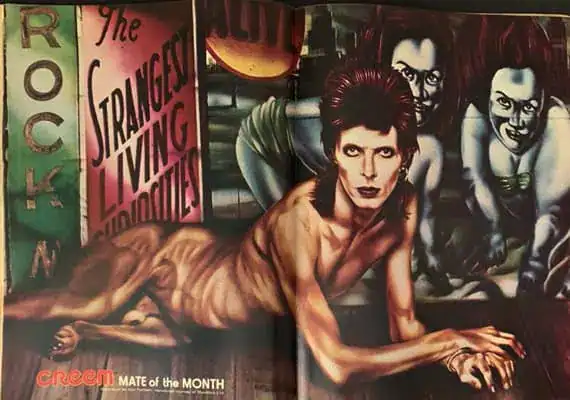
Only a relatively small number of uncensored sleeves entered circulation before the alteration took place. As a result, these original copies became some of the rarest and most valuable Bowie records ever produced.
Collectors later adopted the nickname “The Butcher Cover” for the uncensored sleeve. Although the name recalls the Beatles’ infamous Yesterday And Today cover, it simply refers to the rarity and controversy surrounding the original Diamond Dogs artwork.
A Cover Designed To Shock
The Diamond Dogs sleeve was never intended to be comfortable or reassuring.
Songs such as Future Legend, Sweet Thing, Candidate and Big Brother describe a collapsing society filled with violence, paranoia, hunger and authoritarian control. Peellaert’s artwork gives that disturbing world a physical form before the record even begins.
Rather than presenting Bowie as a conventional pop star, the sleeve depicts him as a survivor from a broken future society. It remains one of the boldest visual statements in his entire catalogue.
Back Cover / Cover Versions
The gatefold and back cover continued the dystopian atmosphere established by the front sleeve, extending the visual narrative rather than simply providing track information.
The packaging was conceived as part of the album’s artistic concept, making Diamond Dogs one of the clearest examples of Bowie treating the entire record sleeve as an extension of the music itself.
Historically, two principal cover versions exist: the original uncensored artwork and the revised commercial edition. Together they form an important part of the album’s continuing legacy among collectors.
Release And Reception
Released by RCA Records on 24 May 1974, Diamond Dogs immediately became another commercial success for David Bowie.
The album reached number one on the UK Albums Chart and peaked at number five on the US Billboard 200, becoming Bowie’s highest-charting American album to that date.
Critical opinion at the time proved more divided. Some reviewers praised its ambition, theatrical scope and originality, while others found its fragmented structure difficult to follow.
Over the decades the album has been substantially re-evaluated and is now widely regarded as one of the key transitional works in Bowie’s career.
Rebel Rebel And Commercial Momentum
The enormous popularity of Rebel Rebel gave the album considerable commercial momentum before its release.
The single became one of Bowie’s defining songs and introduced many listeners to the darker world of Diamond Dogs, even though the album itself proved considerably more experimental than its biggest hit suggested.
Diamond Dogs In America
The album also represented another important step in Bowie’s growing American success.
Its strong chart performance, combined with the ambitious North American tour, established Bowie as far more than a British glam-rock phenomenon. At the same time, his increasing fascination with soul and rhythm-and-blues pointed directly toward the musical transformation that would soon result in Young Americans.
Legacy
Today Diamond Dogs is recognised as one of David Bowie’s most ambitious and imaginative albums.
It brought together literature, theatre, dystopian science fiction, visual art and rock music in a way few contemporary artists attempted. At the same time, it closed one chapter of Bowie’s career while opening another.
The album’s influence can be heard in later artists who combined conceptual storytelling, theatrical presentation and dark urban imagery with popular music.
Its vision of Hunger City, Halloween Jack and the Diamond Dogs themselves remains one of the richest fictional worlds Bowie ever created.
The Final Glam-Rock Bowie Album
Although Bowie would continue making outstanding rock records throughout his career, Diamond Dogs effectively marked the end of his original glam-rock period.
The glitter had disappeared, replaced by rust, concrete, dystopia and uncertainty. Bowie had once again reinvented himself before audiences had fully absorbed the previous version.
The Road To Young Americans
By the end of 1974 Bowie was already moving rapidly toward American soul music.
The later performances on the Diamond Dogs Tour increasingly reflected that change, while songs such as 1984 and Rock ‘n’ Roll With Me clearly foreshadowed the sound he would soon develop on Young Americans.
Seen from that perspective, Diamond Dogs represents both the conclusion of one artistic era and the first decisive step into another.
Why Diamond Dogs Still Matters
More than fifty years after its release, Diamond Dogs continues to fascinate because it captures David Bowie at one of the most daring moments of his career.
He abandoned the character that had made him famous, rebuilt an unfinished literary project into an entirely original dystopian world, produced the album himself and created one of the most visually striking record sleeves ever issued.
Its combination of ambition, experimentation and artistic confidence explains why Diamond Dogs remains one of the essential albums in the David Bowie catalogue.
Article Origin
This article was created using documented information relating to the writing, recording, production, release and artwork of David Bowie’s Diamond Dogs.
It incorporates historical album-session information, contemporary interviews, musician recollections, chart data, recording documentation and material preserved in the David Bowie World archive.
